Points and their Coordinates in 3-Dimensions Class 11 OP Malhotra Exe-26A ISC Maths Ch-26 Solutions. In this article you would learn about Distance Between The Two Points. Step by step solutions of latest textbook has been given as latest syllabus. Visit official Website CISCE for detail information about ISC Board Class-11 Mathematics.
Points and their Coordinates in 3-Dimensions Class 11 OP Malhotra Exe-26A ISC Maths Solutions Ch-26
| Board | ISC |
| Publications | S Chand |
| Subject | Maths |
| Class | 11th |
| Chapter-26 | Points and their Coordinates in 3-Dimensions |
| Writer | O.P. Malhotra |
| Exe-26(A) | Distance Between The Two Points. |
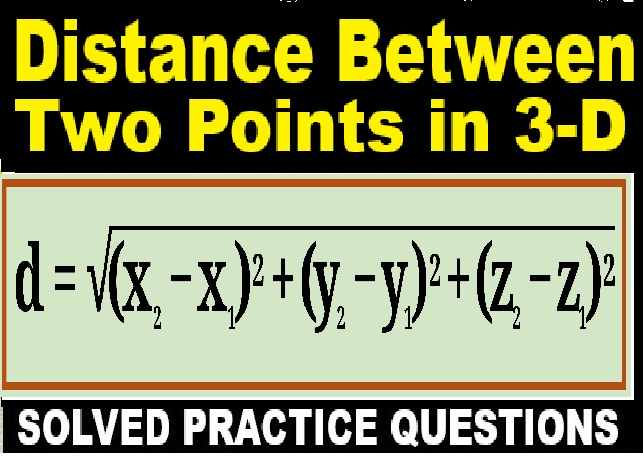
Distance Between The Two Points in Three Dimensions
Points and their Coordinates in 3-Dimensions Class 11 OP Malhotra Exe-26A ISC Maths Ch-26 Solutions.
Que-1: Find the distance from the origin to each of the points :
(i) (2, 2, 3) (ii) (4, -1, 2) (iii) (0, 4, -4) (iv) (-4, -3, -2)
Sol: (i) Required distance of origin O(0, 0, 0) from P(2, 2, 3) = √{(2−0)2+(2−0)2+(3−0)2} = √{4+4+9} = √17
(ii) Required distance = √{(4−0)²+(−1−0)²+(2−0)²} = √{16+1+4} = √21
(iii) Required distance = √{(0−0)²+(4−0)²+(−4−0)²} = √(16+16) = √42
(iv) Required distance = √{(−4−0)²+(−3−0)²+(−2−0)²} = √(16+9+4) = √29
Que-2: Find the distance between each of the following pairs of points :
(i) (2, 5, 3) and (-3, 2, 1); (ii)(0, 3, 0) and (6, 0, 2);
(iii) (-4, -2, 0) and (3, 3, 5).
Sol: (i) Required distance = √{(−3−2)²+(2−5)²+(1−3)²} = √{25+9+4} = √38
(ii) Required distance = √{(6−0)²+(0−3)²+(2−0)²} = √{36+9+4} = √49 = 7
(iii) Required distance = √{(3+4)²+(3+2)²+(5−0)²} = √{49+25+25} = √99 = 3√11
Que-3: Show that the triangle with vertices (6, 10, 10),(1, 0, -5),(6, -10, 0) is a right-angled triangle, and find its axes.
Sol: Let the given vertices of triangle are A(6, 10, 10); B(1, 0, -5) and C (6, -10, 0)
∴ AB = √{(1−6)²+(0−10)²+(−5−10)²} = √{25+100+225} = √350
BC = √{(6−1)²+(−10−0)²+(0+5)²} = √{25+100+25} = √150
CA = √{(6−6)²+(−10−10)²+(0−10)²} = √{400+100} = √500
∴ AB2 + BC2 =350 + 150 = 500 = CA2
Thus △ABC be right angled △ at B.
Therefore A, B and C are the vertices of right angled triangle.
∴ area of △ABC = (1/2) (AB) × (BC) = (1/2) × √350 √(150) = (1/2) √(35×15×100)
= (1/2) × 50√21 = 25√21 sq. units
Que-4: Show that the triangle with vertices A(3, 5, -4), B(-1, 1, 2), C(-5, -5, -2) is isosceles.
Sol: Given vertices of triangle are A (3, 5, -4), B(-1, 1, 2) and C(-5, -5, -2).
AB = √{(−1−3)²+(1−3)²+(2+4)²} = √{16+16+36} = √68 = 2√17
BC = √{(−5+1)²+(−5−1)²+(−2−2)²} = √{{16+16+36}} = √68
CA = √{(3+5)²+(5+5)²+(−4+2)²} = √{64+100+4} = √168
Thus AB = BC
∴ △ ABC be an isosceles triangle.
Que-5: Show that (4, 2, 4),(10, 2, -2) and (2, 0, -4) are the vertices of an equilateral triangle.
Sol: Let the vertices of triangle are A(4, 2, 4), B(10, 2, -2) and C(2, 0, -4).
AB = √{(10−4)²+(2−2)²+(−2−4)²} = √(36+36) = √72 = 6√2
BC = √{(2−10)²+(0−2)²+(−4+2)²} = √{64+4+4} = √72
and CA = √{(4−2)²+(2−0)²+(4+4)²} = √{4+4+64} = √72
Thus AB = BC = CA
∴ △ ABC is an equilateral triangle.
Que-6: Show that the points (1, -1, 3),(2, -4, 5) and (5, -13, 11) are collinear.
Sol: Given points are A(1, -1, 3); B(2, -4, 5) and C(5, -13, 11)
Here AB = √{(2−1)²+(−4+1)²+(5−3)²} = √(1+9+4) = √14
BC = √{(5−2)²+(−13+4)²+(11−5)²} = √{9+81+36} = √126 = 3√14
CA = √{(1−5)²+(−1+13)²+(3−11)²} = √{16+144+64} = √224 = 4√14
Clearly AB + BC = CA
Thus the points A, B and C are collinear.
Que-7: Derive the equation of the locus of a point equidistant from the points (1, -2, 3) and (-3, 4, 2).
Sol: Let P(x, y, z) be any point on locus and A(1, -2, 3), B(-3, 4, 2) are given points.
According to given condition, we have |PA| = | PB |
√{(x−1)²+(y+2)²+(z−3)²} = √{(x+3)²+(y−4)²+(z−2)²}
On squaring both sides; we have
(x – 1)2 + (y + 2)2 + (z – 3)2 =(x + 3)2 + (y – 4)2 + (z – 2)2
⇒ -2x +4y – 6z + 14 = 6x – 8y – 4z + 29
⇒ 8x – 12y + 2z + 15 = 0
which is the required locus of a point.
Que-8: Derive the equation of the locus of a point twice as far from (-2, 3, 4) as from (3, -1, -2).
Sol: Let P(x, y, z) be any point on the locus
such that PA = 2 PB
where A be the point (-2, 3, 4) and B be the point (+3, -1, -2).
√{(x+2)²+(y−3)²+(z−4)²} = 2√{(x−3)²+(y+1)²+(z+2)²}
On squaring both sides; we have
(x + 2)2 + (y – 3)2 + (z – 4)2 =4[(x – 3)2 + (y + 1)2 + (z + 2)2]
⇒ 3x2 + 3y2 + 3z2 – 28x + 14y + 24z + 27 = 0
which is the required locus.
Que-9: Find the equation of the locus of a point whose distance from the y-axis is equal to its distance from (2, 1, -1).
Sol: Let P(x, y, z) be any point on locus and A(0, y, 0) be any point on y-axis and B(2, 1, -1) be the given point.
According to given condition, PA = PB
√{(x−0)²+(y−y)²+(z−0)²} = √{(x−2)²+(y−1)²+(z+1)²}
On squaring both sides; we have
x2 + z2 = x2 + y2 + z2 – 4x – 2y + 2z + 6
⇒ y2 – 4x – 2y + 2z + 6 = 0 be the required eqn. of locus.
Que-10: Find the equation of the locus of a point whose distance from the xy-plane is equal to distance from the point (-1, 2, -3).
Sol: Let P(x, y, z) be any point on locus and A(x, y, 0) be any point in xy plane and B(-1, 2, -3) b the given point.
Then according to given condition; we have PA = PB
√{(x−x)²+(y−y)²+(z−0)²} = √{(x+1)²+(y−2)²+(z+3)²}
On squaring both sides; we have
0 + 0 + z2 = x2 + y2 + z2 + 2x – 4y + 6z + 14
⇒ x2 + y2 + 2x – 4y + 6z + 14 = 0
which is the required locus.
Que-11: A point moves so that the difference of the squares of its distances from the x-axis and the y-axis is constant. Find the equatiol of its locus.
Sol: Let P(x, y, z) be any point on locus and let Q(x, 0, 0) and R(0, y, 0) be any two points on x-axis and y-axis.
Then according to given condition; we have
PQ2 – PR2 = constant = k
⇒ [√{(x−x)²+(y−0)²+(z−0)²}]² – [√{(x−0)²+(y−y)²+(z−0)²}]² = k
⇒ y2 + z2 – x2 – z2 = k
⇒ y2 – x2 = k
which is the required locus.
Que-12: Find the equation of the locus of a point whose distance from the z-axis is equal to its distance from the xy-plane.
Sol: Let P(x, y, z) be any point on locus and let Q(0, 0, z) be any point on z-axis and R(x, y, 0) be any point in xy-plane.
Then PQ = PR
⇒ √{(x−0)²+(y−0)²+(z−z)²} = √{(x−x)²+(y−y)²+(z−0)²}
On squaring both sides; we have
x2 + y2 = z2
⇒ x2 + y2 – z2 = 0
which is the required locus.
–: End of Points and their Coordinates in 3-Dimensions Class 11 OP Malhotra Exe-26A ISC Maths Ch-26 Solutions. :–
Return to :- OP Malhotra ISC Class-11 S Chand Publication Maths Solutions
Please share with your friends
Thanks