Points and their Coordinates in 3-Dimensions Class 11 OP Malhotra Exe-26B ISC Maths Ch-26 Solutions. In this article you would learn about Division or Section Formulae. Step by step solutions of latest textbook has been given as latest syllabus. Visit official Website CISCE for detail information about ISC Board Class-11 Mathematics.
Points and their Coordinates in 3-Dimensions Class 11 OP Malhotra Exe-26B ISC Maths Solutions Ch-26
| Board | ISC |
| Publications | S Chand |
| Subject | Maths |
| Class | 11th |
| Chapter-26 | Points and their Coordinates in 3-Dimensions |
| Writer | O.P. Malhotra |
| Exe-26(B) | Division or Section Formulae |
Division or Section Formulae in 3-Dimensions
Points and their Coordinates in 3-Dimensions Class 11 OP Malhotra Exe-26B ISC Maths Ch-26 Solutions.
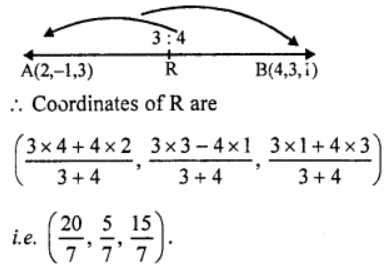
Que-1: Find the coordinates of the points which divide the join of the points (2, -1, 3) and (4, 3, 1) in the ratio 3 : 4 internally.
Sol: Let R be the point which divides the join of points A(2, -1, 3) and B(4, 3, 1) in the ratio 3 : 4 internally.
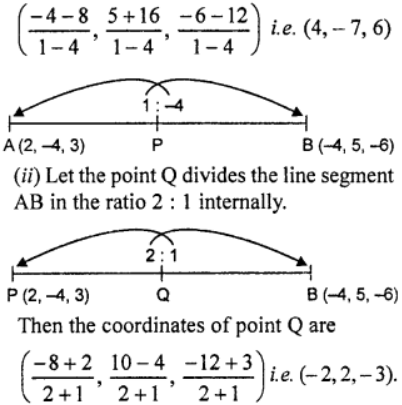
Que-2: Find the coordinates of the points which divide the line joining the points (2, -4, 3), (-4, 5, -6) in the ratio
(i) 1 : -4 (ii) 2 : 1
Sol: (i) Let the point P divides the line segment AB in ratio 1 :-4
Then coordinates of P are
Que-3: Find the ratio in which the line joining the points (2, 4, 5),(3, 5, -4) is divided by the yz-plane.
Sol: Let the point P divides the line segment joining A(2, 4, 5) and B(3, 5, -4) in the ratio k : 1
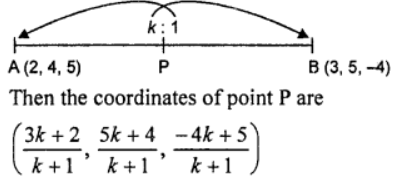
Since the line joining AB is divided by yz – plane
i.e. x-coordinates of point P is 0 .
(3k+2)/(k+1) = 0
⇒ k = –2/3
Thus required ratio be k : 1 i.e. –2/3 : 1 i.e. – 2 : 3.
Que-4: The three points A(0, 0, 0), B(2, -3, 3), C(-2, 3, -3) are collinear. Find in what ratio each point divides the segment joining the other two.
Sol: Let the point B (2, -3, 3) divides the line segment AC in the ratio k : 1 internally.
Then by section formula, we have
The coordinates of B are
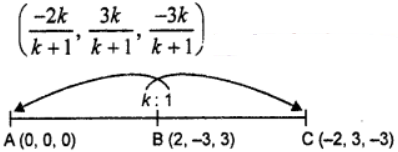
given coordinates of B are (2, -3, 3).
∴ −2k/(k+1) = 2
⇒ – 2k = 2k + 2
⇒ 4k = – 2
⇒ k = −1/2
and 3k/(k+1) = – 3
⇒ 3k = -3 k – 3
⇒ 6 k = – 3
⇒ k =-1/2
and −3k/(k+1) = 3
⇒ – 3k = 3k + 3
⇒ k = –1/2
Thus the required ratio be k : 1 i.e. – 1 : 2.
Let the point C(-2, 3, -3) divides AB in the ratio λ : 1.
Then coordinates of C are
[{2λ/(λ+1)}, {-3λ/(λ+1)}, {3λ/(λ+1)}]
2λ/(λ+1) = – 2 ⇒ 2λ = – 2λ – 2 ⇒ λ = –1/2
−3λ/(λ+1) = 3 ⇒ -3λ = 3λ + 3 ⇒ λ = –1/2
and 3λ/(λ+1) = – 3 ⇒ 6λ = – 3
Thus required ratio be λ : 1 i.e. -1 : 2. Let the point A(0, 0, 0) divides line segment BC in the ratio p : 1.
Then by section formula,
coordinates of point A are
[{(-2p+2)/(p+1)}, {(3p-3)/(p+1)}, {(-3p+3)/(p+1)}]
Also, given coordinates of A are (0,0,0)
i.e., [(-2p+2)/(p+1)] = 0 = p = 1
[(3p-3)/(p+1)] = 0 = p = 1
and [(-3p+3)/(p+1)] = 0 = p = 1
The required ratio be p : 1 i.e. 1 : 1.
Que-5: Find the coordinates of the points which trisect AB given that A(2, 1, -3) and B (5, -8, 3).
Sol: Let P and Q be the point of trisection of line segment AB.

Thus point P divides the line segment AB in the ratio 1 : 2.
Then coordinates of P are
[{(5+4)/(1+2)}, {(−8+2)/(1+2)}, {(3−6)/(1+2)}] i.e. P(3, -2, -1)
Also, point Q divides the line segment AB in the ratio 2 : 1.
Then coordinates of {Q} are
[{(10+2)/(2+1)}, {(−16+1)/(2+1)}, {(6−3)/(2+1)}] i.e. Q(4, -5, 1).
Que-6: Find the coordinates of the point which is three-fifths of the way from (3, 4, 5) to (-2, -1, 0).
Sol: Let the given points are A(3, 4, 5) and E(-2, -1, 0) and let point P is at 3/5th of the way from A.
∴ P is at a 2/5th of the way from B i.e. p divides line segment AB in the ratio 3 : 2.
Then by section formula, we have

Thus, the coordinates of point P are (0, 1, 2).
Que-7: Show that the point (1, -1, 2) is common to the lines which join (6, -7, 0) to (16, -19, -4) and (0, 3, -6) to (2, -5, 10).
Sol: Any point on line segment AB be
P [{(16k+6)/(k+1)}, {(-19k-7)/(k+1)}, {(-4k)/(k+1)}]
and any point on the line segment CD be given
by Q [{(2k`)/(k`+1)}, {(-5k`+3)/(k`+1)}, {(10k`-6)/(k`+1)}]
If AB and CD have a common point. Then P and Q coincide for some values of k and k’.
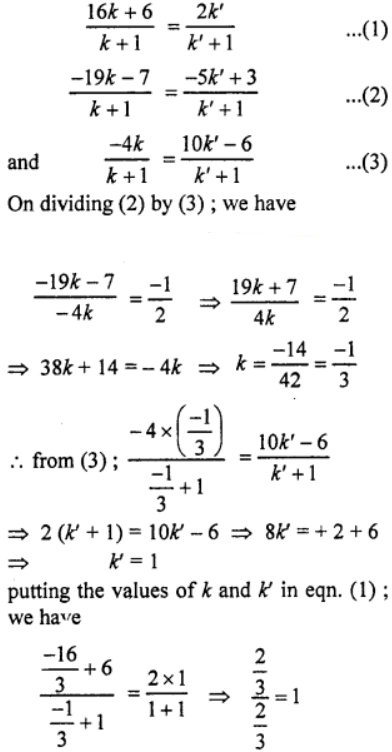
1 = 1, which is true.
Thus eqns. (1), (2) and (3) are satisfied or consistent for k = −1/3 and k’ = 1
putting k = −1/3 in coordinates of P
we get, the required point be (1, -1, 2). Hence, the point P(1, -1, 2) is common to lines which join A(6, – 7, 0)
and B(16, -19, -4) and C(0, 3, -6) and D(2, -5, 10).
Que-8: Find the lengths of the medians of the triangle whose vertices are A(2, -3, 1), B (-6, 5, 3), C (8, 7, – 7).
Sol: Let D, E and F are the mid-points of sides BC, CA and AB of △ABC.
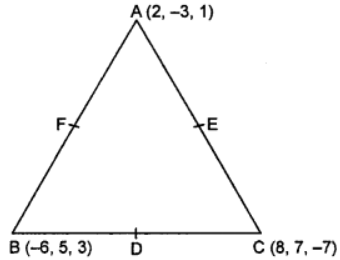
Then coordinates of D, E and F are
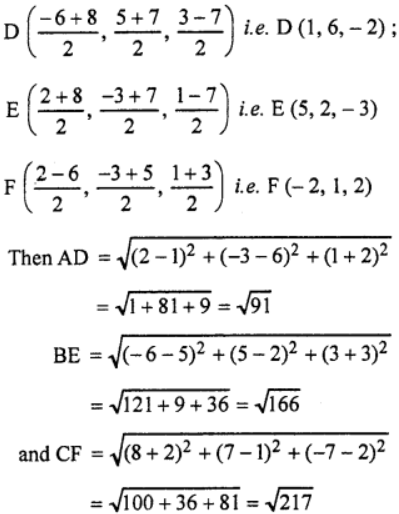
Que-9: Find the point of intersection of the medians of the triangle with vertices (-1, -3, -4), (4, -2, -7), (2, 3, -8).
Sol: Let the vertices of △ABC are A(-1, -3, -4); B(4, -2, -7) and C(2, 3, -8)
We know that the point of intersection of all medians of a triangle is called centroid of triangle.
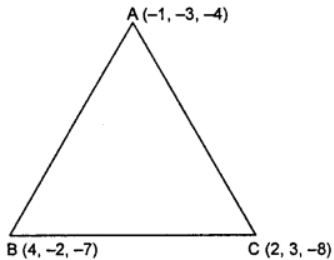
Thus centroid of ΔABC be
[{(-1+4+2)/3}, {(-3-2+3)/3}, {(-4,-7-8)/3}]
i,e., G [(5/3), (-2/3), (-19/3)]
Que-10: Find the ratio in which the join of A(2, 1, 5) and B(3, 4, 3) is divided by the plane 2x + 2y – 2z = 1. Also, find the coordinates of the point of division.
Sol: Let the point R divides the line segment PQ in the ratio k : 1 internally.
Then by section formula, we have coordinates of R are
[{(3k+2)/(k+1)}, {(4k+1)/(k+1)}, {(3k+5)/(k+1)}]
Clearly it is given that, line segment PQ is divided by the plane
2x + 2y – 2z = 1 …(1)
Thus the point R lies on eqn. (1); we have
2{(3k+2)/(k+1)} + 2{(4k+1)/(k+1)} − 2{(3k+5)/(k+1)} = 1
⇒ 6k + 4 + 8k + 2 – 6k – 10 = k + 1
⇒ 7k = 5 ⇒ k = 5/7
Thus the required ratio be k : 1
i.e. 57 : 1 i.e. 5 : 7
Thus, required point of division be
R [{3×(5/7)+2}, {4×(5/7)+1}, {3×(5/7)+5}] / [{(5/7)+1}, {(5/7)+1}, {(5/7)+1}]
i.e., R [(29/12), (9/4), (25/6)]
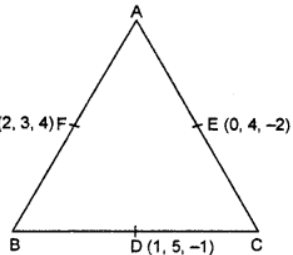
Que-11: The mid-points of the sides of a triangle are (1, 5, -1),(0, 4, -2) and (2, 3, 4). Find its vertices.
Sol: Let the vertices of △ABC are A (x1, y1, z1);
B (x2, y2, z2) and
C (x3, y3, z3).
It is given that D (1, 5, -1) ; E(0, 4, – 2) and F(2, 3, 4) are the mid-points of sides BC, CA and AB of △ABC.
Now D be the mid-point of BC.
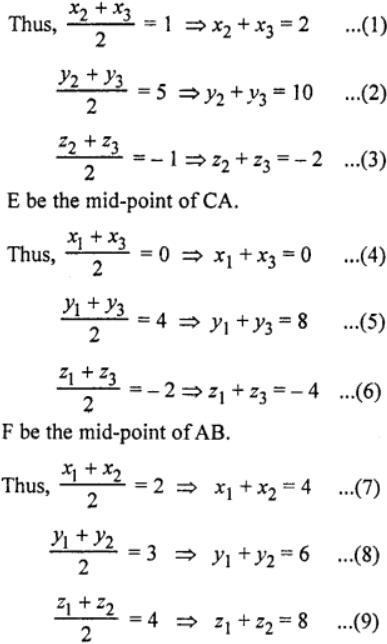
On adding eqn. (1), (4) and (7); we have
x1 + x2 + x3 = 3 …(10)
From eqn. (1) and eqn. (10); x1 = 1
From (4) and (10); x2 = 3
and From eqn. (7) and (10); x3 = -1
On adding eqn. (2), (5) and (8); we have
y1 + y2 + y3 = 12 …(11)
From (2) and (11); y1 = 2
From (5) and (11); y2 = 4
From (8) and (11); y3 = 6
On adding eqn. (3), (6) and (9); we have
z1 + z2 + z3 = 1 …(12)
From (3) and (12); z1 = 3
From (6) and (12); z2 = 5
From (9) and (12); z3 = -7
Thus the required vertices of △ABC are (1, 2, 3) ;(3, 4, 5) and (-1, 6, -7).
Que-12: Three vertices of a parallelogram ABCD are A(3, -1, 2), B(1, 2, -4) and C(-1, 1, 2). Find the coordinates of the fourth vertex D.
Sol: Given vertices of parallelogram ABCD are A(3, -1, 2); B(1, 2, -4); C(-1, 1, 2) and let the coordinates of fourth vertex D are (α, β ,γ).
Mid-point of AC = [{(3−1)/2}, {(−1+1)/2}, {(2+2)/2}]
and Mid-point of BD = [{(1+α)/2}, {(2+β)/2}, {(−4+γ)/2}]
Since ABCD be a parallelogram.
∴ diagonals of || gm ABCD bisect each other.
Thus, mid-point of AC = mid-point of BD
(1,0,2) = [{(1+α)/2}, {(2+β)/2}, {(−4+γ)/2}]
1 = {(1+α)/2} = α = 1
0 = {(2+β)/2} = β = -2
and 2 = {(−4+γ)/2}
-4+γ = 4
γ = 8
Thus the coordinates of fourth vertex D are (1,-2,8).
Que-13: What is the locus of a point for which
(i) x = 0 (ii) y = 0 (iii) z = 0 (iv) x =a (v) y = b (vi) z = c?
Sol: (i) The point for which x = 0 is of the form (0, y, z) and lies in yoz plane. Thus required locus of point be yz-plane.
(ii) The point for which y = 0 is of the form (x, 0, z) and lies in the xoz plane.
Thus, required locus of point be xz-plane.
(iii) The point for which z = 0 is of the form (x, y, 0) and lies in xoy plane. Thus required locus of a point be xy-plane.
(iv) Since x = a be the plane parallel to x = 0 i.e. yz plane. Thus locus of a point for which x = a be a plane parallel to yz plane at a distance of a units from it.
(v) Since y = b be the plane parallel to y = 0 i.e. xz-plane. Thus, locus of a point for which y = b be a plane parallel to xz plane at a distance b units from it.
(vi) Since z = c be a plane parallel to plane z = 0 i.e. xy plane. Thus locus of a point for which z = c be a plane || to xy plane at a distance c units from it.
Que-14: What is the locus of a point for which
(i) x = 0, y = 0 (ii) y = 0, z = 0 (iii) z = 0, x = 0 (iv) x = a, y = b
(v) y = b, z = c (vi) z = c, x = a?
Sol: (i) We know that on z-axis, x = 0 = y Thus required locus be z-axis.
(ii) We know that on x-axis, we have y = 0 = z Thus required locus be x-axis.
(iii) We know that on y-axis, we have x = 0 = z Thus, required locus be y-axis.
(iv) x = a be the line || to y-axis and y = b be the line || to x-axis
Thus locus of a point for which x = a, y = b is the line of intersection of given planes x = a and y = b
(v) Clearly the locus of a point for which y = b, z = c is the line of intersection of given planes y = b and z = c
(vi) Given planes are z = c and x = a
Required locus is the line of intersection of planes z = c and x = a.
–: End of Points and their Coordinates in 3-Dimensions Class 11 OP Malhotra Exe-26B ISC Maths Ch-26 Solutions. :–
Return to :- OP Malhotra ISC Class-11 S Chand Publication Maths Solutions
Thanks
Please share with your friends