Practical Work Very Short Ans Concise Class-10 Chemistry ICSE Selina Solutions Chapter-13. Very Short Ans Questions of Exercise-13 for ICSE Class-10 Chemistry with balance reaction and structure.. The given Solutions is according to the Latest editions. Visit the official Website CISCE for detail information about the ICSE Board Class-10.


Practical Work Very Short Ans Concise Class-10 Chemistry ICSE Selina Solutions Chapter-13
| Board | ICSE |
| Book / Publication | Concise / Selina |
| Subject | Chemistry |
| Class | 10th |
| Writer | Dr SP Singh |
| Chapter-13 | Practical Work |
| Topics | Very Short Ans Questions |
| Edition | 2025-2026 |
Very Short Ans Questions on Practical Work in Chemistry
Page-236
Que-1: Match the gases in column I to the identification of the gases mentioned in column II
| Column I | Column II |
|---|---|
| (a) Hydrogen sulphide | A. Turns acidified potassium dichromate solution green |
| (b) Nitric oxide | B. turns lime water milky |
| (c) Carbon dioxide | C. Turns reddish brown when it reacts with oxygen |
| (d) Sulphur dioxide | D. Turns moist lead aceate paper silvery black |
Ans:
| Column I | Column II |
|---|---|
| (a) Hydrogen sulphide | D. Turns moist lead aceate paper silvery black |
| (b) Nitric oxide | C. Turns reddish brown when it reacts with oxygen |
| (c) Carbon dioxide | B. Turns lime water milky |
| (d) Sulphur dioxide | A. Turns acidified potassium dichromate solution green |
Que-2: Identify the following substances:
(a) An alkaline gas which gives dense white fumes with hydrogen chloride.
(b) The gas has an offensive smell like rotten eggs.
(c) A colourless gas which can be used as a bleaching agent.
Ans:
(a) Ammonia
(b) Hydrogen sulphide
(c) Sulphur dioxide
Que-3: Name :
(a) The gas which turns acidified potassium dichromate solution green.
(b) A gas which turns moist lead acetate paper silvery black
Ans:
(a) Sulphur dioxide gas (SO2)
(b) Hydrogen sulphide (H2S)
Que-4: From the following list of substances choose those which meet the description given below.
Ammonium chloride, Ammonium nitrate, Chlorine, Dilute hydrochloric acid, Iron, Lead nitrate, Manganese (IV) oxide, Silver nitrate, Sodium nitrate, Sodium nitrite, Sulphur
Two compounds whose aqueous solutions give white precipitates with dilute hydrochloric acid.
Ans: Silver nitrate and Lead nitrate.
HCl + AgNO3 ⟶ AgCl + HNO3
2HCl + Pb(NO3)2 ⟶ PbCl2 + 2HNO3
Que-5: Use the information given in (a) to (h) to identify the substances P to W selecting your answers from the given list.
| List | ||
|---|---|---|
| Calcium | Oxygen | Copper (II) oxide |
| Carbon | Calcium hydroxide | Copper (II) nitrate |
| Lead (II) oxide | Hydrogen chloride | Chlorine |
| Lead (II) nitrate | Calcium oxide | Ammonium chloride |
(a) P is a white solid. When heated produces white fumes (sublime).
(b) P and R on warming produce an alkaline gas.
(c) On adding water to T, heat is evolved and R is formed.
(d) Q burns brightly in air to form T.
(e) When S is heated, it gives off brown fumes and leaves a black residue of U.
(f) A solution of S is formed by warming U with dilute nitric acid.
(g) V is a gaseous non-metallic element that reacts with hydrogen to form W.
(h) A solution of W will neutralise the solution of R.
Ans:
(a) Ammonium chloride
(b) Calcium
(c) Calcium hydroxide
(d) Lead (II) Nitrate
(e) Calcium Oxide
(f) Lead (II) Oxide
(g) Chlorine
(h) Hydrogen chloride
Que-6: Copy and complete the following table which refers to the action of heat on some carbonates :
| Carbonate | Colour of residue on cooling |
|---|---|
| Zinc carbonate | |
| Lead carbonate | |
| Copper carbonate |
Ans:
| Carbonate | Colour of residue on cooling |
|---|---|
| Zinc carbonate | White |
| Lead carbonate | Yellow |
| Copper carbonate | Black |
Que-7: Sodium hydroxide solution is added first in a small quantity, then in excess to the aqueous salt solutions of copper (II) sulphate, zinc nitrate, lead nitrate, calcium chloride and iron (III) sulphate. Copy the following table and write the colour of the precipitate in (i) to (v) and the nature of the precipitate (soluble or insoluble) in (vi) to (x).
| Aqueous salt solution | Colour of precipitate when NaOH is added in a small quantity | Nature of precipitate (soluble or insoluble) when NaOH is added in excess |
|---|---|---|
| Copper (II) sulphate | (i) | (vi) |
| Zinc nitrate | (ii) | (vii) |
| Lead nitrate | (iii) | (viii) |
| Calcium chloride | (iv) | (ix) |
| Iron (III) sulphate | (v) | (x) |
Ans:
| Aqueous salt solution | Colour of precipitate when NaOH is added in a small quantity | Nature of precipitate (soluble or insoluble) when NaOH is added in excess |
|---|---|---|
| Copper (II) sulphate | (i) Pale blue | (vi) Insoluble |
| Zinc nitrate | (ii) White gelatinous | (vii) Soluble |
| Lead nitrate | (iii) White chalky | (viii) Soluble |
| Calcium chloride | (iv) White curdy | (ix) Insoluble |
| Iron (III) sulphate | (v) Reddish brown | (x) Insoluble |
Que-8: Mention the colour changes observed when following indicators are added:
| Solution | Acids | Alkalies |
|---|---|---|
| (a) Alkaline phenolphthalein solution, | ||
| (b) Methyl orange solution, | ||
| (c) Neutral litmus solution |
Ans:
| Solution | Acids | Alkalies |
|---|---|---|
| (a) Alkaline phenolphthalein solution, | Colourless | Pink |
| (b) Methyl orange solution | Pink | Yellow |
| (c) Neutral litmus solution | Red | Blue |
Que-9: Select the correct answer from A, B, C and D.
A. Nitroso iron (II) sulphate
B. Iron (III) chloride
C. Chromium sulphate
D. Lead (II) chloride.
(a) The compound which is responsible for the green colour formed when SO2 is bubbled through acidified potassium dichromate solution.
(b) Compound responsible for brown ring.
Ans:
(a) Chromium sulphate
K2Cr2O7 + H2SO4 + 3SO2 ⟶ K2SO4 + Cr2(SO4)3 + H2O
(b) Nitroso iron (II) sulphate
Que-10: Choose from the list of substances – Acetylene gas, aqua fortis, coke, brass, barium chloride, bronze, platinum.
An aqueous salt solution used for testing sulphate radical.
Ans: Barium chloride.
Que-11: Identify :
(a) The flame test with a salt P gave a brick red flame. What is the cation in P.
(b) pH of liquid R is 10. What kind of substance is R ?
Ans:
(a) Cation in P is Ca2+ (calcium ion).
(b) R is an alkaline substance.
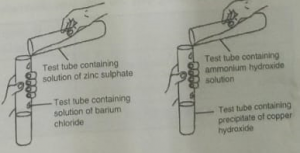
Que-12: A student was asked to perform two experiments in the laboratory based on the instructions given:
Observe the picture given below and state one observation for each of the Experiments 1 and 2 that you would notice on mixing the given solutions.
(a) Experiment 1
(b) Experiment 2
Ans:
(a) White precipitate of barium sulphate is formed.
Hint: When a solution of zinc sulphate is added to a solution of barium chloride, a double displacement reaction occurs. This reaction involves the exchange of ions between the two compounds and a white precipitate of barium sulphate is formed.
ZnSO4 (aq) + BaCl2 (aq) ⟶ BaSO4 (s) + ZnCl2 (aq).
(b) Blue precipitate dissolves to form an inky blue/deep blue solution.
Hint:The light blue precipitate of copper(II) hydroxide (Cu(OH)2) dissolves in excess of ammonium hydroxide due to the formation of a deep blue complex, tetraamminecopper(II) ([Cu(NH3)4]2+), making it soluble.
—: End of Practical Work Very Short Ans Concise Class-10 Chemistry ICSE Selina Solutions : –
Return to:- Concise Selina Chemistry for ICSE Class-10 Solutions
Please Share with Your Friends if Helpful
Thanks