Pressure in Fluids Class-9 Exe-4A MCQs Concise Physics ICSE Selina Solutions Ch-4. In this article you would learn to solve MCQs on Pressure in Fluids and it’s Transmission. Visit official Website CISCE for detail information about ICSE Board Class-9 Physics.
Pressure in Fluids Class-9 Exe-4A MCQs Concise Physics ICSE Selina Solutions Ch-4
| Board | ICSE |
| Class | 9th |
| Subject | Physics |
| Writer / Publication | Concise Selina Publishers |
| Chapter-4 | Pressure in Fluids and Atmospheric Pressure |
| Exe – 4A | Pressure in Fluids and it’s Transmission |
| Topics | Solution of Exe-4(A) MCQs Type |
| Academic Session | 2025-2026 |
Pressure in Fluids and it’s Transmission
Pressure in Fluids and Atmospheric Pressure Class-9 Exe-4A MCQs Concise Physics ICSE Selina Solutions Ch-4
Page 101 (Choose the correct answer from the options given below).
Que-1: The force acting normally on a surface is called:
(a) Pressure
(b) friction
(c) thrust
(d) none of these
Ans: (c) thrust
Que-2: The thrust exerted by a body placed on a surface is :
(a) less than the weight of the body
(b) more than the weight of the body
(c) equal to the weight of the body
(d) independent of the weight of the body.
Ans: (c) equal to the weight of the body
Hint- The thrust exerted by a body placed on a surface is equal to its weight. Thrust is a vector quantity.
Que-3: The S.I. unit of thrust is :
(a) dyne
(b) ms-¹
(c) newton
(d) Nm-¹
Ans: (c) newton
Que-4: The effect of a given thrust is :
(a) less on large area, more on small area
(b) more on large area, small on small area
(c) does not depend on area
(d) maximum when it is inclined at 45 degree with the area
Ans: (a) less on large area, more on small area
Que-5: The pressure exerted on a surface depends on :
(a) the nature of the surface on which the thrust is applied
(b) the area on which the thrust is applied
(c) the magnitude of the thrust applied
(d) both (b) and (c)
Ans: (d) both (b) and (c)
Hint- The pressure exerted on a surface depends on two factors :
the area on which the thrust is applied and
magnitude of thrust.
Que-6: Pressure and thrust are :
(a) vector quantities
(b) scalar quantities
(c) scalar and vector quantities respectively
(d) vector and scalar quantities respectively
Ans: (c) scalar and vector quantities respectively
Hint- Pressure is a scalar quantity whereas thrust is a vector quantity, because pressure is defined in terms of magnitude only, and thrust is defined in terms of both magnitude and direction.
Que-7: The S.I. unit of pressure is :
(a) N cm-²
(b) Pa
(c) N
(d) N m²
Ans: (b) Pa
Que-8: The C.G.S. unit of pressure is :
(a) Pa
(b) Nm-2
(c) dyne cm-2
(d) dyne cm2
Ans: (c) dyne cm-2
Hint- C.G.S. unit of pressure is dyne cm-2 where 1 dyne cm-2 = 0.1 N m-2 or 1 N m-2 = 10 dyne cm-2
Que-9: One bar is equal to :
(a) 103 Nm-2
(b) 104 Nm-2
(c) 105 Nm-2
(d) 106 Nm2
Ans: (c) 105 Nm-2
Hint- 1 bar = 105 Nm-2.
Que-10: 1 atm of pressure is equal to :
(a) 0.076 m of Hg
(b) 760 torr
(c) 76 torr
(d) 7.6 mm of Hg
Ans: (b) 760 torr
Hint- torr is a unit of atmospheric pressure after the name of the scientist Torricelli where, 1 torr = 1 mm of Hg and 1 atm = 760 mm of Hg = 760 torr.
Que-11: The pressure on a surface is reduced by :
(a) using high thrust
(b) increasing the area of surface
(c) decreasing the area of surface
(d) none of these
Ans: (b) increasing the area of surface
Page 102
Que-12: Cutting tools have either sharp or pointed edges so that a …………… thrust may cause a …………… pressure at that edges and cutting can be done with less effort.
(a) high, high
(b) small, small
(c) high, small
(d) small, high
Ans: (d) small, high
Hint- For a given thrust, the pressure on a surface is increased by reducing the area of surface on which it is acting, hence, cutting tools have either sharp or pointed edges so that a small thrust may cause a high pressure at that edges and cutting can be done with less effort.
Que-13: The pressure inside a liquid of density ρ at a depth h is:
(a) hρg
(b) h/ρg
(c) hρ/g
(d) hρ
Ans: (a) hρg
Hint- The three factors on which the pressure at a point in a liquid depends are —
depth of the point below the free surface (h)
density of liquid (ρ) and
acceleration due to gravity (g)
Pressure = hρg
Que-14: Out of the following, which one is correct about the law of liquid pressure ?
(a) Pressure is different in all directions about a point inside the liquid.
(b) In a stationary liquid, pressure is different at all points on a horizontal plane.
(c) Inside the liquid, pressure decreases with an increase in depth from its free surface.
(d) It increases with an increase in the density of the liquid.
Ans: (d) It increases with an increase in the density of the liquid.
Hint- As Pressure = hρg, so pressure is directly proportional to the density of the liquid. Hence, it increases with an increase in the density of the liquid.
Que-15: The pressure P1 at a certain depth in river water and P2 at the same depth in sea water are related as:
(a) P1 > P2
(b) P1 = P2
(c) P1 < P2
(d) P1 – P2 = atmospheric pressure
Ans: (c) P1 < P2
Hint- As the density of sea water is more than the density of river water, hence, the pressure at a certain depth in sea water is more than that at the same depth in river water because pressure increases with the increase in density of liquid.
Que-16: The pressure P1 at the top of a dam and P2 at a depth h from the top inside water (density ρ) are related as:
(a) P1 > P2
(b) P1 = P2
(c) P1 – P2 = hρg
(d) P2 – P1 = hρg
Ans: (d) P2 – P1 = hρg
Hint- The pressure at a point inside a liquid at a depth h is P2
P2 = pressure at the top of a dam (P1) + pressure due to liquid column
= P1 + hρg
So, P2 = P1 + hρg
Hence,
P2 – P1 = hρg
Que-17: The wall of a dam is made thicker at the bottom because :
(a) the pressure exerted by a liquid remains the same with its depth
(b) the pressure exerted by a liquid decreases with its depth
(c) the pressure exerted by a liquid increases with its depth
(d) of safety from outer forces.
Ans: (c) the pressure exerted by a liquid increases with its depth
Hint- A dam has broader walls at the bottom than at the top as the pressure exerted by the liquid increases with it’s depth. Thus, as depth increases, more and more pressure is exerted by water on the walls of the dam.
Que-18: Hydraulic machines work on the principle of :
(a) Newton’s first law
(b) Newton’s third law
(c) Pascal’s law
(d) both (a) and (b)
Ans: (c) Pascal’s law
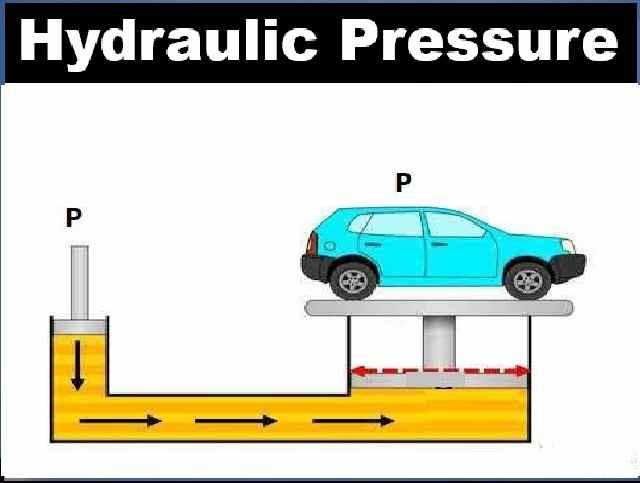
Hint- The principle of a hydraulic machine is that a small force applied on a smaller piston is transmitted to produce a large force on the bigger piston. This principle is based on Pascal’s law.
Que-19: Hydraulic machines act like a :
(a) force subtractor
(b) force reducer
(c) force multiplier
(d) both (a) and (c)
Ans: (c) force multiplier
Hint- The principle of a hydraulic machine is that a small force applied on a smaller piston is transmitted to produce a large force on the bigger piston. Hence, it acts as a force multiplier.
— : End of Pressure in Fluids Class-9 Exe-4A MCQs Concise Physics ICSE Selina Solutions Ch-4 :–
Return to Concise Selina Physics ICSE Class-9 Solutions
Thanks
Please share with your friends