Probability Class 11 OP Malhotra Exe-22A ISC Maths Ch-22 Solutions. In this article you would learn about Space, Tree and Venn Diagrams. Step by step solutions of latest textbook has been given as latest syllabus. Visit official Website CISCE for detail information about ISC Board Class-11 Mathematics.
Probability Class 11 OP Malhotra Exe-22A ISC Maths Solutions Ch-22
| Board | ISC |
| Publications | S Chand |
| Subject | Maths |
| Class | 11th |
| Chapter-22 | Probability |
| Writer | O.P. Malhotra |
| Exe-22(A) | Space, Tree and Venn Diagrams. |
Space, Tree and Venn Diagrams
Probability Class 11 OP Malhotra Exe-22A ISC Maths Ch-22 Solutions.
Que-1: What do you mean by Random Experiment ? Give two illustrations. Define sample space associated with a random experiment. Give an example.
Sol: Random Experiment: An experiment whose all outcomes are known in advance but outcomes of experiment cannot be predictable.
e.g. : Tossing a coin, its outcomes are known i.e. either head or tail but we can’t predict the outcome i.e. on tossing a coin, we can’t predict whether head comes or tail. e.g. : throwing a dice, outcomes are known i.e. {1, 2, 3, 4, 5, 6} but we can’t predict the outcomes which number comes.
Sample space : The set of all outcomes of a random experiment is called sample space.
e.g. : On tossing a coin, outcomes are either head or tail.
∴ Sample space = {H, T}
Que-2: What is the resulting sample space if
(i) one coin is tossed ;
(ii) two coins are tossed simultaneously ;
(iii) three coins are tossed simultaneously ?
Sol: (i) When one coin is tossed
Then sample space S = {H, T}
(ii) Two coins are tossed simultaneously
Then S = {HH, HT, TH, TT}
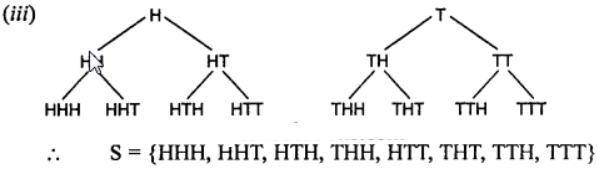
Que-3: Describe the sample space of this experiment:
(i) One die is rolled ; (ii) Two dice are rolled.
Sol: (i) When one die is rolled
Then sample space S = {1, 2, 3,4, 5, 6}
(ii) When two dice are rolled
Then S = {(1, 1), (1, 2), (1, 3), (1, 4), (1, 5), (1, 6), (2, 1), (2, 2), (2, 3), (2, 4), (2, 5), (2, 6), (3, 1), (3, 2), (3, 3), (3, 4), (3, 5), (3, 6), (4, 1), (4, 2), (4, 3), (4, 4), (4, 5), (4, 6), (5, 1), (5, 2), (5, 3), (5, 4), (5, 5), (5, 6), (6, 1), (6, 2), (6, 3), (6, 4), (6, 5), (6, 6)}
Que-4: Describe the sample space :
(i) A coin is tossed twice. If the second throw results in a tail, a die is thrown.
(ii) A coin is tossed twice. If the second throw results in a head, a die is thrown, otherwise a coin is tossed.
(iii) A coin is tossed. If it results in a head, a die is thrown. If the die shows up an even number, the die is thrown again.
Sol: (i) S = {HH, HT1, HT2, HT3, HT4, HT5, HT6, TT1, TT2, TT3, TT4, TT5, TT6}
(ii) S = {HTH, TTH, TTT, HTT, HH1, HH2, HH3, HH4, HH5, HH6, TH1, TH2, TH3, TH4, TH5, TH6}
(iii) S = {T, HI, H3, H5, H21, H22, H23, H24, H25, H26, H41, H42, H43, H44, H45, H46, H61, H62, H63, H64, H65, H66}
Que-5: A five-sided spinner is spun and a coin is tossed.
(i) Show the combined outcomes in a space diagram and in a tree diagram.
(ii) List the combined outcomes and state the number of equally likely combined outcomes.
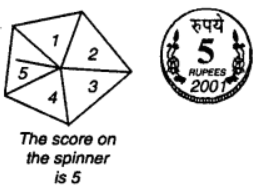
Sol: (i)
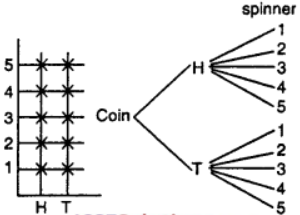
(ii) {(H , 1), (H, 2), (H, 3), (H, 4), (H, 5), (T, 1), (T, 2), (T, 3), (T, 4), (T, 5)}
∴ required total no. of outcomes = 10
Que-6: In a bag there are three balls ; one red, one blue and one yellow. A ball is selected, the colour is recorded and the ball is replaced. A second ball is then selected and the colour is recorded.
(i) Show in a space diagram and in a tree diagram all the possible combined outcomes.
(ii) List these combined outcomes and state the number of equally likely combined outcomes.
Sol: (i)
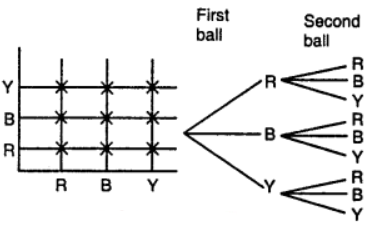
(ii) {(R. R), (R, B), (R, Y), (B, R), (B, B), (B, Y), (Y, R), (Y, B), (Y, Y)}
Que-7: Satish and Mukesh who live in London wish to go on a holiday to France. They can travel to the coast by car, coach or train, and then cross the channel by ferry, train, helicopter or hovercraft.
(i) In a space diagram and in a tree diagram show all the combined outcomes of the different ways they could travel to France.
(ii) How many different ways could they travel ?
Sol: (i)
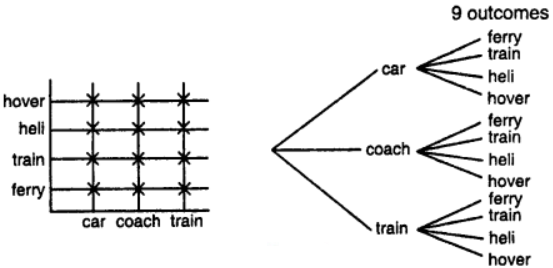
(ii) Thus required no. of ways = 4 + 4 + 4 = 12
Que-8: From a group of 2 men and 3 women, two persons are selected. Describe the sample space of the experiment. If E is the event in which one man and one woman are selected, then which are the cases favourable to E ?
Sol: Given we have group of 2 men {M1, M2} and 3 women {W1, W2, W3}
∴ Sample space = {M1M2, M1W1, M1W2, M1W3, M2W1, M2W2, M2W3, W1W2, W2W3, W1W3} Given E : event in which one man and one woman be selected
∴ favourable cases to E = {M1W1, M1W2, M1W3, M2W1, M2W2, M2W3}
Que-9: A coin is tossed. If it results in a head, a coin is tossed, otherwise a die is thrown. Describe the following events:
(i) A: getting at least one head ; (ii) B : getting an even number ; (iii) C : Getting a tail; (iv) D : getting a tail and an odd number.
Sol: Sample space = {HH, HT, T1, T2, T3, T4, T5, T6}
(i) A = {HH, HT}
(ii) B = {T2, T4, T6}
(iii) C = {HT, Tl, T2, T3, T4, T5, T6}
(iv) D = {T1, T3, T5}
Que-10: A coin and a die are tossed. Describe the following events.
(i) A : getting a head and an even number ;
(ii) B : getting a prime number ;
(iii) C : getting a tail and an odd number;
(iv) D : getting a head or a tail.
Sol: When a coin and a dice are thrown
Then sample space S = {H1, H2, H3, H4, H5, H6, Tl, T2, T3, T4, T5, T6}
(i) A = {H2, H4, H6}
(ii) B = {H2, H3, H5, T2, T3, T5}
(iii) C = {T1, T3, T5}
(iv) D = {H1, H2, H3, H4, H5, H6, Tl, T2, T3, T4, T5, T6}
Que-11: A fair coin is tossed. If it shows a head, we draw a ball from a bag consisting of 3 distinct red and 4 distinct black balls, if it shows a tail, we throw a fair die. Draw a tree diagram to show all the possible outcomes and obtain .he sample space. What are sets representing the following events:
(i) the ball drawn is black ; (ii) the coin shows tail.
Sol:
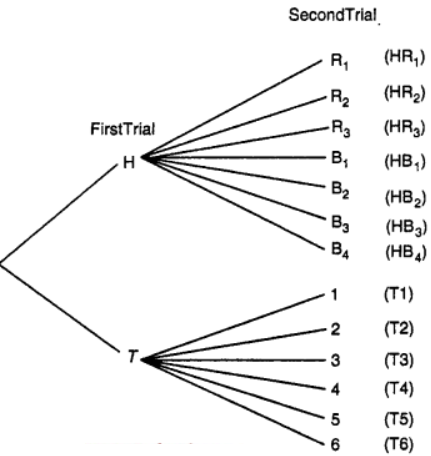
∴ S = {HR1, HR2, HR3, HB1, HB2, HB3, HB4, T1, T2, T3, T4, T5, T6)
(i) {(H, B1), (H, B2), (H, B3), (H, B4)}
(ii) {(T, 1), (T, 2), (T, 3), (T, 4), (T, 5), (T, 6)}
Que-12: Two dice are rolled. A is the event that the sum of the numbers shown on the two dice is 5. B is the event that at least one of the dice shows up a 3. Are the two events A and B (i) mutually exclusive, (ii) exhaustive ? Give arguments in support of your answer.
Sol: When two dice are rolled
Then S = {(1, 1), (1,2), (1,3), (1,4), (1, 5), (1,6), (2,1), (2,2), (2,3), (2,4), (2, 5), (2,6), (3,1), (3,2), (3,3), (3,4), (3, 5), (3,6), (4, 1), (4,2), (4, 3), (4,4), (4, 5), (4, 6), (5, 1), (5,2), (5, 3), (5, 4), (5, 5), (5, 6), (6, 1), (6, 2), (6, 3), (6, 4), (6, 5), (6, 6)}
∴ A = {(1,4), (2, 3), (3, 2), (4,1)}
B = {(3, 1), (3, 2), (3, 3), (3, 4), (3, 5), (3, 6), (1, 3), (2, 3), (4, 3), (5, 3), (6, 3)} .
Here A ∩ B = {(2, 3), (3, 2)} ≠ Φ
Thus A and B are not mutually exclusive events.
Here, A∪B ≠ S .
∴ A and B are not exhaustive events.
–: End of Probability Class 11 OP Malhotra Exe-22A ISC Maths Ch-22 Solutions. :–
Return to :- OP Malhotra ISC Class-11 S Chand Publication Maths Solutions
Thanks
Please share with your friends