Probability Class 11 OP Malhotra Exe-22B ISC Maths Ch-22 Solutions. In this article you would learn about Measurement of Probability and ODDS. Step by step solutions of latest textbook has been given as latest syllabus. Visit official Website CISCE for detail information about ISC Board Class-11 Mathematics.
Probability Class 11 OP Malhotra Exe-22B ISC Maths Solutions Ch-22
| Board | ISC |
| Publications | S Chand |
| Subject | Maths |
| Class | 11th |
| Chapter-22 | Probability |
| Writer | O.P. Malhotra |
| Exe-22(B) | Measurement of Probability and ODDS. |
Measurement of Probability and ODDS.
Probability Class 11 OP Malhotra Exe-22B ISC Maths Ch-22 Solutions.
Que-1: What is the probability of getting :
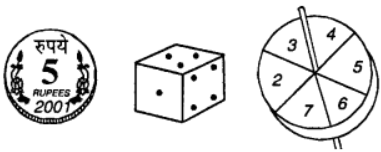
Sol: (i) Total no. of outcomes = 2
no. of favourable outcomes = 1 {H}
∴ required probability of getting head = 1/2
(ii) When a die is known then S = {1, 2, 3, 4, 5, 6}
Then total no. of outcomes = n (S) = 6
E : getting a 6 ∴ n (E) = 1
Thus required probability = n(E)n( S) = 1/6
(iii) Here S = { 2, 3, 4, 5, 6, 7}
Then n (S) = 6
E : getting a prime no. = {2, 3, 5, 7} ∴ n (E) = 4
Thus required probability = n(E)n( S) = 4/6 = 2/3
Que-2: Ramesh chooses a date at random in April for a party. Calculate the probability that he chooses :
(i) a Saturday
(ii) a Sunday
(iii) a Saturday or a Sunday.
Sol: (i) Here n (S) = 30
Let E : event that he chooses a Saturday ∴ n (E) = 4
Thus required probability = n(E) / n( S) = 4/30 = 2/15
(ii) F : a Sunday is chosen = {4, 11, 18, 25}
∴ (F) = 4
Thus required probability = n(F) / n( S) = 4/30
(iii) G : a Saturday or a Sunday is chosen = {3, 10, 17, 24, 4, 11, 18, 25}
∴ n (G) = 8
Thus required probability = n(G) / n( S) = 8/30 = 4/15
Que-3: A normal die is rolled. Calculate the probability that the number on the uppermost face when it stops rolling will be
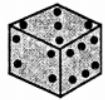
(i) 5 (ii) not 5 (iii) an odd number (iv) a prime number (v) a 3 or a 4 (vi) a 1 or a 2 or a 3 or a 4.
Sol: When a die is rolled then S = {1, 2, 3, 4, 5, 6} ∴ n (S) = 6
(i) A : getting a 5 ∴ n (A) = 1
∴ required probability = n( A) / n( S) = 1/6
(ii) B : getting not 5 = { 1, 2, 3, 4, 6} ∴ n (B) = 5
This required probability = n( B) / n( S) = 5/6
(iii) C : getting an odd no. = {1, 3, 5} ∴ n (C) = 3
Thus, required probability = n( C) / n( S) = 3/6 = 1/2
Que-4: Nine playing cards are numbered 2 to 10. A card is selected from them at random. Calculate the probability that the card will be :
(i) an odd number (ii) a multiple of 4.
Sol: Here S = {2, 3, 4, 5, 6, 7, 8, 9, 10} ∴ n (S) = 9
(i) E : getting an odd numbered card = {3, 5, 7, 9} ∴ n (E) = 4
Thus required probability = n( E) / n( S) = 4/9
(ii) F : getting a card with multiple of 4 = {4, 8} ∴ n (F) = 2
Thus required probability = n( F) / n( S) = 2/9
Que-5: Nine counters numbered 2 to 10 are put in a bag. One counter is selected at random. What is the probability of getting a counter with :
(i) a number 5 (ii) an odd number (iii) not an odd number (iv) a prime number (v) a square number (vi) a multiple of 3 ?
Sol: Here n (S) = total no. of outcomes = 9
(i) E : getting a counter with no. 5 ∴ n (E) = 1
Thus required probability = n( E) / n( S) = 1/9
(ii) F : getting a counter with an odd number = {3, 5, 7, 9} ∴ n (F) = 4
Thus required probability = n( F) / n( S) = 4/9
(iii) G : getting a counter with not an odd number = {2, 4, 6, 8, 10} ∴ n (G) = 5
Thus required probability = n( F) / n( S) = 5/9
(iv) H : getting a prime number = {2, 3, 5, 7} ∴ n (H) = 4
Thus required probability = n( H) / n( S) = 4/9
(v) A : getting a counter with a square number = {4, 9} ∴ n(A) = 2
Thus required probability = n( A) / n( S) = 2/9
(vi) B : getting a counter with a multiple of 3 = {3, 6, 9} ∴ n (B) = 3
Thus required probability = n( B) / n( S) = 3/9 = 1/3
Que-6: A die is rolled. If the outcome is an even number, what is the probability that it is a prime number.
Sol: It is given that outcome is an even number on rolling a die then S = {2, 4, 6} ∴ n (S) = 3
A : getting a prime no. = {2} ∴ n (A) = 1
Thus required probability = n( A) / n( S) = 1/3
Que-7: A bag contains 20 coloured balls. 8 are red, 6 are blue, 3 are green, 2 are white and 1 is brown. A ball is chosen at random from the bag. What is the probability that the ball chosen is :
(i) blue (ii) not blue (iii) brown (iv) not brown (v) blue or red (vi) red or green (vii) green or white or brown ?
Sol: Given no. of red balls = 8 ;
no. of green balls = 3 ;
no. of blue balls = 6 ;
no. of white balls = 2 ;
no. of brown balls = 1
∴ Total no. of balls = 20 = n (S)
(i) required probability of getting a blue ball = (no. of favourable outcomes) / n(S)
= 6/20 = 3/10
(ii) required probability of getting not a blue ball = {(20−6)}/20 = 14/20 = 7/10
(iii) Required probability of getting a brown ball = 1/20
(iv) Required probability of getting not a brown ball = (20−1)/20 = 19/20
(v) Required probability of getting blue or red ball = (8+6)/20 = 14/20 = 7/10
(vi) Required probability of getting red or green ball = (8+3)/20 = 11/20
(vii) Required probability of getting green or white or brown ball = (3+2+1)/20
= 6/20 = 3/10
Que-8: A bag contains 20 balls. These are of three different colours : green, red and blue. A ball is chosen at random from the bag. The probability of a green ball is 1/4 The probability of a red ball is 2/5.
(i) What is the probability of a blue ball ?
(ii) How many balls are red ?
(iii) How many balls are green ?
(iv) How many balls are blue ?
Sol: Given total no. of balls = 20 = n (S)
given probability of getting green ball = P (G) = 1/4
probability of getting green ball = P (R) = 2/5
(i) Required probability of getting a blue ball = 1 – P (G) – P (R)
= 1 – (1/4) – (2/5) = (20−5−8)/20 = 7/20
(ii) Let x be the no. of red balls in a bag
Thus probability of getting a red ball = (x/20) ∴ (x/20) = 25 ⇒ x = 8
(iii) Let y be the no. of green balls in a bag.
Then probability of getting a green ball = (y/20) ∴ (y/20) = (1/4) ⇒ y = 5
Thus required no. of green balls in a bag = 5
(iv) ∴ required no. of blue balls = 20 – 8 – 5 = 7
Que-9: A pair of dice is thrown. Find the probability of getting a sum of 10 or more, if 5 appears on the first die.
Sol: When a pair of dice is thrown
Then S = {(1, 1), (1,2), (1,3), (1,4), (1, 5), (1,6), (2, 1), (2,2), (2, 3), (2,4), (2, 5), (2,6), (3, 1), (3, 2), (3, 3), (3, 4), (3, 5), (3, 6), (4, 1), (4, 2), (4, 3), (4, 4), (4, 5), (4, 6), (5, 1), (5,2), (5, 3), (5, 4), (5, 5), (5, 6), (6, 1), (6, 2), (6, 3), (6, 4), (6, 5), (6, 6)} ∴ n (S) = 36
Let A : getting a sum of 10 or more if 5 appears on the first die = {(5, 5), (5, 6)} ∴ n (A) = 2
required probability = 2/36 = 1/18
Que-10: A match can be won, drawn or lost. One week a school is to play two matches. Draw a tree diagram to show all the possible outcomes and list them. If the outcomes are equally likely, calculate the probability that:
(i) both matches are won ;
(ii) one match is drawn ;
(iii) at least one match is drawn ;
(iv) no match is lost;
(v) both matches are not lost.
Sol: Since a match can be won, drawn or lost
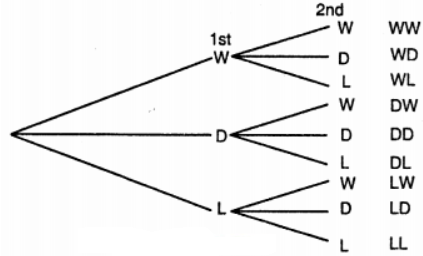
S = {WW, WD, WL, DW, DD, DL, LW, LD, LL}
Thus n(S) = 9
(i) Let E : both matches are won = {WW} ∴ n (E) = 1
Thus required probability = n( E) / n( S) = 1/9
(ii) F : one match is drawn = {WD, DW, DL, LD} ∴ n (F) = 4
Thus required probability = n( F) / n( S) = 4/9
(iii) G : atleast one match is drawn = {WD, DW, LD, DL, DD} ∴ n (G) = 5
Thus required probability = n( G) / n( S) = 5/9
(iv) A : No match is lost = {WW, WD, DW, DD} ∴ n (A) = 4
Thus, required probability = n( A) / n( S) = 4/9
(v) B : both matches are not lost = {WW, WD, DW, DD, DL, LD, WL, LW} ∴ n (B) = 8
Thus, required probability = n( B) / n( S) = 8/9
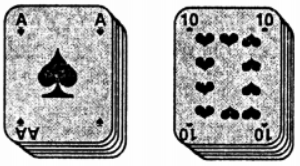
Que-11: The ace, king, queen, jack and ten from both the spades and hearts suits are placed in two separate piles and one card is taken from each pile : Draw the sample space diagram and find the probability that:
(i) both cards will be kings ;
(ii) both of the cards could be either ace or a king ;
(iii) both cards will be a pair ;
(iv) at least one card will be an ace ;
(v) neither card will be a 10 ;
(vi) neither card will be a king or jack;
(vii) one card will be a spade ;
(viii) both cards will be hearts.
Note. Description of normal pack of cards (52)
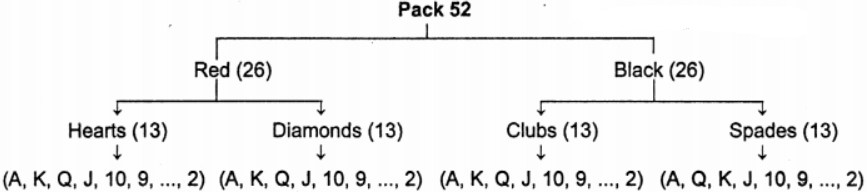
Each of the colours, hearts, diamonds, clubs, spades, is called a suit. Kings, queens and jacks are called face cards. There are 12 face cards in a normal pack of cards.
Sol: Space diagram is given as under :
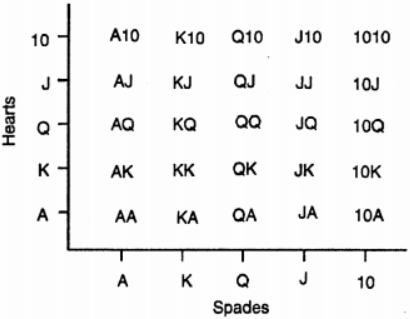
∴ Sample space S = {AA, AK, AQ, AJ, A10, KA, KK, KQ, KJ, K10, QA, QK, QQ, QJ, Q10, JA, JK, JQ, JJ, J10, 10A, 10K, 10Q, 10J, 1010} ∴ n (S) = 5 × 5 = 25
(i) Let A : both drawn cards are kings = {KK} ∴ n (A) = 1
Thus required Probability = n( A) / n( S) = 1/25
(ii) Let B : both cards could be either ace or a king = {AA, KK} ∴ n (B) = 2
Thus required Probability = n( B) / n( S) = 2/25
(iii) Let C : both drawn cards will be a pair = {AA, KK, QQ, JJ, 1010} ∴ n (C) = 5
Thus required Probability = n( C) / n( S) = 5/25 = 1/5
(iv) E : atleast one card will be an ace = {AK, AA, AQ, AI, A10, KA, QA, JA, 10A} ,∴ n(E) = 9
Thus required Probability = n( E) / n( S) = 9/25
(v) F : neither card will be 10 = {AK, AA, AJ, AQ, KA, KK, KQ, KJ, QA, QK, QJ, QQ, JA, JK, JQ, JJ}
Thus n (F) = 16
∴ required probability = n( F) / n( S) = 16/25
(vi) G : neither card will be King or Jack = {AA, AQ, A10, QA, QQ, Q10, 10A, 10Q, 1010}
∴ n (G) = 9
Thus required probability = n( G) / n( S) = 9/25
(vii) H : one card will be spade ∴ n (H) = 25
∴ required probability = n( H) / n( S) = 25/25 = 1
(viii) I : both cards will be heart cards
out of two drawn cards, one always must be from spade and one from heart so both cards can never be from heart suit.
∴ n(I) = 0
Thus required probability = n( I) / n( S) = 0/25 = 0
–: End of Probability Class 11 OP Malhotra Exe-22B ISC Maths Ch-22 Solutions. :–
Return to :- OP Malhotra ISC Class-11 S Chand Publication Maths Solutions
Thanks
Please share with your friends