Probability Class 11 OP Malhotra Exe-22D ISC Maths Ch-22 Solutions. In this article you would learn about Using Permutation and Combination. Step by step solutions of latest textbook has been given as latest syllabus. Visit official Website CISCE for detail information about ISC Board Class-11 Mathematics.
Probability Class 11 OP Malhotra Exe-22D ISC Maths Solutions Ch-22
| Board | ISC |
| Publications | S Chand |
| Subject | Maths |
| Class | 11th |
| Chapter-22 | Probability |
| Writer | O.P. Malhotra |
| Exe-22(D) | Using Permutation and Combination |
Using Permutation and Combination.
Probability Class 11 OP Malhotra Exe-22D ISC Maths Ch-22 Solutions.
Que-1: Four digit numbers are formed by using the digits 1, 2, 3, 4 and 5 without repeating the digit. Find the probability that a number, chose at random, is an odd number.
Sol: Total no. of 4 digit numbers formed by using given digits 1, 2, 3, 4 and 5 without repetition
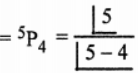
= 5×4×3×2×1 = 120
∴ Total no. of exhaustive cases = 120
Total no. of favourable cases = total no. of 4 digit odd number = 2 × 3 × 4 × 3 = 72
required probability = Total no. of favourable cases / Total no. of cases
= 72/120 = 3/5
Que-2: What is the probability of getting 3 white balls in a draw of 3 balls from a box containing 6 white and 4 red balls ?
Sol: Given Total no. of balls = 6 + 4 = 10
Total no. of cases = Total no. of drawing 3 balls out of 10 balls = 10C3
Favourable no. of cases = Total no. of ways of drawing 3 white balls out of 6 = 6C3

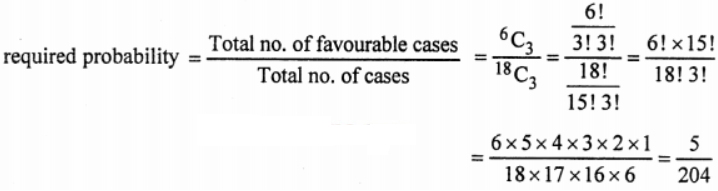
Que-3: A bag contains 6 white, 7 red and 5 black balls, three balls are drawn at random. Find the probability that they will be white.
Sol: Total no. of balls = 6 + 7 + 5 = 18
∴ Total no. of exhaustive cases = Total no. of ways of drawing 3 balls out of 18 = 18C3
Total no. of favourable cases = no. of ways of drawing 3 white balls out of 6 = (6C3)
Que-4: A bag contains 2 white marbles, 4 blue marbles, and 6 red marbles. A marble is drawn at random from the bag. What is the probability’ that
(i) it is white ? (ii) it is blue ? (iii) it is red ? (iv) it is not white ? (v) it is not blue ? (vi) it is black ?
Sol: Total number of marbles = 6 + 4 + 2 = 12
∴ total no. of Exhaustive cases = 12
(i) Required probability of drawing a white ball = 2/12 = 1/6
(ii) Required probability of drawing a blue ball = 4/12 = 1/3
(iii) Required probability of drawing a red ball = 6/12 = 1/2
(iv) Required probability of drawing not a white ball = probability of drawing either red or blue ball = (6+4)/12 = 10/12 = 5/6
(v) drawing ball is not blue ∴ it is either white or red
∴ Total no. of favourable cases = 2 + 6 = 8
Thus required probability = 8/12 = 2/3
(vi) Since there is no black ball
∴ Total no. of favourable cases = 0
Thus, required probability = 0/12 = 0
Que-5: In Q. 4, three marbles are drawn from the bag. What is the probability that
(i) they are all blue ? (ii) they are all red ? (iii) they are all white ?(iv) none of them is red? (v) not all of them are red? (vi) none is black?
Sol: Here total no. of exhaustive cases = Total no. of ways of drawing 3 balls out of 12 = 12C3
(i) Total no. of favourable cases = Total no. of ways of drawing 3 out of 4 = (4C3)
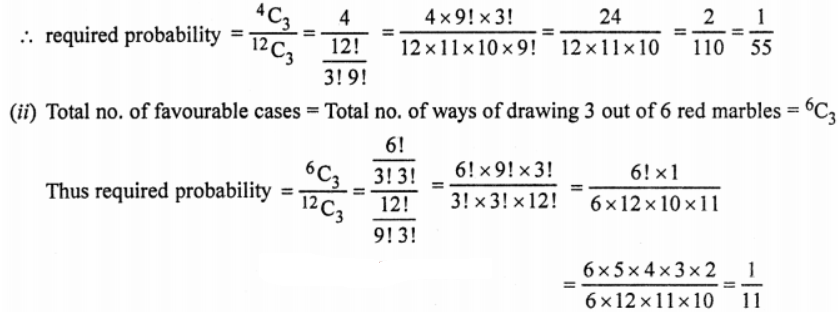
(iii) Since we have to draw 3 white marbles but we have only 2 white marbles.
∴ Total no. of favourable cases = 0
Thus required probability = 0/(12C3) = 0
(iv) Since none of drawing marble be red
∴Total no. of favourable outcomes = Total no. of ways of drawing 3 marbles out of remaining 6 marbles = (6C3)
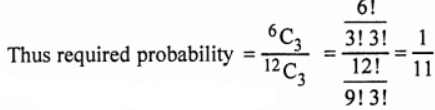
(v) Required probability = 1 – P(all are red) = 1 – (1/11) = 10/11
(vi) Since there is no black ball
∴ required probability that none is black = probability of drawing ball of any colour out of red, blue or white = 1
Que-6: Two balls are drawn from an urn containing 2 white, 3 red and 4 black balls, one by one without replacement. What is the probability that (i) both balls are of the same colour, (ii) at least one ball is red ?
Sol: Given no. of white balls = 2, no. of red balls = 3 and no. of black balls = 4
∴ Total no. of balls = 2 + 3 + 4 = 9
(i) Required probability = P (WW) + P (RR) + P (BB)
= (2/9) × (1/8) + (3/9) × (2/8) + (4/9) × (3/8) = 20/72 = 5/18
(ii) Required probability of drawing atleast one ball is red = P (RW, RB, RR, WR, BR) = P (RW) + P (RB) + P (RR) + P (WR) + P (BR)
= (3/9) × (2/8) + (3/9) × (4/8) + (3/9) × (2/8) + (2/9) × (3/8) + (4/9) × (3/8)
= 42/72 = 7/12
Que-7: From a pack of cards, three are drawn at random. Find the chance that they are a king, a queen and a knave.
Sol: Total no. of exhaustive cases = Total no. of ways of drawing three cards out of 52 = 52C3
Total no. of favourable cases = Total no. of ways of drawing a king, a queen and a knave = 4C1 × 4C1 × (4C1)

Que-8: (i) Two cards are drawn at random from 8 cards numbered from 1 to 8. What is the probability that the sum of the numbers is odd, if the two cards are drawn together ?
(ii) Two cards are drawn at random from a well shuffled pack of 52 cards, show that the chances of drawing two aces is 1/221.
(iii) From a pack of 52 cards, 3 cards are drawn ‘at random’. Find the probability of drawing exactly two aces.
(iv) Three cards are drawn at a time at random from a well shuffled pack of 52 cards. Find the probability that all the three cards have the same number.
(v) Two cards are drawn from a well shuffled pack of cards without replacement. Find the probability that neither a Jack nor a card of spades is drawn.
Sol: Total no. of exhaustive cases = Total no. of ways of drawing two cards out of 8 = 8C2 = n (S)
(i) Let E : the sum of the numbers is odd
= {(1, 2), (2, 1), (1, 4), (4, 1), (1, 6), (6, 1), (1, 8), (8, 1), (2, 3), (3, 2), (2, 5), (5, 2), (2, 7), (7, 2), (3, 4), (4, 3), (3, 6), (6, 3), (3, 8), (8, 3), (4, 5), (4, 7), (5, 4), (7, 4), (6, 5), (5, 6), (5, 8), (8, 5), (6, 7), (7, 6), (8, 7), (7, 8)}
Since cards are taken together
∴ (a, b) = (b, a)
Thus n (E) = 16
∴ required probability = n(E) / n( S) = 16 / 8C2 = 16/28 = 4/7
(ii) Total no. of exhaustive cases = Total no. of ways of drawing 2 cards out of 52 = 52C2
Total no. of favourable outcomes = Total no. of ways of drawing 2 out of 4 = 4C2
∴ required probability = 4C2 / 52C2 = {4!/(2!2!)} / {52!/(50!2!)}
= {6/(26×51)} = 1/(13×17) = 1/221
(iii) Total no. of ways of drawing 3 cards out of 52 = 52C3
∴ Total no. of favourable outcomes = Total no. of ways of drawing exactly two aces = 4C2 × (48C1)

(iv) Total no. of exhaustive case = total no. of ways of drawing 3 cards out of 52 = 52C3
Let E : all the three cards are having the same number.
Since there are 13 such groups each containing 4 same cards
∴ n (E) = 13 × 4C3 = 13 × 4 = 52

(v) Total no. of exhaustive cases = Total no. of ways of drawing 2 cards out of 52 without replacement = 52C2 = n (S)
E : drawing card is neither a Jack nor a card of spades and there are (52 – 13 – 3) = 36 such cards
∴ n (E) = Total no. of ways of drawing 2 cards out of 36 = 36C2

Que-9: Three cards are drawn from a deck of 52 cards. What is the probability that
(i) they are all spades ?
(ii) they are all red cards ?
(iii) none of them is a club ?
(iv) all of them are aces ?
Sol: Total no. of exhaustive cases = Total no. of ways of drawing 3 cards out of 52 = 52C3
(i) Since there are 13 spade cards.
Then total no. of favourable cases = 13C3
∴ required Probability = (13C3) / (52C2) = {13!/(10!3!)} / {52!/(49!3!)}
= {13×12×11}/{52×51×50} = 11/850
(ii) Since there are 26 red cards
∴ Total no. of ways of drawing 3 cards out of 26 = 26C3
∴ required probability = (26C3) / (52C3) = {26!/(3!23!)} / {52!/(49!3!)}
= (26×26×24)/(52×51×50) = 2/17
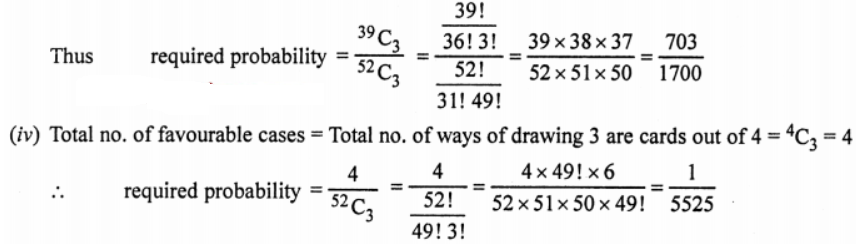
(iii) Since none of the drawing card is club card so the drawing cards can be out of (52 – 13) = 39 cards
∴ Total no. of favourable cases = No. of ways of drawing 3 cards out of 39 = 39C3
Que-10: In Q. 7 what are the odds that
(i) all three cards are spades?
(ii) they are all red cards?
(iii) none is a club?
(iv) all of them are aces?
Sol: Total no. of exhaustive outcomes = Total no. of ways of drawing 3 cards out of 52 = 52C3
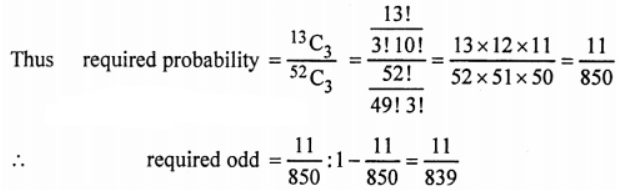
(i) Since there are 13 spade cards
∴ Total no. of ways of drawing 3 cards out of 13 = (13C3)
(ii) Total no. of favourable cases = Total no. of ways of drawing 3 cards out of 26 = 26C3
∴ required probability = (26C3)/(52C3) = (26×25×24)/(52×51×50) = 2/17
Thus required odds = (2/17) : 1 – (2/17) = (2/17) : (15/17) = 2/15
(iii) Total no. of favourable cases = Total no. of ways drawing 3 cards out of (52 – 13) = 39 cards = 39C3
∴ required probability of drawing none is a club card out of 3 = (39C3)/(52C3) = (39×38×37)/(52×51×50) = 703/1700
Thus required odd = (703/1700) : 1 – (703/1700) = (703/1700) : (997/1700) = 703 : 997
(iv) Total no. of ways of drawing 3 ace cards out of 4 = 4C3 = 4
∴ required probability = (4C3)/(52C3) = 4/{(52×51×50)/6} = 1/5525
Thus required odds in favour of favourable event = (1/5525) : 1 – (1/5525) = 1 : 5524
Que-11: One card is drawn from a pack of 52 cards, each of the 52 cards being equally like to be drawn. Find the probability that the card drawn is (i) an ace, (ii) red, (iii) either red or king, (iv) red and a king.
Sol: Total no. of exhaustive cases = 52
(i) since there are 4 ace cards
∴ required probability = 4/52 = 1/13
(ii) since there are 26 red cards
∴ required probability = 26/52 = 1/2
(iii) Since there are 26 red cards that includes 2 red kings and 2 black kings
∴ Total no. of such cards = 26 + 2 = 28
∴ required probability = 28/52 = 7/13
(iv) Since there are 2 red kings in 52 cards
Thus required probability = 2/52 = 1/26
Que-12: Four cards are drawn at random from a pack of 52 playing cards, Find the probability of getting
(i) all the four cards of the same suit;
(ii) all the four cards of the same number;
(iii) one card from each suit;
(iv) two red cards and two black cards ;
(v) all cards of the same colour ;
(vi) all face cards ; (King, Queen, Jack)
(vii) four honours of the same suit.
Sol: Total no. of exhaustive cases = Total no. of ways of drawing 3 cards out of 52 = 52C4
(i) Total no. of favourable cases = Total no. of ways of drawing 4 cards from same suit = 4 × 13C4 [since there are 4 suits and each suit containing 13 cards]

(ii) Let E : getting all the four cards of the same number
∴ n (E) = 13 × 4C4 = 13
[There are 13 such groups and each group containing 4 same cards each one from each suit]
Thus required probability = 13/(52C4) = {13/(52×51×50×49)} / 24 = 13/270725
(iii) Total no. of ways of drawing one card from each suit = 13C1 × 13C1 × 13C1 × 13C1 [since each suit contains 13 cards each]
∴ required probability = favourable cases / total cases = (13C1×13C1×13C1×13C1) / 52C4 = (13×13×13×13)/{(52×51×50×49)/24} = 2197/20825
(iv) Total no. of favourable cases = Total no. of ways of drawing 2 red and 2 black cards out of 26 cards each = 26C2 × 26C2
Thus required probability = {26C2×26C2} / 52C4
= {(26×25)/2}×{(26×25)/2} / {(52×51×50×49)/24} = 325/833
(v) drawing 4 cards of same colour means either all 4 cards are red or black.
∴ Total favourable cases = Total no. of ways of drawing all four cards of same colour = 26C4 × 26C4
∴ required probability = {(26C4)×(26C4)} / 52C4
(vi) since there are 12 face cards (4 kings, 4 queens and 4 jacks)
Thus total no. of ways of drawing 4 cards from 12 cards = 12C4
Therefore required probability = (12C4) / (52C4) = {12!/(4!8!)} / {52!/(4!48!)}
= (12×11×10×9)/(52×51×50×49) = 99/54145
(vii) since there are 16 honours cards including 4 aces, 4 kings, 4 queens and 4 jacks i.e. 4 suits.
Total no. of ways of drawing 4 honour cards of same suit = 4
∴ Required probability = 4 / (52C4) = 4/{(52×51×50×49)/24} = 4/270725
Que-13: In a lottery of 50 tickets numbered 1 to 50, two tickets are drawn simultaneously. Find the probability that
(i) both the tickets drawn have prime numbers ;
(ii) none of the tickets drawn has prime number ;
(iii) a ticket has prime number.
Sol: Total exhaustive cases = Total no. of ways of drawing 2 tickets out of 50 = 50C2
(i) Prime numbers from 1 to 50 are {2, 3, 5, 7, 11, 13, 17, 19, 23, 29, 31, 37, 41, 43, 47}
∴ Total no. of prime numbers from 1 to 50 = 15
Thus total favourable cases = Total no. of ways of drawing 2 tickets out of 15 = 15C2
∴ required probability = favourable cases / Exhaustive cases = (15C2) / (50C2)
= (15×14)/(50×49) = 3/35
(ii) Total numbers which are not prime from 1 to 50 = 50 – 15 = 35
Thus total favourable cases = Total no. ot ways of drawing 2 tickets when none of tickets drawn has prime number = 35C2
∴ required probability = (35C2) / (50C2) = (35×34)/(50×49) = 17/35
(iii) Total no. of ways of drawing 2 tickets in which one ticket containing prime no. = 15C1 × 35C1
∴ required probability = {(15C1)×(35C1)} / (50C2) = (15×35×2)/(50×49) = 3/7
Que-14: (i) Out of 9 outstanding students in a college, there are 4 boys and 5 girls. A team of 4 students is to be selected for a quiz programme. Find the probability that 2 are girls and 2 are boys.
(ii) Four people are chosen at random from a group consisting of 3 men, 2 women, and 3 children. Find the probability that out of four chosen people, exactly 2 are children ?
Sol: (i) Given total no. of outstanding students = 9
∴ Total no. of ways of selecting 4 students out of 9 = 9C4
Total no. of ways of selecting 2 boys out of 4 be 4C2 and no. of ways of selecting 2 girls out of 5 be 5C2
∴ Total no. of ways of drawing 2 girls and 2 boys = 4C2 × (5C2)

(ii) Total no. of peoples =3 + 2 + 3 = 8
∴ Total no. of ways of choosing 4 people out of 8 = 8C4
Total no. of ways of choosing exactly 2 children = 3C2 × 5C2 = 3 × {(5×4)/2} = 30
∴ required probability = 30 / (8C4) = 30 / {(8×7×6×5)/24} = 3/7
Que-15: A committee of 5 principals is to be selected from a group of 6 grant principals and 8 lady principals. If the selected is made randomly, find the probability that there are 3 lady principals and 2 gent principals.
Sol: Total no. of principals = 6 + 8 = 14
∴ Total no. of ways of selecting 5 principals out of 14 = 14C5
Total no. of ways of selecting 3 lady principals from 8 and 2 gents principals out of 6 = 8C3 × 6C2
∴ required probability = {(8C3)×(6C2)} / (14C5)
= [{(8×7×6)/6}×{(6×5)/2}] / [(14×13×12×11×10)/(5×4×3×2)] = 60/143
Que-16: A bag contains tickets numbered 1 to 20. Two tickets are drawn. Find the probability that both numbers are odd.
Sol: Total no. of ways of drawing 2 tickets out of 20 = 20C2
since there are 10 odd numbers from 1 to 20.
∴ Total no. of ways of drawing 2 tickets out of 10 = 10C2
Thus required probability = (10C2) / (20C2) = (10×9)/(20×19) = 9/38
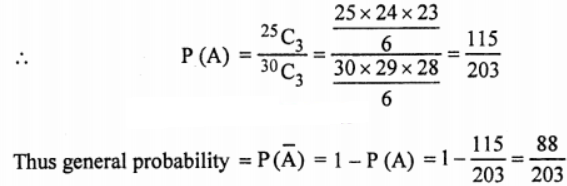
Que-17: A bag contains tickets numbered 1 to 30 . Three tickets are drawn at random from the bag. What is the probability that the maximum number of the selected tickets exceeds 25 ?
Sol: Total no. of ways of drawing 3 tickets out of 30 = 30C3
Let A : event that none of the selected ticket bear number exceeding 25
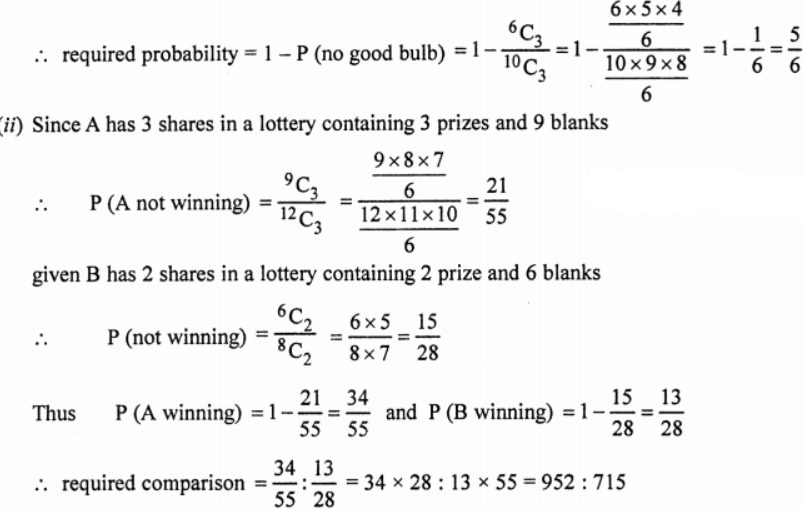
Que-18: (i) A room has 3 lamps. From a collection of 10 light bulbs of which 6 are no good, a person selects 3 at random and puts them in a socket. What is the probability, that he will have light ?
(ii) A has 3 shares in a lottery containing 3 prizes and 9 blanks ; B has two shares in lottery containing 2 prizes and 6 blanks. Compare their chances of success.
Sol: (i) Total no. of light bulbs = 10
no. of no good bulbs = 6
Thus, no. of good bulbs = 10 – 6 = 4
Total exhaustive cases = total no. of ways of selecting 3 out of 10 = 10C3
∴ required probability = 1 – P (no good bulb)
Que-19: (i) There are n letters and n addressed envelopes. If the letters are placed in the envelopes at random, what is the probability that all the letters are not placed in the right envelope ?
(ii) Three letters are written to different persons, and the addresses on the three envelopes are also written. Without looking at the addresses, find the probability that the letters go into the right envelopes.
Sol: (i) Total no. of ways of planning n letters in n envelopes = n!
There is only one way in which all the letters placed correctly.
∴ probability of planning the letters in right envelopes = 1/n!
Thus, required probability that all letters are not placed in right envelopes =1 – (1/n!)
(ii) The total number of ways of placing 3 letters in 3 envelopes = 3! = 6
There is only 1 way in which all the three letters placed correctly.
∴ required probability that the letters placed in right envelopes = 1/6
Que-20: The letters of word ‘SOCIETY’ are placed at random in a row. What is the probability that three vowels come together ?
Sol: The total no. of ways in which all the letters of the word SOCIETY are placed in a row = 7!
Total no. of vowels in word society =3 {O, I, E}
When all three vowels come together they form a group. ∴ 1 group and 4 consonants can be arranged in 5! ways and 3 vowels arranged themselves in 3! ways.
Thus total no. of ways in which three vowels come together = ⌊5 × ⌊3
∴ required probability = (3!×5!)/7! = 6/(7×6) = 1/7
Que-21: In a random arrangement of the letters of the word “COMMERCE”, find the probability that all vowels come together.
Sol: In word COMMERCE, there are 2E’s, 2M’s, 2C’s, 1O and 1R
∴ Total no. of ways in which letters of word COMMERCE arranged themselves = 8! / (2!2!2!)
since there are 3 vowels (O, E, E) and came together to form a group. Thus, this group and 5 consonants arranged themselves in 6!/(2!2!) and 3 vowels can be arranged themselves in 3!/2! .
Thus total no. of favourable cases = {6!/(2!2!)} × (3!/2!)
∴ required probability = [{6!/(2!2!)}×(3!/2!)] / {8!/(2!2!2!)}
= (6!×3!)/8! = 3/28
Que-22: Given a group of 4 persons, find the probability that
(i) no two of them have their birthdays on the same day,
(ii) ail of them have same birthday. [Ignore the existence of a leap year]
Sol: (i) The first person can have birthday on any of 365 days.
The second person can also have birthday on any of 365 days and so on.
Thus the total no. of ways of choosing the birthday for the four persons = (365)4
(i) Since no two persons have their birthday on the same day. Thus for the first person we have 365 choices and second person have 364, third person have 363 and 4th person have 362 choices.
Thus, the total no. of ways in which all the four persons have their birthdays on different days = 365 × 364 × 363 × 362
∴ required probability = (365×364×363×362) / (365)^4 = (364P3) / (365)²
(ii) Since all the four persons have birthday on same day and that day can be any day out of 365 days
∴ Total no. of such ways = 365
∴ Required probability = 365 / (365)^4 = 1 / (365)³
–: End of Probability Class 11 OP Malhotra Exe-22D ISC Maths Ch-22 Solutions. :–
Return to :- OP Malhotra ISC Class-11 S Chand Publication Maths Solutions
Thanks
Please share with your friends