Probability Class 11 OP Malhotra Exe-22F ISC Maths Ch-22 Solutions. In this article you would learn about THEOREMS. Step by step solutions of latest textbook has been given as latest syllabus. Visit official Website CISCE for detail information about ISC Board Class-11 Mathematics.
Probability Class 11 OP Malhotra Exe-22F ISC Maths Solutions Ch-22
| Board | ISC |
| Publications | S Chand |
| Subject | Maths |
| Class | 11th |
| Chapter-22 | Probability |
| Writer | O.P. Malhotra |
| Exe-22(F) | THEOREMS |
THEOREMS.
Probability Class 11 OP Malhotra Exe-22F ISC Maths Ch-22 Solutions.
Que-1: (i) In a single throw of two coins, find the probability of getting both heads or both tails.
(ii) A dice is thrown twice. Find the probability that the sum of the two numbers obtain is 5 or 7 ?
(iii) Two dice are tossed once. Find the probability of getting an even number on first die or a total of 8.
Sol: (i) In a single throw of two coins
Then sample space S = {HH, HT, TH, TT}
∴ Total no. of exhaustive cases = 4
P (both heads) = 1/4 {HH}
P (both tails) = 1/4 {TT}
Thus required probability = P (both heads) + P (tails) = (1/4) + (1/4) = 1/2
(ii) Here total no. of outcomes = 6² = 36 = n (S)
Let A : sum of two numbers be 5 = {(1, 4), (2, 3), (3, 2), (4, 1)} ∴ n (A) = 4
∴ P(A) = n( A) / n( S) = 4/36
B : event that sum of numbers be 7 = {(1, 6), (2, 5), (3, 4), (4, 3), (5, 2), (6, 1)} ∴ n (B) = 6
Thus P(B) = n( B) / n( S) = 6/36
∴ required probability of getting either sum 5 or 7 = P (A or B) = P (A) + P (B) = (4/36) + (6/36) = 10/36 = 5/18
[since A and B are mutually exclusive events as A ∩ B = Φ) P (A ∩ B) = 0]
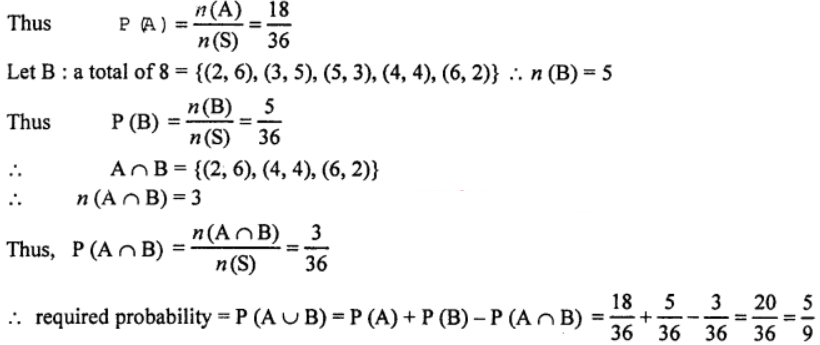
(iii) Here, total no. of exhaustive cases = n (S) = 62 = 36
Let A : event of getting an even number on first die
= {(2, 1), (2, 2), (2, 3), (2, 4), (2, 5), (2, 6), (4, 1), (4, 2), (4, 3), (4, 4), (4, 5), (4, 6), (6, 1), (6, 2), (6, 3), (6, 4), (6, 5), (6, 6)}
∴ n(A) = 18
Que-2: If the probability of a horse A winning a race is 1/5 and the probability of horse B winning the same race is 1/4, what is the probability that one of the horses will win ?
Sol: Given P (horse A winning a race) = 1/5; P (horse B winning a race) = 1/4
∴ required probability = P (A) + P(B) = (1/5) + (1/4) = 9/20
Que-3: In a single throw of two dice, what is the probability of obtaining a total of 9 or 11 ?
Sol: In a single throw of two dice
Then total no. of exhaustive cases = 6² = 36 = n (S)
Let A : event of obtaining a total of 9 = {(3, 6), (4, 5), (5,4), (6, 3)} ∴n (A) = 4
∴ P(A) = n( A) / n( S) = 4/26
Let B : obtaining a total of 11 = {(5, 6), (6, 5)} ∴ n(B) = 2
Thus P(B) = n( B) / n( S) = 2/36
Here A ∩ B = Φ ⇒ P(A ∩ B) = 0
Thus required probability of obtaining a total of 9 or 11 = P (A or B)
= P (A) + P (B) – P (A ∩ B) = (4/36) + (2/36) = 6/36 = 1/6
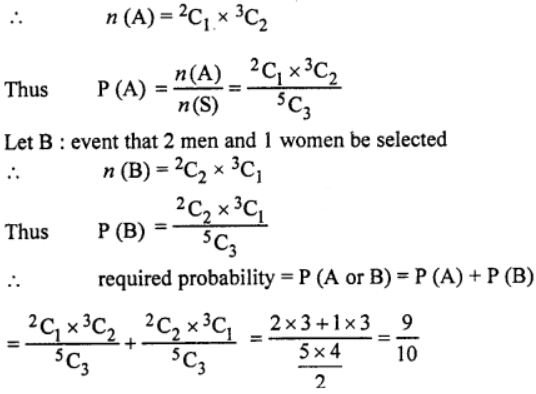
Que-4: In a group there are 2 men and 3 women. 3 persons are selected at random from the group. Find the probability that 1 man and 2 women or 2 men and 1 woman are selected.
Sol: Total no. of persons = 2 + 3 = 5
∴ Total no. of ways of selecting 3 persons out of 5 = 5C3
Let A : event that 1 man and 2 women are selected ∴ n(A) = 2C1 × (3C2)
Que-5: In a class of 25 students with roll numbers 1 to 25, a student is picked up at random to answer a question. Find the probability that the roll number of the selected student is either a multiple of 5 or 7 ?
Sol: Total exhaustive cases = 25 = n (S)
Let A : event that roll no. of selected student be a multiple of 5 = {5, 10, 15, 20, 25}
B : event that roll no. of selected student be a multiple of 7 = {7, 14,21}
∴ A ∩ B = Φ ⇒ P(A ∩ B) = 0
∴ P(A) = n( A) / n( S) = 5/25; P(B) = n( B) / n( S) = 3/25
Thus required probability = P(A or B) = P(A) + P(B) = (5/25) + (3/25) = 8/25
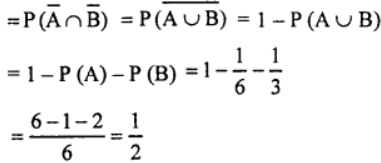
Que-6: If chance of A, winning a certain race be 1/6 and the chance of B winning it is 1/3, what is the chance that neither should win ?
Sol: Given P(A’s Winning) = 1/6, P(B’s Winning) = 1/3
∴ P (neither A nor B wins)
Que-7: Discuss and criticise the following : P(A) = 2/3, P(B) = 1/4, P (C) = 1/3 are the probabilities of three mutually exclusive events A, B and C.
Sol: Since A, B and C are mutually exclusive events.
Now P(A ∪ B ∪ C) = P(A) + P(B) + P(C) = (2/3) + (1/4) + (1/3) = 5/4 > 1
But P(A ∪ B ∪ C) ≤ 1 Thus, given statement is false.
Que-8: E and F are two events associated with a random experiment for which P (F) = 0.35, P (E or F) = 0.85, P (E and F) = 0.15. Find P (E).
Sol: Given P (F) = 0.35 ; P (E or F) = 0.85 and P (E and F) = 0.15
We know that P (E ∪ F) = P (E) + P (F) – P (E ∩ F)
⇒ 0.85 = P(E) + 0.35 – 0.15
⇒ P (E) = 0.85 – 0.20 = 0.65
Que-9: (i) Two events A and B have probabilities 0.25 and 0.50 respectively. The probability that both A and B occur simultaneously is 0.14. Find the probability that neither A nor B occurs.
(ii) The probability of an event A occurring is 0.5 and of B is 0.3. If A and B are mutually exclusive events, then find the probability of neither A nor B occurring.
Sol: (i) Given P (A) = 0.25 ; P (B) = 0.50 and P (A ∩ B) = 0.14
P (neither A nor B) = P(A¯∩B¯) = P P(A∪B¯) = 1 – P(A ∪ B)
= 1 – [P (A) + P (B) – P (A ∩ B)] = 1 – [0.25 + 0.50 – 0.14] = 1 – 0.61 = 0.39
(ii) Given P (A) = 0.5 ; P (B) = 0.3
Since A and B are mutually exclusive events. ∴ A ∩ B = Φ ⇒ P (A ∩ B) = 0
P (neither A nor B) = P(A¯∩B¯) = P P(A∪B¯¯) = 1 – P(A ∪ B)
= 1 – [P (A) + P (B) – P (A ∩ B)] = 1 – 0.5 – 0.3 – 0 = 0.2
Que-10: (i) A box contains 25 tickets numbered 1 to 25. Two tickets are drawn at random. What is the probability that the product of the numbers is event ?
(ii) A bag contains 7 white, 5 black and 4 red balls. Four balls are drawn without replacement. Find the probability that at least three balls are black.
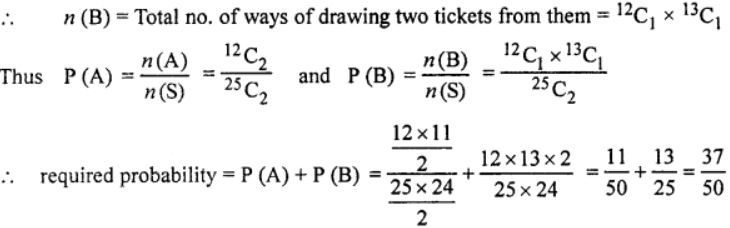
Sol: (i) Total no. of ways of drawing 2 tickets from 25 tickets = 25C2
The product of numbers is even when either both are even or one is even and the other is odd
Let A : event that both are even and there are 12 even numbers from 1 to 25
∴ n (A) = Total no. of ways of drawing 2 tickets out of 12 = 12C2
Let B : event that one is even and other is odd since there are 12 even and 13 odd numbers from 1 to 25.
(ii) Total no. of balls = 7 + 5 + 4 = 16
n (S) = Total no. of ways of drawing four balls out of 16 without replacement = 16C4
Drawing atleast three black balls means drawing 3 black balls out of 5 and one ball from remaining 11 balls or 4 black balls out of 5.
Thus required probability = {(5C3)×(11C1)+(5C4)} / (16C4)
= [{(5×4)/2}×11+5] / [{(16×15×14×13)/24}] = 23/364
Que-11: (i) A and B are two mutually exclusive events of an experiment.
If P(not A) = 0.75, P(A ∪ B) = 0.65 and P(B) = p, find the value of p.
(ii) A and B are two mutually exclusive events. If P (A) = 0.5 and P (B¯) = 0.6, find P (A or B).
Sol: (i) Given A and B are mutually exclusive events.
∴ A ∩ B = Φ ⇒ P(A ∩ B) = 0
Given P (not A) = 0.65 ⇒ 1 – P (A) = 0.65 ⇒ P (A) = 0.35
P(A ∪ B) = 0.65 and P (B) =p
We know that P (A ∪ B) = P (A) + P (B) – P (A ∩ B)
⇒ 0.65 = 0.35 + p – 0 ⇒ p = 0.30
(ii) Given A and B are two mutually exclusive events.
∴ A ∩ B = Φ ⇒ P(A ∩ B) = 0
Given P (A) = 0.5 ; P(B¯) = 0.6 ⇒ 1 – P (B) = 0.6 ⇒ P (B) = 0.4
∴ P (A or B) = P (A) + P (B) – P (A ∩ B) = 0.5 + 0.4 – 0 = 0.9
Que-12: (i) A, B and C are three mutually exclusive and exhaustive events associated with a random experiment. Find P (A) given that P (B) = 3/2 P (A) and P (C) = 1/2 P (B).
(ii) If A, B, C are three mutually exclusive and exhaustive events and P(A) = 2P (B) = 3P (C), then find P(A)
Sol: (i) Given A, B and C are mutually exclusive, exhaustive events
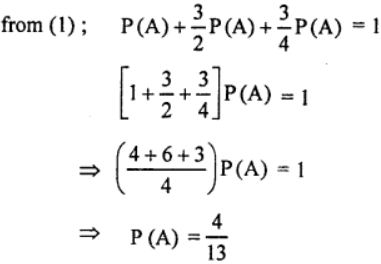
∴ P(A) + P(B) + P(C) = 1 …(1)
Given P(B) = 3/2 P(A) and P (C) = 1/2 P(B) = (1/2) × (3/2)P(A) = 3/4 P (A)
∴ from (1); P(A) + (3/2)P (A) + (3/4) P(A) = 1
[1+(3/2)+(3/4)] P(A) = 1
⇒ {(4+6+3)/4} P(A) = 1
⇒ P (A) = 4/13
(ii) Since A, B and C are mutually exclusive and exhaustive events.
∴ P (A) + P (B) + P (C) = 1
Given P (A) = 2 P (B) = 3 P (C) …(1)
Que-13: (i) In a single throw of two dice, find the probability that neither a doublet nor a total of a 10 will appear.
(ii) Two unbiased dice are thrown. Find the probability that the sum of the numbers obtained on the two dice is neither a multiple of 3 nor a multiple of 4.
(iii) Two dice are thrown together ; what is the probability that the sum of the numbers on the two faces is neither divisible by 3 nor by 5.
Sol: (i) In a single throw of two dice, total exhaustive cases = 6² = 36
Let A: getting a doublet = {(1, 1), (2, 2), (3, 3), (4, 4), (5, 5), (6, 6)} ∴ n (A) = 6
B : getting a total of 10 = {(4, 6), (5, 5), (6, 4)} ∴n (B) = 3
Thus P (A) = n( A) / n( S) = 6/36; P (B) = n( B) / n( S) = 3/36
and A ∩ B = {(5, 5)} ∴ n (A ∩ B) = 1
Thus P (A ∩ B) = n( A∪B) / n( S) = 1/36
∴ P (A ∪ B) = P (A) + P (B) – P (A ∩ B) = (6/36) + (3/36) – (1/36) = 8/36 = 2/9
Thus, required probability = P (neither A nor B) = P(A¯∩B¯) = P(A∪B¯¯)
(ii) Total exhaustive cases = n (S) = 6² = 36
Let A : event that the sum of the numbers obtained on two dice is multiple of 3
= {(U 2), (1, 5), (2, 1), (2, 4), (3, 3), (3, 6), (4, 2), (4, 5), (5, 1), (5, 4), (6, 3), (6, 6)} ∴ n (A)= 12
Let B = event that sum of the numbers on two dice is multiple of 4
= {(1, 3), (2, 2), (2, 6), (3, 1), (3, 5), (4, 4), (5, 3), (6, 2), (6, 6)} ∴ n (B) = 9
∴ A ∩ B = {(6, 6)} ⇒ n (A ∩ B) = 1
Thus, P (A) = n( A) / n( S) = 12/36; P (B) = n( B) / n( S) = 9/36 and P (A ∩ B) = n( A∩B) / n( S) = 1/36
∴ P(A ∪ B) = P (A) + P (B) = P (A ∩ B) = (12/36) + (9/36) – (1/36) = 20/36 = 5/9
∴ required probability = P(A¯∩B¯) = P(A∪B¯¯) = 1 – P (A u B) = 1 – (5/9) = 4/9
(iii) When two dice are thrown together
Then total no. of exhaustive cases = n (S) = 62 = 36
Let A : event that the sum of the numbers on the two faces is divisible by 3
= {(1, 2), (1, 5), (2, 1), (2, 4), (3, 3), (3, 6), (4, 2), (4, 5), (5, 1), (5, 4), (6, 3), (6, 6)} ∴ n (A) = 12
Let B : event that the sum of numbers on two faces is divisible by 5
= {(1, 4), (2, 3), (3, 2), (4, 1), (4, 6), (5, 5), (6, 4)} ∴ n (B) = 7
and A ∩ B = Φ ⇒ P (A ∩ B) = 0
Thus, P (A ∪ B) = P (A) + P (B) – P (A ∩ B) = n( A) / n( S) + n( B) / n( S) – 0
= (12/36) + (7/36) = 19/36
∴ Required probability = P(A¯∩B¯) = P(A∪B¯¯) = 1 – P (A ∪ B) = 1 – (19/36) = 17/36
Que-14: In a given race, the odds in favour of horses A, B, C and D are 1 : 3, 1 : 4, 1 : 5 and 1 : 6 respectively. Find the probability that one of them wins the race.
Sol: Given odds in favour of horse A be 1 : 3
∴ P (horse A’s winning) = 1/(1+3) = 1/4
odds in favour of horse B be 1 : 4
∴ P (horse B’s winning) = 1/(1+4) = 1/5
odds in favour of horse C be 1 : 5
∴ P (horse C’s winning) = 1/(1+5) = 1/6
and odds in favour of horse D be 1 : 6
∴ D (horse D’s winning) = 1/(1+6) = 1/7
∴ Required probability that one of them will win the race = P (A) + P (B) + P (C) + P (D)
[since A, B, C and D are mutually exclusive and exhaustive events]
= (1/4) + (1/5) + (1/6) + (1/7) = (105+84+70+60)/420 = 319/420
Que-15: 100 students appeared for two examinations. 60 passed the first, 50 passed the second and 30 passed both. Find the probability that a student selected at random has failed in both examinations.
Sol: Let A : event that students pass the fist examination
B : event that students pass the second exam.
Then P(A) = 60/100; P (B) = 5/100; P(A ∩ B) = (60/100) + (50/100) – (30/100) = 80/100
Thus required probability that selected student failed in both exams = P(A¯∩B¯) = P(A∪B¯¯)
= 1 – P (A ∪ B) = 1 – (80/100) = 20/100 = 0.2
Que-16: (i) A card is drawn from a deck of 52 can is. Find the probability of getting an ace or a spade card.
(ii) From a well shuffled deck of 52 cards, 4 cards are drawn at random. What is the probability that all the drawn cards are of the same colour.
Sol: (i) Total no. of exhaustive cases = 52
Let A : event of getting an ace card ∴ n (A) = 4
B : getting a spade card ∴ n (B) = 13
A ∩ B : getting an ace of spade
∴ n (A ∩ B) = 1
Thus P (A ∪ B) = P (A) + P (B) – P (A ∩ B) = [n( A)/n( S)] + [n( B)/n( S)] – [n( A∩B)/n( S)]
= (4/52) + (13/52) – (1/52) = 16/52 = 4/13
(ii) n(S) = Total no. of ways of drawing 4 cards out of 52 = 52C4
All drawing cards are of same colour means all cards are either red or black.
Let A : drawing four red cards.
∴ n (A) = Total no. of ways of drawing four cards out of 26 = 26C4
Let B : drawing four black cards
∴ n (B) = Total no. of ways of drawing four cards out of 26 = 26C4
Thus required probability =P (A) + P (B) = [n( A)/n( S)] + [n( B)/n( S)] = {2×26C4} / (52C4)
= 2 × {(26×25×24×23)/(52×51×50×49)} = 92/833
Que-17: (i) A card is drawn at random from a well shuffled pack of cards. What is the probability that it is a heart or a queen ?
(ii) A card is drawn at random from a well shuffled pack of 52 cards. Find the probability it is neither a king nor a heart ?
Sol: (i) Given total exhaustive cases = 52 = n (S)
Let A : event that heart card is drawing ∴ n (A) = 13
and B : drawing a queen card ∴ n (B) = 4
A ∩ B : drawing a queen of heart ∴ n (A ∩ B) = 1
Thus required probability = P (A ∪ B) = P (A) + P (B) – P (A ∩ B)
= [n( A)/n( S)] + [n( B)/n( S)] – [n( A∩B)/n( S)] = (13/52) + (4/52) – (1/52) = 16/52 = 4/13
(ii) Total no. of exhaustive cards = n (S) = 52
Let A : drawing a king card ∴ n (A) = 4
and B : drawing a heart card ∴ n (B) = 13
A ∩ B : drawing a king card of heart ∴ n (A ∩ B) = 1
Thus P (A ∪ B) = P (A) + P (B) – P (A ∩ B) = [n( A)/n( S)] + [n( B)/n( S)] – [n( A∩B)/n( S)]
= (4/52) + (13/52) – (1/52) = 16/52 = 4/13
∴ Required probability = P(A¯∩B¯) = P(A∪B¯¯) = 1 – P (A ∪ B) = 1 – (4/13) = 9/13
Que-18: A card is drawn from a pack of 52 cars. Find the probability of getting a king or a heart or a red card.
Sol: Total no. of outcomes = n (S) = 52
Let A : drawing a king card ∴ n (A) = 4
B : drawing a heart card ∴ n (B) = 13
C : drawing a red card ∴ n (C) = 26
A ∩ B : drawing a king of heart card
∴ n( A ∩ B) = 1
B ∩ C : drawing a heart card
∴ n( B ∩ C) = 13
A ∩ C : drawing a king of red card
∴ n( A ∩ C) = 2
∴ A ∩ B ∩ C : drawing a king of heart card
∴ n(A ∩ B ∩ C) = 1
Required probability = P(A ∪ B ∪ C) = P (A) + P (B) + P(C) – P (A ∩ B) -P (B ∩ C) – P (A ∩ C) + P(A ∩ B ∩ C)
= (4/52)+ (13/52) + (26/52) – (1/52) – (13/52) – (2/52) + (1/52) = 28/52 = 7/13
Que-19: There are three events A, B, C one of which must and only one can happen. The odds are 8 to 3 against A, 5 to 2 against B ; find the odds against C.
Sol: Given odds against A be 8 : 3.
∴ P (A) = {3/(8+3)} + (3/11)
Also, odds against B be 5 : 2
Since out of three events A, B and C, one of which must and only one can happen ∴ A, B and C are mutually exclusive and exhaustive events.
∴ P (A) + P (B) + P (C) = 1
⇒ P (C) = 1 – (3/11) – (2/7) = (77−21−22)/77 = 34/77
P(C¯) = 1 – P (C) = 1 – (34/77) = 43/77
Thus required odds against C be P(C¯) : P (C) i.e. 43/77 : 34/77 i.e. 4/3 : 3/4.
Que-20: In a group of students, there are 3 boys and 3 girls. Four students are to be selected at random from the group. Find the probability that either 3 boys and 1 girl or 3 girls and 1 boy are selected.
Sol: Given total no. of students = 3 + 3 = 6
∴ n (S) = Total no. of ways of selecting 4 students out of 6 = 6C4
Let A : selecting 3 boys and 1 girl
∴ n (A) = Total no. of ways of selecting 3 boys out of 3 and 1 girl out of 3 = 3C3 × 3C1
Let B : selecting 1 boy and 3 girls
∴ n (B) = Total no. of ways of selecting 1 boy out of 3 and 3 girls out of 3 = 3C1 × 3C3
Thus required probability = P (A ∪ B) = P
(A) + P (B) = {(3C3)×(3C1)+(3C1)×(3C3)} / 6C4
=( 1×3+3×1)/{(6×5)/2} = 6/15 = 2/5
–: End of Probability Class 11 OP Malhotra Exe-22F ISC Maths Ch-22 Solutions. :-
Return to :- OP Malhotra ISC Class-11 S Chand Publication Maths Solutions
Please share with your friends
Thanks