
Probability Class 10 RS Aggarwal Exe-27 ICSE Maths Goyal Brothers Solutions. In this article you would learn how to solve problems on Probability in a very easy way. Solved practice questions / problems has been given related probability on Deck of Playing Cards, Coin Tossing, Dice. Visit official Website CISCE for detail information about ICSE Board Class-10 Mathematics.
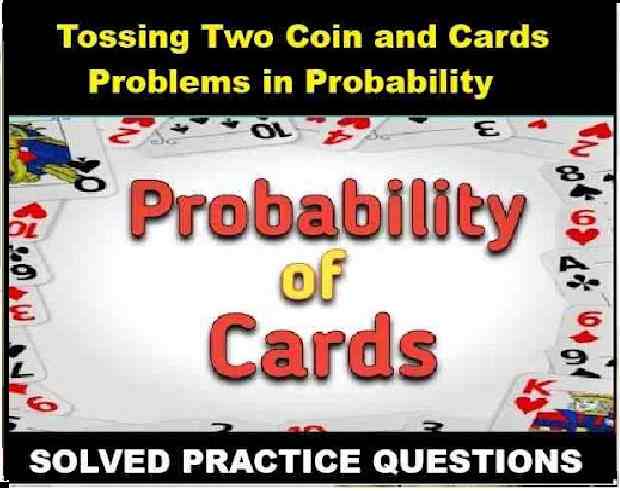
Probability Class 10 RS Aggarwal Exe-27 ICSE Maths Goyal Brothers Solutions
| Board | ICSE |
| Publications | Goyal Brothers Prakashan |
| Subject | Maths |
| Class | 10th |
| Chapter-27 | Probability |
| Writer | RS Aggarwal |
| Book Name | Foundation |
| Topics | Probability of occurence of an event (Classical Definition) |
Que-1: A coin is tossed once.
(i) Describe the sample space S.
(ii) Find the probability of getting a tail.
Sol: In a single toss of a coin ,
we find either head or tail
(i) sample space = {H,T}
number of space = 2
n(s) = 2
(ii) Let E be the event of getting a tail then ,
E = 1 ⇒ n(E) = 1
∴P(E) = n(E)/n(s) = 1/2
Que-2: Two coins are tossed simultaneously. Describe the sample space S. Find the probability of getting
(i) two heads
(ii) at least one head
(iii) at most one head
(iv) exactly one head
(v) no head
Sol: In tossing two coins
we get two heads (H,H) or one head on tail (H,T) and one head , on tail on head (T,H) and one head or two tails (T,T)
S = 4
(i) Probability of two heads P(E1) = 1/4
(ii) Probability of at least one head P(E2) = 3/4
(iii) Probability of at the most one head P(E3) = 3/4
(iv) Probability of exactly one head P(E4) = 2/4 = 1/2
(v) Probability of no head P(E5) = 1/4
Que-3: Three coins are tossed simultaneously. Describe the sample spaces S. Find the probability of getting:
(i) at most 2 heads
(ii) at least 2 heads
(iii) exactly 2 heads
Sol: Three unbiased coins are tossed
∴ we get (HHT) , (HTH) , (THH) , (HHH) , (TTT) , (TTH) , (THT) , (HTT)
S = 8
(i) Probability of getting at most two heads will be = 7/8
(ii) Probability of getting at least two heads will be = 4/8 = 1/2
(iii) Probabiilty of exaclty two heads will be = 3/8
Que-4: A die is thrown once. What is the probability of getting:
(i) an odd number
(ii) a number greater than 4
(iii) a number less than 5
(iv) the number 5
Sol: A die is thrown once only
A die has 6 faces numbered as 1 , 2 , 3 , 4 , 5 , 6
n(s) = 6
(i) Probability of an odd number which are 1 , 3 , 5 ⇔ P(E1) = 3/6 = 1/2
(ii) Probability of a number greater than ‘4’ which are 5 , 6 ⇒ P(E2) = 2/6 = 1/3
(iii) Probability of a number greater than ‘5’ which are 1 , 2 , 3 , 4 ⇒ P(E1) = 4/6 = 2/3
(iv) Probability of a number ‘5’ ⇒ P(E4) = 1/6
Que-5: Two dice are thrown simultaneously. Find the probability of getting:
(i) 10 as the sum of two numbers that turn up
(ii) a doublet of even numbers
(iii) a total of at least 10.
(iv) a multiple of 3 as the sum of two numbers that turn up
Sol: Two dice are thrown simultaneously
∴ Number of total possible outcome = 6×6 = 36
(i) 10 as the sum of two numbers that turn up (6,4) , (5,5) , (4,6) ⇔ P(E1) = 3/36 = 1/12
(ii) a doublet of even numbers (6,6) (4,4) , (2,2) P(E2) = 3/36 = 1/12
(iii) total of at least 10 which are (4,6) , (5,5) , (5,6) , (6,4) , (6,5) , (6,6) P(E3) = 6/36 = 1/6
(iv) a multiple of 3 as the same two numbers that turn up are (1,2) , (1,5) , (2,1) , (2,4) , (3,3) , (3,6) , (4,2) , (4,5) , (5,1) , (5,4) , (6,3) , (6,6) P(E4) = 12/36 = 1/3
Que-6: A box of 160 electric bulbs contains 12 defective bulbs. One bulb is taken out at random from the box. What is the probability that the bulb drawn is:
(i) defective?
(ii) non-defective?
Sol: Total numbers of bulbs in a box = 160
number of defective bulbs = 12
number of not defective bulbs = 160 – 12 = 148
(i) probabilty of defective bulbs P(E1) = 12/160 = 3/40
(ii) probability of not defective bulbs P(E1) = 148/160 = 37/40
Que-7: A box contains 16 cards bearing numbers 1, 2, 3, 4, …, 15, 16 respectively. A card is drawn at random from the box. What is the probability that the number on the card is:
(i) an odd number?
(ii) a prime number?
(iii) a number divisible by 3?
(iv) a number not divisible by4?
Sol: Total number of cards = 16
bearing numbers 1 , 2 , 3 , 4 , . . . , 15 , 16
(i) odd no. 1 , 3 , 5 , 7 , 9 , 11 , 13 , 15
probability of odd numbers P(E1) = 8/16 = 1/2
(ii) prime numbers are 2,3,5,7,11,13
probabilty of prime numbers P(E2) = 6/16 = 3/8
(iii) number divisible by 3 3,6,9,12,15
probabilty of number divisible by 3 P(E3) = 5/16
(iv) numbers not divisible by 4 are 1,2,3,5,7,9,10,11,13,14,15
probabilty of number not divisible by 4 P(E4) = 12/16 = 3/4
Que-8: Cards bearing numbers 2, 4, 6, 8, 10, 12, 14, 16, 18 and 20 are kept in a bag. A card is drawn at random from the bag. Find the probability of getting a card which is:
(i) a prime number
(ii) a number divisible by 4
(iii) a number that is a multiple of 6
(iv) an odd number
Sol: (i) prime no. = {2}
no. of favourable outcomes = 1
total no. of cards = 10
probability = 1/10
(ii) no. of divisible by 4 = {4,8,12,16,20}
no. of favourable cards = 5
probabilty of no. divisible by 4 = 3/10
(iii) no. which is multiple of 6 = {6,12,18}
no. of favourable cards = 3
probability of no. which is multiple of 6 = 3/10
(iv) probability of an odd number = 0/10 = 0
Que-9: A box contains 15 balls bearing numbers 1, 2, 3, …, 14, 15 respectively. A ball is drawn at random from the box. Find the probability that the number on the ball is:
(i) an even number
(ii) a number divisible by 5
(iii) the number 6
(iv) a number lying between 8 and 12
(v) a number greater than 9
(vi) a number less than 6
Sol: Total no. of balls = 15
bearing no. = 1,2,3,….,14,15
(i) even no. are ,4,6,8,10,12,14
probability of even no. = 7/15
(ii) no. divisible by 5 are 5,10,15
probability of no. divisible by 5 P(E2) = 3/15 = 1/5
(iii) no. 6
probability of number 6 = 1/15
(iv) no. lying between 8 and 12 are 9,10,11
probability of number lying between 8 and 12 P(E4) = 3/15 = 1/5
(v) Number greater than 9 are 10,11,12,13,14,15
Probability of number greater than 9 P(E5) = 6/15 = 2/5
(vi) no. less than 6 are 1,2,3,4,5
probabilty of no. less than 6 P(E6) = 5/15 = 1/3
Que-10: There are 25 discs numbered 1 to 25. They are put in a closed box and shaken thoroughly. A dise is drawn at random from the box. Find the probability that the number on the disc is:
(i) an odd number
(ii) divisible by 2 and 3 both.
(iii) a number less than 16.
Sol: Total no. of discs = 25
(i) an odd number are 1,3,5,7,9,11,13,15,17,19,21,23,25 = 13
∴ probability = 13/25
(ii) divisible by 2 and 3 both are 6,12,18,24 = 4
∴probability = 4/25
(iii) a number less than 16 are 1,2,3,4,5,6,7,8,9,10,11,12,13,14,15 = 15
∴probability = 15/25 = 3/5
Que-11: In a class of 40 students, there are 16 boys and the rest are girls. From these students, one is selected at random. What is the probability that the selected student is a girl?
Sol: Total no. of student = 40
no. of boys = 16
no. of girls = 40 – 16 = 24
one girl is selected at random from total no. of students
n(s) = 40
probabilty of girls = 24/40 = 3/5
Que-12: A bag contains 8 red, 4 white and 3 black balls. One ball is drawn at random. What is the probability that the ball drawn is:
(i) white?
(ii) red or white?
(iii) neither red nor white?
(iv) not red?
Sol: No. of total balls = 8 red + 4 white + 3 black = 15 balls
one ball is drawn at random
(i) probability of white balls P(E1) = 4/15
(ii) probabilty of red or white balls P(E2) = (8+4)/15 = 12/15
= 4/5
(iii) probabilty of neither red nor white ball P(E3) = 3/15 = 1/5
(iv) probability of not red ball P(E4) = (4+3)/15 = 7/15
Que-13: A bag contains 6 black, 5 white and 9 green balls. One ball is drawn at random. What is the probability that the ball drawn is:
(i) black?
(ii) not green?
(iii) either white or green?
(iv) neither white nor black?
Sol: No. of total balls = 6 black + 5 white + 9 green = 20 balls
(i) probability of a black balls P(E1) = 6/30 = 3/10
(ii) probability of not green P(E2) = (6+5)/20 = 11/20
(iii) probability of either white or green P(E3) = (5+9)/20 = 14/20
= 7/10
(iv) probability of neither white nor green P(E4) = 6/20 = 3/20
Que-14: One card is drawn at random from a well-shuffled deck of 52 cards. Find the probability of drawing:
(i) an ace
(ii) a 5 of a red suit
(iii) a black queen.
(v) a 10 of hearts
(iv) a jack of spades
(vi) a face card
Sol: No. of cards = 52 without suits and two colour
each suit has 13 colours
(i) probability of getting an ace P(E1) = 4/52 = 1/13
(ii) probability of getting a ‘5’ of red suit P(E2) = 2/52 = 1/26
(iii) probability of getting a black queen P(E3) = 2/52 = 1/26
(iv) probability of getting a jack of spades P(E4) = 1/52
(v) probability of getting a ’10’ of hearts P(E5) = 1/52
(vi) probability of getting a face card P(E6) = 12/52 = 3/13
Que-15: A card is drawn at random from a well-shuffled deck of 52 cards. Find the probability that the card drawn is:
(i) either a king or a queen
(ii) neither a king nor a queen
Sol: A deck of 52 playing cards
There are 4 suits of each 13 cards
(i) Number of cards either a queen or king 4+4=8
probability = 8/52 = 2/13
(ii) no. of cards which are neither a queen nor a king = 52-8
= 44
probability P(E2) = 44/52 = 11/13
Que-16: If the probability of winning a game is 0.6, what is the probability of losing the game?
Sol: Probability of winning a game = 0.6
probability of not winning a game = 1 – 0.6 = 0.4
probability of losing a game = P(winning) + P(not winning)
= 0.6 + 0.4 = 1
Que-17: Fill in the blanks:
(i) The probability of a sure event is
(ii) The probability of an impossible event is
(iii) For an event E, we have [P(E) + P(notE)] =\
(iv) For an event E, we have, (…..)<= P(E) <=(…….) .
Sol: (i) The probability of a sure event is 1
(ii) The probability of an impossible event is 0
(iii) For an event E , we have {P(E) + P(not E) } = 1
(iv) For an event E , we have (Q) ≤ P(E) ≤ 1
Que-18: Sixteen cards are labelled as a,b,c,… m,n,o,p. They are put in a box and shuffled. A boy is asked to draw a card from the box. What is the probability that the card drawn is:
(i) a vowel
(ii) a consonant
(iii) none of the letters of the word ‘median’
Sol: Sixteen cards are labelled as a,b,c,…,m.n,o,p
(i) vowels are a,c,i,o = 4
∴probability = 4/16 = 1/4
(ii) consonants = b,c,d,f,g,g,j,k,l,m,n,p = 12
∴probability = 12/16 = 3/4
(iii) probability (none of the letters of the word median) = 10/16 = 5/8
Que-19: A bag contains 25 cards, numbered through 1 to 25. A card is drawn at random. What is the probability that the number on the card drawn is:
(i) a multiple of 5 number?
(ii) a perfect square
(iii) a prime number?
Sol: Total no. of cards = 25
(i) multiple of 5 are 5,10,15,20,25 = 5
∴probability = 5/25 = 1/5
(ii) a perfect square are 1,4,9,16,25 = 5
∴probability = 5/25
(iii) a prime number are 2,3,5,7,11,13,17,19,23 = 9
∴probability = 9/25
Que-20: A bag contains 5 white, 2 red and 3 black balls. A ball is drawn at random. What is the probability that the ball drawn is a red ball?
Sol: Total balls = 5 + 2 + 3 = 10
probability of ball drawn is red = 2/10 = 1/5
Que-21: A letter of the word SECONDARY is selected at random. What is the probability that the letter selected is not a vowel?
Sol: Total no. of words in the letter SECONDARY = 9
no. of vowels in the word = 3
∴probability of selected word is vowel = 3/9 = 1/3
— : Probability Class 10 RS Aggarwal Exe-27 ICSE Maths practice questions :–
Return to :– RS Aggarwal ICSE Class 10 Solutions Goyal Brothers
Please, Share with your friends
Thanks

6 thoughts on “Probability Class 10 RS Aggarwal Exe-27 ICSE Maths Solutions”
Sir please upload the questions added in 2027 edition
ok
Sir when the answers will be available… Board exams are arriving shortly we want for practice…plz fix the problems
Thank you ..
very soon
Answers are not available
Answers are available very soon