Probability of Dependent Events Class 12 OP Malhotra Exe-18D ISC Maths Solutions Ch-18. In this article you would learn about finding the probability of dependent events . Step by step solutions of latest textbook has been given as latest syllabus. Visit official Website CISCE for detail information about ISC Board Class-12 Mathematics.

Probability of Dependent Events Class 12 OP Malhotra Exe-18D ISC Maths Solutions Ch-18
| Board | ISC |
| Publications | S Chand |
| Subject | Maths |
| Class | 12th |
| Chapter-18 | Probability |
| Writer | OP Malhotra |
| Exe-18(d) | Probability of Dependent Events |
Finding The Probability of Dependent Events
Probability Class 12 OP Malhotra Exe-18D Solutions
Que-1: The probability of happening of the event A is ‘a’ and that of the event B is ‘b’ Given that A and B are independent events; calculate the probability of
(i) happening of both the events A and B
(ii) not happening of both the events A and B
(iii) event A happens and B does not happen
(iv) event B happens and A does not happen
(v) the event B does not happen
Sol: Given prob. of happening of event A = P (A) = a and P (B) = b
(i) prob. of happening of both the events A and B = P (A ∩ B) = P (A) P (B) = ab [since A and B are independent event]
(ii) required prob. = P(A¯∩B¯)=P(A¯)P(B¯) = (1 – a) (1 – b) [∵ 1/2 are independent events]
(iii) required prob. = P(A∩B¯)=P(A)P(B¯) = P (A) [ 1 – P (B)] = a (1 – b)
(iv) required probability = P(A¯∩B)=P(A¯)P(B) = [1 – P (A)] P (B) = (1 – a) b
(v) required prob. = P(B¯) = 1 – P (B) = 1 – b
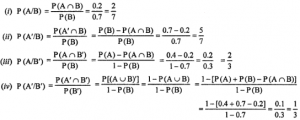
Que-2: Given that P (A) = 0.4, P (.B) = 0.7, P (A ∩ B) = 0.2, find
(i) P(A/B)
(ii) P(A’/B’)
(iii) P(A/B’)
(iv) P(A’/B’)
Sol: Given P (A) = 0.4; P (B) = 0.7 ; P (A ∩ B) = 0.2
Que-3: Given that P (A) = 0.8, P (B) = 0.7, P(C) = 0.6, P (A/B) = 0.8, P (C/B) = 0.7, P(A ∩ C) = 0.48, determine whether:
(i) A and B are independent, (ii) A and C are independent (ii) B and C are independent.
Sol: Given P (A) = 0.8 ; P (B) = 0.7 ; P (C) = 0.6, P (A/B) = 0.8, P (C/B) = 0.7, P (A ∩ C) = 0.48 ;
(i) Given P (A/B) = 0.8 ⇒ P(A∩B)/P(B) = 0.8 ⇒ P (A ∩ B) = 0.8 x 0.7 = 0.56
Also P (A) . P (B) = 0.8 x 0.7 = 0.56
∴ P (A ∩ B) = P (A) P (B)
Thus A and B are independent events
(ii) Now P (A ∩ C) = 0.48 = 0.8 x 0.6 = P (A) x P (C)
Thus A and C are independent events.
(iii) Now, P (C/B) = 0.7 ⇒ P(B∩C)/P(B) = 0.7
⇒ P(B∩C) = 0.7 x 0.7 = 0.49
and P (B) . P (C) = 0.7 x 0.6 = 0.42
∴ P (B ∩ C) ≠ P (B) P (C)
Thus B and C are not independent events.
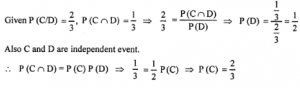
Que-4: Given that C and D are independent and that P(C/D) = 2/3, P(C∩D) = 1/3, find
(i) P(C)
(ii) P(D)
Sol:
Que-5: The events A and B are such that P (A’) = 3/4, P (B) = 1/3 and P (A ∪ B) = 2/3. show that A and B are neither mutually exclusive nor independent.
Sol: Given P (A) = 2/5, P (B) = 1/6; P(A∪B) = 13/30
We know that, P (A ∩ B) = P (A) + P (B) – P (A ∪ B)
= 2/5 + 1/6 − 13/30 = 12+5−13/30 = 4/30 = 2/15
since P (A ∩ B) ≠ 0
Thus A and B are not mutually exclusive events.
Now P(A) . P(B) = 2/5×1/6=1/15≠P(A∩B)
Thus A and B are not independent events.
Hence A and B are neither mutually exclusive nor independent events.
Que-6: The events A and B are such that P (A’) = 3/4 , P (A/B) = 1/3, P(A ∪ B)= 2/3, where A’ denotes the event “X does not occur”. Find
(i) P(A)
(ii) P (A ∩ B)
(iii) P (B)
(iv) P (A/B’)
where B’ denotes the events “5 does not occur”. Deter mine whether A and B are independent.
Sol:
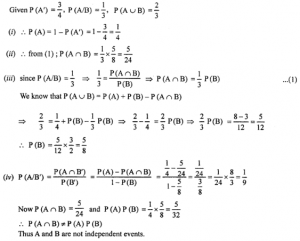
Que-7: A bag contains 4 white, 7 black and 5 red balls. Three balls are drawn one after the other without replacement. Find the probability that the balls drawn are white, black and red respectively.
Sol: Given a bag contains 4 white, 7 black and 5 red balls.
∴ Total no. of balls in a bag = 4 + 7 + 5 = 16
Since three balls are drawn one by one without replacement.
∴ required probability = 4/16×7/15×5/14=1/24
Que-8: There are three urns A, B and C Urn A contains 4 white balls and 5 blue balls. Urn B contains 4 white balls and 3 blue balls. Urn C contain 3 white balls and 6 blue balls. One ball is drawn from each of the urns. What is the probability that out of these three balls drawn two are white balls and one is blue ball?
Sol: Given urn A contains 4 white balls and 5 blue balls
urn B contains 4 white and 3 blue balls
urn C contains 3 white and 6 blue balls
Since one ball is drawn from each of the three urns s.t out of there 3 balls, two are white and other is blue drawing of these balls can be done in three ways.
(1) white, white, blue
(2) white, blue, white
(3) blue, white, white
∴ required probability = P (WWB) + P (WBW) + P (BWW)
= 4/9×4/7×6/9+4/9×3/7×3/9+5/9×4/7×3/9
= 32/189 + 12/189 + 20/189 = 64/189
Que-9: There are two bags, one of which contains 3 black and 4 white balls while the other contains 4 black and 3 white balls. A die is cast. If the face 1 or 3 rums up, a ball is taken from the first bag. and if any other face turns up, a ball is chosen from the second bag. Find the probability of choosing a black ball.
Sol: Let us define the events are as follows :
E : fare 1 or 3 turns up
A : black ball chosen from first bag
B : black ball chosen from second bag.
Thus P(E) = 2/6=1/3 ; P(E¯) = 1 – P(E) = 1 – 1/3=2/3
required probability = P (E) . P (A) + P (E¯) P (B) = 1/3×3/7+2/3×4/7=11/21
Que-10: Three bags contain 5 white and 8 red; 7 white and 6 red; 6 white and 5 red balls respectively. One ball is drawn from each bag at random. Find the probability that all the three balls drawn are of the same colour.
Sol: Given
bag I contains 5W and 8R
bag II contains 7W and 6R
bag III contains 6W and 5R
Since one ball is drawn from each bag at random.
∴ required probability = P (WWW) + P (RRR)
= 5/13 × 7/13 × 6/11 + 8/13 × 6/13 × 5/11 = 210/1859 + 240/1859 = 450/1859
Que-11: A bag contains 4 white and 2 black balls. Another contains 3 white and 5 black balls. If one ball is drawn from eact bag, find the probability that (i) both are white (ii) both are black (iii) one is white and one is black.
Sol: bag I contains 4W, 2B
bag II contains 3W, 5B
since one ball is drawn from each bag
(i) ∴ required prob. that both balls are white = P(WW) = P(W) P(W) = 46×38=14
(ii) required prob. = P (BB) = 2/6×5/8=5/24
(iii) required probability = P (WB) + P (BW) = 4/6×5/8+2/6×3/8=26/48=13/24
Que-12: (i) The bag A contains 5 red and 3 green balls and bag B contains 3 red and 5 green balls. One ball is drawn from bag A and two from bag B. Find the probability that of the three balls drawn two are red and one is green.
(ii) Bag A contains 3 red and 5 black balls and bag B contains 2 red and 3 black balls. One ball is drawn from bag A and two from bag B. Find the probability that out of 3 balls drawn two are black and one is red.
Sol: (i) Given bag A contains 5R and 3G and bag B contains 3R and 5G
Since one ball is drawn from bag A and two from bag B s.t out of 3 drawing balls, two are red and one is green.
∴ required probability = P (red ball from bag A and one red and one green from bag B) – P (green ball from bag A, two red from bag B)
= 5/8 × (5C1×3C1)/8C2 + 38 × 3C2/8C2 = 5/8 × (5×3/(8×7/2)) + 3/8 × 3/(8×7/2)
= 75+9/8×4×7 = 84/32×7 = 12/32 = 3/8
(ii) Given bag A contains 3 red and 5 black balls bag B contains 2 red and 3 black balls
Since one ball is drawn from bag A and two from bag B s.t out of 3 drawing balls, one is red and two are black.
So there are two possibilities :
(I) drawing one red ball from bag A and 2 black balls from bag B
(II) drawing one black ball from bag A and 1 red, 1 black ball from bag B
∴ required probability = P (I) + P (II)
= 3/8 × 3C2/3C2 + 5/8 × 2C1×3C1/5C2 = (3×3+5×2×3)/(8×(5×4)/2) = 39/80
Que-13: Two balls are drawn from an urn containing 2 white, 3 red and 4 black balls one by one without replacement. What is the probability that
(i) both the balls are of same colour?
(ii) at least one ball is red?
Sol: Given urn contains 2 white, 3 red and 4 black balls
∴ Total no. of balls = 2 + 3 + 4 = 9
(i) required probability = P (WW) + P (RR) + P (BB)
= 2/9 × 1/8 + 3/9 × 2/8 + 4/9×3/8 = (2+6+12)/72 = 20/72 = 5/18
(ii) required probability = P (RW) + P (RB) + P (RR) + P (WR) + P (BR)
= 3/9×2/8 + 3/9×4/8 + 3/9×2/8 + 2/9×3/8 + 4/9×3/8
= (6+12+6+6+12)/72 = 42/72 = 7/12
Que-14: (i) Two cards are drawn without replace- ment from a well shuffled pack of 52 cards. Find then probability that one is a spade and the other is a queen of red colour.
(ii) Two cards are drawn without replace- ment from a well shuffled pack of 52 cards. What is the probability that one is a red queen and the other is a king of black colour?
(iii) Two cards are drawn one by one without replacement from a pack of 52 cards. What is the probability that one is the red and the other is a black card?
(iv) Two cards are drawn from a well shuffled pack of 52 cards, one after another without replacement Find the probability that one of these is a queen and the other is a king of the opposite shade.
Sol: (i) prob. of drawing a spade card in first draw = 13/52 = 1/4
and prob. of drawing a queen of red colour in second draw = 2/51
prob. of drawing = queen of red colour in first draw = 2/52
and prob. of drawing a spade card in 2nd draw = 13/51
∴ required probability = 1/4×2/51 + 2/52×13/51 = 1/102+1/102 = 2/102 = 1/51
(ii) prob. of drawing a red queen in first draw = 2/52
and prob. of drawing a king of black colour in second draw = 2/51 [since cards are drawn without replacement]
prob. of drawing a king of black colour in first draw = 2/52
and prob. of drawing a red queen in second draw = 251
∴ required Probability = 2/52×2/51 + 2/52×2/51 = 8/(52×51) = 2/663
(iii) prob. of drawing a red card in first draw = 26/52
and prob. of drawing a black card in second draw = 26/52
Also prob. of drawing a black card in first draw = 26/52
and prob. of drawing a red card in 2nd draw = 26/51
∴ required prob. = 2×26/52×26/51 = 26/51
(iv) prob. of drawing a queen in first draw = 4/52
and prob. of drawing a king of opposite shade = 2/51
Since cards are drawn one after other without replacement.
∴ prob. of drawing a king card in first draw = 4/52
prob. of drawing a queen of opposite shade in 2nd draw = 2/51
∴ required probability = 4/52×2/51 + 4/52×2/51 = 16/(52×51) = 4/663
Que-15: Find the probability of drawing one rupee coin from a purse with two compartments one of which contains 3 fifty paisa coins and 2 one-rupee coins and other contains 2 fifty paisa coins and 3 one rupee coins.
Sol: prob. of drawing a first compartment = prob. of drawing second compartment = 1/2
Given
compartment I contains 3 fifty paise coin and 2 one rupee coin
compartment II contains 2 fifty paisa and 3 one rupee coin
∴ required probability = P (choosing one rupee coin from compartment-I) + P (choosing one rupee coin from compartment-II)
= 1/2×2/5 + 1/2×3/5 = 5/10 = 1/2
Que-16: A bag contains 4 yellow and 5 red balls and another bag contains 6 yellow and 3 red balls. A ball is drawn from the first bag and without seeing its colour, it is put into the second bag. Find the probability that if now a ball is drawn from the second bag, it is of yellow colour.
Sol: Given bag-I contains 4 yellow and 5 red balls and bag-II contains 6 yellow and 3 red balls
Case-I.
When a yellow ball transferred from I to II
Then bag-II contains 7 yellow and 3 red balls
Thus prob. of drawing a yellow ball from second bag P (I) = 4/9 x 7/10
Case-II.
When a red ball transferred from I to II then bag-II contains 6 yellow and 4 red balls

Que-17: A bag contains 4 white and 3 black bails. Four balls are successively drawn out with replacement. Find the probability that they are alternately of different colours.
Sol: Given bag contains 4 white and 3 black balls
∴ Prob. of drawing white ball = 4/3 = P (W)
prob. of drawing black ball = P (B) = 37
Thus required probability = P (WBWB, BWBW) = P (WBWB) + P (BWBW)
= 4/7×3/7×4/7×3/7+3/7×4/7×3/7×4/7 = 2 × (12×12)/74 = 288/2401
Que-18: (i) A bag contains 4 red and 3 black balls. A second bag contains 2 red and 4 black balls. One bag is selected at random. From the selected bag, one ball is drawn. Find the probability that the ball drawn is red.
(ii) A bag contains 2 white and 4 black balls while another bag contains 4 white and 2 black balls. A bag is selected at random and a ball is drawn. Find the probability that the ball drawn is of black colour.
Sol: (i) Given bag A contains 4 red and 3 black balls and bag B contains 2 red and 4 black balls
∴ prob. of selecting a bag A = prob. of selecting a bag B = 1/2
Thus prob. of drawing a red ball from bag A = 1/2×4/7 = 2/7
Similarly prob. of drawing a red ball from bag B = 1/2×2/6 = 1/6
∴ required prob. of drawing a red ball from either of two bags = 2/7+1/6 = 19/42
(ii) Given bag A contains 2 white and 4 black balls
and bag B contains 4 white and 2 black balls
∴ prob. of choosing bag A = prob. of choosing bag B = 1/2
Thus prob. of drawing a black ball from bag A = 4/6×1/2
prob. of drawing a black ball from bag B = 1/2×2/6
∴ required prob. = 4/12+2/12 = 6/12 = 1/2
Que-19: (i) A speaks truth in 60% of the cases and B in 90% of the cases. In what percentage of cases are they likely to contradict each in stating the same fact?
(ii) A problem of statistics is given to three students A, B and C whose chances of solving it are 12, 13 and 14 respectively, find the probability that only one of them solves the problem.
(iii) A speaks truth in 75% of the cases and B in 80% of the cases. In what percentage of cases are they likely to contradict each other in starting the same fact ? In what percentage of cases do they (a) contradict, (b) agree with each other?
Sol: (i) Given P (A speaks truth) = P1 = 60% = 60/100
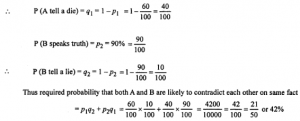
(ii) Let E1, E2 and E3 be the events that the problem is solved by A, B and C respectively.
Let p1, p2 and p3 be their corresponding probabilities.
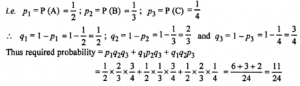
(iii) Given P (A speaks truth) = 75% = p1 = 75/100
P (A tell a lie) = q1 = 1 – p1 = 25/100
P (B speaks truth) = p2 = 80% = 80/100
P (B tell a lie) = q2 = 20% = 20/100
∴ required probability that both A and B are likely to contradict each other on same fact
p1q2+p2q1 = 75/100×20/100 + 80/100×25/100 = (1500+2000)/10000 = 3500/10000 = 35/100
Thus both persons A and B contradict each other in 35% cases.
(b) ∴ required probability = p1p2 + q1q2 =75/100×80/100 + 25/100×20 100 = (6000+500)/10000 = 65/100
Thus in 65% cases, both A and B agree with each other on same fact.
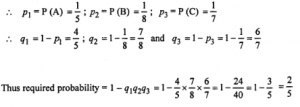
Que-20: (i) A husband and wife appear in an interview for two vacancies in the same post. The probability of husband’s selection is 1/7 and that of wife’s selection is 1/5. What is the probability that (a) both of them will be selected (b) only one of them will be selected (c) none of them will be selected (d) At least one of them will be selected ?
(ii) A candidate is selected for interview for three posts. For the first post there are 5 candidates, for the second there are 8 and for the third there are 7. What are the chances for his getting at least one post?
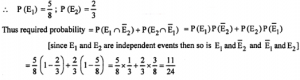
(iii) The probability of a student A passing an examination is 5/8 and that of B passing is 2/3
Assuming that the two events “A passes” and “B passes” are independent, find the probability of only one of them passing the examination.
Sol: (i) Given P (husband’s selection) = p1 = 1/7
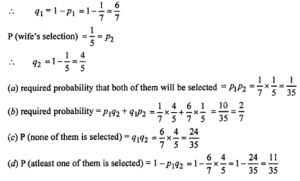
(ii) Let us define the events are as follows :
A : candidate selected for first post
B : candidate selected for 2nd post
C: candidate selected for 3rd post
(iii) Given E1 : student A pass the examination.
E1 : student B pass the examination.
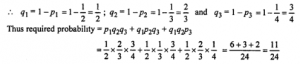
Que-21: (i) The probability of hitting a target by three marksmen is 1/2, 1/3 and 1/4 respectively. Find the probability that one and only one of them will hit the target when they fire simultaneously.
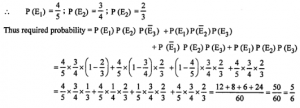
(ii) A, B and C shoot to hit a target. If A hits target 4 times in 5 trials, B hits it 3 times in 4 trials and C hits it 2 times in 3 trials, what is the probability that the target is hit by at least 2 persons?
Sol: (i) p1 = prob. (that first mark man hit the target) =1/2
p2 = prob. (that second marks man hit the target) = 1/3
p3 = prob. (that third marks man hit the target) = 1/4
(ii) Let E1 : A hits the target
E1: B hits the target
E3 : C hits the target
Que-22: The odds that a Ph.D. thesis will be favourably reviewed by three inde- pendent examiners are 5 to 2.4 to 3, and 3 to 4 respectively. What is the probability that of the three examiners:
(a) all reject the thesis, (b) all approve the thesis, (c) a majority approve the thesis?
Sol: Given odds in favour of examiner A are in the ratio 5 : 2
∴ P(A) = 5/(5+2) = 5/7 ; and P(A¯) = 1−P(A) = 1−5/7 = 2/7
also odds in favour of examiner B are in the ratio 4 : 3 4 4
∴ P(B) = 4/(4+3) = 4/7 ; P(B¯) = 1−4/7 = 37
odds in favour of examiner C are in the ratio 3 : 4
∴ P(C) = 3/(3+4) = 3/7; P(C¯) = 1−3/7 = 4/7
(a) Thus required probability that all the three examiners reject the thesis = P(A¯)P(B¯)P(C¯)
= 2/7×3/7×4/7 = 24/343
(b) Thus, required prob. that all the three examiners will approve the thesis = P (A) P (B) P (C)
= 5/7×4/7×3/7=60/343
(c) ∴ required prob. that majority of examiners will approve the thesis
= P (A¯) P (B) P (C) + P (A) P (B¯) P (C) + P (A) P (B) P (C¯) + P (A) P (B) P (C)
= 2/7×4/7×3/7 + 5/7×3/7×3/7 + 5/7×4/7×4/7 + 5/7×4/7×3/7 = (24+45+80+60)/343 = 209/343
Que-23: (i) Two persons A and B throw a die alternately till one of them gets a three and wins the game. Find their respective probabilities of winning, if A begins.
(ii) A, B, C in order cut a pack of cards, replacing them after each cut, on the condition that the first who cut a spade shall win a prize; find their respective chances of winning, assuming that the game may continue indefinitely.
Sol: (i) Let p = prob. of success i.e. prob. of getting 3 in single toss of a die = 16
∴ q = 1 – p = 1 – 1/6 = 5/6
Since A starts the game so A can win in first throw, 3rd throw, 5th throw and so on
∴ probability of A’s winning in first throw = 1/6 = p
probability of A’s winning in 3rd throw = qqp = (5/6)² 1/6
probability of A’s winning in 5th throw = qqqqp = (5/6)4 1/6 and so on
Since all thesecases are mutually exclusive
∴ required prob. of A’s winning =p + qqp + qqqqp + …
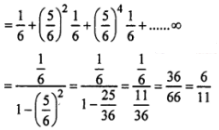
Since A and B are mutually exclusive and exhaustive events.
∴ required probability of B’s winning the game first = 1 – P (A) = 1 – 6/11 = 5/11
(ii) Let p = probability of success = prob. of getting a spade card = 13/52 = 1/4
∴ q = 1 – p = 1 – 1/4 = 3/4
When A starts the game so he can win in 1st throw, 4th throw, 7th throw and so on.
Thus prob. of A’s winning in first throw = p = 1/4
prob. of A’s winning in 4th throw = qqqp = (3/4)3 1/4
prob. of A’s winning in 7th throw = qqqqqqp = (3/4)6 1/4 and so on
Therefore prob. of A’s winning the game first =p + qqqp + qqqqqqp +
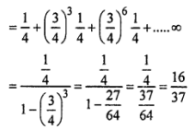
Clearly B will win the game in 2 nd throw, 5 th throw and 8 th throw and so on.
∴ prob. of B’s winning the game first = qp + qqqqp + qqqqqqqp + ……… ∞
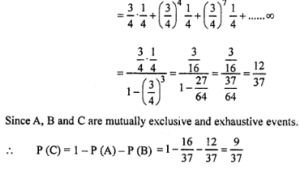
Que-24: (i) Three persons A, B, C throw a die in succession in the same order till one of them gets a ‘six’ and wins the game. If A starts the game, find their respective probabilities of winning.
(ii) A and B take turn in throwing two dice, the first to throw 9 being awarded. Show that if A has the first throw, their chances of winning are in the ratio 9 : 8.
Sol: (i) Let p = prob. of success = prob. of getting a six = 1/6
∴ q = 1 – p = 1 – 1/6 = 5/6
Given A starts the game so A can win in first throw, 4th throw, 7th throw and so on.
∴ prob. of A’s winning the game first =p + qqqp + qqqqqqp + ….. ∞
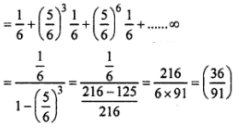
B wins the game if he throws a six in 2nd, 5th and 8th throw.
i.e. B wins the game first in 2nd, 5th and 8th throw
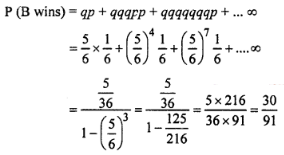
Since A, B and C are mutually exclusive and exhaustive events
∴ P (C wins) = 1 – P (A wins) – P (B wins) = 1 − 36/91 − 30/91 = (91−66)/91 = 25/91
(ii) Let p = prob. of success = prob. of getting 9 in a single throw of two dice
⇒ p = 4/36 = 1/9
∴ q = 1 – p = 1 – 1/9 = 8/9
[Here favourable cases = {(3, 6), (4, 5), (5, 4), (6, 3)} and Total no. of outcomes = 6² = 36]
given A has the first throw. So A can wins the game in first throw, 3rd throw, 5th throw and so on.
∴ required prob. of A’s winning = p + qqp + qqqqp + …. ∞
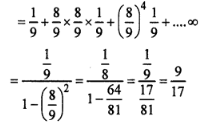
Since A and B are mutually exclusive and exhaustive events.
∴ P (B wins) = 1 – P (A’s wins) = 1 – 9/17 = 8/17
Thus, the required ratio of chance of winning A and B
= P (A wins): P (B wins) = 9/17 : 8/17 i.e. 9 : 8
Que-25: (i) A man alternately tosses a coin and throws a die beginning with the coin. Find the probability he gets a head in the coin before he gets a 5 or 6 in the die.
(ii) A and B throw with a pair of dice. A wins if he throws 7 before B throws 8 and B wins if he throws 8 before A throws 7. If A begins, show that his chance of winning is 36/61. What is B’s chance of winning?
(iii) A and B throw a pair of dice alternately. A wins the game, if he gets a total of 1 and B
wins the game, if he gets a total of 10. If A starts the game, then find the probability that B wins.
(iv) In a hockey match, both tear is A and B scored same number of goals up to the end of the game, so to decide the winner, the referee asked both the captains to throw die alternately and decided that the team, whose captain gets a six first, will be declared the winner, if the captain of team A was asked to start, then find heir respective probabilities of winning the match and state whether the decision of the referee was fair or not.
Sol: (i) Let us define the events are as follows :
A : Man gets head and B : Man gets 5 or 6
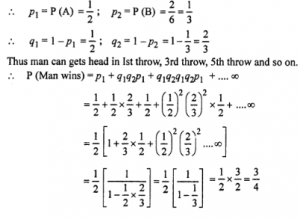
(ii) Let us define the events are as follows :
A : A gets 7 with a pair of dice = {(1, 6), (2, 5), (3, 4), (4, 3), (5, 2), (6, 1)}
B : B gets 8 = {(2, 6), (3, 5), (4, 4), (5,3), (6,2)}
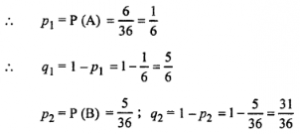
Since A starts the game. So A can wins in first throw, 3rd throw, 5th throw and so on.
Thus P (prob. of A’s winning the game first) = p1 + q1q2p1 + q1q2q1q2p1 + … ∞
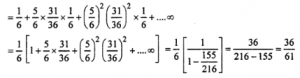
Since A and B are mutually exclusive and exhausitive events.
∴ P(B) = 1 – P(A) = 1 – 36/61 = 25/61
(iii) Let us define the events are as follows :
A : A gets a total of 7 with pair a dice B : B gets a total of 10
∴ A = {(1, 6), (2, 5), (3, 4), (4, 3), (5, 2), (6, 1)}
B = {(4, 6), (5, 5), (6, 4)}
Since A starts the game. Thus A can wins the game first in first throw, 3rd throw, 5th throw and so on.
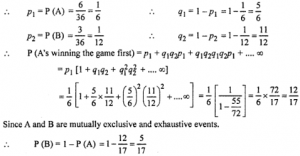
(iv) Let p = prob. of success = prob. of getting a six = 1/6
∴ q = 1 – p = 1 – 1/6 = 5/6
Since team A’s captain starts the game.
So, A can wins in first throw, 3rd throw, 5th throw and so on.
∴ P (A’s winning of the game first) = p + qqp + qqqqp + …. ∞
= 1/6+(5/6)2 1/6 + (5/6)4 1/6+….∞
= 1/6/(1−(5/6)2)= 1/6/(1−25/36) = 6/11
Since A and B are mutually exclusive and exhaustive events.
Thus P (B’s winning) = 1 – P (A’s winning) = 1 – 6/11 = 5/11
Since P (A) ≠ P (B). Thus the decision of Refree is not fair.
Que-26: A bag contains 6 red 5 blue balls and another bag contains 5 red and 8 blue balls. A ball is drawn from the first bag and without noticing colour is put in the second bag. A ball is then drawn from the second bag. Find the probability that the bail drawn is blue in colour.
Sol: bag I contains 6 red and 5 blue balls
bag II contains 5 red and 8 blue balls
Case-I. When a red ball transferred from bag I to bag II
Then bag II contains 6 red and 8 blue balls.
∴ Prob. that the ball drawn from second bag be blue in colour = 6/11 x 8/14
Case-II. When a blue ball transferred from bag I to bag II.
Then bag II contains 5 red ball and 9 blue balls.
Thus the probability that the ball drawn from second bag be blue in colour = 5/11 x 9/14
Thus required probability = 6/11×8/14+5/11×9/14=93/154
Que-27: Box A contains 3 red balls and 2 black balls and box B contains 2 red balls and 3 black balls. One ball is drawn from box A and placed in box B. Then one bail is drawn at random from box B and placed in box A. Find the probability that the composition of the balls in the two boxes remains unaltered.
Sol: Let us define the events are as follows :
E1 : Red ball is transferred from bag A to bag B
E2 : black ball is transferred from bag A to bag B
E3 : Red ball is transferred from bag B to bag A
E4 : black ball is transferred from bag B to bag A
Thus, P(E1)=3/5; P(E2)=2/5; P(E3)=3/6; P(E4)=4/6
∴ required probability = P(E1)P(E3) + P(E2)P(E4) = 3/5×3/6 + 2/5×46 = 17/30
Que-28: Three peopled, B and C have probabilities 3/5, 2/5 and 3/4 respectively of hitting a target with a rifle shot. Calculate the probability of there being exactly 2 hits if each A, B and C fires once at the target. A, B and C decide to participate in a contest in which each fires once and the first to hit the target receive a prize of ₹ 94. If they agree to fire in the order A, B and then C, calculate how much of ₹ 94 prize money each should contribute so that this game is fair.
Sol: Given P (A) = prob. of hitting the target by A = 3/5 ; P (B) = prob. of hitting the target by B = 2/5
P (C) = prob. of hitting the target by C = 3/4
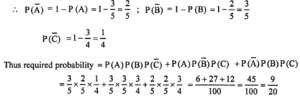
(ii) Probability of A’s success
∴ prob. of B’s success = prob. of a’s failure x prob. of B’s success = 2/5 x 2/5 = 425
Since C takes a chance only if A and B both fails
∴ prob. of C s success = 2/5×3/5×3/4 = 18/100 =9/50
Thus A, B and C contribute in the ratio 3/5 : 4/25 : 9/20 i.e. 3/5×50 : 4/25×50 : 9/50×50 i.e. 30 : 8 : 9
∴ A’s contribution = ₹(30/47×94) = Rs. 60
B’s contribution = ₹(8/47×94) = Rs. 16
C’s contribution = ₹(9/47×94) = Rs. 18
–: End of Probability of Dependent Events Class 12 OP Malhotra Exe-18D ISC Maths Solutions :–
Return to :- OP Malhotra ISC Class-12 S Chand Publication Maths Solutions
Please share with your friends
Thanks