Multiple Choice Questions on Properties of Triangles Class 11 OP Malhotra Exe-7C ISC Maths Solutions Ch-7. In this article you would learn to solve all mcq questions on Properties of Triangles. Step by step solutions of latest textbook has been given as latest syllabus. Visit official Website CISCE for detail information about ISC Board Class-11
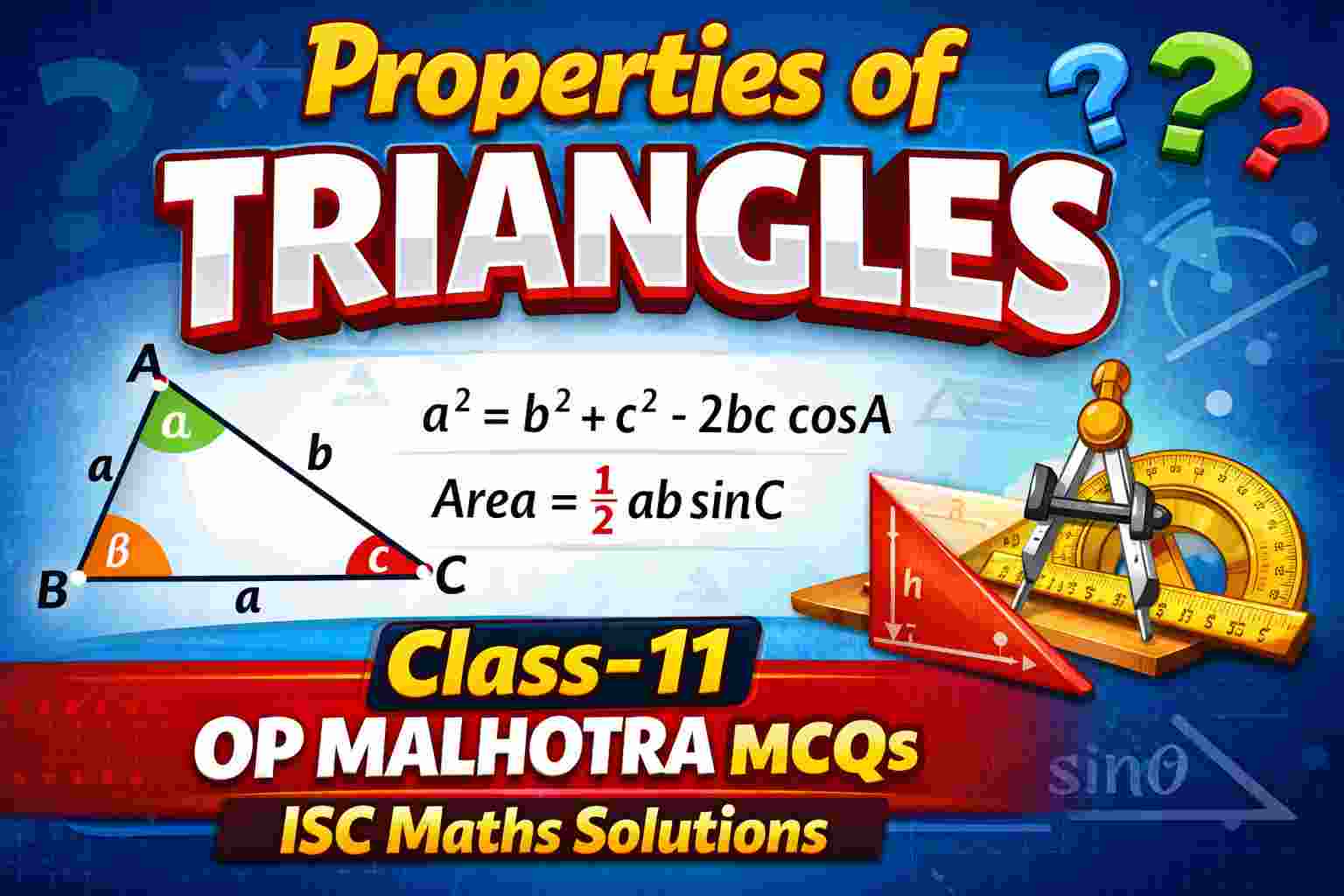
Properties of Triangles Class 11 OP Malhotra Multiple Choice Questions ISC Maths Solutions Ch-7
| Board | ICSE |
| Publications | S Chand |
| Subject | Maths |
| Class | 11th |
| Chapter-7 | Properties of Triangle. |
| Writer | OP Malhotra |
| Exe-7(C) | Multiple Choice Questions. |
Multiple Choice Questions on Properties of Triangles
OP Malhotra ISC Class 11 Maths Solutions
Que-1: In Δ ABC, cos (A + B) = ____
(a) − cos C
(b) sin C
(c) tan C
(d) cos C
Sol: (a) cos C
In a triangle,
A + B + C = 180°
Therefore,
A + B = 180° − C
So,
cos(A + B) = cos(180° − C)
We know that:
cos(180° − θ) = − cos θ
Hence,
cos(A + B) = − cos C
Que-2: If the sides of a triangle are p, q, √(p2 + q2 + pq), then the greatest angle is
(a) 2π/3
(b) π/2
(c) π/3
(d) 2π/5
Sol: (a) 2π/3
Using Cosine Rule:
Let greatest side = √(p² + q² + pq)
cos θ = (p² + q² − (p² + q² + pq)) / (2pq)
= −pq / 2pq
= −1/2
θ = 2π/3
Que-3: In a Δ ABC, if a = 4, b = 12 and ∠B = 60°, then sin A is
(a) 2/√3
(b) 1/√2
(c) √3/2
(d) 1/(2√3)
Sol: (d) 1/(2√3)
Using Sine Rule:
a/sinA = b/sinB
4/sinA = 12/sin60°
4/sinA = 12/(√3/2)
4/sinA = 24/√3
sinA = 4√3 / 24
= 1/(2√3)
Que-4: In a Δ ABC, (cos C + cos A)/(c + a) + (cos B)/b is equal to
(a) 1/a
(b) 1/b
(c) 1/c
(d) (c + a)/b
Sol: (b) 1/b
Using projection formula:
a = b cosC + c cosB
c = a cosB + b cosA
After simplifying expression:
= 1/b
Que-5: If tan[(B − C)/2] = x cot(A/2), then x is equal to
(a) (b − c)/(b + c)
(b) (c − b)/2bc
(c) (b + c)/a2
(d) (b − c)/2a2
Sol: (a) (b − c)/(b + c)
Using identity:
tan[(B − C)/2] = (b − c)/(b + c) cot(A/2)
Comparing with given equation,
x = (b − c)/(b + c)
Que-6: The angles of a triangle are in the ratio 1 : 2 : 3, then the corresponding sides are in the ratio
(a) 1 : 2 : 3
(b) 1 : √3 : √2
(c) 1 : √2 : 3
(d) 1 : √3 : 2
Sol: (d) 1 : √3 : 2
Angles are in ratio 1 : 2 : 3
Let angles = x, 2x, 3x
x + 2x + 3x = 180°
6x = 180° ⇒ x = 30°
Angles are 30°, 60°, 90°
Sides opposite are in ratio:
1 : √3 : 2
Que-7: If a = 2√2, b = 6, ∠A = 45°, then
(a) no triangle is possible
(b) one triangle is possible
(c) two triangles are possible
(d) either no triangle or two triangles are possible
Sol: (a) no triangle is possible
Given: a = 2√2, b = 6, A = 45°
Using sine rule:
a/sinA = b/sinB
2√2 / sin45° = 6 / sinB
2√2 / (√2/2) = 6 / sinB
4 = 6 / sinB
sinB = 6/4 = 1.5
Since sinB > 1, not possible.
Que-8: If two angles of a Δ ABC are 45° and 60°, then the ratio of the smallest and the greatest sides are
(a) 1 : √3
(b) √3 : 1
(c) (√3 − 1) : 1
(d) √3 : √2
Sol: (c) (√3 − 1) : 1
Third angle = 180° − (45° + 60°) = 75°.
Smallest side ∝ sin45°, Greatest side ∝ sin75°.
Ratio = sin45° : sin75° = (√2/2) : ((√6 + √2)/4)
= (√3 − 1) : 1
Que-9: In a Δ ABC, a (b cos C − c cos B) =
(a) 0
(b) a2
(c) b2 − c2
(d) b2
Sol: (c) b2 − c2
Using cosine rule:
b cosC = (a² + b² − c²)/2a
c cosB = (a² + c² − b²)/2a
Subtracting ⇒ a(b cosC − c cosB) = b² − c²
Que-10: In a Δ ABC, if cos A / a = cos B / b = cos C / c and a = 2 then its area is
(a) 2√3
(b) √3
(c) √3/2
(d) √3/4
Sol: (b) √3
Condition implies triangle is equilateral.
So a = b = c = 2.
Area = (√3/4)a² = (√3/4)(4) = √3
Que-11: If A + B + C = π and sin C + sin A cos B = 0, then tan A · cot B is
(a) 0
(b) −1/2
(c) 1
(d) −1
Sol: (b) −1/2
Since C = π − (A + B),
sinC = sin(A + B).
Equation simplifies to tanA · cotB = −1/2
Que-12: If the angles of a triangle are in the ratio 1 : 1 : 4, then the ratio of the perimeter of the triangle to its largest side is
(a) 3 : 2
(b) (√3 + 2) : √2
(c) (√3 + 2) : √3
(d) (√2 + 2) : √3
Sol: (c) (√3 + 2) : √3
Let angles = x, x, 4x.
6x = 180° ⇒ x = 30°.
Angles = 30°, 30°, 120°.
Sides ∝ sin30°, sin30°, sin120°
= 1/2, 1/2, √3/2.
Perimeter ∝ (1/2 + 1/2 + √3/2) = (2 + √3)/2.
Ratio = (√3 + 2) : √3
Que-13: If (b + c)/11 = (c + a)/12 = (a + b)/13, then cos A =
(a) 5/7
(b) 1/5
(c) 2/5
(d) 4/7
Sol: (b) 1/5
Given:
(b + c)/11 = (c + a)/12 = (a + b)/13 = k
b + c = 11k
c + a = 12k
a + b = 13k
Adding all:
2(a + b + c) = 36k
a + b + c = 18k
a = 18k − 11k = 7k
b = 18k − 12k = 6k
c = 18k − 13k = 5k
Using Cosine Formula:
cos A = (b² + c² − a²) / 2bc
= (36k² + 25k² − 49k²) / (2 × 6k × 5k)
= 12k² / 60k² = 1/5
Que-14: In any Δ ABC, the value of
a (b2 + c2) cos A + b (c2 + a2) cos B + c (a2 + b2) cos C is
(a) 3abc
(b) 3ab2c
(c) 3abc2
(d) 3a2bc
Sol: (a) 3abc
Using identity:
a(b² + c²)cosA = a[(b² + c² − a²)/2]
Similarly for all terms and adding:
Expression = 3abc
Que-15: In a Δ ABC, if ∠A = 60°, a = 5, b = 4, then c is a root of the equation
(a) c2 − 5c − 9 = 0
(b) c2 − 4c − 9 = 0
(c) c2 − 10c + 25 = 0
(d) c2 − 5c − 41 = 0
Sol: (b) c2 − 4c − 9 = 0
Given: A = 60°, a = 5, b = 4
Using Cosine Rule:
a² = b² + c² − 2bc cosA
25 = 16 + c² − 2(4)c(1/2)
25 = 16 + c² − 4c
c² − 4c − 9 = 0
–: End Properties of Triangles Class 11 OP Malhotra Exe-7C ISC Maths Ch-7 Solutions :–
Return to :- OP Malhotra ISC Class-11 S Chand Publication Maths Solutions
Thanks
Please share with your friends