Quadratic Equations Class 11 OP Malhotra Exe-10F ISC Maths Solutions Ch-10 Solutions. In this article you would learn about Sign of the quadratic functions. Step by step solutions of latest textbook has been given as latest syllabus. Visit official Website CISCE for detail information about ISC Board Class-11 Mathematics.
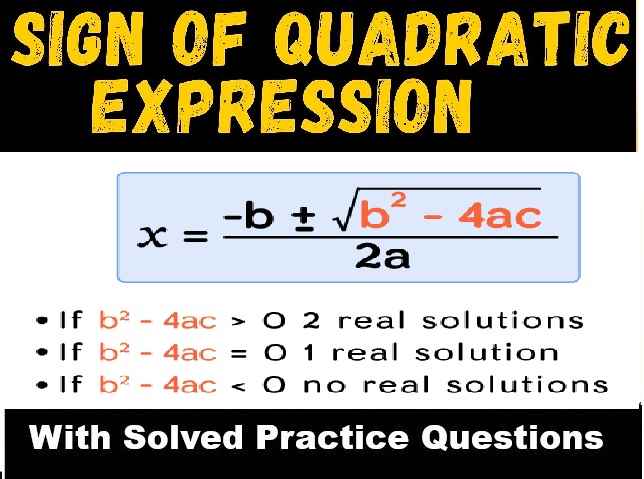
Quadratic Equation Class 11 OP Malhotra Exe-10F ISC Maths Solutions Ch-10
| Board | ISC |
| Publications | S Chand |
| Subject | Maths |
| Class | 11th |
| Chapter-10 | Quadratic Equations |
| Writer | O.P. Malhotra |
| Exe-10(F) | Sign of the quadratic functions. |
Exercise- 10F
Quadratic Equations Class 11 OP Malhotra Exe-10F Solution.
Que-1: Show that
(a) x² – 3x + 6 > 0 for all x
(b) 4x – x² – 6 < 0 for all x
(c) 2x² – 4x + 7 is always +ve
(d) – 2x² + 3x – 4 is always -ve
(e) – x² + 3x – 3 is always -ve.
Sol: (a) Here D = b² – 4ac = (- 3)² – 4 x 1 x 6
= 9 – 24 = – 15 < 0
Thus the expression x² – 3x + 6 and coeff. of x² have same sign.
Here coeff. of x² = a = 1 > 0
∴ x² – 3x + 6 > 0 ∀ x
(b) Here a = – 1, b = + 4; c = – 6
and Discriminant D = b² – 4ac = 4² – 4 x ( – 1) x (- 6)
= 16 – 24 = – 8 < 0
Thus the given expression 4x – x² – 6 has same sign as that of a.
Here a = – 1 < 0
∴ 4x – x² – 6 < 0 for all x.
(c) Here a = 2 ; b = – 4 ; c = 1
and discriminant D = b² – 4 ac = (- 4)² – 4 x 2 × 7 = 16 – 56 = – 40 < 0
∴ roots are imaginary. Thus the given expression 2x² – 4x + 7 and a has same sign. Here a = 2 > 0
∴ 2x² – 4x + 7 > 0 for all x
(d) Here a = – 2 ; b = – 3 and c = – 4
and discriminant D = b² – 4ac = (- 3)² – 4 x (- 2) x (- 4) = 9 – 32 = – 23 < 0
∴ roots are imaginary
Hence the given expression – 2x² + 3x – 4 and a has same sign. Here a = – 2 < 0
∴ – 2x² + 3x – 4 < 0 ∀ x
(e) Here a = – 1 ; b = 3 ; c = -3
Here discriminant D = b² – 4ac = 32 – 4 x (- 1) x (- 3) = 9 – 12 = – 3 < 0
∴ roots are imaginary. Hence given expression and ‘a’ has same sign.
Here, a = – 1 < 0
∴ – x² + 3x – 3 < 0 ∀ x.
Que-2: Explain why 3x² + kx – 1 is never always positive for any value of k.
Sol: Here, a = 3 ; b = k; c = – 1
Here discriminant D = b² – 4ac = k² – 4 x 3 x (- 1) = k² + 12 > 0
∴ roots are real and unequal.
Let a and P be its two roots s.t a > P
Then when x > α or x < ß, the given expression 3x² + kx – 1 has same sign as that of ‘a’
Here a = 3 > 0
∴ 3x² + kx – 1 > 0
But when ß < x < α, then 3x² + kx – 1 and a has opposite sign.
∴ 3x² + kx – 1 < 0
Hence 3x² + kx – 1 is never always positive for any value of k.
Que-3: Under what conditions is 2x² + kx + 2 always positive ?
Sol: Comparing 2x² + kx + 2 with ax² + bx + c, we have a = 2 ; b = k; c = 2
Here discriminant D = b² – 4ac = k² – 4 x 2 x 2 = k² – 16
Here a = 2 > 0 if D < 0 then 2x² + kx + 2 > 0 ∀ x i.e. if – 16 < 0 if k² < 16
if | k |< 4 if – 4 < k < 4
Hence, 2x² + kx + 2 > 0 ∀x, where – 4 < k < 4
Que-4: Find the values of a so that the expression x? – (a + 2) x + 4 is always positive.
Sol: On comparing x² – (a + 2) x + 4 with Ax² + Bx + C
we have A = 1 ; B = – (a + 2) and C = 4
Here Discriminant D = b² – 4AC = (a + 2)² – 16
Also, A = 1 > 0 if D < 0 then given expression is always be positive.
i.e. if (a + 2)² – 16 < 0 if (a + 2)² < 16 if |a + 2| < 4
if – 4 < a + 2 < 4 [∵ |x| < l ⇒ – l < x < l]
if – 6 < a < 2
Que-5: Find the range of values of x for which the expression 12x² + 7x – 10 is negative.
Sol: For range of x for which 12x² + 7x – 10 < 0
⇒ (1/2) [x²+(7/12)x−(5/6)] < 0
⇒ x² + (7/12)x+(49/576)−(49/576)−(5/6) < 0
⇒ (x+(7/24))² − ((49+480)/576) < 0
⇒ (x+(7/24))² < (23/24)² ⇒ ∣∣ x + (7/24) ∣∣ < 23/24
⇒ (−23/24) < x + (7/24) < (23/24)
⇒ (−23/24) − (7/24) < x < (23/24) − (7/24)
⇒ (−30/24) < x < (16/24) i.e (−5/4) < x < (2/3)
Que-6: (i) Find the values of ‘a’ for which the expression x² – (3a – 1) x + 2a² + 2a – 11 is always positive.
(ii) If x² + 4ox + 2 > 0 for all values of x, then a lies in the interval
(a) ( – 2,4)
(b) (1, 2)
(c) (- √2, √2)
(d) (−(1/√2), (1/√2)
(e) (- 4, 2)
Sol: (i) On comparing x² – (3a – 1) x + 2a² + 2a – 11 with Ax² + Bx + C, we have
A = 1 ; B = – (3a – 1) and C = 2a² + 2a – 11
Here D = B² – 4AC = (3a – 1)² – 4 (2a²+ 2a-ll) = (9a² – 6a + 1) – (8a² + 8a – 44)
= a²- 14a + 45
Here A = 1 > 0 and if D < 0 then given expression will be always positive
if a² – 14a + 45 < 0 if (a – 9) (a – 5) < 0
The critical points are a = 5, 9
Then by method of intervals, 5 < a < 9.
(ii) On comparing x² + 4ax + 2 with Ax² + Bx + C.
Here A = 1 ; B = 4a and C = 2 and discriminant
D = b² – 4AC = (4a)² – 4 x 1 x 2 = 16a² – 8
Here A = 1 > 0.
Then x² + 4ax + 2 > 0
if D < 0 if b² – 4AC < 0 if 16a² – 8 < 0
if a² < (1/2) if | a | < (1/2) if – (1/√2) < a < (1/√2) if a ∈ (−(1/√2), (1/√2)
Que-7: Find the greatest value of 3 + 5x – 2x² for all real values of x.
Sol: Let y = 3 + 5x – 2x² ⇒ – 2x² + 5x + 3 – y = 0
Since x is real
∴ D ≥ 0
⇒ b² – 4ac ≥ 0
⇒ 5² – 4 x (- 2) (3 – y) ≥ 0
⇒ 25 + 24 – 8y ≥ 0
⇒ 49 – 8y ≥ 0
⇒ 8y ≤ 49
⇒ y ≤ 49/8 = 6*(1/8)
Greatest value of y is {6*(1/8)}.
Que-8: Find the least value of (6x²−22x+21)/(5x²−18x+17) for real values of x.
Sol: Let y = (6x²−22x+21)/(5x²−18x+17)
⇒ y (5x² – 18x + 17) = 6x² – 22x + 21
⇒ x² (6 – 5y) + x (18y – 22) + 21 – 17y = 0
Since x is given to be real
∴ D ≥ 0
⇒ (18y – 22)² – 4 x (6 – 5y) (21 – 17y) ≥ 0
⇒ 4 (9y- 11 )² – 4 (6 – 5y) (21 – 17y) ≥ 0
⇒ (81y² + 121 – 198y) – (126 – 102y – 105y + 85y²) ≥ 0
⇒ – 4y² + 9y – 5 ≥ 0
⇒ 4y² – 9y + 5 ≤ 0
⇒ (y – 1) (4y – 5) ≤ 0
The critical points are y – 1 = 0 and 4y – 5 = 0 i.e. y = 1, (5/4)
Then by method of intervals, we have 1 ≤ y ≤ (5/4) = y ∈ [1, (5/4)]
∴ least value of y = 1
Que-9: If x be real, prove that the value of (11x²+12x+6)/(x²+4x+2) cannot lie between – 5 and 3.
Sol: Let y = (11x²+12x+6)/(x²+4x+2)
⇒ y (x² + 4x + 2) = 11x² + 12x + 6
⇒ x²(y – 11) + x (4y – 12) + 2y – 6 = 0
For x is to be real ∴ Disc ≥ 0 ⇒ (4y – 12)² – 4 (y – 11) (2y – 6) ≥ 0
⇒ 16 (y – 3)² – 8(y – 11) (y – 3) ≥ 0
⇒ 8[2(y² – 6y + 9) – (y² – 14y + 33)] ≥ 0
⇒ y² + 2y – 15 ≥ 0
⇒ (y – 3) (y + 5) ≥ 0
The critical points are given by y = 3, – 5.
Then by method of intervals, we have y ≤ – 5 or y ≥ 3
Hence y cannot lie between – 5 and 3.
–: End of Quadratic Equations Class 11 OP Malhotra Exe-10F ISC Math Ch-10 Solution :–
Return to :- OP Malhotra ISC Class-11 S Chand Publication Maths Solutions
Thanks
Please share with your friends