Reflection of Light Exe-7C MCQs Class-9 Concise Physics ICSE Selina Solutions Ch-7. In this article you would learn to solve MCQs on Image Formation by Spherical Mirrors . Visit official Website CISCE for detail information about ICSE Board Class-9.
Reflection of Light Exe-7C MCQs Class-9 Concise Physics ICSE Selina Solutions Ch-7
| Board | ICSE |
| Class | 9 |
| Subject | Physics |
| Writer / Publication | Concise Selina Publishers |
| Chapter-7 | Reflection of Light |
| Exe-7C | Image Formation by Spherical Mirrors |
| Topics | Solution of Exe-7(C) MCQs Type |
| Academic Session | 2025-2026 |
Image Formation by Spherical Mirrors
Reflection of Light Exe-7C MCQs Class-9 Concise Physics ICSE Selina Solutions Ch-7
page -189
(Choose the correct answer from the options given below).
Que-1: A spherical mirror is made by silvering a part of a :
(a) solid metal sphere
(b) hollow metal sphere
(c) hollow glass sphere
(d) None of the above
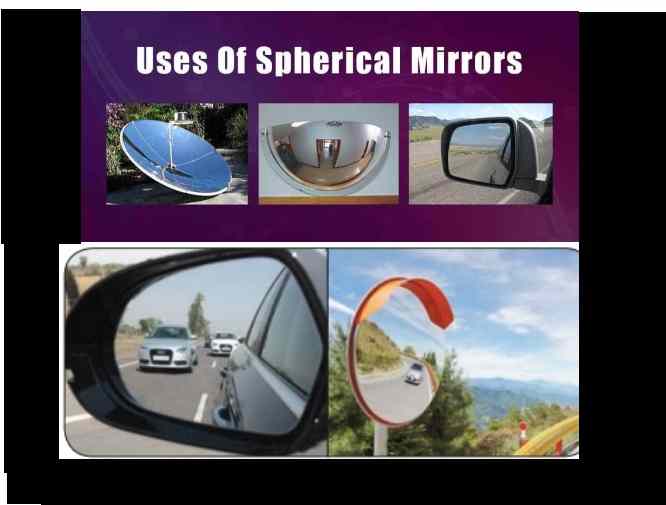
Ans: (c) hollow glass sphere
Hint- A spherical mirror is made by silvering a part of a hollow glass sphere .
Que-2: A …………… mirror is made by silvering the …………… surface of a piece of a hollow sphere.
(a) convex, outer
(b) plane, outer
(c) concave, outer
(d) concave, inner
Ans: (c) concave, outer
Hint- A concave mirror is made by silvering the outer (or bulging) surface of a piece of a hollow sphere such that the reflection takes place from the hollow (or concave) surface.
Page 188
Que-3: A …………… mirror is made by silvering the …………… surface of a piece of a hollow sphere.
(a) concave, inner
(b) convex, inner
(c) convex, outer
(d) None of the above
Ans: (b) convex, inner
Hint- A convex mirror is made by silvering the inner surface of a piece of a hollow sphere such that the reflection takes place from the outer (or bulging) surface.
Que-4: The correct statement(s) is/are :
(i) The radius of a sphere of which the spherical mirror is a part is called the radius of curvature.
(ii) The geometric centre of the spherical surface of a mirror is called the centre of curvature.
(iii) Principal axis is the straight line joining the pole of the mirror to its aperture.
(a) (i)
(b) (ii)
(c) (iii)
(d) None of the above
Ans: (a) (i)
Hint- The radius of a sphere of which the spherical mirror is a part is called the radius of curvature.
The geometric centre of the spherical surface of a mirror is called the pole of the mirror.
Principal axis is the straight line joining the pole of the mirror to its centre of curvature.
Que-5: The focus of a concave mirror is a point on the …………… through which the light rays incident …………… to the principal axis pass after reflection from the mirror.
(a) centre of curvature, perpendicular
(b) principal axis, parallel
(c) principal axis, perpendicular
(d) aperture, parallel
Ans: (b) principal axis, parallel
Que-6: A concave mirror has a …………… focus, whereas a convex mirror has a …………… focus.
(a) real and virtual, real
(b) real, virtual
(c) virtual, real
(d) virtual, real and virtual
Ans: (b) real, virtual
Hint- A concave mirror has a real focus because the light rays incident parallel to the principal axis, after reflection actually pass through the focus.
A convex mirror has a virtual focus because the light rays incident parallel to the principal axis, appear to come from the focus after reflection from the mirror.
Que-7: A focal plane passes through the focus and is …………… to the principal axis.
(a) parallel
(b) inclined
(c) normal
(d) none of the above
Ans: (c) normal
Hint- A plane passing through the focus and normal to the principal axis of the mirror, is called the focal plane.
Que-8: For an incident ray directed towards center of curvature of a spherical mirror, the reflected ray:
(a) retraces it’s path
(b) passes through the focus
(c) passes through the pole
(d) becomes parallel to the principal axis
Ans: (a) retraces it’s path
Que-9: A ray either incident from the focus (or converging at the focus), after reflection from a spherical mirror :
(a) becomes perpendicular to the principal axis
(b) becomes parallel to the principal axis
(c) becomes normal to the focus
(d) passes through the centre of curvature
Ans: (b) becomes parallel to the principal axis
Hint- A ray either incident from the focus (or converging at the focus), after reflection from a spherical mirror becomes parallel to the principal axis.
Que-10: For a concave mirror, when the object is at infinity, the nature of the image formed at focus is
(a) virtual, inverted
(b) virtual, diminished to a point
(c) real, enlarged, inverted
(d) real, inverted, diminished to a point
Ans: (d) real, inverted, diminished to a point
Que-11: For a concave mirror, when the object is at the centre of curvature, the place and nature of the image formed is :
(a) at focus, real, inverted
(b) at focus, virtual, inverted
(c) at centre of curvature, real, inverted, diminished
(d) at centre of curvature, real, same size as that of the object
Ans: (d) at centre of curvature, real, same size as that of the object
Hint- For a concave mirror, when the object is at the centre of curvature, the image is also at the centre of curvature. It is real and same size as that of the object.
Que-12: For a concave mirror, when the object is at focus, the size of the image formed is:
(a) magnified
(b) highly magnified
(c) diminished
(d) of the same size
Ans: (b) highly magnified
Hint- For a concave mirror, when the object is at focus, the image is at infinity. It is real, inverted and highly magnified.
Que-13: The image formed by a convex mirror is:
(a) erect and diminished
(b) erect and enlarged
(c) inverted and diminished
(d) inverted and enlarged
Ans: (a) erect and diminished
Hint- In a convex mirror, the image formed is always virtual, erect and diminished. It is always situated between it’s pole and focus irrespective of the distance of object in front of the mirror.
Que-14: For a convex mirror, when the object is in front of the mirror, the image formed is :
(a) real, upright and magnified
(b) real, inverted and diminished
(c) virtual, upright and magnified
(d) virtual, upright and diminished
Ans: (d) virtual, upright and diminished
Que-15: For a spherical mirror, the focal length is …………… its radius of curvature.
(a) equal to
(b) half of
(c) twice of
(d) one-third of
Ans: (b) half of
Hint- The focal length of a spherical mirror is equal to half of its radius of curvature i.e., f = 12R
Que-16: The wrong rule of sign convention is :
(i) All distances are measured from the centre of curvature of the mirror taken as origin.
(ii) The distances measured along the principal axis in the direction of incident light are positive.
(iii) The distances above the principal axis are taken positive.
(a) (i)
(a) (ii)
(a) (iii)
(a) both (i) and (ii)
Ans: (a) (i)
Hint- The rules of sign convention are :
(i) All distances are measured from the pole of the mirror taken as origin.
(ii) The distances measured along the principal axis in the direction of incident light are positive while those opposite to the incident light are negative.
(iii) The distances above the principal axis are taken positive and those below the principal axis are taken negative.
Page 189
Que-17: For a convex mirror, the value of u is always …………… and the value of v is ……………
(a) positive, positive
(b) positive, negative
(c) negative, negative
(d) negative, positive
Ans: (d) negative, positive
Hint- For a convex mirror, the value of u is always negative and the value of v is always positive.
Que-18: A real and enlarged image can be obtained by using a:
(a) convex mirror
(b) plane mirror
(c) concave mirror
(d) either convex or plane mirror
Ans: (c) concave mirror
Hint- The image formed by a concave mirror is real and enlarged, when the object is between centre of curvature and focus or at focus.
Que-19: The type of mirror used as a reflector in the street lights is :
(a) plane mirror
(b) convex mirror
(c) concave mirror
(d) parabolic mirror
Ans: (b) convex mirror
Hint- A convex polished metallic surface is used in street lamps as a reflector so as to diverge light over a larger area.
Que-20: The type of mirror used as a shaving mirror in daily life is :
(a) plane mirror
(b) convex mirror
(c) concave mirror
(d) parabolic mirror
Ans: (c) concave mirror
Hint- When a concave mirror is held near the face (such that the face is between pole and focus of the mirror), it gives an upright and magnified image. Hence even tiny hair can be seen. For this concave mirror of large focal length and large aperture is used.
Que-21: Which mirror always forms a diminished image for all positions of the object placed in front of it ?
(a) plane mirror
(b) convex mirror
(c) concave mirror
(d) parabolic mirror
Ans: (b) convex mirror
Hint- A convex mirror always forms a diminished image for all positions of the object placed in front of it.
— : End of Reflection of Light Exe-7C MCQs Class-9 Concise Physics ICSE Selina Solutions Ch-7 :—
Return to: – Concise Selina Physics ICSE Class-9 Solutions
Thanks