Refraction at Spherical Surface Numerical Class-12 Nootan ISC Physics Solution Ch-16 Refraction of Light at Spherical Surfaces : Lenses. Step by step solutions of Kumar and Mittal Physics of Nageen Prakashan as council latest prescribe guideline for upcoming exam. Visit official Website CISCE for detail information about ISC Board Class-12 Physics.
Refraction at Spherical Surface Numerical Class-12 Nootan ISC Physics Solution Ch-16 Refraction of Light at Spherical Surfaces : Lenses
| Board | ISC |
| Class | 12 |
| Subject | Physics |
| Book | Nootan |
| Chapter-16 | Refraction of Light at Spherical Surfaces : Lenses |
| Topics | Numericals on Refraction at Spherical Surface |
| Academic Session | 2025-2026 |
Numericals on Refraction at Spherical Surface
Numerical Class-12 Nootan ISC Physics Solution Ch-16 Refraction of Light at Spherical Surfaces : Lenses
Que-1. A point-object is placed in air at 60 cm from a convex spherical refracting surface of refractive index 1.5. The radius of curvature of the surface is 25 cm. Find the position of the image.
Ans- u = -60 cm , R = +25 cm , μ1 = 1 , μ2 = 1.5
According to formula
μ2-μ1/R = μ2/v – μ1/u
=> 1.5-1/25 = 1.5/v – 1/-60
=> 1.5/v = 0.5/25 – 1/60
=> 1.5/v = 0.5/25 – 1/60 = 450 cm
Que-2. A convex spherical refracting surface of refractive index 1.5 forms the image of an object distant 10 cm from it at a distance of 40 cm on the same side as the object. What is the radius of curvature of the surface?
Ans- μ1 = 1 , μ2 = 1.5 , u = -10 , v = -40
μ2-μ1/R = μ2/v – μ1/u
=> 1.5-1/R = 1.5/-40 + 1/10
=> 0.5/R = (-1.5+ 4)/40
Hence R = 8 cm
Que-3. An empty spherical flask of diameter 100 cm is placed in water (n = 4/3). A parallel beam of light strikes the flask. Where will it appear to come from to an observer within the flask?
Ans- μ1 = 4/3 , μ2 = 1 , u = ∞ , v = ? , R = +50 cm
μ2-μ1/R = μ2/v – μ1/u
=> 1-(4/3)/R = 1/v – 1.5/∞
=> 1/v = -1/150
Hence v = -150 cm
Que-4. A point-object is placed in air at 40 cm from a concave spherical surface of radius of curvature 20 cm and refractive index 1.5. Locate the image.
Ans- μ1 = 1 , μ2 = 1.5 , u = -40 , v = ? , R = -20
μ2-μ1/R = μ2/v – μ1/u
=> 1.5-1/-20 = 1.5/v + 1/40
After solving ,
=> v = -30
Que-5. A point-object is 2.0 cm below the concave meniscus of water (n = 4/3) of radius of curvature 0.5 cm. Locate the image.
Ans- μ1 = 4/3 , μ2 = 1 , u = -2 cm , v = ? , R = -0.5 cm
μ2-μ1/R = μ2/v – μ1/u
=> 1-(4/3)/0.5 = 1/v + 4/3(-2)
After solving ,
=> 1/v = -4/3
=> v = 0.75 cm
Que-6. A glass sphere of radius 5 cm has a small bubble 2 cm from its centre. The bubble is viewed along a diameter of the sphere, from the side on which it lies. How far from the surface will it appear? Refractive index of glass is 1.5.
Ans- μ1 = 1.5 , μ2 = 1 , u = -(5-2) = -3 cm , v = ? , R = -5 cm
μ2-μ1/R = μ2/v – μ1/u
=> 1-1.5/-5= 1/v – 1.5/-3
After solving ,
=> 1/v = -4/10
=> v = -2.5 cm
Que-7. An air bubble is seen inside a solid sphere of glass (n = 1.5) of 4.0 cm diameter at a distance of 1.0 cm from the surface of the sphere (on seeing along the diameter). Determine the real position of the bubble inside the sphere.
Ans- μ1 = 1.5 , μ2 = 1 , u = ? , v = -1 , R = -2
μ2-μ1/R = μ2/v – μ1/u
=> 1-1.5/-2 = 1/-1 – 1.5/u
=> 2.5/2 = -1.5/u
After solving ,
=> u = -1.2 cm
Que-8. One end of a cylindrical rod of glass (n = 1.5) shown in the figure is given hemi-spherical shape of radius 2.0 cm. On the left-side of this end is placed an object O at a distance of 12 cm. Find out the distance (v) of the image.
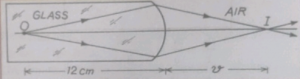
Ans- μ1 = 1.5 , μ2 = 1 , u = -12 , v = ? , R = -2 cm
μ2-μ1/R = μ2/v – μ1/u
=> 1-1.5/-2 = 1/v – 1.5/-12
After solving ,
=> 1/v = 1.5/12
=> v = 8 cm
Que-9. A small object is 2 cm below the concave meniscus of water. The radius of meniscus is 10 mm and refractive index (n) of water is 4/3. Find the nature and position of image.
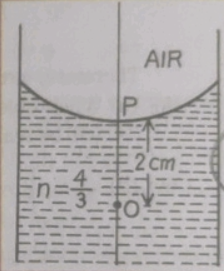
Ans- μ1 = 4/3 , μ2 = 1 , u = -2 cm , v = ? , R = -1 cm
μ2-μ1/R = μ2/v – μ1/u
=> 1-(4/3)/-1 = 1/v – (4/3)/-2
After solving ,
=> v = -1.0 cm
Que-10. A ray of light is incident on a glass sphere of refractive index 3/2. What should be the angle of incidence so that ray which enters the sphere will not come out of the sphere.
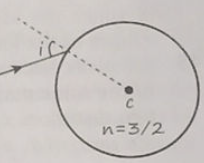
Ans- To prevent light from exiting a glass sphere (refractive index 3/2), it must undergo total internal reflection inside. This requires the angle of incidence outside the sphere to be 90°, meaning the light must enter at the sphere’s edge.
— : End of Refraction at Spherical Surface Numerical Class-12 Nootan ISC Physics Solution Ch-16. :–
Return to : – Nootan Solutions for ISC Class-12 Physics
Thanks
Please share with your friends