Very Short Answer Type Questions on Relations and Functions Class 11 OP Malhotra Exe-2H ISC Maths Solutions Ch-2. In this article you would learn to solve VSAs on Relation and Function. Step by step solutions of latest textbook has been given as latest syllabus. Visit official Website CISCE for detail information about ISC Board Class-11 Mathematics.
Relations and Functions Class 11 OP Malhotra Very Short Answer Type Questions ISC Maths Solutions Ch-2
| Board | ISC |
| Publications | S Chand |
| Subject | Maths |
| Class | 11th |
| Chapter-2 | Relations and Functions |
| Writer | OP Malhotra |
| Exe-2(H) | Very Short Answer Type Questions. |
Very Short Answer Type Questions on Relations and Functions
OP Malhotra ISC Class 11 Maths Solutions
Que-1: If A = {5, 7, 9}, B = {5, 7}, and C = {5, 7, 11}, find A × (B ∩ C)
Sol: B ∩ C = {5, 7}
A × (B ∩ C) = A × {5, 7}
= {(5,5), (5,7), (7,5), (7,7), (9,5), (9,7)}
Que-2: Find x if (x + 4, 2) = (7, 3x − y)
Sol: x + 4 = 7
⇒ x = 3
Check second component:
2 = 3x − y
2 = 3(3) – y
2 = 9 – y
y = 9 – 2
y = 7.
Que-3: Find the domain and range of the relation {(80, 5), (100, 5), (120, 6), (140, 12)}
Sol: Domain = Set of all first elements of ordered pairs
Domain = {80, 100, 120, 140}
Range = Set of all second elements of ordered pairs
Range = {5, 6, 12}
Que-4: Tick the Correct Answer:
(i) Is the relation {(3, p), (3, q), (3, r)} a function? Yes / No
(ii) Is the relation {(p, 3), (q, 3), (r, 3)} a function? Yes / No
Sol: (i) No
Reason: One element (3) has multiple images (p, q, r), so it is not a function.
(ii) Yes
Reason: Each element (p, q, r) has exactly one image (3), so it is a function.
Que-5: Name four different ways to represent a relation or function.
Sol: Ordered pairs, table, mapping, diagram, graph
Que-6: Let A = {1, 2, 3, 4, …, 10}. Define a relation from A to A by
R = {(x, y) : 2x − y = 0, where x, y ∈ A}.
Write down its codomain, domain and range.
Sol: Given relation condition:
2x − y = 0 ⟹ y = 2x
Now check values of x ∈ A such that y = 2x is also in A = {1 to 10}
x = 1 ⟹ y = 2 ✔
x = 2 ⟹ y = 4 ✔
x = 3 ⟹ y = 6 ✔
x = 4 ⟹ y = 8 ✔
x = 5 ⟹ y = 10 ✔
x = 6 ⟹ y = 12 ✖ (not in A)
So relation R = {(1,2), (2,4), (3,6), (4,8), (5,10)}
Domain = {1, 2, 3, 4, 5}
Codomain = A = {1, 2, 3, 4, 5, 6, 7, 8, 9, 10}
Range = {2, 4, 6, 8, 10}
Que-7: Explain whether the relation from A to B is a function, the relation from B to A is a function, or both are functions
| A | B |
|---|---|
| (i) Date of birth | Person |
| (ii) Thumbs print | Person |
| (iii) Area code | State |
| (iv) River Ganga | City |
| (v) Mother | Her children |
Sol: (i) B to A
(ii) Both
(iii) A to B
(iv) B to A
(v) B to A
Que-8: Use the vertical line test to determine whether each relation is a function
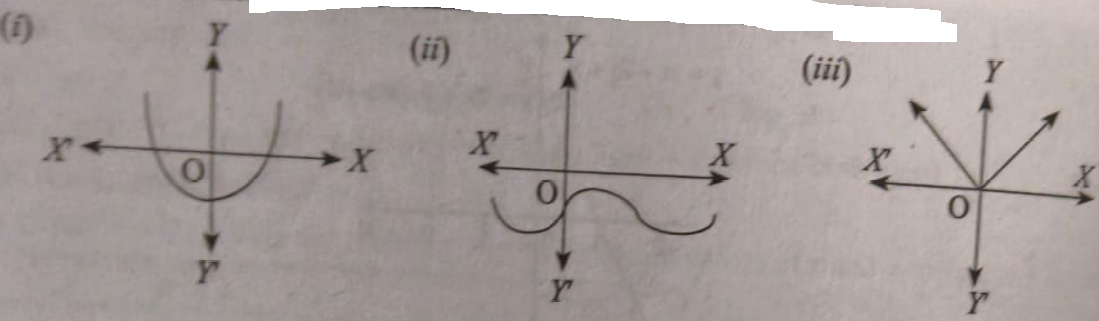
Sol: (i) Not a function
(ii) Function
(iii) Function
Que-9: Find f(0), f(-2), f(-1/3) − f(3) for the function
f(x) = x² − 4x
Sol: With f(0)
= (0)² − 4(0) = 0
With f(−2)
= (−2)² − 4(−2)
= 4 + 8 = 12
With f(−1/3)
= (−1/3)² − 4(−1/3)
= 1/9 + 4/3
= 1/9 + 12/9 = 13/9
With f(3)
= (3)² − 4(3)
= 9 − 12 = −3
With f(−1/3) − f(3)
= 13/9 − (−3)
= 13/9 + 3
= 13/9 + 27/9 = 40/9
Que-10: If f(x) = x² − 1/x², find the value of f(x) + f(1/x)
Sol: Given: f(x) = x² − 1/x²
Now find f(1/x):
f(1/x) = (1/x)² − 1/(1/x)²
= 1/x² − x²
Now,
f(x) + f(1/x)
= (x² − 1/x²) + (1/x² − x²)
= x² − 1/x² + 1/x² − x²
= 0
Que-11: Find the domain of the function
f(x) = (x² + 9x + 11) / (x² − 7x + 12)
Sol: The denominator must not be zero.
x² − 7x + 12 = 0
(x − 3)(x − 4) = 0
So, x ≠ 3 and x ≠ 4
Domain = All real numbers except 3 and 4
Domain = ℝ − {3, 4}
Que-12: If f(x) = x² − 8x + 1, find the image of −3 and pre-image of −6.
Sol: Image of −3:
f(−3) = (−3)² − 8(−3) + 1
= 9 + 24 + 1 = 34
Image of −3 = 34
Pre-image of −6:
f(x) = −6
x² − 8x + 1 = −6
x² − 8x + 7 = 0
(x − 1)(x − 7) = 0
x = 1 or x = 7
Pre-image of −6 = 1, 7
Que-13: If f(x) = 2x² − 3x + 4 and g(x) = 5x + 3, find (g − f)(3).
Sol: (g − f)(x) = g(x) − f(x)
= (5x + 3) − (2x² − 3x + 4)
= 5x + 3 − 2x² + 3x − 4
= −2x² + 8x − 1
Now put x = 3:
(g − f)(3) = −2(3)² + 8(3) − 1
= −2(9) + 24 − 1
= −18 + 24 − 1
= 5
Que-14: If f : R → R is defined by f(x) = [x], the greatest integer function, find its domain, range and draw its graph.
Sol: Given: f : R → R defined by f(x) = [x], where [x] denotes the greatest integer ≤ x.
Domain:
The function is defined for all real values of x.
Domain = R
Range:
The output of the greatest integer function is always an integer.
Range = Z (all integers)
Graph:
![Que-14: If f : R → R is defined by f(x) = [x], the greatest integer function, find its domain, range and draw its graph.](https://icsehelp.com/wp-content/uploads/2026/02/4-3.png)
The graph of y = [x] is a step function:
For 0 ≤ x < 1, y = 0
For 1 ≤ x < 2, y = 1
For -1 ≤ x < 0, y = -1
And so on…
Each step is:
Closed circle at the left endpoint
Open circle at the right endpoint
Que-15: Find the range of the real function f(x) = 1 − [x − 2].
Sol: Let [x − 2] = n, where n is an integer (since greatest integer function gives integer values).
Then the function becomes:
f(x) = 1 − n
Since n can be any integer (… −2, −1, 0, 1, 2, …),
the value of f(x) = 1 − n will also be an integer.
Hence, the range of the function is:
Range = All integers ( Z )
–: End Relation and Functions Class 11 OP Malhotra Exe-2H ISC Math Ch-2 Solutions :–
Return to :- OP Malhotra ISC Class-11 S Chand Publication Maths Solutions
Thanks
Please share with your friends