Science Stream After Class 10 – Reality, Subjects, Career Options. Choosing the Science stream after Class 10 is a major decision for students. This guide explains the reality, core subjects like Physics, Chemistry, and Biology, and top career options including engineering, medical, and research fields. Discover opportunities, challenges, and how to choose the right path for your future.
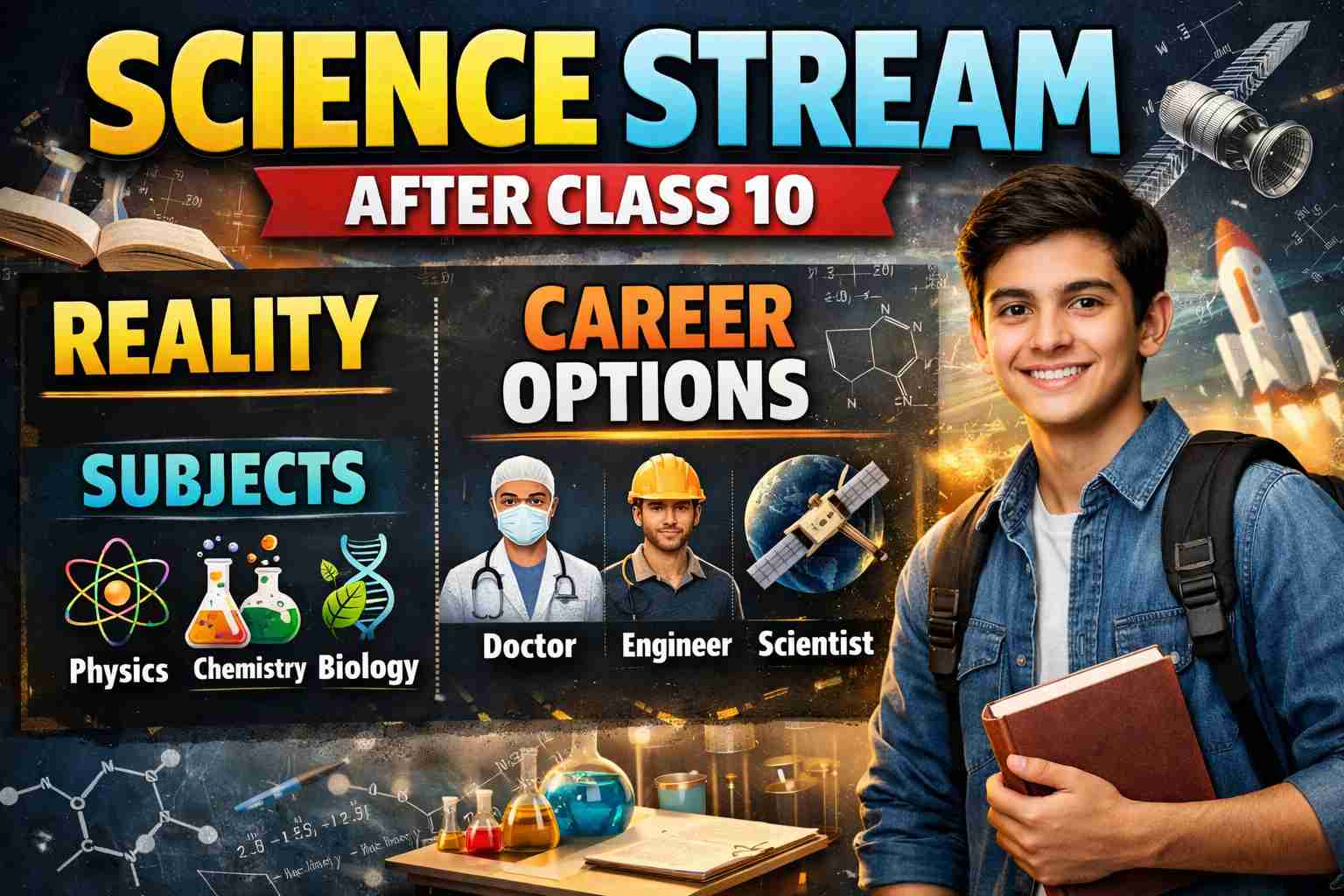
Science Stream After Class 10 – Reality, Subjects, Career Options
Choosing a stream after Class 10 is one of the first major decisions in a student’s life. Among all options, the Science stream is often seen as the most prestigious, but also the most challenging. Many students choose it due to societal pressure, parental expectations, or the belief that it keeps all career options open.
But what is the real picture? Is Science really for everyone? What subjects will you study, and what career paths can you explore?
Let’s break everything down in a simple, realistic, and student-friendly way.
1. What is the Science Stream?
The Science stream focuses on subjects related to the natural world, mathematics, and technology. It is usually divided into two main combinations:
a) PCM (Physics, Chemistry, Mathematics)
- Ideal for students interested in engineering, technology, or mathematics.
- Opens doors to careers like engineering, architecture, data science, etc.
b) PCB (Physics, Chemistry, Biology)
- Best for students interested in medical or life sciences.
- Leads to careers like doctor, pharmacist, biotechnologist, etc.
c) PCMB (Physics, Chemistry, Math, Biology)
- A combination of both streams (very challenging but flexible).
- Keeps maximum career options open.
2. The Reality of Choosing Science

Let’s be honest—Science is not just about “being intelligent.” It demands consistency, discipline, and interest.
What students think:
- “Science lene se life set ho jaati hai”
- “Top students hi Science lete hain”
- “Scope sabse zyada Science mein hai”
Actual Reality:
(i). It is Concept-Based
Unlike some subjects where you can rely on memorization, Science requires deep understanding.
(ii). Regular Study is Necessary
You can’t study everything one night before the exam. Daily revision is key.
(iii). Pressure Can Be High
- School exams
- Competitive exams (like JEE/NEET)
- Coaching + school balance
(iv). Not Everyone Enjoys It
If you don’t have interest, it can become stressful and overwhelming.
Truth: Science is powerful, but only if you genuinely like it.
3. Subjects You Will Study
1. Physics
- Focus: Laws of nature, motion, electricity, magnetism
- Requires strong conceptual clarity and problem-solving skills
- Often considered the toughest subject by students
2. Chemistry

- Organic Chemistry (reactions, compounds)
- Inorganic Chemistry (elements, periodic table)
- Physical Chemistry (numericals, formulas)
- Mix of theory + memorization + logic
3. Mathematics (for PCM students)
- Topics: Algebra, Calculus, Trigonometry
- Requires practice and logical thinking
- Very scoring if concepts are clear
4. Biology (for PCB students)
- Topics: Human body, plants, genetics
- More theory-based compared to Physics/Math
- Requires memorization + understanding diagrams
5. English (Compulsory)

- Improves communication skills
- Includes writing, comprehension, and literature
4. Skills Required to Succeed in Science
Before choosing Science, ask yourself:
- ✔ Do I enjoy solving problems?
- ✔ Am I curious about how things work?
- ✔ Can I study regularly without procrastinating?
- ✔ Am I ready to handle pressure?
If your answer is “yes” to most of these, Science could be a good fit.
5. Career Options After Science
A. Career Options with PCM

- Engineering – Computer Science, Mechanical, Civil, Electrical
- Architecture – Designing buildings
- Data Science / AI – High demand field
- Defense Services – NDA
- Commercial Pilot
- Pure Sciences – Research and teaching
B. Career Options with PCB

- Medical (Doctor) – MBBS, BDS
- Pharmacy
- Biotechnology
- Nursing
- Forensic Science
- Psychology
C. Career Options with PCMB

You can choose both engineering and medical paths. Maximum flexibility, but also maximum workload.
6. Advantages of Taking Science
- ✔ Wide career options
- ✔ High earning potential (in some fields)
- ✔ Respect in society
- ✔ Opportunities in research & innovation
- ✔ Flexibility to switch fields later
7. Disadvantages of Taking Science
- ✖ Heavy syllabus
- ✖ High competition
- ✖ Time-consuming
- ✖ Pressure from exams and expectations
- ✖ Less time for hobbies (if not managed well)
8. Common Mistakes Students Make

- ❌ Choosing Science because of friends
- ❌ Taking it due to parental pressure
- ❌ Ignoring personal interest
- ❌ Thinking “backup options mil jayenge”
- ❌ Underestimating difficulty
9. Who Should Choose Science?
- ✔ You are genuinely interested in the subjects
- ✔ You enjoy logical thinking and problem-solving
- ✔ You are ready to study consistently
- ✔ You have clear or slightly inclined career goals
10. Who Should NOT Choose Science?
- ✖ You dislike Math or Biology strongly
- ✖ You prefer creative or business-related fields
- ✖ You are choosing it just for “status”
- ✖ You struggle with regular study habits
Remember: Every stream has value. Success depends on your skills, not your stream.
11. Final Advice for ICSE Students
- Don’t rush your decision
- Talk to seniors and teachers
- Try to understand subjects deeply
- Think long-term, not just about Class 11
Conclusion
Choosing the Science stream after Class 10 can open doors to some of the most exciting and rewarding careers. However, it is not a shortcut to success. It demands dedication, interest, and consistent effort.
Instead of following the crowd, choose wisely based on your strengths and goals. Because at the end of the day, the right stream is not the most popular one—it’s the one that suits YOU.
–: End of Science Stream After Class 10 – Reality, Subjects, Career Options :–
–: also visit : —
Please share with your friends
Thanks