Self Evaluation on Quadratic Equations Class 10 ICSE OP Malhotra Maths 2026-27. We Provide Step by Step Solutions of self evaluation on Quadratic Equations. Visit official Website CISCE for detail information about ICSE Board Class-10 Mathematics.
Self Evaluation on Quadratic Equations Class 10 ICSE OP Malhotra Maths 2026-27
| Board | ICSE |
| Publications | S Chand |
| Subject | Maths |
| Class | 10th |
| Chapter-5 | Quadratic Equations |
| Writer | OP Malhotra |
| Self Evaluation | Extra Practice Questions |
| Edition | 2026-2027 |
Self Evaluation on Quadratic Equations
Self Evaluation on Quadratic Equations Class 10 ICSE OP Malhotra Maths 2026-27
Que-1: Solve for x and give your answer correct to 2 decimal places : x² – 10x + 6 = 0.
Sol: x² – 10x + 6 = 0
Here a = 1, b = – 10, c = 6
∴ D = b² – 4ac = (- 10)² – 4 x 1 x 6 = 100 – 24 = 76
∴ x = {−b±√(b²−4ac)}/2a={−(−10)±√76}/2×1
= {10±√(4×19)}/2 = {10±2√19}/2
= 5 ± √19
= 5 ± 4.358
∴ x1 = 5 + 4.358 = 9.358 = 9.36
x2 = 5 – 4.358 = 0.642 = 0.64
∴ x = 9.36, 0.64
Que-2: Solve using the quadratic formula x² – 4 + 1 = 0
Sol: x² – 4x + 1 = 0
Here a = 1, b = – 4, c = 1
D = b² – 4ac = (- 4)² – 4 x 1 x 1 = 16 – 4 = 12
∴ x = {−b±√(b²−4ac)}/2a ={−(-4)±√(12)}/2×1
= 4±√4×3/2 = 4±2√3/2
= 2 ± √3 (Dividing by 2)
= 2 ± 1.732
∴ x1 = 2 + 1.732 = 3.732
x2 = 2 – 1.732 = 0.268
∴ x = 3.732, 0.268
Que-3: Solve the equation 3x² – x – 7 = 0 and give your answer correct to two decimal places.
Sol: 3x2 − x − 7 = 0
Here a = 3, b = −1, c = −7
D = b2 − 4ac = (−1)2 − 4 × 3 × (−7) m= 1 + 84 = 85
∴ x = (−b ± √(b2 − 4ac)) / (2 × 3)
= (−(−1) ± √85) / 6
= (1 ± 9.22) / 6
x1 = (1 + 9.22) / 6 = 10.22 / 6 = 1.70
x2 = (1 − 9.22) / 6 = −8.22 / 6 = −1.37
∴ x = 1.70, −1.37
Que-4: Solve the following equation and give your answer up to two decimal places : x² – 5x – 10 = 0
Sol: x2 − 5x − 10 = 0
Here a = 1, b = −5, c = −10
D = b2 − 4ac = (−5)2 − 4 × 1 × (−10) = 25 + 40 = 65
x = (−b ± √(b2 − 4ac)) / (2 × 1)
= (−(−5) ± √65) / (2 × 1)
= (5 ± √65) / 2
= (5 ± 8.06) / 2
x1 = (5 + 8.06) / 2 = 13.06 / 2 = 6.53
x2 = (5 − 8.06) / 2 = −3.06 / 2 = −1.53
∴ x = 6.53, −1.53
Que-5: Solve the equation 2x – 1/x = 7. Write your answer correct to two decimal places.
Sol: 2x − 1/x = 7
2x2 − 1 = 7x
2x2 − 7x − 1 = 0
Here a = 2, b = −7, c = −1
D = b2 − 4ac = (−7)2 − 4 × 2 × (−1)
= 49 + 8 = 57
x = (−b ± √(b2 − 4ac)) / (2 × 2)
= (−(−7) ± √57) / (2 × 2)
= (7 ± √57) / 4
= (7 ± 7.55) / 4
x1 = (7 + 7.55) / 4 = 14.55 / 4 = 3.64
x2 = (7 − 7.55) / 4 = −0.55 / 4 = −0.14
∴ x = 3.64, −0.14
Que-6: The bill for a number of people for overnight stay is ₹ 4800. If there were 4 more, the bill each person had to pay would have reduced by ₹ 200. Find the number of people staying overnight.
Sol: Total amount of the bill = ₹4800
Let number of persons originally = x
Then share of each person = ₹4800/x
If there were 4 more persons, then number of persons = x + 4
Then share of each person = ₹4800/(x + 4)
According to the condition,
(4800/x) − (4800/(x + 4)) = 200
(4800(x + 4) − 4800x) / x(x + 4) = 200
19200 / x(x + 4) = 200
19200 = 200x(x + 4)
96 = x(x + 4)
x2 + 4x − 96 = 0
x2 + 12x − 8x − 96 = 0
x(x + 12) − 8(x + 12) = 0
(x + 12)(x − 8) = 0
x + 12 = 0 or x − 8 = 0
x = −12 or x = 8
Since number of persons cannot be negative, x = 8
∴ Number of persons = 8
Que-7: An aeroplane travelled a distance of 400 km at an average speed of x km/hr. On the return journey, the speed was increased by 40 km/hr. Write down an expression for the time taken for :
(i) The onward journey
(ii) The return journey.
If the return journey took 30 minutes less than the onward journey, write down an equation in x and find its value.
Sol: Distance travelled by an aeroplane = 400 km
Speed of aeroplane = x km/hr
(i) ∴ Time taken = 400/x hours
On return speed by increasing 40 km/hr,
The speed will be (x + 40) km/hr
(ii) ∴ Time taken = 400/(x + 40)
(iii) According to the condition,
400/x − 400/(x + 40) = 30/60
(400(x + 40) − 400x) / x(x + 40) = 1/2
16000 / (x2 + 40x) = 1/2
x2 + 40x = 32000
x2 + 40x − 32000 = 0
x2 + 200x − 160x − 32000 = 0
x(x + 200) − 160(x + 200) = 0
(x + 200)(x − 160) = 0
Either x + 200 = 0, then x = −200 but it is not possible being negative
or x − 160 = 0, then x = 160
∴ Speed = 160 km/hr
Que-8: In an auditorium, seats were arranged in rows and columns. The number of rows were equal to the number of seats in each row. When the number of rows were doubled and the number of seats in each row were reduced by 10, the total number of seats increased by 300. Find :
(i) the number of rows in the original arrangement.
(ii) the number of seats in the auditorium after rearrangement.
Sol: In first case
Let number of rows = x
∴ Number of seats in each row = x
∴ Number of seats = x2
In second case,
Number of rows = 2x
and number of columns = x − 10
∴ Total number of seats = 2x(x − 10)
According to the condition,
2x(x − 10) = x2 + 300
2x2 − 20x = x2 + 300
x2 − 20x − 300 = 0
x2 − 30x + 10x − 300 = 0
x(x − 30) + 10(x − 30) = 0
(x − 30)(x + 10) = 0
Either x = 30, or x = −10
∵ x = −10 is not possible being negative
∴ Number of rows in the original arrangement = 30
(ii) Number of seats after re-arrangement = 2x(x − 10)
= 60 × 20 = 1200
Que-9: P and Q are centres of circles of radius 9 cm and 2 cm respectively. PQ = 17 cm. R is the centre of a circle of radius x cm, which touches the above circles externally. Given that ∠PRQ = 90°, write an equation in x and solve it.
Sol: P and Q are the centres of two circles with radii 9 cm and 2 cm respectively.
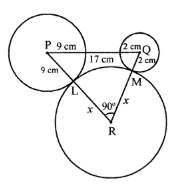
PQ = 17 cm
Let x be the radius of the circle with centre R.
Since the circles touch externally,
PR = PL + LR = 9 + x cm
and QR = QM + MR = 2 + x cm
In right-angled ΔPQR,
PR2 + QR2 = PQ2
(9 + x)2 + (2 + x)2 = 172
81 + 18x + x2 + 4 + 4x + x2 = 289
2x2 + 22x + 85 = 289
2x2 + 22x − 204 = 0
x2 + 11x − 102 = 0
x2 + 17x − 6x − 102 = 0
x(x + 17) − 6(x + 17) = 0
(x + 17)(x − 6) = 0
Either x = 6 or x = −17
∵ x = −17 is not possible being negative
∴ x = 6 cm
Que-10: By increasing the speed of car by 10 km/ hr, the time of journey for a distance of 72 km is reduced by 36 min. Find the original speed of the car.
Sol: Distance of journey = 72 km
Let original speed of car = x km/hr
and increased speed of car = (x + 10) km/hr
New time taken = 72/(x + 10) hrs
and time taken in first case = 72/x hrs
According to the condition,
72/x − 72/(x + 10) = 36/60
720 / x(x + 10) = 3/5
3600 = 3x(x + 10)
x2 + 10x − 1200 = 0
x2 + 40x − 30x − 1200 = 0
(x + 40)(x − 30) = 0
Either x = −40 or x = 30
∵ x = −40 is not possible being negative
∴ Original speed of the car = 30 km/hr
Que-11: A shopkeeper buys a certain number of books for ₹ 720. If the cost per book was ₹ 5 less, the number of books that could be bought for ₹ 720 would be 2 more. Taking the original cost of each book to be ₹ x, write an equation in x and solve it.
Sol: Price of books = ₹720
Let cost of one book = ₹x
∴ Number of books purchased = 720/x
In second case, the price of each book = (x − 5)
∴ Number of books = 720/(x − 5)
According to the condition,
720/(x − 5) − 720/x = 2
(720x − 720(x − 5)) / x(x − 5) = 2
3600 / x(x − 5) = 2
3600 = 2x(x − 5)
2x2 − 10x − 3600 = 0
x2 − 5x − 1800 = 0
x2 − 45x + 40x − 1800 = 0
x(x − 45) + 40(x − 45) = 0
(x − 45)(x + 40) = 0
Either x = 45 or x = −40
Since, x = −40 is not possible being negative
∴ x = 45
∴ Number of books originally purchased = 720/45 = 16
Que-12: Solve the following quadratic equation for x and give your answer correct to 2 decimal places : x² – 3x – 9 = 0
Sol: x2 − 3x − 9 = 0
Here a = 1, b = −3, c = −9
D = b2 − 4ac = (−3)2 − 4 × 1 × (−9) = 9 + 36 = 45
x = (−b ± √(b2 − 4ac)) / (2 × 1)
= (−(−3) ± √45) / 2
= (3 ± 3√5) / 2
= (3 ± 6.71) / 2
x1 = (3 + 6.71) / 2 = 9.71 / 2 = 4.86
x2 = (3 − 6.71) / 2 = −3.71 / 2 = −1.86
∴ x = 4.86, −1.86
Que-13: Five years ago, a woman’s age was the square of her son’s age. Ten years hence her age will be twice that of her son’s age. Find :
(i) The age of her son five years ago.
(ii) The present age of the woman.
Sol: 5 years ago,
Let the age of son = x years
Then age of his mother = x² years
Present age of son = (x + 5) years
and age of mother = (x² + 5) years
10 years hence,
Age of son = x + 5 + 10 = x + 15
and age of mother = x² + 5 + 10 = x² + 15
According to the condition,
x² + 15 = 2 (x + 15) ⇒ x² + 15 = 2x + 30
⇒ x² + 15 – 2x – 30 = 0 ⇒ x² – 2x – 15 = 0
⇒ x² – 5x + 3x – 15 = 0
⇒ x (x – 5) + 3 (x – 5) = 0
⇒ (x – 5) (x + 3) = 0
Either x – 5 = 0, then x = 5
or x + 3 = 0, then x = – 3
but it is not possible being negative
(i) ∴ Age of son 5 years ago = 5 years
(ii) Present age of woman = x² + 5 = (5)² + 5 = 25 + 5 = 30 years
Que-14: Solve the following quadratic equation for x and give your answer correct to two decimal places : 5x (x + 2) = 3
Sol: 5x(x + 2) = 3
5x2 + 10x = 3
5x2 + 10x − 3 = 0
Here a = 5, b = 10, c = −3
D = b2 − 4ac = 102 − 4 × 5 × (−3) = 100 + 60 = 160
x = (−b ± √D) / 2a
= (−10 ± √160) / (2 × 5)
= (−10 ± 12.65) / 10
x1 = (−10 + 12.65) / 10 = 2.65 / 10 = 0.265 = 0.26
x2 = (−10 − 12.65) / 10 = −22.65 / 10 = −2.265 = −2.26
∴ x = 0.26, −2.26
Que-15: Some students planned a picnic. The budget for the food was ₹ 480. As eight of them failed to join the party the cost of the food for each member increased by ₹ 10. Find how many students went for the picnic?
Sol: Budget for food = ₹480
Let number of students who went to picnic = x
∴ Each share = ₹480/x
Number of students who did not go = 8
Remaining students = x − 8
and then each share = ₹480/(x − 8)
Now according to the condition,
480/(x − 8) − 480/x = 10
(480x − 480(x − 8)) / x(x − 8) = 10
3840 / (x² − 8x) = 10
10x² − 80x = 3840
10x² − 80x − 3840 = 0
x² − 8x − 384 = 0
x² − 24x + 16x − 384 = 0
x(x − 24) + 16(x − 24) = 0
(x − 24)(x + 16) = 0
Either x − 24 = 0, then x = 24
or x + 16 = 0, then x = −16 which is not possible being negative
∴ Number of students who went for the picnic = 24
Que-16: Solve the following quadratic equation and give the answer correct to two significant figures 4x² – 7x + 2 = 0.
Sol: 4x2 − 7x + 2 = 0
x = (7 ± √(49 − 32)) / 8
x = (7 ± √17) / 8
x = (7 ± 4.12) / 8
Taking (+) sign,
x = 11.12 / 8 = 1.4
Taking (−) sign,
x = 2.88 / 8 = 0.36
∴ x = 1.4, 0.36
Que-17: The speed of an express train is x km/h and the speed of an ordinary train is 12 km/h less than that of the express train. If the ordinary train takes one hour longer than the express train to cover a distance of 240 km, find the speed of the express train.
Sol: 240/(x – 12) − 240/x = 1
240[(1/(x – 12)) − (1/x)] = 1
240[(x – (x – 12))/x(x – 12)] = 1
240[12/(x(x – 12))] = 1
2880/(x² – 12x) = 1
x² − 12x = 2880
x² − 12x − 2880 = 0
x² − 60x + 48x − 2880 = 0
x(x − 60) + 48(x − 60) = 0
(x − 60)(x + 48) = 0
Either x − 60 = 0, then x = 60
or x + 48 = 0, then x = −48 which is not possible being negative
∴ Speed of the express train = 60 km/h
Que-18: Without solving the following quadratic equation, find the value of ‘p’ for which the roots are equal. px² – 4x + 3 = 0.
Sol: px2 − 4x + 3 = 0 …(i)
Compare (i) with ax2 + bx + c = 0
Here a = p, b = −4, c = 3
∴ D = b2 − 4ac = (−4)2 − 4 × p × 3 = 16 − 12p
As roots are equal,
∴ D = 0
16 − 12p = 0
16 = 12p
p = 16/12
∴ p = 4/3
Que-19: Solve the following equation : x – 18/x = 6. Give your answer correct to two significant figures.
Sol: x − 18/x = 6
x2 − 6x − 18 = 0
a = 1, b = −6, c = −18
x = (−b ± √(b2 − 4ac)) / 2a = (6 ± √(36 + 72)) / 2
= (6 ± √108) / 2
= (6 ± 6√3) / 2
= 3(1 + 1.73) or 3(1 − 1.73)
= 3 × 2.73 or 3 × (−0.73)
= 8.19 or −2.19
∴ x = 8.19, −2.19
Que-20: ₹ 480 is divided equally among ‘x’ children. If the number of children were 20 more then each would have got ₹ 12 less. Find ‘x’.
Sol: Share of each child = ₹480/x
According to the question :
480/(x + 20) = 480/x − 12
480/(x + 20) = (480 − 12x)/x
480/(x + 20) = 12(40 − x)/x
480x = 12(x + 20)(40 − x)
(x + 20)(40 − x) = 40x
40x − x2 + 800 − 20x = 40x
x2 + 20x − 800 = 0
x2 + 40x − 20x − 800 = 0
x(x + 40) − 20(x + 40) = 0
(x + 40)(x − 20) = 0
x = −40 or x = 20
Negative value of x is not possible.
∴ Number of children = 20
Que-21: Without solving the following quadratic equation, find the value of ‘m’ for which the given equation has real and equal roots.
x² + 2 (m – 1) x + (m + 5) = 0.
Sol: Here, a = 1, b = 2(m − 1), c = m + 5
Discriminant, D = b2 − 4ac
= 4(m − 1)2 − 4(1)(m + 5)
= 4(m2 + 1 − 2m) − 4(m + 5)
= 4m2 + 4 − 8m − 4m − 20
= 4m2 − 12m − 16
For real and equal roots, D = 0
4m2 − 12m − 16 = 0
m2 − 3m − 4 = 0
m2 − 4m + m − 4 = 0
m(m − 4) + 1(m − 4) = 0
(m − 4)(m + 1) = 0
∴ m = 4 or m = −1
Que-22: A car covers a distance of 400 km at a certain speed. Had the speed been 12 km/ h more, the time taken for the journey would have been 1 hour 40 minutes less. Find the original speed of the car.
Sol: Let the original speed of the car be x km/h.
Time taken to cover 400 km = 400/x h …(i)
New speed = (x + 12) km/h
New time taken to cover 400 km = 400/(x + 12) h …(ii)
Time taken for journey would have been 1 hour 40 minutes less.
1 hour 40 minutes = 1 + 40/60 = 5/3 hours
∴ From (i) and (ii),
(400/x) − 400/(x + 12) = 5/3
(400(x + 12) − 400x)/x(x + 12) = 5/3
⇒400(x + 12 − x)/(x² + 12x) = 5/3
1200x + 14400 = 5x² + 60x
5x² − 1140x − 14400 = 0
x² − 228x − 2880 = 0
x² + 60x − 48x − 2880 = 0
x(x + 60) − 48(x + 60) = 0
(x + 60)(x − 48) = 0
x = 48 or x = −60
x = 48 (Rejecting x = −60, being speed)
Hence, original speed of the car = 48 km/h.
Que-23: (i) Solve the following equation and calculate the answer correct to two decimal places: x² – 5x – 10 = 0
(ii) Without solving the following quadratic equation, find the value of ‘p’ for which the given equation has real and equal roots x2 + (p – 3)x + p = 0.
Sol: (i) x2 − 5x − 10 = 0
Here, a = 1, b = −5, c = −10
x = (−b ± √(b² − 4ac)) / 2a = (5 ± √65) / 2
= (5 ± 8.06) / 2
x1 = (5 + 8.06) / 2 = 13.06 / 2 = 6.53
x2 = (5 − 8.06) / 2 = −3.06 / 2 = −1.53
∴ x = 6.53, −1.53
(ii) x2 + (p − 3)x + p = 0
Equation has real and equal roots.
∴ b² − 4ac = 0
(p − 3)² − 4(1)(p) = 0
p² + 9 − 6p − 4p = 0
p² − 10p + 9 = 0
p² − 9p − p + 9 = 0
p(p − 9) − 1(p − 9) = 0
(p − 1)(p − 9) = 0
∴ p = 1, 9
Que-24: A shopkeeper purchases a certain number of books for ₹ 960. If the cost per book was ₹ 8 less, the number of books that could be purchased for ₹ 960 would be 4 more. Write an equation, taking the original cost of each book to be ₹ x, and solve it to find the original cost of the books.
Sol: Let original cost = ₹ x
No. of books bought = 960/x
New cost of books = ₹ (x − 8)
∴ No. of books bought = 960/(x − 8)
∴ According to condition,
960/(x − 8) − 960/x = 4
960[(1/(x − 8)) − (1/x)] = 4
(x − (x − 8)) / x(x − 8) = 4/960
(x − x + 8) / (x² − 8x) = 4/960
8/(x² − 8x) = 1/240
x² − 8x = 8 × 240
x² − 8x − 1920 = 0
Now, x = (−b ± √(b² − 4ac)) / 2a
x = (−(−8) ± √((−8)² − 4(1)(−1920))) / 2
= (8 ± √(64 + 7680)) / 2
= (8 ± √7744) / 2
= (8 ± 88) / 2
= 96/2 , −80/2
= 48, −40 (rejecting)
∴ No. of books = 48
Que-25: Solve for x using the quadratic formula. Write your answer correct to two significant figures. (x – 1)² – 3x + 4 = 0.
Sol: (x − 1)2 − 3x + 4 = 0
x2 + 1 − 2x − 3x + 4 = 0
x2 − 5x + 5 = 0
Now, x = (−b ± √(b² − 4ac)) / 2a
Here, a = 1, b = −5, c = 5
x = (−(−5) ± √((−5)² − 4(1)(5))) / 2
= (5 ± √(25 − 20)) / 2
= (5 ± √5) / 2
= (5 ± 2.236) / 2
= 7.236/2 or 2.764/2
= 3.618, 1.382
∴ x = 3.62, 1.38
Que-26: A two digit positive number is such that the product of its digits is 6. If 9 is added to the number, the digits interchange their places. Find the number.
Sol: Let 2-digit number = xy = 10x + y
Reversed digits = yx = 10y + x
Acc. to question xy = 6
y = 6/x
and 10x + y + 9 = 10y + x
10x + 6/x + 9 = 10 x 6/x + x
10x² + 6 + 9x = 60 + x²
10x² – x² + 9x + 6 – 60 = 0
9x² + 9x – 54 = 0 ⇒ x² + x – 6 = 0 ⇒ x² + 3x – 2x – 6 = 0
x(x + 3) – 2(x + 3) = 0
⇒ (x – 2) (x + 3) = 0
⇒ x = 2 or – 3 (rejecting -3)
putting the value of x in (i)
y = 6/2 = 3
∴ 2-digit = 10x + y = 10 x 2 + 3 = 23
Que-27: Find the value of ‘k’ for which x = 3 is a solution of the quadratic equation, (k + 2)x² – kx + 6 = 0.
Thus find the other root of the equation.
Sol: (k + 2)x² – kx + 6 = 0 … (i)
Substitute x = 3 in equation (1)
(k + 2) (3)² – k(3) + 6 = 0
⇒ 9(k + 2) – 3k + 6 = 0
⇒ 9k + 18 – 3k + 6 = 0
⇒ 6k + 24 = 0
⇒ 6k = – 24
⇒ k = −24/6 = 4
∴ k = – 4
Now, substituting = – 4 in equation (i), we get,
(- 4 + 2)x² – (- 4)x + 6 = 0
⇒ – 2x² + 4x + 6 = 0
⇒ x² – 2x – 3 = 0 (Dividingby2)
⇒ x² – 3x + x – 3 = 0
⇒ x(x – 3) + 1(x – 3) = 0
⇒ (x + 1) (x – 3) = 0
So, the roots are x = -1 and x = 3
Thus, the other root of the equation is x = – 1
Que-28: Sum of two natural numbers is 8 and the difference of their reciprocal is 2/15. Find the numbers.
Sol: Let x and y be two numbers Given that
x + y = 8 … (i)
and 1/x – 1/y = /215 … (ii)
From equation (i), we have, y = 8 – x
Substituting the value of y in equation (ii), we have,
1/x−1/8−x=2/15
⇒ 8−x−x/x(8−x)=2/15
⇒ 8−2x/x(8−x)=2/15
⇒ 4−x/x(8−x)=1/15
⇒ 15(4 – x) = x(8 – x)
⇒ 60 – 15x = 8x – x²
⇒ x² – 15x – 8x + 60 = 0
⇒ x² – 23x + 60 = 0
⇒ x² – 20x – 3x + 60 = 0
⇒ x(x – 20) – 3(x – 20) = 0
⇒ (x – 3) (x – 20) = 0
⇒ (x – 3) = 0 or (x – 20) = 0
⇒ x = 3 or x = 20
Since sum of two natural numbers is 8 : x cannot be equal to 20
Thus x = 3
From equation (1), y = 8 – x = 8 -3 = 5
Thus the values of x and y are 3 and 5 respectively.
Que-29: Solve the quadratic equation x² – 3(x + 3) = 0; Give your answer correct two significant figures.
Sol: x² − 3(x + 3) = 0
x² − 3x − 9 = 0
a = 1, b = −3, c = −9
x = (−b ± √(b² − 4ac)) / 2a
x = (−(−3) ± √((−3)² − 4(1)(−9))) / 2(1)
x = (3 ± √(9 + 36)) / 2
x = (3 ± √45) / 2
x = (3 ± √(9 × 5)) / 2
x = (3 + 3√5) / 2 or x = (3 − 3√5) / 2
x = (3 + 3(2.236)) / 2 or x = (3 − 3(2.236)) / 2
x = (3 + 6.708) / 2 or x = (3 − 6.708) / 2
x = 9.708 / 2 or x = −3.708 / 2
x = 4.854 or −1.854
x = 4.85 or x = −1.85
x = 4.9 or x = −1.9
Que-30: A bus covers a distance of 240 km at a uniform speed. Due to heavy rain its speed gets reduced by 10 km/h and as such it takes two hrs longer to covers the total distance. Assuming the uniform speed to be ‘x’ km/h, form an equation and solve it to evaluate ‘x’.
Sol: Time taken by the bus with moving at speed x km/h = 240/x
Time taken by the bus with moving at speed (x − 10) km/h = 240/(x − 10)
According to the given condition,
2 = 240/(x − 10) − 240/x
2 = 240 (1/(x − 10) − 1/x)
1/120 = 1/(x − 10) − 1/x
1/120 = (x − x + 10) / x(x − 10)
1/120 = 10 / x(x − 10)
x(x − 10) = 10 × 120
x² − 10x = 1200
x² − 10x − 1200 = 0
x² − 40x + 30x − 1200 = 0
x(x − 40) + 30(x − 40) = 0
(x − 40)(x + 30) = 0
x − 40 = 0 or x + 30 = 0
x = 40 or x = −30
Since, the speed cannot be negative, the uniform speed is 40 km/h.
Very Short Answer Type Questions (VSA)
Que-1: If (x + 5)(x − 3) = 0, then x = __
Sol: Using the zero product property:
x + 5 = 0 or x − 3 = 0
x = −5 or x = 3
Answer: x = −5, 3
Que-2: Solve : 5y2 + y = 0
Sol: 5y² + y = 0
Take common factor y:
y(5y + 1) = 0
y = 0 or 5y + 1 = 0
y = −1/5
Answer: y = 0, −1/5
Que-3: Solve : x2 − 9 = 0
Sol: x² − 9 = 0
x² – 3² = 0
(x-3)(x+3) = 0
x = ±3
Answer: x = 3, −3
Que-4: Solve by using the quadratic formula: −x2 + 7x − 10 = 0
Sol: Given:
a = −1, b = 7, c = −10
Quadratic Formula:
x = (−b ± √(b² − 4ac)) / 2a
Substituting values:
x = (−7 ± √(7² − 4(−1)(−10))) / 2(−1)
x = (−7 ± √(49 − 40)) / −2
x = (−7 ± 3) / −2
x = −4 / −2 = 2
x = −10 / −2 = 5
Answer: x = 2, 5
Que-5: Solve : x + 9/x = 6
Sol: Multiply both sides by x:
x² + 9 = 6x
x² − 6x + 9 = 0
(x − 3)² = 0
x = 3
Answer: x = 3
Que-6: What are the values of a, b and c for the equation 4x2 = 8x − 3 in the quadratic formula?
Sol: Write in standard form:
4x² − 8x + 3 = 0
Comparing with ax² + bx + c = 0:
a = 4, b = −8, c = 3
Answer: a = 4, b = −8, c = 3
Que-7: The discriminant for the quadratic equation ax2 + bx + c = 0, a ≠ 0 is __
Sol: D = b² − 4ac
Answer: b² − 4ac
Que-8: Comment upon the roots of a quadratic equation ax2 + bx + c = 0 if the discriminant is positive and is not a perfect square.
Sol: If D = b² − 4ac > 0 and D is not a perfect square, then the roots are:
- Real
- Distinct (unequal)
- Irrational
Answer: The roots are real, distinct and irrational.
Que-9: Find the value of k so that the equation x2 − 4x + k = 0 has real and equal roots.
Sol: For real and equal roots:
D = 0
b²-4ac = 0
(−4)² − 4(1)(k) = 0
16 − 4k = 0
4k = 16
k = 4
Answer: k = 4
Que-10: Find the discriminant of the quadratic equation 3√3x2 + 10x + √3 = 0
Sol: Given:
a = 3√3, b = 10, c = √3
D = b² − 4ac
D = 10² − 4(3√3)(√3)
D = 100 − 36
D = 64
Answer: D = 64
Multiple Choice Questions (MCQs)
1. If the quadratic equation mx2 + 2x + m = 0 has two equal roots,
then find the value of m
(a) +1
(b) 0, 2
(c) 0, 1
(d) −1, 0
Sol: (a) +1
Given:
mx2 + 2x + m = 0
For equal roots, the discriminant must be zero.
D = b2 − 4ac
Here, a = m, b = 2, c = m
D = (2)2 − 4(m)(m)
= 4 − 4m2
For equal roots:
4 − 4m2 = 0
1 − m2 = 0
m2 = 1
m = ±1
Answer: m = ±1
2. The roots of the quadratic equation
2x2 − x − 6 = 0 are
(a) −2, 3/2
(b) 2, -3/2
(c) −2, -3/2
(d) 2, 3/2
Sol: (b) 2, −3/2
Given:
2x2 − x − 6 = 0
Using the quadratic formula:
x = [−b ± √(b2 − 4ac)] / 2a
Here, a = 2, b = −1, c = −6
x = [−(−1) ± √{(−1)2 − 4(2)(−6)}] / 2(2)
= [1 ± √(1 + 48)] / 4
= [1 ± √49] / 4
= (1 ± 7) / 4
x = (1 + 7) / 4 = 2
x = (1 − 7) / 4 = −3/2
Roots: 2, −3/2
Answer: (b) 2, −3/2
3. Which of the following equations has 2 as a root.
(a) x2 − 4x + 5 = 0
(b) x2 + 3x − 12 = 0
(c) 2x2 − 7x + 6 = 0
(d) 3x2 − 6x − 2 = 0
Sol: (c) 2x2 − 7x + 6 = 0
To check whether 2 is a root, substitute x = 2 in each equation.
(a) x2 − 4x + 5 = 0
= (2)2 − 4(2) + 5
= 4 − 8 + 5
= 1 ≠ 0
So, 2 is not a root.
(b) x2 + 3x − 12 = 0
= (2)2 + 3(2) − 12
= 4 + 6 − 12
= −2 ≠ 0
So, 2 is not a root.
(c) 2x2 − 7x + 6 = 0
= 2(2)2 − 7(2) + 6
= 8 − 14 + 6
= 0
So, 2 is a root.
(d) 3x2 − 6x − 2 = 0
= 3(2)2 − 6(2) − 2
= 12 − 12 − 2
= −2 ≠ 0
So, 2 is not a root.
Answer: (c) 2x2 − 7x + 6 = 0
4. If 1⁄2 is a root of the equation x2 + kx − 5⁄4 = 0, then the value of k is
(a) 2
(b) −2
(c) 1⁄4
(d) 1⁄2
Sol: (a) 2
Given:
x2 + kx − 5/4 = 0
Since 1/2 is a root, substitute x = 1/2 in the equation.
(1/2)2 + k(1/2) − 5/4 = 0
1/4 + k/2 − 5/4 = 0
k/2 − 1 = 0
k/2 = 1
k = 2
Answer: (a) 2
5. The quadratic equation 2x2 − √5x + 1 = 0 has
(a) two distinct real roots
(b) two equal real roots
(c) no real roots
(d) more than 2 real roots
Sol: (c) no real roots
Given:
2x2 − √5x + 1 = 0
Here, a = 2, b = −√5, c = 1
Discriminant, D = b2 − 4ac
D = (−√5)2 − 4(2)(1)
= 5 − 8
= −3
Since D < 0, the equation has no real roots.
Answer: (c) no real roots
6. The sum of a number as its square is 20, then, the number is
(a) −5, or 4
(b) 2 or 3
(c) −5 only
(d) 5 or −4
Sol: (a) −5, or 4
Let the number be x.
According to the question,
x + x2 = 20
x2 + x − 20 = 0
Factoring,
(x + 5)(x − 4) = 0
x + 5 = 0 or x − 4 = 0
x = −5 or x = 4
Answer: (a) −5, or 4
7. The roots of the quadratic equation x2 − 2√3x − 22 = 0 are
(a) non-real
(b) real, rational and equal
(c) real, irrational and unequal
(d) real, rational and unequal
Sol: (c) real, irrational and unequal
Given:
x2 − 2√3x − 22 = 0
Here, a = 1, b = −2√3, c = −22
Discriminant, D = b2 − 4ac
D = (−2√3)2 − 4(1)(−22)
= 12 + 88
= 100
Since D > 0, the roots are real and unequal.
Also, √D = √100 = 10, which is rational.
x = [−b ± √D] / 2a
= [2√3 ± 10] / 2
= √3 ± 5
Since √3 is irrational, both roots are irrational.
Answer: (c) real, irrational and unequal
8. The value of a for which the equation 2x2 + 2√6x + a = 0 has equal roots, is
(a) 3
(b) 4
(c) 2
(d) √3
Sol: (a) 3
Given:
2x2 + 2√6x + a = 0
For equal roots, the discriminant must be zero.
D = b2 − 4ac
Here, a = 2, b = 2√6, c = a
D = (2√6)2 − 4(2)(a)
= 24 − 8a
For equal roots:
24 − 8a = 0
8a = 24
a = 3
Answer: (a) 3
9. If one root of equation x2 + ax + 12 = 0 is 4 while the equation x2 + ax + b = 0 has equal roots, then the value of b is
(a) 4/49
(b) 49/4
(c) 7/4
(d) 4/7
Sol: (b) 49/4
Given:
x2 + ax + 12 = 0 has 4 as a root.
Substituting x = 4,
42 + 4a + 12 = 0
16 + 4a + 12 = 0
28 + 4a = 0
a = −7
Now consider the equation:
x2 + ax + b = 0
x2 − 7x + b = 0
Since it has equal roots, its discriminant is zero.
D = b2 − 4ac
= (−7)2 − 4(1)(b)
49 − 4b = 0
4b = 49
b = 49/4
Answer: (b) 49/4
10. Value(s) of k for which the quadratic equation 2x2 − kx + k = 0 has equal roots is/are
(a) 0
(b) 4
(c) 8
(d) 0, 8
Sol: (d) 0, 8
Given:
2x2 − kx + k = 0
For equal roots, the discriminant must be zero.
D = b2 − 4ac
Here, a = 2, b = −k, c = k
D = (−k)2 − 4(2)(k)
= k2 − 8k
For equal roots:
k2 − 8k = 0
k(k − 8) = 0
k = 0 or k = 8
Answer: (d) 0, 8
— : End of Self Evaluation on Quadratic Equations Class 10 ICSE OP Malhotra Maths 2026-27 :–
Return to :– OP Malhotra S Chand Solutions for ICSE Class-10 Maths
Thanks
Please Share with Your Friends