Sequence and Series Class 11 OP Malhotra Exe-14C ISC Maths Solutions Ch-14 Solutions. In this article you would learn about Sum of n terms of an A.P. Step by step solutions of latest textbook has been given as latest syllabus. Visit official Website CISCE for detail information about ISC Board Class-11 Mathematics.

Sequence and Series Class 11 OP Malhotra Exe-14C ISC Maths Solutions Ch-14
| Board | ISC |
| Publications | S Chand |
| Subject | Maths |
| Class | 11th |
| Chapter-14 | Sequence and Series |
| Writer | O.P. Malhotra |
| Exe-14(C) | Sum of n terms of an A.P. |
Sum of n terms of an A.P.
Sequence and Series Class 11 OP Malhotra Exe-14C Solution.
Que-1: Find the sum :
(i) 10 terms of 5 + 8 + 11 +….;
(ii) 18 terms of 57 + 49 + 41 +….;
(iii) n terms of 4 + 7 + 10 +….;
(iv) 24 terms and n terms of {2*(1/2)}, {3*(1/3)}, {4*(1/6)}, 5, …….,
Sol: (i) Clearly given series forms A.P with first term a = 5 and common difference d = 8 – 5 = 3; n = 10
We know that Sn = (n/2) [2a + (n – 1) d]
∴ S10 = (10/2) [2 × 5 + (10 – 1) 3]
= 5 [10 + 27] = 185
(ii) Clearly given series forms A.P with first term a = 57 and common difference
d = 49 – 57 = – 8 ; n = 18
We know that Sn = (n/2)[2a + (n – 1) d]
∴ S18 = (18/2) [2 × 57 + (18 – 1) (-8)]
= 9[114 – 136] = 9 × (-22) = – 198
(iii) Clearly given series forms A.P with first term a = 2*(1/2)
and common difference d = {3*(1/2)} – {2*(1/2)}
= (10/3) – (5/2) = 5/6
We know that Sn = (n/2) [2a + (n – 1)d]
∴ S24 = (24/2) [2 × (5/2) + (24 – 1)(5/6)]
= 12[5 + (115/6)] = (12×145)/6 = 290
and Sn = (n/2) [2 × (5/2) + (n – 1)(5/6)]
= (n/2)[5 + (n – 1)(5/6)] = (n/12) (5n + 25)
= (5n/12) (n + 5)
(v) Given series forms an A.P with first term a = 101 and common difference
d = 99 – 101 = -2
Since l = 47
⇒ 47 = Tn = a +(n – 1) d
⇒ 47 = 101 + (n – 1)(- 2)
⇒ (n – 1)(- 2) = -54
⇒ n – 1 = 27
⇒ n = 28
We know that Sn = (n/2) [a + l]
⇒ S28 = (28/2) [101 + 47] = 14 × 148 = 2072
Que-2: Find the sum of all the numbers between 100 and 200 which are divisible by 7 .
Sol: Numbers between 100 and 200 which are divisible by 7 are 105, 112, ……, 196
Clearly given progression forms an A.P with first term a = 105 and common difference = d = 112 – 105 = 7
Let n be the no. of terms of given A.P
s.t Tn = 196
⇒ 196 = a + (n – 1) d
⇒ 196 = 105 + (n – 1) 7
⇒ 91 = (n – 1) 7 ⇒ n – 1 = 13
⇒ n = 14
We know that, Sn = (n/2)[a + l]
∴ S14 = (14/2)[105 + 196] = 7 × 301 = 2107
Que-3: The sum of a series of terms in A.P. is 128. If the first term is 2 and the last term is 14 , find the common difference.
Sol: Let a be the first term and be the common difference of given A.P
Then a = 2; d = 14 and Sn = 128
We know that, Sn = (n/2)(a + l)
⇒ 128 = (n/2)(2 + 14) ⇒ n = (128/8) = 16
Since last term = 14 ⇒ 14 = a + (n – 1) d
⇒ 14 = 2 + (16 – 1) d ⇒ 12 = 15d
⇒ d = 4/5
Que-4: The sum of 30 terms of a series in A.P., whose last term is 98 , is 1635 . Find the first term and the common difference.
Sol: Let a be the first term and d be the common difference of given A.P.
Here n = 30 s.t S30 = 1635 and l = 98
We know that Sn = (n/2)(a + l)
⇒ S30 = (30/2)(a + 98)
⇒ 1635 = 15(a + 98)
⇒ a + 98 = 109 ⇒ a =11
Further l = Tn = a + (n – 1) d = 98
⇒ 11 +(30 – 1) d = 98
⇒ 29 d = 87
⇒ d = 3
Que-5: If the sums of the first 8 and 19 terms of an A.P. are 64 and 361 respectively, find (i) the common difference and (ii) the sum of n terms of the series.
Sol: Let a be the first term and d be the common difference of given A.P.
given S8 = 64 ⇒ (8/2) [2a + (8 – 1)d] = 64
⇒ 2a + 7d = 16 …(1) [∵ Sn = (n/2) [2a + (n – 1)d]]
Also S19 = 361
⇒ (19/2) [2a + (19 – 1) d] = 361
⇒ 2a + 18d = 38 …(2)
eqn. (2) – eqn. (1) gives;
11d = 22 ⇒ d = 2
∴ from (1); 2a + 14 = 16 ⇒ a = 1
Since Sn = (n/2) [2a + (n – 1) d]
= (n/2) [2 × 1 + (n – 1) 2]
= (n/2) [2 + 2n – 2] = n²
Que-6: Find the number of terms of the series 21, 18, 15, 12, ……. which must be taken to give a sum of zero.
Sol: Clearly the given series forms A.P with first term a = 21 and common difference d = -3 Let n be the required no. of terms of given A.Ps and Sn = 0
We know that
Sn = (n/2) [2a + (n – 1) d]
⇒ Sn = 0 ⇒ 0 = 2a + (n – 1) d
⇒ 0 = 2 × 21 + (n – 1) (-3)
⇒ – 42 = (n – 1) (- 3)
⇒ n – 1 = 14
⇒ n = 15
Hence the required number of terms of given A.P be 15 .
Que-7: The sum of n terms of a series is (n2 + 2n) for all values of n. Find the first 3 terms of the series.
Sol: Given Sn = n2 + 2n
∴ Sn – 1 = (n – 1)2 + 2(n – 1)
Thus, Tn = Sn – Sn – 1
= n2 + 2n – (n – 1)2 – 2(n – 1)
⇒ Tn = n2 + 2n – (n2 – 2n + 1) – (2n – 2)
⇒ Tn = 2n + 1
∴ T1 = 2 × 1 + 1 = 3
T2 = 2 × 2 + 1 = 5
and T3 = 2 × 3 + 1 = 7
Hence the first three terms of given A.P be 3, 5 and 7 .
Que-8: The third term of an arithmetical progression is 7, and the seventh term is 2 more than 3 times the third term. Find the first term, the common difference and the sum of the first 20 terms.
Sol: Let a be the first term and d be the common difference of given A.P.
given T3 = 7 ⇒ a + 2d = 7 …(1)
and T7 = 2 + 3T3 ⇒ T7 = 2 + 3 × 7
⇒ a + 6d = 23 …(2)
eqn. (2) – eqn. (1) gives ;
4d = 16 ⇒ d = 4
∴ from (1); a + 8 = 7 ⇒ a = – 1
We know that Sn = (n/2)[2 a+(n-1) d]
∴ S20 = (20/2)[2(- 1) + (20 – 1) 4]
= 10[- 2 + 76]
⇒ S20 = 740
Que-9: The interior angles of a polygon are in arithmetic progression. The smallest angle is 52° and the common difference is 8°. Find the number of sides of the polygon.
Sol: Let a be the smallest angle ∴ a = 52°
and common difference = d = 8°
Let n be the required no. of sides of polygon Then Sn = sum of all interior angles of polygon with side n
⇒ (n/2) [2 × 52° + (n – 1) 8°] = (n – 2) × 180°
⇒ n[52° + (n – 1) 4°] = (n – 2) 180°
⇒ n[52° + 4n – 4°] = (n – 2) 180°
⇒ n (4n + 48) = (n – 2) 180°
⇒ n(n + 12) = (n – 2) 45
⇒ n2 – 33n + 90 = 0
⇒ (n – 3) (n – 30) = 0 ⇒ n = 30, 3
When n = 30; T30 = 50° + 29 × 8°
= 52° + 232° = 284°
which is not possible. Since any interior angle of polygon cannot be more than 180°.
∴ n = 3
Hence the required number of sides of the polygon be 3.
Que-10: Determine the sum of first 35 terms of an A.P. if t2 = 1 and t7 = 22.
Sol: Let a be the first term and d be the common difference of given A.P.
given t2 = 1 ⇒ a + d = 1 ….(1)
and t7 = 22 ⇒ a + 6d = 22 …(2)
eqn. (2) – eqn. (1) gives;
5d = 21 ⇒ d = 21/5
∴ from (1); a = 1 – (21/5) = −16/5
We know that Sn = (n/2)[2a + (n – 1)d]
∴ S35 = [2(−16/5)+34×(21/5)]
= (35/2) [(−32/5)+(714/5)] = (35/2) × (682/5)
= 7 × 341 = 2387
Que-11: Find the sum of all natural numbers between 100 and 1000 which are multiples of 5 .
Sol: All natural numbers between 100 and 1000 which are multiples of 5 are 105, 110, 115, …, 995
it clearly forms A.P with first term a = 105 and d = 110 – 105 = 5; l = 995
Let n be the required no. of terms of given A.P.
∴ 995 = a + (n – 1) d
⇒ 995 = 105 + (n – 1) 5
⇒ 995 – 105 = (n – 1) 5 ⇒ 800/5 = n – 1
⇒ n – 1 = 178 ⇒ n = 179
We know that Sn = (n/2) = [a + l]
∴ S179 = [105 + 995]
= (179/2) × 1100 = 98450
Que-12: How many terms of the A.P. 1, 4, 7, ….are needed to give the sum 715 ?
Sol: Let a be the first term and d be the common difference of given A.P.
Then a = 1, d = 4 – 1 = 3
Let n be the required no. of terms of given A.P s.t Sn = 715
⇒ 715 = (n/2) [2a + (n – 1) d]
⇒ 715 = (n/2) [2 × 1 + (n – 1) 3]
⇒ 1430 = n[2 + 3n – 3]
⇒ 1430 = n (3n – 1)
⇒ 3n² – n – 1430 = 0
⇒ n = [1±√{1+4×3×1430}]/6
= [1±√17161]/6 = {(1±131)/6}
⇒ n = 22, (–65/3)
But n ∈ N
∴ n = 22
Hence the required no. of terms of given A.P be 22 .
Que-13: Find the rth term of an A.P., sum of whose first n terms is 2n + 3n2.
Sol: Given Sn = 2n + 3n2
∴ Sn – 1 = 2(n – 1) + 3(n – 1)2
Thus Tn = Sn – Sn – 1
= [2n + 3n2] – [2(n – 1) + 3(n – 1)2]
= 2n + 3n2 – [2n – 2 + 3n2 – 6n + 3]
= 2n + 3n2 – [3n2 – 4n + 1]
Tn = 6n – 1
∴ Tr =6r – 1
Que-14: In an arithmetical progression, the sum of p terms is m and the sum of q terms is also m. Find the sum of (p + q) terms.
Sol: Let a be the first term and d be the common difference of given A.P.
It is given that Sp = m
⇒ (p/2) [2a + (p – 1)d] = m
⇒ ap = (p/2) (p – 1)d = m …(1)
and Sq = m ⇒ (q/2) [2a + (q – 1) d] = m
⇒ aq + (q/2) (q – 1)d = m …(2)
eqn. (1) – eqn. (2) gives ;
a(p – q) + (d/2) [p² – p – q² + q] = 0
⇒ a(p – q) + (d/2) [(p – q) (p + q) – 1 (p – q)] = 0
⇒ (p – q) a + (d/2) (p – q) [p + q – 1] = 0
⇒ a + (d/2) (p + q – 1) = 0 …(3) [∵ p – q ≠ 0]
∴ Sp + q ={(p+q)/2} [2a + (p + q – 1)d]
= (p + q) [a + (p + q – 1)(d/2)]
= (p + q) × 0 = 0
Que-15: The sum of the first fifteen terms of an arithmetical progression is 105 and the sum of the next fifteen terms is 780 . Find the first three terms of the arithmetical progression.
Sol: Let a be the first term and d be the common difference of given A.P.
given S15 = 105
⇒ (15/2) [2a + (15 – 1) d] = 105
⇒ 2a + 14d = 14 …(1)
Also, S30 – S15 = 780
⇒ S30 = 780 + 105 = 885
⇒ (30/2) [2a + (30 – 1)d] = 885
⇒ 2a + 29d = (885/15) = 59 …(2)
eqn. (2) – eqn. (1) gives;
15 d = 45 ⇒ d = 3
∴ from (1); 2a + 42 = 14 ⇒ a = -14
Thus the first three terms of A.P are
a, a + d, a + 2d
i.e. – 14, – 14 + 3, – 14 + 6
i.e. – 14, – 11, – 8
Que-16: The sum of the first six terms of an arithmetic progression is 42 . The ratio of the 10th term to the 30 th term of the A.P. is (1/3). Calculate the first term and the 13th term.
Sol: Let a be the first term and d be the common difference of an A.P.
∴ S6 = 42
⇒ (6/2) [2a + (6 – 1)d] = 42
⇒ 2a + 5d = 14 …(1)
Also (T10/T30) = (1/3) ⇒ 3T10 T30
⇒ 3(a + 9d) = a + 29d
⇒ 2a = 2d ⇒ a = d
∴ from (1); 7a = 14
∴ a = 2 = d
∴ T13 = a + 12d = 2 + 12 × 2 = 26
Que-17: A sum of ₹ 6240 is paid off in 30 instalments, such that each instalment is ₹ 10 more than the preceeding instalment. Calculate the value of the first instalment.
Sol: Let the value of first instalment be ₹ a.
Then the sequence of instalments is given as under :
a, a + 10, a + 20, a + 30, …… 30 terms
Clearly it form an A.P with common difference d = 10
Also it is given that S30 = 6240
⇒ 6240 = (30/2)[2a + (30 – 1) 10]
[∵ Sn = (n/2)[2 a+(n-1) d]]
⇒ 6240 = 15(2a + 290)
⇒ 2a + 290 = 416
⇒ 2a = 416 – 290 = 126
⇒ a = 63
Que-18: The nth term of an A.P. is p and the sum of the first n term is s. Prove that the first term is {2xs-pn}/n
Sol: Let a be the first term and d be the common difference of given A.P.
given Tn = last term = p
Also Sn = (n/2) [a + l] ⇒ s = (n/2) [a + p]
⇒ (2s/n) – p = a
⇒ a = {2s−np}/n
Que-19: The sum of the first n terms of the arithmetical progression 3, {5(1/2)}, 8, …. is equal to the 2nth term of the arithmetical progression {16*(1/2)}, {28*(1/2)}, {40*(1/2)}. Calculate the value of n.
Sol: Given first series be 3, 5*(1/2), 8, ….
it clearly forms A.P with first term a = 3 and common difference d = (11/2) – 3 = 5/2
We know that Sn = (n/2)[2 a +(n – 1) d]
∴ Sn = (n/2) [2×3+(n−1)(5/2)]
= (n/2) [6+(n−1)(5/2)]
⇒ Sn = (n/4) [12 + 5n – 5] = (n/4) [5n + 7] …(1)
Also, given second series be,
{16*(1/2)}, {28*(1/2)}, {40*(1/2)}, ….
it clearly forms A.P with first term A = (33/2) and common diff. D = (57/2) – (33/2) = 12
∴ T′2n=[A+(2n−1)D]
= [(33/2)+(2n−1)12]
= [24n+(9/2)]
According to given condition, we have
Sn = T′2n
⇒ (n/4)(5n + 7) = [(33/2)+(2n−1)12]
⇒ (n/4)(5n + 7) = [24n+(9/2)]
⇒ n(5n + 7) = 96n + 18
⇒ 5n2 – 89n – 18 = 0
∴ n = [89±√{7921+360}]/10
⇒ n = (89±91)/10 = 18, – 1/5
Since n ∈ N
∴ n = 18
Que-20: If the sum of the first 4 terms of an arithmetic progression is p, the sum of the first 8 terms is q and the sum of the first 12 terms is n express 3p + r in terms of q.
Sol: Let a be the first term and d be the common difference of given A.P.
It is given that S4 = p
⇒ (4/2) [2a + (4 + 1)d] = p
⇒ 4a + 6d = p …(1)
Also, S8 = q ⇒ (8/2)[2a + (8 – 1) d] = q
⇒ 8a + 28d = q …(2)
Also, S12 = r ⇒ (12/2)[2a + (12 – 1) d] = r
⇒ 12r + 66d = r …(3)
∴ 3p + r = 3(4a + 6d) + 12a + 66d
[using eqn. (1) and (3)]
= 24a + 84d = 3(8a + 28d) = 3q
Que-21: The last term of an A.P. 2, 5, 8, 11, …. is x. The sum of the terms of the A.P. is 155 . Find the value of x.
Sol: Clearly given A.P is having first term a = 2
and common difference = d = 5 – 2 = 3
given last term = l = x = a + (n + 1) d
∴ x = 2 + (n – 1) 3
⇒ x = 3n – 1 ⇒ n = (x+1)/3
Also, given Sn = 155
⇒ 155 = (n/2) [2a + (n + 1)d]
⇒ 155 = ((x+1)/6)[4+[{(x+1)/3}−1]3]
⇒ 155 = {(x+1)/6} [4 + (x + 1 – 3)]
⇒ 155 = {(x+1)/6} (x + 2)
⇒ x2 + 3x – 928 = 0
⇒ x = [−3±√{9+4×928}]/2 = (−3±61)/2
⇒ x = 29, – 32
Since last term is x
∴ x = 29 as x ∈ N
Que-22: A gentleman buys every year Banks’ certificates of value exceeding the last year’s purchase by ₹ 25. After 20 years he finds that the total value of the certificates purchased by him is ₹ 7,250. Find the value of the certificates purchased by him (i) in the 1st year (ii) in the 13th year.
Sol: Let ₹a be the value of certificates purchased by him.
Value of purchasing certificates every year forms a sequence is under :
₹ a, ₹(a + 25), ₹(a + 50),…. 20 terms, it clearly forms A.P with first term = a
and common difference d = 25
Also given S20 = ₹ 7250
⇒ 7250 = (20/2) [2 a+(20-1) 25]
⇒ 7250 = 10[2a + 475]
⇒ 725 – 475 = 2a
⇒ a = 125
Hence the value of certificates purchased by him in first year be ₹ 125 .
Value of certificates purchased by him in 13th year = T13 =a + 12d
= (125 + 12 × 25) = ₹ 425
Que-23: A carpenter was hired to build 192 windows. The first day he made five frames and each day, thereafter he made two more frames then he made the day before. How many days did it take him to finish the job ?
Sol: Given : Total window frames = 192
First day = 5
Thereafter he made 2 more frames
Series 5, 7, 9, 11, ——
192 = (n/2)[10 + (n – 1)2]
⇒ 384 = n[2n + 8]
⇒ 2n2 + 8n – 384 = 0
⇒ n2 + 4n – 192= 0
⇒ (n + 16)(n – 12) = 0
⇒ n = 12
∴ Carpenter to finish the job in 12 days.
Que-24: The sum of interior angles of a triangle is 180°. Show that the sum of the interior angles of polygon with 3, 4, 5, 6,….. sides form on arithmetic progression. Find the sum of the interior angles for a 21 sided polygon.
Sol: Since, the sum of all interior angles of a polygon of n sides
= (2n – 4) × 90°
∴ Sum of interior angles of a polygon of sides 3
= (2 × 3 – 4) × 90°
= 180°
Sum of interior angles of a polygon of sides 4
= (2 × 4 – 4) × 90°
= 360°
Similarly, the sum of interior angles of the polygon of sides,
5, 6, 7 … are 540°, 720°, 900°…
Therefore, the series will be 180°, 360°, 540°, 720°, 900°… which is A.P.
Here a = 180°
d = 180°
We have to find the sum of interior angles of a polygon of 21 sides
i.e. 19th term
an = a + (n – 1)d
a19 = 180° + (19 – 1)180°
= 180° + 18 × 180°
= 180° + 3240°
= 3420°
Hence, the required sum of interior angles = 3420°.
Que-25: In a potato race 20 potatoes are placed in a line at intervals of 4m with the first potato 24m from the starting point. A contestant is required to bring the potatoes back to the starting place one at a time. How far would he run in bringing back all the potatoes ?
Sol: We have,
the distance travelled to bring the first potato, a1 = 2 ×24 = 48 m,
the distance travelled to bring the second potato, a2 = 2 × (24 + 4) = 56 m,
the distance travelled to bring the third potato, a3 = 2 × (24 + 4 + 4) = 64 m,
As, and As, a2−a1 = 56−48 = 8 and a3−a2 = 64−56 = 8
i.e .a2−a1 = a3−a2
So, are in A . P So, a1, a2, a3, … are in A . P .
Also, a = 48, d = 8, n = 20
Now ,
S20 = (20/2)[2a+(20−1)d]
=10[2×48+19×8]
=10×(96+152)
=10×248
=2480
So, he would have to run 2480 m to bring back all the potatoes.
Que-26: In a cricket tournament 16 school teams participated. A sum of Rs8000 is to be awarded among themselves as prize money. If the last placed team is awarded Rs275 in prize money and the award increases by the same amount for successive finishing places, how much amount will the first place team receive ?
Sol: We have,
the total sum of prize money to be awarded among 16 teams, S16 = ₹8000 and
the prize money awarded to the last place team i.e. a16 = ₹275
As, the award increases by the same amount for successive finishing places.
So, the prize money are in A.P.
Let the prize money awarded to the first team be a.
Now,
S16 = 8000
⇒ (16/2) [a+a16] = 8000
⇒ 8[a+275] = 8000
⇒ a+275 = 8000/8
⇒ a = 1000−275
∴a = 725
So, the amount which the first place team will receive is ₹725.
Que-27: If the sums of the first n terms of two A.P.’s are in the ratio 7n – 5; 5n + 17; show that the 6th terms of the two series are equal.
Sol: Let a and A be the first terms of two A.P.’s and d, D be their common differences.
Then Sn / S′n = (7n−5)/(5n+17)
⇒ [(n/2)[2a+(n−1)d]] / [(n/2)[2 A+(n−1)D]] = (7n−5)/(3n+17)
⇒ [a+{(n−1)/2}d] / [A+{(n−1)/2}D] = (7n−5)/(5n+17) …(1)
For ratio of 6th terms, putting (n−1)/2 = 5
i.e. n = 11 in eqn. (1); we have
(a+5d)/(A+5D) = {7×11−5}/{5×11+17} = 72/72 = 1
⇒ T6 / T′6 = 1 ⇒ T6 = T ‘6
Thus 6th term of both series are equal.
Que-28: (i) If the ratio of the sum of m terms and n terms of an A.P. be m2 : n2, prove that the ratio of its mth and nth terms is (2m – 1) : (2n – 1).
(ii) Let a1, a2, a3, …… be terms of an A.P.
if {a1+a2+…+ap} / {a1+a2+…+aq} = p²/q², (p ≠ q)
then find a6 / a21.
Sol: (i) Let the two A.P’s are
a, a + d, a + 2d, ……….
and A, A + D, A + 2D, ………..
We have given Sm / Sn = m²/n²
⇒ [(m/2)[2a+(m−1)d]] / [(n/2)[2a+(n−1)D]] = m²/n²
⇒ [2a+(m−1)d] / [2a+(n−1)d] = m/n
⇒ [a+{(m−1)/2}d] / [a+{(n−1)/2}d] = m/n …(1)
For Tm / Tn, replacing m by 2m – 1 and n
by 2m – 1 in eqn. (1); we have
Tm / Tn = [a+(m−1)d] / [a+(n−1)d]
= (2m−1)/(2n−1).
(ii) Since a1, a2, a3, ….. are in A.P. Let d be the common difference of given A.P.
Given [a1+a2+…+ap] / [a1+a2+….+aq] = p²/q²
⇒ (sum of first p terms) / (sum of first q terms) = p²/q²
⇒ [(p/2)[2a1+(p−1)d]] / [(q/2)[2a1+(q−1)d]] = p²q²
⇒ [2a1+(p−1)d] / [2a1+(q−1)d] = p/q
⇒ 2a1q (p – 1) d = 2a1p + p (q – 1)d
⇒ 2a1(p – q) + d(pq – p – pq + q) = 0
⇒ 2a1 (p – q) + d (-p + q) = 0
⇒ (p – q) (2a1 – d) = 0
⇒ 2a1 = d [∵ p ≠ q]
Now a6/a21 = (a1+5d)/(a1+20d)
= {a1+5×2a1}/{a1+20×2a1}
= (11a1)/(41a1)
= 11/41
Que-29: If the sums of n, 2n, 3n terms of an A.S are S1, S2, S3 respectively, prove that S3 = 3(S2 S1)
Sol: Let a be the first term and d be the common difference of given A.P respectively.
S1 = Sum of n terms
= (n/2)[2a + (n – 1) d] …(1)
S2 = Sum of first 2n terms
= (2n/2)[2a + (2n-1) d] …(2)
S3 = Sum of first 3n terms
= (3n/2) [2a + (3n – 1)d] …(3)
∴R.H.S = 3 (S2 – S1)
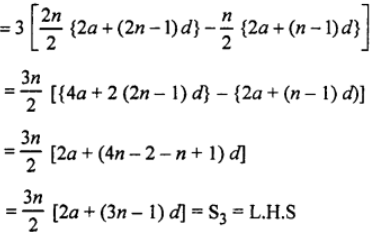
Que-30: If the sum of p terms of an A.S is q and the sum of q terms is p, show that the sum of (p + q) terms is -(p + q).
Sol: Let a be the first term and d be the common difference of given A.P.
Given Sp = q ⇒ (p/2) [2a + (p – 1)d] = q
⇒ ap + (p/2) (p – 1) d = q …(1)
and Sq = p ⇒ (q/2) [2a + (q – 1)d] = p
⇒ aq + (q/2) (q – 1) d = p …(2)
eqn. (1) – eqn. (2) gives ;
a(p – q) + (d/2) [p² – p – q² + q] = q + p
⇒ (p – q) [a+(d/2)(p+q−1)] = q + p
⇒ 2a + d(p + q – 1) = – 2 …(3) [∵ p ≠ q]
Thus S(p+q) = {(p+q)/2}[2a+(p+q−1)d]
= {(p+q)/2} (-2)
= – (p + q)
Que-31: The ratio between the sum of n terms of two A.P.’s is (7n + 1) : (4n + 27). Find the ratio of their 11 th terms.
Sol: Let the two A.P.’s are a, a + d, a + 2 d, …… and A, A + D, A + 2 D, ….
Given Sn / S′n = (7n+1)/(4n+27)
⇒ [(n/2)[2a+(n−1)d]] / [(n/2)[2 A+(n−1)D]] = (7n+1)/(4n+27)
⇒ [a+{(n−1)/2}d] / [A+{(n−1)/2}D] = (7n+1)/(4n+27) …(1)
For ratio of 11th terms i.e. T11 / T′11;
We put (n−1)/2 = 10 ⇒ n = 21 in eqn. (1);
we have
(a+10d)/(a+10D) = T11 / T′11
= (7×21+1)/(4×21+27) = 148/111
Que-32: The first term of an A.P. is a, the sum of first p terms is zero, show that the sum of its next q terms is [-a(p+q)q]/(p-1).
Sol: Given that a1 = a and Sp = 0
Sum of next q terms of the given A.P. = Sp+q – Sp
∴ S(p+q) = {(p+q)/2} [2a+(p+q-1)d]
And Sp = (p/2) [2a+(p-1)d] = 0
⇒ 2a + (p – 1)d = 0
⇒ (p – 1)d = – 2a
⇒ d = -2a/(p-1)
Sum of next q terms = Sp+q – Sp
![Que-32: The first term of an A.P. is a, the sum of first p terms is zero, show that the sum of its next q terms is [-a(p+q)q]/(p-1).](https://icsehelp.com/wp-content/uploads/2025/07/2-14.png)
Hence, the required sum = [-a(p+q)q]/(p-1).
–: End of Sequence and Series Class 11 OP Malhotra Exe-14 ISC Maths Ch-14 Solutions. :–
Return to :- OP Malhotra ISC Class-11 S Chand Publication Maths Solutions
Thanks
Please share with your friends