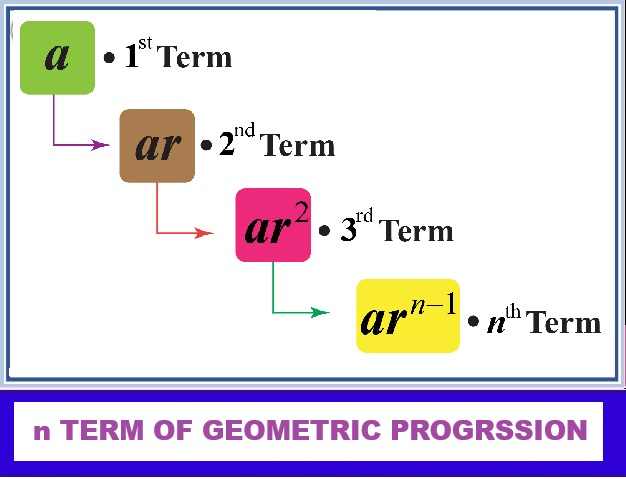
Sequence and Series Class 11 OP Malhotra Exe-14E ISC Maths Solutions Ch-14 Solutions. In this article you would learn about Geometric Progression and its nTh term. Step by step solutions of latest textbook has been given as latest syllabus. Visit official Website CISCE for detail information about ISC Board Class-11 Mathematics.
Sequence and Series Class 11 OP Malhotra Exe-14E ISC Maths Solutions Ch-14
| Board | ISC |
| Publications | S Chand |
| Subject | Maths |
| Class | 11th |
| Chapter-14 | Sequence and Series |
| Writer | O.P. Malhotra |
| Exe-14(E) | Geometric Progression and its nTh term |
Exercise- 14E
Sequence and Series Class 11 OP Malhotra Exe-14E Solution.
Que-1: Find : (i) the 7th term of 2, 4, 8, …..
(ii) the 9 th term of 1, (1/2), (1/2²), ….
(iii) the nth term of (15/8), (3/8), (3/40), ….
Sol: (i) Given sequence be 2, 4, 8,…
Here T2/T1 = 4/2 = 2; T3/T2 = 8/4 = 2 ….
Clearly given progression form G.P with first term a = 2 and common ratio r = 2
We know that Tn = arn – 1
∴ T7 = ar6 = 2 × 26 = 128
(ii) Given sequence be 1, 1/2, 1/2², ……
Here T2/T1 = 1/2; T3/T2 = (1/2²)/(1/2) = 1/2 = …..
Clearly given series form G.P with first term a = 1 and common ratio r = 1/2< 1
We know that Tn = arn – 1
∴ T9 = ar8 = 1 × (1/2)^8 = 1/256
(iii) Given sequence be, 15/8, 3/8, 3/40, ……
Here T2/T1 = (3/8)/(15/8) = 1/5; T3/T2 = (3/40)/(3/8) = 1/5 ….
Thus, the given progression forms G.P. with first term a = 15/8
and r = common ratio = 1/5
We know that Tn = arn – 1
⇒ Tn = (15/8) (15)^(n−1)
Que-2: The second term of a G.P. is 18 and the fifth term is 486. Find :
(i) the first term,
(ii) the common ratio
Sol: Let a be the first term and r be the common ratio of given G.P.
Given T2 = 18 ⇒ ar = 18 …(1) [∵ Tn = arn-1]
and T5 = 486 ⇒ ar4 = 486
On dividing (2) by (1) ; we have
r3 = 486/16 = 27 = 33 ⇒ r = 3
∴ from (1); a = 18/3 = 6
Hence the required first term be 6 and common ratio be 3 .
Que-3: Find the value of x for which x + 9, x – 6, 4 are the first three terms of a geometrical progression and calculate the fourth term of progression in each case.
Sol: Since x + 9, x – 6 and 4 are the three consecutive terms of G.P.
∴ (x – 6)2 = 4(x + 9)
[∵ if a, b, c are in G.P Then b2 = ac]
⇒ x2 – 12x + 36 = 4x + 36
⇒ x2 – 16x = 0 ⇒ x = 0, 16
When x = 0, given three terms of G.P becomes ; 9, -6 and 4 i.e. r = -6/9 = -2/3
∴ T4 = ar3 = 9 (-2/3)³ = -8/3
When x = 16, given three terms of G.P becomes ; 25, 10 and 4 with r = 10/25 = 2/5
∴ T4 = ar3 = 25 (2/5)³ = 8/5
Que-4: If 5, x, y, z 405 are the first five terms of a geometric progression, find the values of x, y and z.
Sol: Since 5, x, y, z 405 are first five terms of G.P.
Let r be the common ratio of G.P
∴ 405 = T5 = ar4 = 5r4 ⇒ r4 = 81 = 34
⇒ r = 3
∴ x = T2 = ar = 5 × 3 = 15
y = T3 = ar2 = 5 × 32 = 45
z = T4 = ar3 = 5 × 33 = 135
Que-5: Insert 3 geometric means between 16 and 256.
Sol: Let G1, G2, G3 are three GM between 16 and 256
Thus 16, G1, G2, G3, 256 are in G.P
Let r be the common ratio of given G.P.
∴ 256 = T5 = ar4 = 16 × r4
⇒ r4 = 16 = 24 ⇒ r = 2
Thus G1 = T2 = ar = 16 × 2 = 32
G2 = T3 = ar2 = 16 × 22 = 64
and G3 = T4 = ar3 = 16 × 23 = 128
Hence the required three G.M between 16 and 256 are 32, 64, 128.
Que-6: Insert 5 geometric means between 1/3 and 243.
Sol: Let G1, G2, G3, G4 and G5 are five G.M’s between 1/3 and 243 .
Then 1/3, G1, G2, G3, G4 and G5, 243 are in G.P.
Let r be its common ratio.
∴243 = T7 = ar6 = (1/3)r6 ⇒ r6 = 243 × 3 = 36
∴ r = 3
∴ G1 = T2 = ar = (1/3) × 3 = 1
G2 = T3 = ar2 = (1/3) × 32 = 3
G3 = T4 = ar3 = (1/3) × 33 = 9
G4 = T5 = ar4 = (1/3) × 34 = 27
and G5 = T6 = ar5 = (1/3) × 35 = 81
Thus the required five G.M’s between (1/3) and 243 are 1, 3, 9, 27 and 81 .
Que-7: If the A.M. and G.M. between two numbers are respectively 17 and 8, find the numbers.
Sol: Let the required two numbers are a and b
Then (a+b)/2 = 17 ⇒ a + b = 34 …(1)
Also G.M between a and b be 8
√ab = 8 ⇒ ab = 64 …(2)
Now, (a – b)2 = (a + b)2 – 4ab
(a – b)2 = 342 – 4 × 64 = 1156 – 256 = 900 = 302
⇒ a – b = ± 30
Case-I. When a – b = 30
On adding (1) and (3); we have
2a = 64 ⇒ a = 32 ∴ from (1); b = 2
Case-II. When a – b = – 30 …(4)
On adding eqn. (1) and eqn. (4); we have
2a = 4 ⇒ a = 2 ∴ from (1); b = 32
Hence the required numbers are 2 and 32 .
Que-8: The second, third and sixth terms of an A.P. are consecutive terms of a geometric progression. Find the common ratio of the geometric progression.
Sol: Let a be the first term and d be the common difference of given A.P.
Given T2, T3 and T6 of A.P are consecutive terms of G.P.
∴ T(2,3) = T2 T6
[if a, b and c are in G.P. Then b2 = ac]
⇒ (a + 2d)2 = (a + d)(a + 5d)
[∵ Tn = a + (n – 1) d]
⇒ a2 + 4ad + 4d2 = a2 + 5d2 + 6ad
⇒ 2ad = – d2 ⇒ 2a = – d
⇒ d = – 2a …(1)
∴ required common ratio of G.P = T3/T2
= (a+2d)/(a+d) = {a+2(−2a)}/{a−2a }= −3a/−a = 3
Que-9: The 5th, 8th and 11 th terms of a G.P. are P, Q and S respectively. Show that Q2 = PS.
Sol: Let a be the first term and r be the common ratio of G.P.
We know that Tn = arn – 1
Given T5 = P ⇒ ar4 = P …(1)
T8 = Q ⇒ ar7 = Q …(2)
T11 = S ⇒ ar10 = S …(3)
∴ PS = (ar4) (ar10) [using (1) and eqn. (2)]
= a2r14 = (ar7)2 = Q2 [using eqn. (2)]
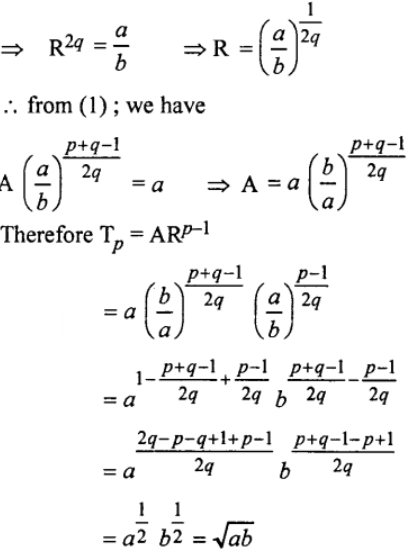
Que-10: The (p + q)th term and (p – q)th terms of a G.P. are a and b respectively. Find the pth term.
Sol: Let A be the first term and R be the common ratio of given G.P.
given Tp+q = a ⇒ ARp+q-1 = a …(1) [∵ Tn = arn-1]
Tp-q = b ⇒ ARp-q-1 = b …(2)
On dividing eqn. (1) by (2); we have
(R)p+q-1-p+q+1 = a/b
Que-11: If the pth, qth, rth terms of a G.P. are x, y, z respectively, prove that xq-r, yr-p, zp-q = 1.
Sol: Let A be the first term and R be the common ratio of given G.P.
Given Tp = x ⇒ ARp-1 = x …(1)
Tq = y ⇒ ARq-1 = y …(2)
Tr = z ⇒ ARr-1 = z …(3)
L.H.S = xq-r yr-p zp-q
= [ARp-1]p-r [ARq-1]r-p [ARr-1]p-r
= A^(q−r+r−p+p−q) R^{(p−1)(q−r)+(q−1)(r−p)+(r−1)(p−q)}
= A^0 R^[pq−pr−q+r+rq−pq−r+p+rp−rq−p+q]
= A^0 R^0 = 1 = R.H.S.
Que-12: In a set of four numbers, the first three are in G.P. and the last three are in A.P. with difference 6 . If the first number is the same as the fourth, find the four numbers.
Sol: Since it is given that, out of four numbers the first three are in G.P and last three are in A.P with common difference 6 .
Let the numbers are x, a – 6, a, a + 6. Since first three are in G.P.
∴ (a – 6)2 = ax …(1)
Also x = a + 6 ∴ from (1); we have
(a – 6)2 = a(a + 6)
⇒ a2 – 12a + 36 = a2 + 6a
⇒ 18a = 36 ⇒ a =2
∴ x = 2 + 6 = 8
Hence the required four numbers are
8, 2 -6 , 2, 2 + 6 i.e. 8, -4, 2, 8.
Que-13: If a^(1/x) = b^(1/y) = c^(1/z) and a, b, c, are in G.P., prove that x, y, z are in A.P.
Sol: Given : a^(1/x) = b^(1/y) = c^(1/z)
∴ a = kx; b = ky; c = kz
Since a, b and c are in G.P.
∴ b2 = ac ⇒ (ky)2 = kx . kz ⇒ k2y = kx+z
⇒ 2y = x + z ∴ x, y, z are in A.P.
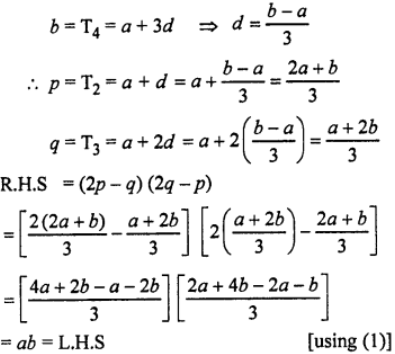
Que-14: If one G.M., G and two A.M’s p and q be inserted between two given numbers, prove that G2 =(2p – q)(2q – p).
Sol: Let a and b are two given numbers given G be the G.M between a and b
∴ G = √ab ⇒ G2 = ab
Also given p, q are two A.M’s between a and b
Then a, p, q, b are in A.P
Que-15: Construct a quadratic equation in x such that the A.M. of its roots is A and G.M. is G.
Sol: Let α and β are the roots of quadratic eqn.
s.t (α+β)/2 = A ⇒ α + β = 2A
and √αβ = G ⇒ αβ = G²
∴ required quadratic eqn. having roots α and β be given by
x2 – (α + β) x +αβ = 0
⇒ x2 – 2Ax + G2 = 0
Que-16: The fourth term of a G.P. is greater than the first term, which is positive, by 372 . The third term is greater than the second by 60 . Calculate the common ratio and the first term of the progression.
Sol: Let a be the first term and r be the common ratio of G.P.
Given T4 = T1 + 372
⇒ ar3 – a = 372 …(1)
T3 = T2 + 60
⇒ ar2 – ar = 60 …(2)
On dividing eqn. (1) and eqn. (2); we have
(r³−1)/{r(r−1)} = 372/60 = 62/10 = 31/5
⇒ {r²+r+1}/r = 31/5
⇒ 5r2 – 26r + 5 = 0
⇒ (r – 5)(5r – 1) = 0 ⇒ r = 5, 1/5
When r = 5 ∴ from (1); we have
a[125 – 1] = 372 ⇒ a = 372/124 = 3
When r = 15 ∴ from (1); we have
a[(1/125)−1] = 372 ⇒ a (−124/125) = 372
⇒ a = – 375, which is not possible.
Thus required first term be 3 and common ratio be 5.
Que-17: The first, english and twenty-second terms of an A.P. are three consecutive terms of a G.P. Find the common ratio of the G.P. Given also that the sum of the first twenty-two terms of the A.P. is 275 , find its first term.
Sol: Let a be the first term and d be the common difference of an A.P.
It is given that T1, T8 and T22 terms of an A.P. are three consecutive terms of G.P.
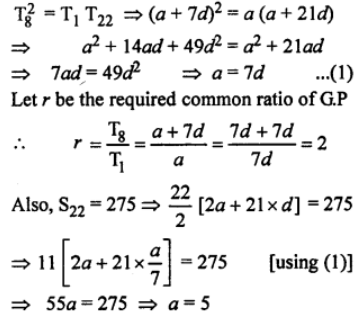
Hence the required first term be 5.
Que-18: The difference between two number is 48 and the difference between their arithmetic mean and their geometric mean is 18. Find the greater of the numbers.
Sol: The difference between two number is 48
the difference between their arithmetic mean and their geometric mean is 18.
Let the number be x and y, where x>y
x-y = 48
{(x+y)/2} – √xy = 18
x = y+48
[{(y+48)+y}/2] – √{(y+48)y} = 18
{(2y+48)/2} – √{y(y+48)} = 18
y+24 – √{y(y+48)} = 18
√{y(y+48)} = y+6
{y(y+48)} = (y+6)²
y²+48y = y²+36+12y
48y = 12y + 36
36y = 36
y = 1
x = y + 48
= 1 + 48 = 49.
Que-19: If a, b, c are in G.P. and x, y are arithmetic mean of a, b and b, c respectively, then show that (1/x)+(1/y) = (2/b).
Sol: a, b and c are in G . P a, b and c are in G . P .
∴ b² = ac ……..(i)
a, x and b are in A . P a, x and b are in A . P .
∴2x = a+b……..(ii)
Also, b, y and c are in A . P Also, b, y and c are in A . P .
∴2y = b+c
⇒ 2y = b + (b²/a) [ Using (i)]
⇒ 2y = b + {b²/(2x−b)} [ Using (ii)]
⇒ 2y = [{b(2x−b)+b²}/(2x−b)]
⇒ 2y = [{2bx−b²+b²}/(2x−b)]
⇒ 2y = {2bx/(2x−b)}
⇒ y = {bx/(2x−b)}
⇒ y(2x−b) = bx
⇒ 2xy−by = bx
⇒ bx + by = 2xy
Dividing both the sides by xy Dividing both the sides by xy :
⇒ (1/y) + (1/x) = (2/b)
Que-20: If the arithmetic mean of two numbers a and b, a>b>0, is five times their geometric mean, then show that {(a+b)/(a-b)} = (5√6)/12.
Sol: The arithmetic mean of two numbers a and b is
(a + b)/2
The geometric mean of two numbers a and b is
√ab
It is given that the arithmetic mean of two numbers a and b is five times their geometric mean. That is,
a + b/2 = 5√ab
⇒ a + b = 10√ab ….(1)
Squaring on both sides, of Eq. (1), we get
(a + b)2 = 100ab
⇒ a2 + b2 + 2ab = 100ab
⇒ a2 + b2 = 98ab
Subtracting -2ab from both sides of this equation, we get
a2 + b2 – 2ab = 98ab – 2ab
⇒ (a – b) 2 = 96ab
⇒ (a – b) = √96√ab ……(2)
Now,
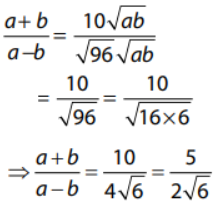
Multiplying and dividing RHS by √6, we get
(a+b)/(a-b) = (5/2√6) ×(√6/√6)
= (5√6)/12
Que-21: The product of first three terms of a G.P. is 1000. If we add 6 to the second term and 7 to the third term, the resulting three terms form an A.P. Find the terms of the G.P.
Sol: Product of first three terms of GP = 1000 (Given)
Number added to the second term = 6 (Given)
Number added to the third term = 7 (Given)
Let the three numbers be = a, ar and a/r
Thus,
a × ar × a/r = 1000
a³ =1000
a = 10
Now,
a/ r, a+6, ar +7 will form an AP
Thus, 2b = a+ c are in AP
Substituting the value –
= 2(a+6) = a/ r + ( ar + 7)
= 2 (10+6) = 10/r + (10r+7)
= 2(16) = 10/r + 10r +7
= 25 = 10/r + 10r
5 = 2/r + 2r
5r = 2+2r²
Factorizing the equation –
r = 1/2 or r = 2
Thus, if r = 1/2, then GP is 20, 10,5
If r = 2, then GP is 5,10,20.
Que-22: If the arithmetic mean of two unequal positive real number a and b (a>b) be twice as greater as their geometric mean, show that : a:b = 2+√3 : 2-√3
Sol: AM = 2GM
∴ (a+b)/2 = 2√ab
⇒ a+b = 4√ab
Squaring both the sides :
⇒ (a+b)² = (4√ab)²
⇒ a²+2ab+b² = 16ab
⇒ a²−14ab+b² = 0
Using the quadratic formula
⇒ a = [−(−14b)+√{(−14b)²−4×1×b²}/(2×1)] [∵ a is positive number ]
⇒ a = [{14b+2b√(49−1)}]/2
⇒ a = b(7+4√3)
⇒ a/b = 7+4√3
⇒ a/b = 4+3+2×2×√3
⇒ a/b = (2+√3)²
⇒ a/b = {(2+√3)²(2−√3)}/(2−√3)
⇒ a/b = {(2+√3)(4−3)}/(2−√3)
∴ a/b = (2+√3)/(2−√3)
Que-23: The sum of two numbers is 6 times their geometric mean, show that the numbers are in the ratio (3+2√2) : (3-2√2)
Sol: Let the two numbers be a and b.
Then its G.M. = √ ab
According to the given condition,
⇒ a + b = 6√ab ….(1)
⇒ (a + b)2 = 36(ab)
Also,
(a – b)2 = (a + b)2 – 4ab
= 36ab – 4ab
= 32ab
a – b = √32 √ ab
= 4√ 2 √ ab …(2)
Adding (1) and (2) , we obtain
2a = (6 + 4√2) √ ab
a = (3 + 2√2) √ ab
Substituting the value of a in (1) , we obtain
b = 6√ab – (3 + 2√2) √ ab
= (3 – 2√2) √ ab
Hence the ratio of the numbers is
a/b = [(3 + 2√2)√ ab] / [(3 – 2√2) √ ab]
= (3 + 2√2) / (3 – 2√2)
Thus, the required ratio is (3 + 2√2) : (3 – 2√2)
Que-24: A side of an equilateral triangle is 20cm long. A second equilateral triangle is described in it by joining the mid-points of the sides of the first triangle. The process is continued as shown in the accompanying diagram. Find the perimeter of the sixth inscribed triangle.
Sol: By joining the midpoints of the sides of this triangle
We get the second equilateral triangle which each side
= 20/2
= 10 cm
[∵ The line joining the mid-points of two sides of a triangle is 1/2 and parallel to third side of the triangle]
Similarly each side of the third equilateral triangle = 10/2 = 5cm
∴ Perimeter of first triangle = 20 × 3 = 60 cm
Perimeter of the second triangle = 10 × 3 = 30 cm
And the perimeter of the third triangle = 5 × 3 = 15 cm
Therefore, the series will be 60, 30, 15, …
Which is G.P. in which a = 60
And r = 30/60 = 1/2
Now, we have to find the perimeter of the sixth inscribed equilateral triangle
∴ a6 = ar6–1
= 60×(1/2)^5
= 60 × (1/32)
= 15/8 cm
Hence, the required perimeter = 15/8 cm.
–: End of Sequence and Series Class 11 OP Malhotra Exe-14F ISC Maths Ch-14 Solutions. :–
Return to :- OP Malhotra ISC Class-11 S Chand Publication Maths Solutions
Thanks
Please share with your friends