Sequence and Series Class 11 OP Malhotra Exe-14F ISC Maths Solutions Ch-14 Solutions. In this article you would learn about Sum of infinite and n term Geometric Progression. Step by step solutions of latest textbook has been given as latest syllabus. Visit official Website CISCE for detail information about ISC Board Class-11 Mathematics.

Sequence and Series Class 11 OP Malhotra Exe-14F ISC Maths Solutions Ch-14
| Board | ISC |
| Publications | S Chand |
| Subject | Maths |
| Class | 11th |
| Chapter-14 | Sequence and Series |
| Writer | O.P. Malhotra |
| Exe-14(F) | Sum of infinite and n term Geometric Progression. |
Sum of infinite / n terms of Geometric Progression
Sequence and Series Class 11 OP Malhotra Exe-14F ISC Maths Solutions Ch-14 Solutions.
Que-1: Find the sum to
(i) 8 terms of 3 + 6 + 12 + …..
(ii) 20 terms of 2 + 6 + 18 + ……..
(iii) 10 terms of 1 + √3 + 3 + …….
(iv) n terms of 3*(3/8) + 2*(1/4) + 1*(1/2) + ……
Sol: (i) Given series 3 + 6 + 12 + ……… 8 terms G.P with first term a = 3
and common ratio r = 2 > 1 and n = 8
∴ Sn = {a(r^n−1)}/(r−1) = {3(2^8−1)}/(2−1)
= 3 × 255 = 765
(ii) Given series be, 2 + 6 + 18 + …….
it clearly forms G.P with first term a = 2
and common ratio r = 6/2 = 3 > 1 ; n = 20
We know that
Sn = {a(r^n−1)}/(r−1)
= {2(3^20−1)}/(3−1)
= 3^20 – 1
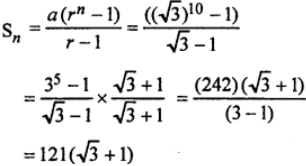
(iii) Given series be 1 + √3 + 3 +……
it clearly form G.P with first term a = 1
and common ratio = r = √3 > 1 and n = 10
We know that
(iv) Given series be, 3*(3/8) + 2*(1/4) + 1*(1/2) + ……
Clearly it forms G.P. with first term a = 3*(3/8( = 27/8
and common ratio = r = (9/4)/(27/8) = (9/4) × (8/27)
∴ r = 23 < 1
We know that Sn = {a(1−r^n)}/(1−r)
= [(27/8)[1−(2/3)^n]]/{1−(2/3)}
= (81/8) [1−(2/3)^n]
Que-2: Sum the following series to infinitely:
(i) 1 + 1/2 + 1/4 + 1/8 + ….
(ii) 16, -8, 4 ……
(iii) √2 – 1/√2 + 1/2√2 – 1/4√2 + ……
(iv) √3 + 1/√3 + 1/3√3
Sol: (i) Given series be, 1 + 1/2 + 1/4 + 1/8 + …. ∞
it clearly forms G.P with a = 1; r = 1/2 < 1
∴ S∞ = a/(1−r) = 1/(1−(1/2)) = 2
(ii) Given series be, 16 + (-8) + 4 + …. it clearly forms G.P with a = 16 and
r = −8/16 = −1/2 < 1
∴ S∞ = a/(1−r)
= 1/{61−(−1/2)}
= 16/(3/2) = 32/3
(iii) Given series be
√2 – 1/√2 + 1/2√2 – 1/4√2 …. ∞
it clearly forms G.P with first term a = √2
and common ratio r = (−1/√2)/√2 = –1/2
∴ |r| = 1/2 < 1
Thus S∞ = a/(1−r)
= {√2/{1+(1/2)}} = 2√2/3
(iv) Given series clearly forms G.P. with first term a = √3
and common ratio = r = 1/(√3/√3) = 1/3 < 1
∴ S∞ = a/(1−r)
= {√3/{1−(1/3)}}
= 3√3/2
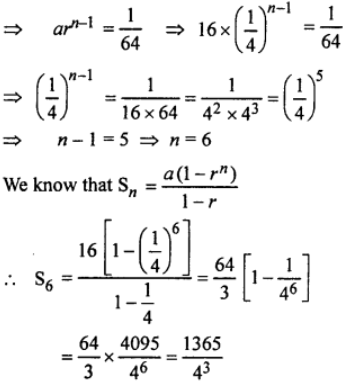
Que-3: Find the sum of a geometric series in which a = 16, r = 1/4, l = 1/64
Sol: Given : a = 16, r = 1/4, l = 1/64
Let n be the required no. of terms
Tn = 1/64
Que-4: Find the sum of the series 81 – 27 + 9 – … – 1/27
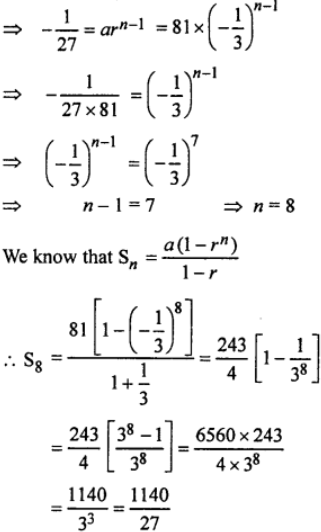
Sol: Given series be
81 – 27 + 9 – …. –1/27
it clearly forms G.P with first term a = 81
and common ratio r =−27/81 = −1/3
Also l = – 1/27
Que-5: The first three terms of a G.P. are x, x + 3, x + 9. Find the value of x and the sum of first eight terms.
Sol: Given x, x + 3 and x + 9 are in G.P.
∴ (x + 3)2 = x(x + 9)
⇒ x2 + 6x + 9 = x2 + 9x
⇒ 3x = 9 ⇒ x = 3
∴ The three terms of G.P are 3, 6, 12
Here a = 3 ; r = 6/3 = 2 > 1
Thus S8 = {a(r^n−1)}/(r−1)
= {3(2^8−1)}/(2−1) = 3 × 255
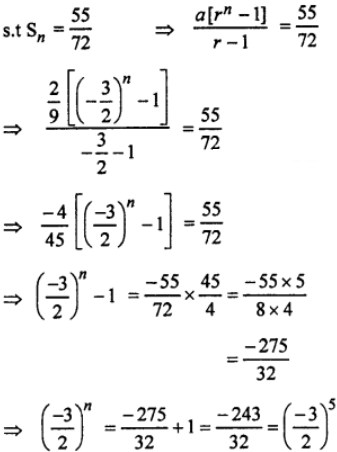
Que-6: Of how many terms is 55/72, the sum of the series (2/9)-(1/3)+(1/2)-…?
Sol: Given series forms G.P with first term a = 2/9
and common ratio = r = (−1/3)/(2/9) = −32
Let n be the required no. of terms
n = 5.
Que-7: The second term of a G.P. is 2 and the sum of infinite terms is 8 . Find the first term.
Sol: Let a be the first term and r be the common ratio of given G.P.
Given T2 = 2 ⇒ ar =2 …(1)
and S∞ = 8 ⇒ a/(1−r)) = 8
⇒ a/{1−(2/a)} = 8 [using (1)]
⇒ a²(a−2) = 8 ⇒ a² – 8a + 16 = 0
⇒ (a – 4)² = 0
⇒ a = 4
Hence the required first term of G.P be 4.
Que-8: If the 2nd and 5th term of a G.P. are 24 and 3 respectively, then find the sum of its first six terms.
Sol: Given : The 2nd term of GP is 24
The 5th term of GP is 3
Let the first term be a and common ratio be r
Tn = a.r^(n-1)
T2 = ar = 24 …….. (1)
T5 = ar^4 = 3 ………. (2)
Dividing equation (2) by (1)
ar^4 / ar = 3/24
r³ = 1/8
r = 1/2
Substitute r in eq(1) we get,
a.(1/2) = 24
a = 48
Sn = {a(1-r^n)}/(1-r)
= {48(1-(1/2)^6)} / {1-(1/2)}
= [48{1-(1/64)}] / (1/2)
= 48 [{63/64}/{1/2}]
= 48 × (63/64) × 2
= 6048/64 = 2/189.
Que-9: Find the common ratio of a G.P., if the ratio of the first three terms and first six terms is 125 : 152.
Sol: Let a be the first term and r be the common ratio of given G.P.
Now, sum of first three terms = S3 = {a(r³-1)}/(r-1)
Now, sum of first six terms = S6 = {a(r^6-1)}/(r-1)
It is given that
[{a(r³-1)}/(r-1)] / [{a(r^6-1)}/(r-1)] = 125/152
⇒ (r³-1)/(r^6-1) = 125/152
⇒ (r³-1)/{(r³)²-(1)²} = 125/152
⇒ (r³-1)/{(r³-1)(r³+1)} = 125/152
⇒1/(r³+1) = 125/152
⇒ (r³+1) = 152/125
⇒ r³ = (152/125) – 1
= (152-125)/125
= 27/125
⇒ r = 3/5
Hence, the common ratio is 3/5.
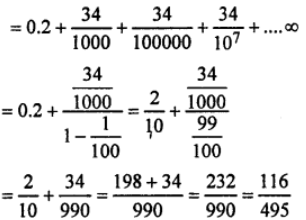
Que-10: (i) Find the value of 0.234 regarding it as a geometric series.
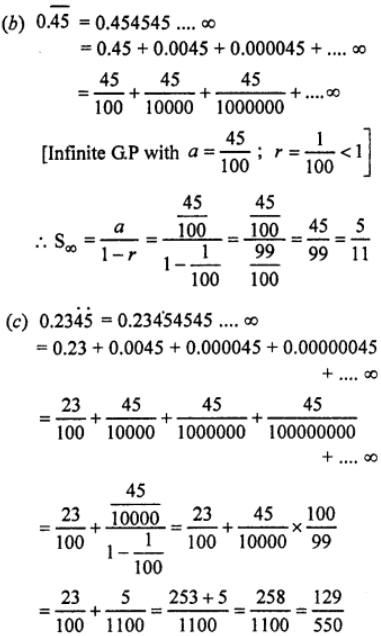
(ii) Evaluate : (a)0.97¯¯¯ (b) 0.45¯¯¯¯¯ (c) 0.2345¯¯¯¯¯
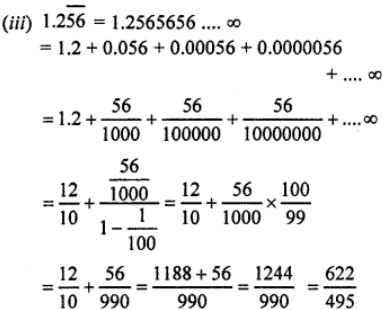
(iii) Find a rational number which when expressed as a decimal will have 1.256¯¯¯¯¯ as its expansion.
Sol: (i) 0.234 = 0.234343434……
= 0.2 + 0.034 + 0.00034 + 0.0000034 + ……..
(ii) (a) 0.97¯¯ = 0.9777…..
= 0.9 + 0.07 + 0.007 + 0.0007 + ……..
= 0.9 + (0.07)/[1-(1/10)]
= (9/10) + [(7/100)/(9/100)]
= (9/10) + (7/90)
= (81+7)/90
= 88/90 = 44/45
Que-11: If a + b + …. + l is a G.P., prove that its sum is (bl-a²)/(b-a)
Sol: Given a + b + …….. + l forms G.P.
with first term = a; r = ba and last term = l
We know that
Sn = {a(r^n−1)}/(r−1) = {ar^(n−1)⋅r−a}/(r−1)
⇒ Sn = {l⋅(b/a)−a}/{(b/a)−1}
= (lb−a²)/(b−a)
Que-12: The nth term of a geometrical progression is {2^(2n-1)}/3 for all values of the first three terms and calculate the sum of the first 10 terms, correct to 3 significant figures.
Sol: Given Tn = {2^(2n−1)}/3
∴ T1 = a = {2²−1}/3 = 2/3;
T2 = {2^(4−1)}/3 = 8/3;
T3 = 2^5/3 = 32/3;
Clearly a = 2/3
and common ratio = r = T2 / T1 = (8/3)/(2/8) = 4 > 1
We know that Sn = {a(r^n−1)}/(r−1)
∴ S10 = [(2/3){(4^10)−1}]/(4−1) = (2/9) ((4^10) – 1)
= 233016.6667 = 233000 (correct to 3 significant figures)
Que-13: A geometrical progression of positive terms and an arithmetical progression have the same first term. The sum of their first terms is 1 , the sum of their second terms is (1/2) and the sum of their third terms is 2. Calculate the sum of their fourth terms.
Sol: Let a be the first term of both series A.P and G.P
Let d be the common difference of an A.P and r be the common ratio of given G.P.
Given sum of their first terms = 1
⇒ a + a = 1 ⇒ a = 1/2
Also, second term of A.P + second term of G.P = 1/2
⇒ (a + d) + ar = 1/2 ⇒ 1/2 + d + r/2 = 1/2
⇒ 2d + r = 0 ….(1)
Also, third term of A.P + third term of G.P = 2
⇒ (a + 2d) + ar² = 2 ⇒ (1/2) + 2d + (r²/2) = 2
⇒ 4d + r² = 3 ….(2)
∴ from eqn. (1) and eqn. (2) ; we have
4d + (-2d)² = 3
⇒ 4d² + 4d – 3 = 0
⇒ d = [−4±√(16+48)]/8 = (−4+8)/8 = 1/2, –3/2
When d = 1/2 ∴ from (1); r = – 1
which is not possible since G.P is given to be progression of positive terms
∴ d = –3/2 and from (1); r = + 3
∴ required sum of fourth terms of A.P and
G.P = a + 3d + ar³ = (1/2) – (9/2) + (1/2) × 27
= – 4 + (27/2) = 19/2
Que-14: In a geometric progression, the third term exceeds the second by 6 and the second exceeds the first by 9 . Find
(i) the first term, (ii) the common ratio and (iii) the sum of the first ten terms.
Sol: Let a be the first term and r be the common ratio of G.P.
Given T3 = T2 + 6 ⇒ ar² = ar + 6
⇒ ar² – ar = 6 ….(1)
and T2 = T1 + 9 ⇒ ar = a + 9
⇒ ar – a = 9 …(2)
On dividing eqn. (1) by eqn. (2); we have
(r²−r)/(r−1) = 6/9 = 2/3
⇒ 3r² – 3r – 2r – 2
⇒ 3r² – 5r + 2 = 0
⇒ (r – 1) (3r – 2) = 0
⇒ r = 1, 2/3
when r = 1 ∴ from (1); a – a = 6 ⇒ 0 = 6
which is false.
Thus r = 2/3 ∴ from (1); we have
a((2/3)−1)=9
⇒ a(−1/3)=9
⇒ a = – 27
We know that Sn = {a(1−r^n)}/(1−r)
∴ S10 = {−27[1−(2/3)^10]}/{1−(2/3)}
= – 81 [1−(2/3)^10]
Que-15: Find the sum of the infinite series whose first term is 1 and each term is twice the sum of the succeeding terms.
Sol: Let the terms of the G . P Let the terms of the G . P .be a, a2, a3, a4, a5, …, ∞.
And, let the common ratio be r And, let the common ratio be r .
Now ,a + a2 = 1
∴a + ar = 1……..(i)
Also Also ,a = 2(a2+a3+a4+a5+…∞)
⇒ a = 2(ar+ar2+ar3+ar4+…∞)
⇒ a = 2{ar/(1−r)}
⇒1−r = 2r
⇒ 3r = 1
⇒ r = 1/3
Putting the value of r in Putting the value of r in (i):
a + (a/3) = 1
⇒ 4a/3 = 1
⇒ 4a = 3
⇒ a = 3/4
S∞ = a/(1−r) = (3/4)/{1−(1/3)}
= (3/4)/(2/3) = 2/3
Que-16: In an infinite geometric progression, the sum of first two terms is 6 and every term is four times the sum of all the terms that follow it. Find :
(i) the geometric progression and
(ii) its sum to infinity.
Sol: Let a be the first term and r be the common ratio of G.P.
given a + ar = 6 ….(1)
given Tn = = 4 [T(n+1) T(n+2)+…..]
or ar^(n-1) = 4[ar^n + ar^(n+1) … ∞]
⇒ ar^(n-1) = 4ar^n[1 + r + r² … ∞]
⇒ ar^(n-1) = (4ar^n)/(1−r)
⇒ (1 – r)r^(n-1) = 4r^n
⇒ (1 – r) = 4r ⇒ 5r = 1 ⇒ r = 1/5
∴ from (1) ; a{1+(1/5)} = 6
⇒ a × (6/5) = 6 ⇒ a = 5
Thus the required G.P is given by
a, ar, ar², …. i.e. 5, 5 × (1/5), 5 × (1/5)², …..
i.e. 5, 1, 1/5, …..
∴ S∞ = a/(1−r) = 5/{1−(1/5)}
= 5/(4/5) = 254
Que-17: Three numbers are in A.P. and their sum is 15 . If 1, 4 and 19 be added to these numbers respectively, the numbers are in G.P. Find the numbers.
Sol: Let the three numbers in A.P are
a – d, a, a + d.
Since their sum is 15.
∴ a – d + a + a + d = 15
⇒ 3a = 15 ⇒ a = 5
When 1, 4 and 19 be added to these numbers we get the numbers
a – d + 1, a + 4, a + d + 19 are in G.P.
Thus, (a + 4)2 = (a – d + 1)(a + d + 19)
⇒ (5 + 4)2 = (5 – d + 1)(5 + d + 19)
⇒ 81 = (6 – d)(24 + d)
⇒ 81 = – d2 – 18d + 144
⇒ d2 + 18d – 63 = 0
∴ d = {−18±√(324+252)}/2 = (−18±24)/2 = 3, – 21
When a = 5, d = 3
Then required numbers are ;
5 – 3, 5, 5 + 3 i.e. – 2, 5, 8
When a = 5, d = – 21
Then required numbers are;
5 + 21, 5, 5 – 21 i.e. 26, 5, -16
Que-18: Calculate the least number of terms of the geometric progression 5 + 10 + 20 + …. whose sum would exceed 10,00,000.
Sol: When G.P be 5 + 10 + 20 + ….
With first term a = 5;
common ratio = r = 10/5 = 2 > 1
We know that Sn = {a(r^n−1)}/(r−1)
∴ Sn = {5(2^n−1)}/(2−1) = 5(2n – 1)
Now we want to find the least value of n for which Sn > 10,00,000
⇒ 5(2n – 1) > 1000000
⇒ 2n – 1 > 200000 ⇒ 2n > 200001
When n = 17, we have
217 = 131072 < 200001
When n = 18, we have
218 = 262144 > 200001
Hence the least value of n be 18 .
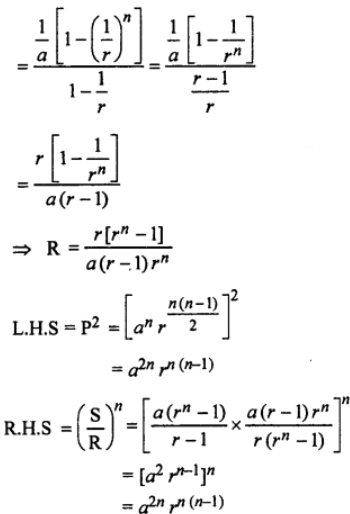
Que-19: If S be the sum, P the product and R the sum of the reciprocals of n terms in G.P., prove that P2 = (S/R)^n
Sol: Let a be the first term and r be the common ratio of given G.P.
S = {a(r^n−1)}/(r−1)
and P = a . ar . ar² ….. ar^(n-1)
= a^n r^(1+2+3….+n-1)
= a^n a^[{(n−1)/2}[1+n−1]] = a^n r^[{n(n−1)}/2]
and R = 1/a + 1/ar + 1/ar² + …. n terms
LHS = RHS
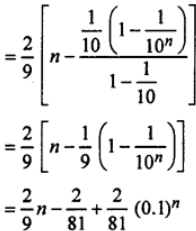
Que-20: Find the sum of the first n terms of the series : 0.2 + 0.22 + 0.222 + …..
Sol: Let Sn = 0.2 + 0.22 + 0.222 + ….. n terms
= 2[0.1 + 0.11 + 0.111 + ….. n terms]
= (2/9) [0.9 + 0.99 + 0.999 + ….. n terms]
= (2/9) [(1-0.1) + (1-0.01) + (1-0.001) + …… n terms]
= (2/9) [1 + 1 + 1 + ….. n terms] – [(1/10) + (1/100) + (1/1000) + ………. n terms]
Que-21: If (2/3) = [x-(1/y)] + [x²-(1/y²)] + …. ∞ to and xy = 2, then calculate the values of x and y with the condition that x < 1.
Sol: Given : (2/3) = [x-(1/y)] + [x²-(1/y²)] + …. ∞
= (x + x² + ……∞) – [(1/y) + (1/y²) + …….∞]
![Que-21: If (2/3) = [x-(1/y)] + [x²-(1/y²)] + …. ∞ to and xy = 2, then calculate the values of x and y with the condition that x < 1.](https://icsehelp.com/wp-content/uploads/2025/07/3-20.png)
Que-22: S1, S2, S3, ……, Sn are sums of n infinite geometric progressions. The first terms of these progressions are 1, 22 – 1, 23 – 1, ……., 2n – 1 and the common ratios are (1/2), (1/2²), (1/2³), ……., (1/2^n). Calculate the value of S1 + S2 + …… + Sn.
Sol: Given S1 be an infinite G.P with first term a1 = 1 and r1 = 1/2 < 1
∴ S1 = a1/(1−r1) = 1/(1−(1/2)) = 2
S2 be an infinite G.P with first term
a2 = 22 – 1 and common ratio r2 = 1/2²
∴ S2 = a2/(1−r2) = (2²−1)/(1−(1/4)) = 3/3 = 4
S3 be an infinite G.P with first term
a3 = 2³ – 1 and common ratio r3 = 1/2³
∴ S3 = a3/(1−r3) = (2³−1)/(1−(1/8)) = 7/(7/8) = 8
Sn be an infinite G.P with first term
an = 2^n – 1 and common ratio = rn = 1/2^n
∴ Sn = an/(1−r^n) = {2^n−1}/{1−(1/2^n)}
= {(2^n−1)2^n}/{2^n−1} = 2n
Then S1 + S2 + S3 + …. + S^n = 2 + 4 + 8 + … + 2^n
which form G.P with a = 2 and r = 2 > 1
= {a(r^n−1)}/(r−1) = {2(2^n−1)}/(2−1)
= 2(2^n−1)
Que-23: Find three numbers a, b, c between 2 and 18 such that :
(i) their sum is 25 , and
(ii) the numbers 2, a, b are consecutive terms of an arithmetic progression, and
(iii) the numbers b, c 18 are consecutive terms of a geometric progression.
Sol: Given a, b, c are three numbers between 2 and 18 .
it is given that a + b + c = 25 …(1)
Since 2, a, b are consecutive terms of an A.P.
2a = 2 + b ⇒ b = 2a – 2 …(2)
Further b, c, 18 are consecutive terms of G.P.
∴ c2 = 18b ⇒ c = √18b …(3)
Using eqn. (2) and (3) in eqn. (1); we have
{(2+b)/2} + b + √18b = 25
⇒ 2 + b + 2b + 2√18b = 50
⇒ 2√18b = 48 – 3b ⇒ 6√2b = 48 – 3b
⇒ 2√2b = 16 – b
On squaring both sides; we have
8b = (16 – b)2 ⇒ 8b = b2 + 256 – 32b
⇒ b2 – 40b + 256 = 0
⇒ b² – 40b + 256 = 0
⇒ b = {40±√(1600−1024)}/2
⇒ b = (40±24)/2 = 32, 8
since all the three numbers lies between 2 and 18
∴ b = 8 is acceptable.
∴ from (3); c = √(18×8) = √144 = 12
∴ from (1); a = 25 – 8 – 12 = 5
Hence a = 5, b = 8 and c = 12
Que-24: Three numbers, whose sum is 21 , are in A.P. If 2, 2, 14 are added to them respectively, the resulting numbers are in G.P. Find the numbers.
Sol: Let the three numbers in A.P are
a – d, a, a + d
and their sum is 21 .
∴ a – d + a + a + d = 21
⇒ 3a = 21 ⇒ a = 7
Further a – d + 2, a + 2, a + d + 14 are in G.P.
∴ (a + 2)2 = (a – d + 2)(a + d + 14)
⇒ (7 + 2)2 = (7 – d + 2)(7 + d + 14)
⇒ 81 = (9 – d)(21 + d)
⇒ 81 = 189 – 12d – d2
⇒ d2 + 12d – 108 = 0
⇒ (d – 6)(d + 18) = 0
⇒ d = 6, -18
When a = 7 and d = 6
Then required numbers are ;
7 – 6, 7, 7 + 6 i.e. 1, 7, 13.
When a = 7 and d = -18
Then required numbers are ;
7 + 18, 7, 7 – 18 i.e. 25, 7, -11.
Que-25: If the sum of an infinitely decreasing G.P. is 3 and the sum of the squares of its terms is (9/2), then find the sum of the cubes of the sum.
Sol: Given : sum of an infinite GP is 3
Sum of the squares of its terms = 9/2
S∞ = a/(1-r) = 3
a = 3 (1-r) ……….. (1)
Sum of squares = a²/(1-r²) = 9/2 ……….. (2)
Substitute (1) into (2)
{3(1-r)}²/(1-r²) = 9/2
{9(1-r)²}/(1-r²) = 9/2
(1-r)²/(1-r²) = 1/2
(1-2r+r²)/(1-r²) = 1/2
2-4r+2r² = 1-r²
3r²-4r-1 = 0
r = {4±√(16-12)}/6
r = (4±2)/6
r = 1, 1/3
Substitute r in eq (1)
a/{1-(1/3)} = 3
a/(2/3) = 3
a = 2
Sum of cubes = a³/(1-r³)
= 2³/(1-(1/3)³) = 8/{1-(1/27)}
= 8/(26/27) = 8 (27/26)
= 216/26 = 108/13.
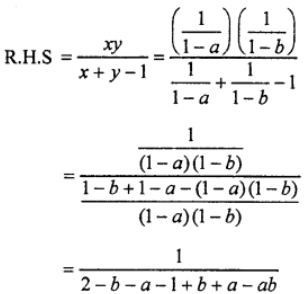
Que-26: If x = 1 + a + a2 + ….. ∞, a < 1 and y = 1 + b + b2 + ….. ∞, b < 1, then prove that 1 + ab + a2b2 + …. = {xy/(x+y-1)}
Sol: x = 1 + a + a2 + ….. ∞
Clearly form infinite G.P with first term = 1
and common ratio = a < 1
∴ x = 1/(1-a)
L.H.S. = 1 + ab + a2b2 …. ∞
Here a = 1 and C.R = ab < 1 (∵ a < 1, b < 1) = 1/(1-ab)
= 1/(1-ab)
LHS = RHS.
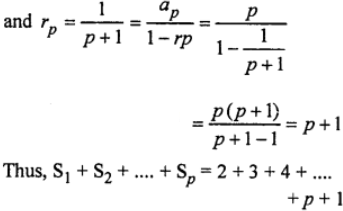
Que-27: If S1, S2, S3, Sp are the sums of infinite geometric series whose first terms are 1 , 2, 3, …., p and whose common ratios are (1/2), (1/3), ……, {1/(p+1)} respectively, Prove that S1 + S2 + S3 + …….. + Sp = (1/2) p (p+3)
Sol: S1 = infinite G.P with first term a1 = 1
and r1 = 1/2 < 1
∴ S1 = a1/(1−r1) = 1/{1−(1/2)} = 2
S2 = infinite G.P with first term a2 = 2
and r2 = 1/3 < 1
∴ S2 = a2/(1−r2) = 2/{1−(1/3)} = 2/(2/3) = 3
S3 = infinite G.P with first term a3 = 3
and r3 = 1/4 < 1
∴ S3 = a3/(1−r3) = 3/{1−(1/4)} = 4 and so on
Sp = infinite G.P with first term ap = p
= (p/2) (2+p+1)
= {p(p+3)}/2
Que-28: A person writes a letter to four of his friends. He asks each of them, to copy the letter and mail to four different persons with instruction that they move the chain similarly. Assuming that the chain is not broken and that it costs 50 paise to mail one letter. Find the amount on postage when 8th set of letters is mailed.
Sol: The first person writes four letters. The 4 people who receive the letter then write four letters each. In this way, the chain keeps increasing.
Numbers of letters on each occasion up to 4, 16, 24, …… to 8 terms
Total number of papers = 4 + 16 + 64 + …… to 8 terms
= {4(4^8-1)}/(4-1)
= (4/3) (65536-1)
= (4/3) × 65535
= 87380
Postage cost of one letter = 50 paise = 1/2 Rs.
total postage cost = 87380 × 1/2
= 43690 Rs.
–: End of Sequence and Series Class 11 OP Malhotra Exe-14F ISC Maths Ch-14 Solutions. :–
Return to :- OP Malhotra ISC Class-11 S Chand Publication Maths Solutions
Thanks
Please share with your friends