Sequence and Series Class 11 OP Malhotra Exe-14I ISC Maths Solutions Ch-14 Solutions. In this article you would learn about Series Involving Natural Numbers. Step by step solutions of latest textbook has been given as latest syllabus. Visit official Website CISCE for detail information about ISC Board Class-11 Mathematics.

Sequence and Series Class 11 OP Malhotra Exe-14I ISC Maths Solutions Ch-14
| Board | ISC |
| Publications | S Chand |
| Subject | Maths |
| Class | 11th |
| Chapter-14 | Sequence and Series |
| Writer | O.P. Malhotra |
| Exe-14(I) | Series Involving Natural Numbers. |
Exercise- 14I
Sequence and Series Class 11 OP Malhotra Exe-14I Solution.
Que-1: Find the sum to n terms of the series whose nth term is
(i) n(n + 2)
(ii) 3n2 + 2n
(iii) 4n3 + 6n2 + 2n
Sol: (i) Given Tn = n(n + 2)=n2 + 2n
∴ Sn = ΣTn = Σ (n2 + 2n) = Σn2 + 2Σn
= [{n(n+1)(2n+1)}/6] + [{2n(n+1)}/2]
= [{n(n+1)}/6] [2n + 1 + 6]
= {n(n+1)(2n+7)}/6
(ii) Given Tn = 3n2 + 2n
∴ Sn = ΣTn = 3 Σn2 + 2Σn
= [{3n(n+1)(2n+1)}/6] + [{2n(n+1)}/2]
= [{n(n+1)}/2] [2n + 1 + 2]
= {n(n+1)(2n+3)}/2
(iii) Given Tn = 4n3 + 6n2 + 2n
∴ Sn = ΣTn = 4 Σn3 + 6Σn2 + 2Σn
= [{4n²(n+1)²}/4] +[{6n(n+1)(2n+1)}/6] + [{2n(n+1)}/2]
= n(n + 1)[n(n + 1) + 2n + 1 + 1]
= n(n + 1)[n(n + 1) + 2(n + 1)]
= n(n + 1)2(n + 2)
Que-2: Find the sum of the series
(i) 3 × 5 + 5 × 7 + 7 × 9 + ….. to n terms
(ii) 12 + 32 + 52 +….. to n terms
(iii) 22 + 42 + 62 + ….. to n terms.
Sol: (i) Tn = (nth term of 3, 5, 7, ….)(nth term of 5, 7, 9, …)
= [3 + 2(n – 1)][5 + 2(n – 1)] = (2n + 1)(2n + 3) = 4n2 + 8n + 3
∴ Sn = ΣTn = 4Σn2 + 8Σn + Σ3 = [{4n(n+1)(2n+1)}/6] + [{8n(n+1)}/2] + 3n
= (n/3) [2(n + 1)(2n + 1) + 12(n + 1) + 9] = (n/3) [4n2 + 18n + 23]
(ii) Here Tn = [nth term of 1, 3, 5, ……]²
= [1 + 2(n – 1)]² = (2n – 1)² = 4n² – 4n + 1
∴ Sn = ΣTn = 4Σn² – 4Σn + n
= [{4n(n+1)(2n+1)}/6] – [{4n(n+1)}/2] + n
= [{2n(n+1)(2n+1)}/3] – 2n (n + 1) + n
= (n/3) [2(n + 1)(2n + 1) – 6(n + 1) + 3]
= (n/3) [4n² + 6n + 2 – 6n – 6 + 3] = (n/3) [4n² – 1]
= (n/3) (2n – 1) (2n + 1)
(iii) Tn = (nth term of 2, 4, 6,……..)² = [2 + (n – 1) 2]²
⇒ Tn = 4n²
∴ Sn = ΣTn = 4Σn²
= [{4n(n+1)(2n+1)}/6]
= {2n(n+1)(2n+1)}/3
Que-3: Find the nth term and the sum to n terms of the series 1.2 + 2.3 + 3.4 + ……
Sol: ∴ Tn = (nth term of 1, 2, 3, ……)(nth term of 2, 3, 4, …..)
= [1 + (n + 1) . 1] [2 + (n – 1) . 1] = n(n + 1) = n2 + n
∴ Sn = ΣTn = Σn2 + Σn = [{n(n+1)(2n+1)}/6] + [{n(n+1)}/2]
= [{n(n+1)}/6] [2n + 1 + 3]
= [{n(n+1)(2n+4)}/6] = [{n(n+1)(n+2)}/3]
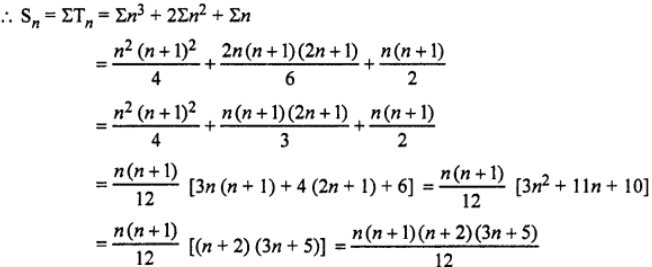
Que-4: Sum up to n terms the series 1.22 + 2.32 + 3.42 + …..
Sol: Tn = (nth term of 1, 2, 3, …..)(nth term of 2, 3, 4, …….)2 = n(n + 1)2 = n(n2 + 2n + 1)
∴ Tn = n3 + 2n2 + n
Que-5: Sum up 1 +(1 + 2) + (1 + 2 + 3) + ……. +(1 + 2 + 3 + ….. + n).
Sol: Here Tn = 1 + 2 + 3 + …… + n
= Σn = {n(n+1)}/2 = (1/2) [n² + n]
∴ Sn = ΣTn = (1/2) [Σn² + Σn]
= (1/2) [[{n(n+1)(2n+1)}/6] + [{n(n+1)}/2]]
= [{n(n+1)}/12] (2n+1+3) = [{n(n+1)(2n+4)}/12]
= {n(n+1)(n+2)}/6
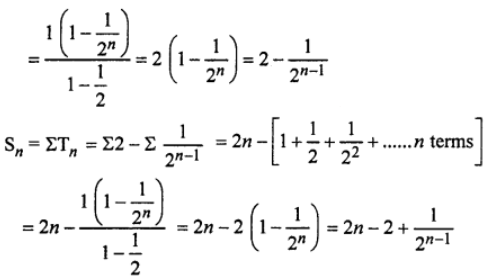
Que-6: Sum up to n terms the series 1 + (1+(1/2)) + (1+(1/2)+(1/4)) ….
Sol: Tn = 1 + 1/2 + 1/4 + ……. n terms
Que-7: Sum up to n terms the series where nth term is 2n – 1.
Sol: Given Tn = 2n – 1
∴Sn = ΣTn = Σ(2n – 1) = Σ2n – n = (21 + 22 + 23 …… n terms) – n
= {2(2^n−1)}/(2−1) − n
= 2n+1 – 2 – n
Que-8: Sum up 1 + 4 + 8 + 13 + ….. to n terms.
Sol: Let Sn = 1 + 4 + 8 + 13 +……. + Tn-1 + Tn …(1)
Sn = 1 + 4 + 8 + ….. + Tn-1 + Tn …(2)
0 = 1 + [3 + 4 + 5 + ….. (n – 1) terms] – Tn
Tn = 1 + {(n−1)/2} [6 + (n – 1 – 1) 1] = 1 + (6 + n – 2) {(n−1)/2}
⇒ Tn = 1 + [(n+4)(n−1)/2] = (1/2) [n^n + 3n + 2]
∴ Sn = ΣTn = (1/2) [Σn² + 3Σn – 2n]
= (1/2) [[{n(n+1)(2n+1)}/6] + [{3n(n+1)}/2] − 2n]
= (n/12) [(n + 1) (2n + 1) + 9 ( n + 1) – 12]
= (n/12) (2n² + 12n – 2) = (n/6) [n² + 6n – 1]
Que-9: Sum up 3 + 5 + 11 + 29 + ….. to n terms.
Sol: Let S = 3 + 5 + 11 + 29 ……. + Tn-1 + Tn …(1)
∴ S = 3 + 5 + 11 + …. + Tn-1 + Tn …(2)
eqn. (1) – eqn. (2) gives;
0 = 3 + [2 + 6 + 18 + ….. +(n – 1) terms] – Tn
⇒ Tn = 3 + [2{3^(n−1)−1}]/(3−1)
⇒ Tn = 3 + 3n-1 – 1 = 3n-1 + 2
∴ Sn = ΣTn = Σ3n-1 + 2n = [3 + 31 + 32 + …….. + 3n-1] + 2n
= [1{3^n−1}/(3−1)] + 2n = [{1(3^n−1)}/2] + 2n
Que-10: Sum to n terms the series 7 + 77 + 777 + ……..
Sol: Let Sn = 7 + 77 + 777 + …. + Tn-1 + Tn …(3)
∴ Sn = 7 + 77 + ….. + Tn-1 + Tn …(2)
eqn. (1) – eqn. (2) gives ;
0 = 7 + [70 + 700 + …… (n – 1) terms ] – Tn
⇒ Tn = 7 + 70 + 700 …… n terms = {7[10^n−1]}/(10−1) = (7/9) [10^n – 1]
∴ Sn = ΣTn = (7/9) [Σ10^n – n]
= (7/9) [10 + 10² + 10³ … n terms – n]
= (7/9) [{10(10^n−1)}/(10−1) − n]
= (7/9) [(10/9) (10^n−1)−n]
= (70/81) (10^n−1) – (7n/9)
Que-11: Sum to n terms the series 1 + 3 + 7 + 15 + 31 + ….
Sol: Let Sn = 1 + 3 + 7 + 15 + 31 + ……. + Tn-1 + Tn …(1)
∴ Sn = 1 + 3 + 7 + 15 + …… +….. Tn-1 + Tn …(2)
eqn. (1) – eqn. (2) gives ;
0 = 1 + 2 + 4 + 8 + 16 + …… n terms – Tn
⇒ Tn = {1[2^n−1]}/(2−1) = 2^n
∴ Sn = ΣTn = Σ(2n – 1) = Σ2n – n = (21 + 22 + … + n terms) – n
= [{2(2^n−1)}/(2−1)] – n = 2n+1 – 2 – n
Que-12: Find the sum to n terms of the series 1. 2. 3 + 2. 3. 4 + 3. 4. 5 + ……
Sol: Tn = (nth term of 1, 2, 3, …) × (nth term of 2, 3, 4, ……) × (nth term of 3, 4, 5, …)
= n(n + 1) (n + 2) = n (n2 + 3n + 2) = n3 + 3n2 + 2n
∴ Sn = ΣTn = Σn3 + 3Σn2 + 2Σn
= [{n²(n+1)²}/4] + [{3n(n+1)(2n+1)}/6] + [{2n(n+1)}/2]
= [{n(n+1)}/4] [n (n + 1) + 2 (2n + 1) + 4]
= [n² + 5n + 6] = {n(n+1)(n+2)(n+3)}/4
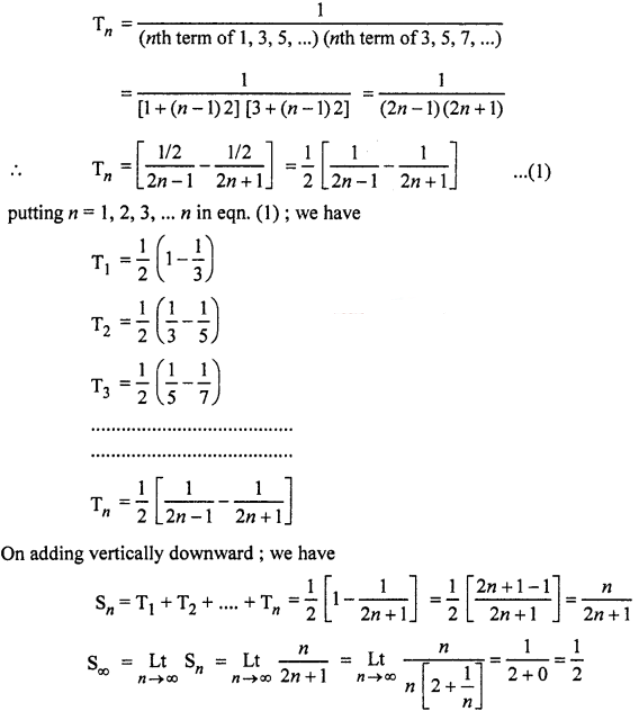
Que-13: Find the sum of the series to n terms and to infinity : 1/1.3 + 1/3.5 + 1/5.7 + 1/7.9 + …..
Sol:
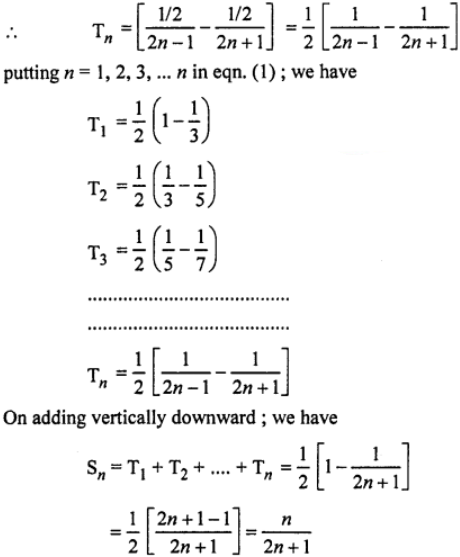
Que-14: Sum to n terms the series whose nth term is 1/(4n²-1)
Sol: Tn = 1/(4n²-1) = 1/(2n-1)(2n+1)
Que-15: Natural numbers are written as
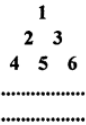
Show that the sum of the numbers in the nth group is (n/2) (n²+1)
Sol: First term of nth group is the nth term of series 1, 2, 4, …..
Let Sn = 1 + 2 + 4 + …… + Tn-1 + Tn …(1)
∴ Sn = 1 + 2 + …… + Tn-1 + Tn …(2)
∴ eqn. (1) – eqn. (2) gives ;
Tn = 1 + [1 + 2 + 3 ……(n – 1) terms]
∴ Tn = 1 + [{(n−1)n}/2] = {n²−n+2}/2
Thus first term of nth group = A = {n²−n+2}/2
and last term of nth group is the nth term of series 1, 3, 6, ……
Let Sn = 1 + 3 + 6 + 10 + …… + Tn-1 + Tn ….(3)
∴ Sn =1 + 3 + 6 + ….. + Tn-1 + Tn …(4)
eqn. (3) – eqn. (4) gives ;
0 = 1 + 2 + 3 + 4 + …… n terms – Tn
⇒ Tn = Σn = {n(n+1)}/2
∴ last term of nth group = L = {n(n+1)}/2
Hence required sum of numbers in nth groups = (n/2) [ A+L]
= (n/2) [{(n²−n+2)/2} + {(n(n+1))/2}]
= (n/4) [n²−n+2+n²+n]
= (n/4) [2n²+2] = (n/2) (n²+1)
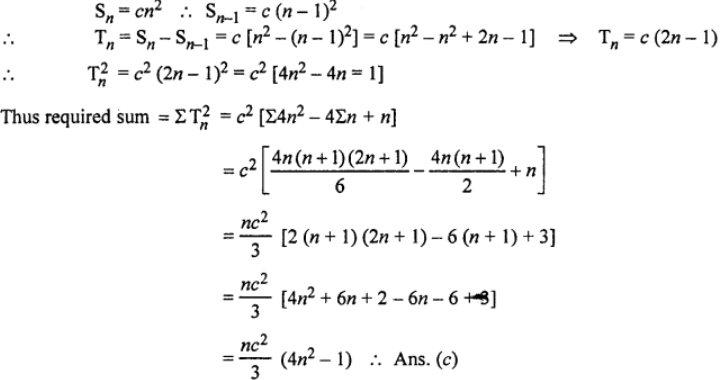
Que-16: If the sum of first n terms of an A.P. is cn², then the sum of squares of these n terms is
(a) {n(4n²−1)c²}/6
(b) {n(4n²+1)c³}/3
(c) {n(4n²−1)c²}/3
(d) {n(4n²+1)c²}/6
Sol:
–: End of Sequence and Series Class 11 OP Malhotra Exe-14I ISC Maths Ch-14 Solutions. :–
Return to :- OP Malhotra ISC Class-11 S Chand Publication Maths Solutions
Thanks
Please share with your friends