Short Ans Type on Physical Quantities and Measurement Class 6 Concise Physics ICSE Solutions Ch-2. In this article you would learn how to solve short answer type questions on Physical Quantities and Measurement. Visit official Website CISCE for detail information about ICSE Board Class-6.
Short Ans Type on Physical Quantities and Measurement Class 6 Concise Physics ICSE Solutions
| Board | ICSE |
| Publications | Selina Publication |
| Subject | Physics |
| Class | 6th |
| Chapter-2 | Physical Quantities and Measurement |
| Book Name | Concise |
| Topics | Solution of Short Answer Type |
| Academic Session | 2025-2026 |
Short Answer Type Questions on Physical Quantities and Measurement
Que-1: What is measurement ? How is a measurement expressed?
Ans- Measurement is a comparison of an unknown quantity with a known fixed quantity of the same kind. A measurement needs two things to express itself :
(i) The unit u, and
(ii) The number n which tells us how many times that unit is contained in that quantity.
Thus, a measurement is expressed as :
Measurement = n х u = nu
Que-2: State two characteristics of a unit.
Ans- A unit must have the following characteristics :
(i) It should be of convenient size, and
(ii) It must be universally accepted, i.e. its value must remain same at all places and at all times. It should not change with the change of place or time.
Que-3: Name four basic measurements in our daily life.
Ans- Four basic measurements in our daily life are:
(i) Length
(ii)Mass
(iii)Time
(iv)Temperature
Que-4: What are the S.I. units of (i) mass (ii) length (iii) time and (iv) temperature ? Write their names and symbols.
Ans-
| Physical Quantity | S.I. Unit | Symbol for S.I. unit | |
|---|---|---|---|
| (i) | Length | metre | m |
| (ii) | Mass | Kilogram | kg |
| (iii) | Time | second | s |
| (iv) | Temperature | Kelvin | K |
Que-5: Define one metre, the S.I. unit of length. State its one multiple and one sub multiple.
Ans- One metre is defined as the distance travelled by light in air in 1/(3×108) of a second.
Multiple : Kilometre (symbol km)
1 km = 1000 m
Submultiple : Centimetre (symbol cm)
1 cm = 1/100 m or 10-2 m
Que-6: The diagram below shows a stick placed along a metre ruler. The length of the stick is measured keeping the eye at positions A, B and C.
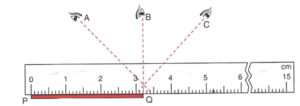
(i) Write the length of stick PQ as observed, for each position of the eye. Are they all same ?
(ii) Which is the correct position of the eye? Write the correct length of the stick.
Ans- (i) For A position :
PQ = 3.4 cm
For B position :
PQ = 3.2 cm
For A position :
PQ = 3.0 cm
No, length of PQ observed from positions A, B and C are not same.
(ii) The correct position for the eye is position B due to low parallax error. The correct length of PQ is 3.2 cm.
Que-7: Define mass. State its (i) S.I. (ii) C.G.S and (iii) F.P.S units. How are they related?
Ans-The mass of a body is the quantity of matter contained in it.
(i) S.I. Unit — Kilogram (kg)
(ii) C.G.S unit — Gram (g)
(iii) F.P.S unit — Pound (lb)
Relationship between kilogram, gram and pound
1 kg = 1000 g = 2.20462 lb,
1 g = 10-3 kg = 2.20462 10-3 lb
1 lb = 453.59 g = 0.45359 kg
Que-8: Name the instrument which is commonly used to measure the mass of a body. State how it is used.
Ans- The instrument commonly used to measure the mass of a body is a beam balance.
To use it, the body is placed on one pan and standard weights on the other until the beam becomes horizontal again. The total weight on the right pan gives the mass of the body.
Que-9: Define one kilogram, the S.I. unit of mass. How is it related to (i) quintal (ii) metric tonne and (iii) gram?
Ans- 1 kilogram is the mass of 1 litre (= 1000 ml) of water at 4°C.
(i) 1 quintal = 100 kilogram
(ii) 1 metric tonne = 1000 kilogram
(iii) 1 gram = 10-3 kilogram
Que-10: Name and define the S.I. unit of time. How is it related to (i) minute (ii) hour, (iii) day and (iv) year?
Ans- The S.I. unit of time is second (s). One second is defined as 1/86400 part of a mean solar day.
(i) 1 minute = 60 seconds
(ii) 1 hour = 3600 seconds
(iii) 1 day = 86400 seconds
(iv) 1 year = 3.15 x 10⁷ seconds
Que-11: Name two devices used to measure the short time interval of an event.
Ans- (i) Stop clock
(ii) Stop watch
Que-12: What does the temperature measure ?
Ans- The temperature is the measure of degree of hotness or coldness of an object.
Que-13: Name the (i) S.I. unit and (ii) one common unit of temperature. Write their symbols also.
Ans- (i) S.I. unit : kelvin (symbol : K)
(ii) Common unit : Degree fahrenheit (symbol : °F)
Que-14: Write the temperature of (i) melting ice (ii) boiling water.
Ans- (i) Temperature of melting ice : 0°C
(ii) Temperature of boiling water : 100°C
Que-15: What is the normal temperature of the human body? How is it indicated in a clinical thermometer?
Ans- Normal temperature of human body is 37°C or 98.6°F. In a clinical thermometer the red arrow indicates the temperature (i.e, 37°C or 98.6°F) of a normal healthy person.
Que-16: Can a clinical thermometer be used to measure the temperature of boiling water ? Give reason for your answer.
Ans- No, a clinical thermometer can not be used to measure the temperature of boiling water (i.e. 100 °C) because it can measure only up to 42 °С.
Que-17: Explain the term ‘area of a surface’.
Ans- The total surface occupied by an object is called area of a surface or simply the area.
Que-18: Name the S.I. unit of area and define it.
Ans- The S.I. unit of area is square metre or metre2 which in short form is written as m² and one square metre is the area of a square of each side length of 1 metre.
Que-19: How are the units (i) square yard (ii) hectare (iii) km2 (iv) cm2 (v) mm2 related to the S.I. unit of area?
Ans-S.I. unit of area is m2
(i) 1 square yard = 1 yard × 1 yard = 0.9144 m × 0.9144 m = 0.836 m2
(ii) 1 hectare = 100 m × 100 m = 10000 m2 = 104 m2
(iii) 1 km2 = 1 km × 1 km = 1000 m × 1000 m = 106 m2
(iv) 1 cm2 = 1 cm × 1 cm = (1/100 m)×(1/100 m)=1/10000 m2=10-4 m2
(v) 1 mm2 = 1 mm × 1 mm = (1/1000 m)×(1/1000 m)=1/1000000 m2=10-6 m2
Return to:- ICSE Class-6 Concise Selina Solutions
Please, Share with your friends
Thanks