Short Answer Questions on Force Class 6 Concise Physics ICSE Solutions Ch-3. In this article you would learn how to solve Short Answer Questions on Force . Visit official Website CISCE for detail information about ICSE Board Class-6.
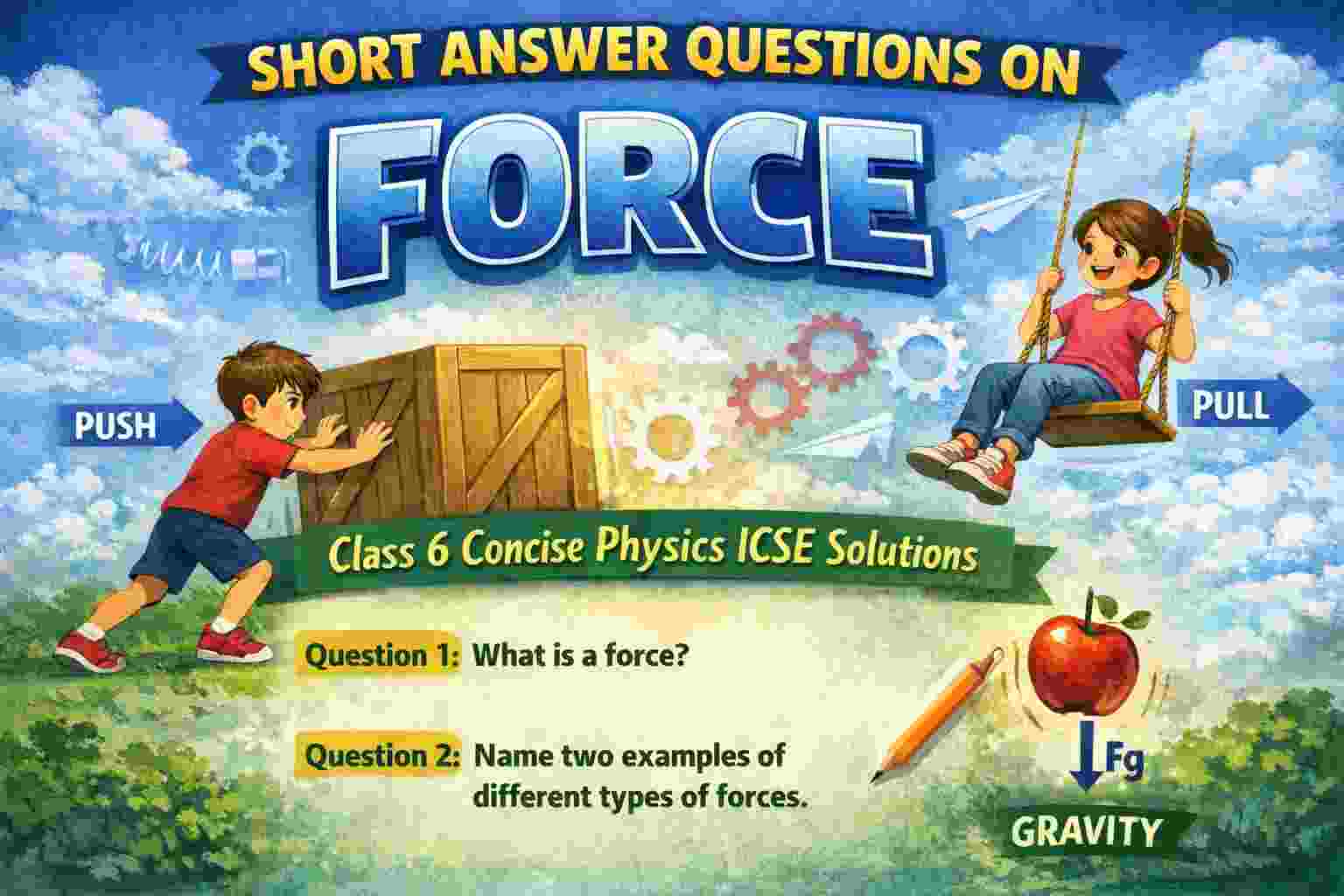
Short Answer Questions on Force Class 6 Concise Physics ICSE Solutions
| Board | ICSE |
| Publications | Selina Publication |
| Subject | Physics |
| Class | 6th |
| Chapter-3 | Force |
| Book Name | Concise |
| Topics | Solution of Short Answer Questions |
| Academic Session | 2025-2026 |
Short Answer Questions on Force
Que-1: Name the term used for the push or pull.
Ans- Force.
Que-2: Give one example each of a force as
(i) a push
(ii) a pull
(iii) a stretch and
(iv) a squeeze.
Ans- Examples are given below :
(i) Force as push : Pushing a shopping trolley in a market.
(ii) Force as pull : Pulling a drawer open.
(iii) Force as stretch : Stretching clothes while putting them on a line.
(iv) Force as squeeze : Pressing clay to give it a shape.
Que-3: Explain the meaning of the term force.
Ans- Force is a push or a pull acting on an object. It can: (i) change the shape of an object, (ii) change the speed of an object, (iii) change the direction of motion or (iv) bring a moving object to rest.
Que-4: What effect can a force have on a stationary body?
Ans- A force can have the following effects on a stationary body: (i)It can set the body in motion. (ii) It can change the shape or size of the body.
Que-5: What effects can a force have on a moving body?
Ans- A force can have several effects on a moving body. In simple terms, it can change how the body moves or even deform it. Here are the main effects:
(i) Change in speed: A force can increase the speed (accelerate the body) or decrease the speed (decelerate or slow it down).
(ii) Change in direction of motion: A force can make a moving body turn or change its path without changing its speed.
(iii) Change both speed and direction: A force can change both the speed and direction at the same time.
(iv) Bring the body to rest: A force can stop a moving body completely.
(v) Change in shape or size: A force may deform the body while it is moving.
Que-6: What effect can a force produce on a body which is not allowed to move?
Ans- If a body is not allowed to move, a force cannot change its position, but it can still produce an important effect:
Change in shape or size : When a force is applied to a body that is fixed or constrained, the force causes the body to deform.
Que-7: Give one example each to indicate that the application of a force
(i) produces motion
(ii) stops motion
(iii) slows down motion
(iv) changes the direction of motion
(v) deforms a body.
Ans- (i) produces motion : Kicking a stationary football makes it start moving.
(ii) stops motion : Applying brakes to a moving bicycle stops it.
(iii) slows down motion : Applying brakes to a moving car reduces its speed.
(iv) changes the direction of motion : Hitting a moving ball with a bat changes its direction.
(v) deforms a body : Stretching a rubber band changes its shape.
Que-8: State the effect produced by a force in the following cases :
(i) The sling of a rubber catapult is stretched
(ii) A man pushes a heavy cart
(iii) A player uses his stick to deflect the ball
(iv) A cyclist applies brakes
(v) A spring is compressed.
Ans- (i) The sling of a rubber catapult is stretched : The force changes the shape of the rubber sling.
(ii) A man pushes a heavy cart : The force sets the cart in motion or increases its speed.
(iii) A player uses his stick to deflect the ball : The force changes the direction of motion of the ball.
(iv) A cyclist applies brakes : The force reduces the speed of the bicycle or brings it to rest.
(v) A spring is compressed : The force changes the shape of the spring.
Que-9: Name the two kinds of forces in nature.
Ans- The two kinds of forces are:
(i) Contact forces
(ii) Non contact forces
Que-10: Name the type of force which acts in the following cases :
(i) A coolie lifts a luggage
(ii) A bicycle comes to rest slowly when the cyclist stops pedalling
(iii) A stone falls from a roof
(iv) A comb rubbed with silk attracts bits of paper
(v) A string hangs with a load
(vi) A horse moves a cart
(vii) A magnet attracts an iron pin
(viii) A boy opens a door
(ix) An apple falls from a tree
(x) A man rows a boat
Ans- (i) A coolie lifts a luggage : Muscular force
(ii) A bicycle comes to rest slowly when the cyclist stops pedalling : Frictional force
(iii) A stone falls from a roof : Gravitational force
(iv) A comb rubbed with silk attracts bits of paper : Electrostatic force
(v) A string hangs with a load : Tension force
(vi) A horse moves a cart : Muscular force
(vii) A magnet attracts an iron pin : Magnetic force
(viii) A boy opens a door : Muscular force
(ix) An apple falls from a tree : Gravitational force
(x) A man rows a boat : Muscular force
Que-11: Define the term “weight of a body”.
Ans- Weight of a body is the force with which the Earth attracts the body towards its centre.
Que-12: What do you understand by the term friction?
Ans- Friction is the force that opposes the relative motion between the two surfaces in contact with each other.
Que-13: Give an example to illustrate the existence of force of friction.
Ans- When you push a book on a table, it does not move easily and after some distance it stops. This happens because a force of friction acts between the surface of the table and the book, opposing its motion.
Que-14: What is the cause of friction?
Ans- Friction is caused due to the interlocking of irregularities (roughness) present on the surfaces in contact with each other.
Que-15: State two factors which directly affect the force of friction.
Ans- Two factors that directly affect the force of friction are:
(i) Nature (roughness or smoothness) of the surfaces in contact – Rough surfaces produce more friction, while smooth surfaces produce less friction.
(ii) Force pressing the two surfaces together (normal force or load) – Greater the load or pressure, greater is the force of friction.
Que-16: In which case will there be more friction between a truck and the road : when the truck is empty or when it is loaded ?
Ans- There will be more friction when the truck is loaded.
Reason: When the truck is loaded, its weight increases. This increases the force pressing the tyres against the road, which in turn increases the force of friction.
Que-17: Which offers more friction on a body : a glass surface or a wooden surface ?
Ans- A wooden surface offers more friction on a body than a glass surface.
Reason: Wooden surfaces are rough, while glass surfaces are smooth. Rough surfaces produce more friction than smooth surfaces.
Que-18: Name the three kinds of friction.
Ans- Three kinds of friction are as follow :
(i) Static friction
(ii) Sliding friction
(iii) Rolling friction
Que-19: List three disadvantages of friction.
Ans- Three disadvantages of friction are:
(i) Causes wear and tear of machine parts and moving objects.
(ii) Produces heat, leading to loss of energy.
(iii) Reduces efficiency of machines by opposing motion and slowing down movement.
Que-20: List three ways of reducing friction.
Ans- Three ways of reducing friction are:
(i) Lubrication – Applying oil, grease, or graphite reduces friction by making surfaces smooth.
(ii) Polishing surfaces – Smoother surfaces produce less friction.
(iii) Using wheels or ball bearings – Rolling friction is much less than sliding friction.
Que-21: Give three examples to illustrate that friction is a necessary evil.
Ans- Three examples showing that friction is a necessary evil:
(i) Walking: We can walk because of friction between our feet and the ground. Without friction, we would slip. (Necessary) But it also causes wear of shoes (Evil)
(ii) Writing: We can write with a pen or pencil due to friction between the tip and paper. (Necessary) But it wears down the pen nib or pencil . (Evil)
(iii) Braking in vehicles: Brakes stop vehicles due to friction. (Necessary) But friction causes wear and heating of brake parts . (Evil)
Que-22: Define
(i) static friction
(ii) sliding friction and
(iii) rolling friction.
(ii) Sliding friction: The force of friction that acts when one surface slides over another surface is called sliding friction. It opposes the motion of the sliding object.
(iii) Rolling friction: The force of friction that acts when a body rolls over a surface is called rolling friction. It is much smaller than sliding friction.
Que-23: Arrange the following in descending order of magnitude :
(i) static friction
(ii) sliding friction
(iii) rolling friction
Ans- Descending order of magnitude: Static friction > Sliding friction > Rolling friction
So, (i) > (ii) > (iii).
— : End of Short Answer Questions on Force Class 6 Concise Physics ICSE Solutions :–
Return to:- ICSE Class-6 Concise Selina Solutions
Please, Share with your friends
thanks