Short Answer Questions on Light Class 6 Concise Physics ICSE Solutions Chapter-5. In this article you would learn how to solve short answer questions on Light. Visit official Website CISCE for detail information about ICSE Board Class-6.
Short Answer Questions on Light Class 6 Concise Physics ICSE Solutions
| Board | ICSE |
| Publications | Selina Publication |
| Subject | Physics |
| Class | 6th |
| Chapter-5 | Light |
| Book Name | Concise |
| Topics | Solution of Short Answer Questions |
| Academic Session | 2025-2026 |
Short Answer Questions on Light
Que-1: What is light ? Define it.
Ans- Light is a form of energy that affects our eyes to produce the sensation of vision.
Que-2: How does light make an object visible ?
Ans- An object becomes visible to us when the light after striking the object gets reflected and reaches our eyes.
Que-3: Name two natural sources of light.
Ans- Two natural sources of light are :
(i)Sun
(ii)A firefly
Que-4: List two artificial sources of light.
Ans- Two artificial sources of light are :
(i) Electric tubelight
(ii) A burning candle
Que-5: Differentiate between luminous and non-luminous bodies. Give two examples of each.
Ans-
| Luminous bodies | Non-luminous bodies | |
|---|---|---|
| (i) | They shine and glow by their own light. | They do not emit light by their own. |
| (ii) | A luminous body becomes visible when light emitted from it reaches our eyes. | A non-luminous body becomes visible when light from a luminous body falls on it and after striking it, light reaches our eyes. |
| (iii) | Example : sun, torch. | Example : moon, earth. |
Que-6: Is the moon a luminous object ?
Ans- The moon is not a luminous body as it has no light of its own.
Que-7: What do we call a body that shines on its own?
Ans- A body that shines on its own is called luminous body.
Que-8: What do we call an electric bulb producing light ?
Ans- An electric bulb producing light is called an artificial source of light.
Que-9: What is a transparent medium? Give two examples.
Ans- A medium is said to be transparent if light passes through it easily so an object can be distinctly seen across a transparent substance. The examples of transparent medium are glass, air, etc.
Que-10: What do we call a substance through which we cannot see light ? Give an example of such a substance.
Ans- A substance through which we cannot see light is called opaque. The examples of opaque substances are metallic sheets, black paper, etc.
Que-11: What do we call a substance through which light passes? Give an example of such a substance.
Ans- A substance through which light passes is called transparent substance. The example of a transparent substance is glass.
Que-12: Can a transparent medium form an image? Explain your answer.
Ans- No, a transparent medium cannot form an image because it allows light to pass through it without changing its path significantly. For an image to be formed, light needs to be redirected or blocked, which does not happen in a transparent medium.
Que-13: How can you obtain a point source of light?
Ans- A point source of light is obtained either by placing a screen having a fine hole, in front of the luminous body or by placing the luminous body inside a box having a fine hole on one of its sides.
Que-14: Define the terms : a ray of light and a beam of light.
Ans- Ray of light : The light travelling in any one direction in a straight line is called a ray of light.
Beam of light : A group of light rays given out from a source is called a beam of light.
Que-15: What do you mean by ‘rectilinear propagation of light’?
Ans- The motion of light in a straight line path is called the rectilinear propagation of light.
Que-16: In which of the following two arrangements (a) and (b) shown in figure below, you can see the light of the bulb? Explain your answer.
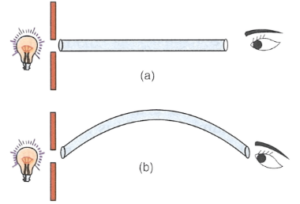
Ans- In arrangement (a) light of the bulb can be seen because light travels in a straight line path but in arrangement
(b) as the straw is bent, the light of the candle flame does not reach our eye.
Que-17: Name a simple application of the rectilinear propagation of light.
Ans- Pin hole camera is a simple application of the rectilinear propagation of light.
Que-18: State two factors which affect the size of image formed in a pin hole camera.
Ans- The size of an image depends on the following two factors :
(i)The distance of screen from the pin hole.
(ii)The distance of object in front of the pin hole.
Que-19: Is the image obtained in a pin hole camera erect or inverted? Give reason for your answer.
Ans- The image obtained is inverted because in a pinhole camera, light rays from the top of the object pass through the tiny hole and travel in a straight line to reach the bottom of the screen inside the camera and light rays from the bottom of the object go to the top of the screen. As a result, the top becomes bottom and the bottom becomes top. So, the image is inverted (upside down).
Que-20: How is the image affected in a pin hole camera when another fine hole is made near the first pin hole ?
Ans- If another pin hole is made near the first pin hole, two images are formed on the screen, one due to each of the two pin holes. If the holes are very close, the two images tend to overlap each other. As a result, a blurred image will be seen.
Que-21: State the effect on the image in a pin hole camera if:
(a) the hole is made bigger.
(b) the luminous object is moved towards the pin hole.
(c) the length of the pin hole camera is increased (i.e. the screen is moved away from the pin hole).
Ans- (a) If the hole is made bigger then a blurred image is seen because a bigger hole is equivalent to a large number of pin holes and each pin hole produces one image so these images overlap each other resulting in a blurred image.
(b) If the luminous object is moved towards the pin hole i.e., the distance of object from the pin hole is decreased then the size of the image increases.
(c) On increasing the the length of the pin hole camera i.e., distance of screen from the pin hole, the size of image also increases.
Que-22: What is a shadow? Give a reason for its formation.
Ans- If an opaque object is placed in front of a point source of light, it obstructs the passage of light and produces a dark patch on a screen placed behind the object. This dark patch is called the shadow of the opaque object.
The shadow is formed because light from the source travels in straight lines.
Que-23: State two differences between an umbra and a penumbra.
Ans-
| (i) | It is the portion of shadow where no light reaches from the source of light due to the opaque object. | It is the portion of shadow where a portion of light from the source of light reaches the shadow even in the presence of the opaque object in between them. |
| (ii) | It is completely dark. | It is not completely dark, but is dim (or less bright). |
Que-24: Why is it that the birds flying in the sky do not cast their shadows on the earth ?
Ans- The birds flying in the sky do not cast their shadows on the earth because in their shadow, the umbra is absent and the penumbra is too large and too faint that it is not visible as the distance of earth (i.e, screen) is very large from the bird (i.e, object).
Que-25: Why are shadows at noon shorter than in the morning or in the evening?
Ans: Shadows are shorter at noon because the sun is directly overhead or nearly so. This causes the sunlight to fall vertically on objects, resulting in shorter shadows.
Que-26: What is an eclipse? Name the two types of eclipses.
Ans: As the sun is bigger in size than the earth and the earth is bigger in size than the moon so when the sun, the earth and the moon come in a straight line, the earth or the moon whichever comes in between, casts its shadow on the other and causes an eclipse.
Two types of eclipses are :
1. Lunar eclipse
2. Solar eclipse
Que-27: When does a lunar eclipse take place ? Does it occur on every full moon’s night?
Sol: When the earth comes in between the sun and the moon, the earth casts its shadow on the moon and the part of the moon which lies within the umbra of earth, will not be visible from the earth. Thus, the lunar eclipse takes place.
No, lunar eclipse does not occur on every full moon’s night because the Moon’s orbit is slightly tilted with respect to Earth’s orbit. Due to this tilt, the Sun, Earth, and Moon do not always line up perfectly in a straight line during every full moon.
Que-28: When does a solar eclipse take place ? Does it occur on every new moon’s day?
Sol: When the moon comes in between the sun and the earth, the moon casts its shadow on the earth and in the part of the earth which lies in the umbra of the moon, the sun is not visible. Thus, total solar eclipse occurs.
No, solar eclipse does not occur on every new moon’s day because the Moon’s orbit is slightly tilted with respect to Earth’s orbit. Due to this tilt, the Sun, Earth, and Moon do not always line up perfectly in a straight line during every new moon’s day.
–
— : End of Short Answer Questions on Light Class 6 Concise Physics ICSE Solutions :–
Return to:- ICSE Class-6 Concise Selina Solutions
Please, Share with your friends
thanks