Significance of Baye’s Theorem Class 12 OP Malhotra Exe-19A ISC Maths Solutions Ch-19. In this article you would learn about significance of baye’s theorem and how to apply it . Step by step solutions of latest textbook has been given as latest syllabus. Visit official Website CISCE for detail information about ISC Board Class-12 Mathematics.
Significance of Baye’s Theorem Class 12 OP Malhotra Exe-19A ISC Maths Solutions Ch-19
| Board | ISC |
| Publications | S Chand |
| Subject | Maths |
| Class | 12th |
| Chapter-19 | Baye’s Theorem |
| Writer | OP Malhotra |
| Exe-19(a) | Significance of Baye’s Theorem and How to Apply it |
Significance of Baye’s Theorem and How to Apply it
Baye’s Theorem Class 12 OP Malhotra Exe-19A Solutions
Que-1: Bag A contains 2 white and 3 red balls and bag B contains 4 white and 5 red balls. One ball is drawn at random from one of the bags and is found to be red. Find the probability that it was-drawn from bag B.
Sol: Given Bag A contains 2 white and 3 red balls Bag B contains 4 white and 5 red balls Consider the following events as :
E1 = bag A is chosen
E2 = bag B is chosen
A = Drawing one red ball
Then P(E1) = 1/2; P(E2) = 1/2
[Since there are 2 bags]
∴ P (A | E1)
= P[Drawing one red ball from bag A]
= 3/5
P(A / E2)
= P[Drawing one red ball from bag B]
= 5/9
We want to find P (Drawing, one red ball is from bag B) = P(E2 / A)
Then By Baye’s theorem, we have
Required probability = P(E2/ A)
= P(E2)P(A/E2)/P(E1)P(A/E1)+P(E2)P(A/E2)
= (1/2×5/9)/(1/2×3/5 + 1/2×5/9)
= 5/9 / (3/5+5/9)
= 5/9 /( 27+25 / 45)
= 5/9 × 45/52
= 25/52
Que-2: There are two bags I and II, containing 3 red and 4 white balls, and 2 red and 3 white balls respectively. A bag is selected at random and a ball is drawn from it. It is found to be a red ball, find the probability that it is drawn from the first bag.
Sol: Given bag-I contains 3 red and 4 white balls bag-II contains 2 red and 3 white balls Let us define the events as follows:
E1 : bag- I is selected
E2 : bag-II is selected
E : a red ball is drawn
∴ P(E1) = P(E2) = 12
Clearly E1 and E2 are mutually exclusive and exhausitive events.
P(E / E1) = prob. of drawing red ball from bag-I = 3/7
P(E / E2) = prob. of drawing a red ball from bag-II = 2/5,
we want to find the prob. that ball drawn from first bag when it is found that it is red. i.e. To find P(E1 / E)
Then by Baye’s Theorem, we have
P(E1 / E) = P(E/E1)P(E1)/(P(E/E1)P(E1) + P(E/E2)P(E2))
= 3/7×1/2 / (3/7×1/2 + 2/5×1/2)
= 3/7 / (3/7+2/5)
= 3/7 / (15+14/35)
= 3/7 × 35/29
= 15/29
Que-3: Suppose that 5 men out of 100 and 25 women out of 1000 are good orators. An orator is chosen at random. Find the probability that a male person is chosen. Assume that there are equal number of men and women.
Sol: Consider the following events :
E2 = Selected person is male
E2 = Selected person is female
A = Selected person is an orator
Then P(E1) = 1/2; P(E2) = 1/2
[Since number of males and females are equal] and P(A | E1) = P (Selecting person be a male orator)
= 5/100 = 1/20
P(A/ E2) = P(Selecting person be a female orator)
= 251000 = 140
We want to find the probability that the orator chosen be a male = P(E1/ A)
Then By baye’s theorem, we have
P(E1/ A) = P(E1)P(A/E1)/(P(E1)P(A/E1) + P(E2)P(A/E2))
= 1/2×1/20 / (1/2×1/20 + 1/2×1/40)
= 1/(1 + 1/2)
= 2/3
∴ Required probability = 2/3
Que-4: Suppose that 5 % of men and 0.25 % of women have grey hair. A grey haired person is selected at random, what is the probability of this person being male? Assume that there are equal number of males and females.
Sol: Let us define the events are as follows :
E1 : person selected is male
E2 : person selected is female
E : person is having grey hair
Then P(E1) = P(E2) = 1/2
Thus E1 and E2 are mutually exclusive and exhausitive events.
P(E/ E1) = prob. that person is having grey hair is male = 5/100
P(E / E2) = prob. that person is having grey hair is women = 0.25 % = 0.25/100
Now we want to find the prob. that person being male when it is given that he is having grey hair i.e. to find P(E1 / E).
Thus by Baye’s Theorem, we have
P(E1|E) = P(E∣E1)P(E1)/∑2i=11P(E∣Ei)P(Ei)
= 5/100×1/2 / (5/100×1/2 + 0.25/100×1/2)
= 5/100 / (5/100+0.25/100)
= 5/5.25
= 500/525
= 20/21
Que-5: A company has two plants to manufacture scooters. Plant I manufactures 7 0 % of the scooters and plant II manufactures 30 %. At plant I, 80 % of scooters are rated standard quality and at plant II, 9 0 % of scooters are rated standard quality. A scooter is picked up at random and is found to be of standard quality. What is the chance that it was from plant II ?
Sol: Let us define the events as follows :
E1 : scooter is manufactured by plant-I
E2 : scooter is manufactured by plant-II
Then P(E1) = 70 % = 70/100 = 7/10;
P(E2) = 30 % = 30/100 = 3/10
Let E : scooter is of standard quality Thus E1 and E2 are mutually exclusive and exhausitive events.
Also P(E | E1) = prob. of getting scooter of standard quality and coming from plant I
= 80 % = 80/100
P(E | E2) = prob. of getting scooter of standard quality from plant II = \frac{90}{100}
= 9/10
Now we want to find P(E2)
Thus by Baye’s Theorem, we have
P(E2) = P(E|E2)P(E2) / (P(E|E1)P(E1) + P(E|E2)P(E2))
= 9/10×3/10 / (8/10×7/10 + 9/10×3/10)
= 27/100 / 83/100
= 27/83
Que-6: A company has two plants to manufacture bicycles. The first plant manufactures 60 % of the bicycles and the second plant 40 % .80 % of the bicycles are rated of standard quality at the first plant and 90 % of standard quality at the second plant. A bicycle is picked up at random and found to be of standard quality. Find the probability that it comes from the second plant.
Sol: Let us consider the events :
E1 = Selecting bicycle manufactured by first plant
E2 = Selecting bicycle manufactured by second plant
A = selected bicycle is of standard quality Thus, P(E1) = 60/100;
P(E2) = 40/100; and P(A | E1 = P
(Selecting a bicycle of standard quality from first plant ) = 80/100
P(A / E2) = P( Selecting bicycle of standard quality from second plant ) = 90/100
We want to find, P (Selected bicycle of standard quality is from second plant)
= P(2/ A)
Then By Baye’s theorem, we have
= P(E2/ A)
= P(E2)P(A/E2)P(E1)P(A/E1)+P(E2)P(A/E2)
= 40/100×90/100 / (60/100×80/100 + 40/100×90/100)
= 3600 / (4800+3600)
= 3600/8400
= 3/7
∴ Required probability = 3/7.
Que-7: A has an alarm which will ring at the appointed time with probability 0.9 . If the alarm rings, it will awake him and he will/ each the examination hall in time with probability 0.8 . If the alarm does not ring, A will get up at his own time to reach the
examination hall in time, with probability 0.3. K now ing that the person \boldsymbol{A} reached the hall in time, find the probability that the alarm ring.
Sol: Let us define the events are as follows :
E1 : alarm rings
E2 : alarm donot rings
E : person A reached the hall in time.
Thus P(E1) = 0.9 ; P(E2) = 1 – 0.9 = 0.1
∴ E1 and E2 are mutually exclusive and exhausitive events.
Given, P(E | E1) = prob. that person A reached the hall in time when it is given that alarm rings = 0.8
P(E | E2) = prob. that person A reached the hall in time when it is given that alarm donot rings = 0.3
We want to find P(E1 | E)
Thus by Baye’s Theorem, we have
P(E1 | E) = P(E∣E1)P(E1) / ∑2i=1P(E∣Ei)P(Ei)
= 0.8×0.9 / (0.8×0.9 + 0.3×0.1)
= 0.72/0.75
= 72/75 = 24/25 = 0.96
Que-8: By examining the chest X-rays, probability that T.B. is detected when a person is actually suffering, is 0.99 . The probability that the doctor diagnoses incorrectly that a person has T.B. on the basis of X-ray is 0.001 . In a certain city 1 in 1000 persons suffers from T.B. A person selected at random is diagnosed to have T.B. What is the chance that he actually has T.B.
Sol: Consider the following events:
E1 = The person selected is actually suffering from T.B.
E2 = The person selected is not suffering from T.B.
A = The selected person diagnosed to have T.B.
Then P(E1) = 1/1000;
P(E2) = 999/1000
∴ P(A/ E1) = probability that person diagnosed to have T.B. and he is actually having T.B. = 0.99
and P(A/ E2) = probability that person diagnosed to have T.B. and he is not actually having T.B. = 0.001
We want to find, probability that person diagnosed to have T.B. is actually having T.B. = P(E1/ A)
Then by baye’s theorem, we have
P(E1/ A) = P(E1)P(A/E1) / (P(E1)P(A/E1) + P(E2)P(A/E2))
= (1/1000×0.99) / (1/1000×0.99 + 999/1000×0.001)
= 990/(990+999)
= 990/1989
= 110/221
Thus, required probability = 110/221.
Que-9: Shoes are produced by two machines A and B .50 % of the shoes are produced by machine A with an estimate of 10 % of them being defective. On machine B, 20 % of the shoes produced are defective if a shoe taken at random is found to be defective, what is the probability that shoe was produced by machine A I
Sol: Let us define the events are as follows:
E1: shoes are produced by machine A
E2 : shoes are produced by machine B
Then P(E1) = 50 % = 1/2;
P(E2) = 1/2
∴ E1 and E2 are mutually exclusive and exhausitive events.
Let E : shoe is taken to be defective
∴ P(E | E1) = 10 % = 1/10;
∴ P(E | E2) = 20 %
= 20/100
= 2/10
we want to find P(E1 | E).
Thus by Baye’s Theorem, we have
P(E1 | E) = P(E|E1)P(E1)/(P(E|E1)P(E1) + P(E|E2)P(E2))
= 1/10×1/2 / (1/10×1/2 + 2/10×1/2) = [latex]1/10 / (1/10 + 2/10)
= 1/3
Que-10: In a large company, 15 % of the employees are graduates (G), and of these, 80 % work in administrative posts (A). Of the non-graduate (NG) employees of the company, 10 % work in administrative posts. Find the probability that an employee of this company selected at random from those working in administrative posts will be a graduate.
Sol: Let us define the events are as follows:
E1 : employees are graduate
E2 : employees are Non-graduate
E : employee of the company working in administrative post
Then P(E1) = 15 % = 15/100
∴ P(E2) = 85 % = 85/100
∴ P(E | E1) = 80 % = 80/100;
∴ P(E | E2) = 10 % = 10/100
We want to find (E1 | E).
Then by Baye’s Theorem, we have
P(E1 | E) = P(E|E1)P(E1) / (P(E|E1)P(E1) + P(E|E2)P(E2))
= 80/100×15/100 / (80/100×15/100 + 10/100×85/100)
= 1200 / (1200+850)
= 1200/2050
= 120/205
= 0.585
Que-11: Three urns contain 6 red and 4 black, 4 red and 6 black, and 5 red and 5 black balls respectively. One of the urns is selected at random and a ball is drawn from it. If the ball drawn is red, find the probability that it is drawn from the first urn.
Sol: Given urn I contains 6 red and 4 black balls urn II contains 4 red and 6 black balls urn III contains 5 red and 5 red balls Let us define the events are as follows:
E1 : urn-I is chosen
E2 : urn-II is chosen
E3 : urn-III is chosen
E : ball drawn is red.
Then P(E1) = P(E2) = P(E3) = 1/3
∴ E1 and E2, E3 are mutually exclusive and exhausitive events.
Also P(E | E1) = prob, of drawing a red ball from urn l = 6/10
P(E | E2) = prob. of drawing red ball from urn 11 = 4/10
P(E | E3) = prob. of drawing red ball from urn III = 5/10
We want to find P(E1 | E).
Thus by Baye’s theorem, we have
P(E1 | E) = P(E|E1)P(E1)/ ∑3i=11P(E|Ei)P(Ei)
= 6/10×1/3 / (6/10×1/3 + 4/10×1/3 + 5/10×1/3)
= 6/10 / (6/10+4/10+5/10)
= 6/15
= 2/5
Que-12: Three mris are given, each containing red and black balls as indicated below:
Urn I: 6 rid and 4 black balls.
Urn II: 2 red and 6 black balls.
Urn III: 1 red and 8 black balls.
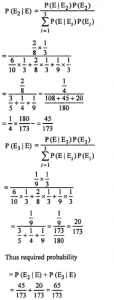
An urn is chosen at random and a ball is drawn from the urn. The ball drawn is red. Find the probability that the ball is drawn.either from urn II or from urn III.
Sol: Given urn I : 6 red and 4 black ball
urn II : 2 red and 6 black ball
urn III : 1 red and 8 black ball
Let us define the events are as follows :
E1 : urn I is chosen
E2 : urn II is chosen
E3 : urn III is chosen
Then P(E1) = P(E2) = P(E3) = 1/3
∴ E1, E2 and E3 be mutually exclusive and exhausitive events.
Let E : ball drawn is red.
∴ P(E | E1) = prob. of drawing a red ball from urn-I = 6/10
P(E | E2) = prob. of drawing a red ball from urn-II = 2/8
P(E | E3) = prob. of drawing a red ball from urn-III = 1/9
Thus by Baye’s Theorem,
Que-13: Suppose that there is a chance for a newly constructed house to collapse whether the design is faulty or not. The chance that the design is faulty is 20 %. The chance that the house collapses if the design is faulty is 98 % and otherwise it is 25 %. It is seen that the house collapsed. What is the probability, that it is due to faulty design?
Sol: Let us define the events are as follows :
E1 : design of house is faulty
E2 : design of house is not faulty
E : house is collapsed
Then P(E1) = 20 % = 0.2;
P(E2) = 1 – 0.2 = 0.8
∴ E1 and E2 are mutually exclusive and exhaustive events.
Also P(E | E1) = Prob. that house is collapsed when it is given that design is faulty = 98 % = 0.98
P(E} | E2) = prob. that house is collapsed when it is given that design is not faulty = 25 % = 0.25
We want to find P(E1 | E)
Thus by Baye’s Theorem, we have
P(E1 | E) = P(E|E1)P(E1)/((P(E|E1)P(E1) + P(E|E2)P(E2))
= 0.98×0.2 / (0.98×0.2 + 0.25×0.8)
= 0.196 / (0.196+0.2)
= 0.196/0.396
= 196/396
= 49/99
Que-14: In an automobile factory, certain parts are to be fixed to the chasis in a section before it moves into another section. On a given day, one of the three persons A, B and C carries out this task. A has 45 % B has 35 % and C has 20 % chance of doing it. The probability that A, B and C will take more than the allotted time are 1 / 6, 1 / 10 and 1 / 20 respectively. If it is found that none of them has taken more time, what is the probability that A has taken more time?
Sol: Let us define the events are as follows:
E1 : Task carry out by person A
E2 : Task carry out by person B
E3 : Task carry out by person C
E : event of taking more time than the allotted time
Then P(E1) = 45/100;
P(E2) = 35/100;
P(E3) = 20/100
P(E | E1) = prob. that A takes more time than the allotted time = 16
P(E | E2) = 1/10;
P(E | E3) = 1/20
We want to find P(E1 | E)
Thus by Baye’s Theorem, we have
P(E1 | E) = P(E∣E1)P(E1)/ ∑3i=11P(E∣Ei)P(Ei)
= 1/6×45/100 / (1/6×45/100 + 1/10×35/100 + 1/20×20/100)
= 45/600 / (450+210+60)/6000
= 45/600×6000/720
= 45/72
= 5/8
Que-15: Urn A contains 2 white, 1 black and 3 red balls, urn B contains 3 white, 2 black and 4 red balls and urn C contains 4 white, 3 black and 2 red balls. One urn is chosen at random and 2 balls are drawn at random from the urn. If the chosen balls happen to be red and black, what is the probability that both balls come from urn B?
Sol: Given urn A contains 2 white, 1 black and 3 red balls
urn B contains 3 white, 2 black and 4 red balls
and urn C contains 4 white, 3 black and 2 red balls
Let us define the events as follows :
E1 : urn A is chosen
E2 : urn B is chosen
E3 : urn C is chosen
E : chosen ball happen to be red and black.
Then P(E1) = P(E2) = P(E3) = 1/3
P(E | E1) = prob. of drawing 1 red and 1
black ball from urn A = 3C1×1C1/6C2
= 3 / (6×5/2)
= 1/5
P(E | E2) = probability of drawing 1 red and 1 black ball from urn B = 2C1×4C1/9C2
= 2×4 / (9×8/2)
= 16/72
= 2/9
P(E | E3) = prob. of drawing 1 red and 1
black ball from urn C = 3C1×1C1/6C2
= 3×2/(9×8/2)= 1/6
We want to find P(E2 | E)
Thus by Baye’s Theorem, we have
P(E2 | E) = =P(E∣E2)P(E2)/∑3i=1P(E∣Ei)P(Ei)
= 2/9×1/3 / 1/5×1/3+2/9×1/3+1/6×1/3
= 2/9 / 1/5+2/9+1/6
= 2/9 / 18+20+15/90
= 2/9×90/53
= 20/53
Que-16: Three bags contain balis as shown in the following table :
| Bag | Number of | ||
| White balls | Black balls | Red balls | |
| I | 1 | 2 | 3 |
| II | 2 | 1 | 1 |
| III | 4 | 3 | 2 |
A bag is chosen at random and two balts are drawn. They happen to be white and red. What is the probability that they came from the third bag?
Sol: Let us define the events are as follows:
E1 : bag I is chosen
E2 : bag II is chosen
E3 : bag III is chosen
E : Two drawn balls are white and red
Since E1, E2 and E3 are mutually exclusive and exhaustive events.
∴ P(E1) = P(E2) = P(E3) = 1/3
Also, P(E | E1) = prob. of drawing one white and one red ball from bag-I
= 1C1×3C1/6C2
= 3/(6×5/2)
= 1/5
P(E | E2) = prob. of drawing one white and one red ball from bag II
= 2C1×1C1/6C2
= 2/(4×3/2) = 1/3
P(E | E3) = porb. of drawing one white and one red ball from bag III
= 4C1×2C1/9C2
= 4×2/(9×8/2)
= 2/9
We want to find P(E3 | E)
Thus by Baye’s Theorem, we have
P(E3 | E) = P(E∣E3)P(E3)/∑3i=1P(E∣Ei)P(Ei)
= 2/9×1/3 / (1/5×1/3 + 1/3×1/3 + 2/9×1/3)
= 2/9 / 1/5 + 1/3 + 2/9
= 2/9 / (9+15+10/45)
= 2/9 × 45/34
= 5/17
Que-17: In a bolt factory, machines A, B and C manufacture 25 %, 35 % and 40 % respectively. Of the total of their output 5,4 , and 2 per cent are defective. A bolt is drawn and found to be defective.
(i) What are the probabilities that it was manufactured by the machines A, B and C ?
(ii) Find the probability that it was manufactured by either machine A or C.
Sol: (i) Let us define the events are as follows :
E1 : bolt is manufactured by machine A
E2 : bolt is manufactured by machine B
E3 : bolt is manufactured by machine C
Then P(E1) = 25 % = 25/100;
P(E2) = 35 % = 35/100
and P(E3) = 40 % = 40/100
Let E : drawing a defective bolt. P(E | E1) = prob. of drawing a defective bolt from machine A = 5 % = 5/100
P(E | E2) = prob. of drawing a defective bolt from machine B = 4 % = 4/100P(E | E3) = prob. of drawing a defective bolt from machine C = 2 % = 2/100 We want to find P(E1 | E), P(E2 | E) and P(E3 | E)
Thus by Baye’s Theorem; we have
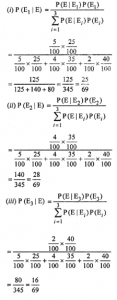
(ii) ∴ required probability
=P(E1 | E)+P(E3| E)
= 25/69 + 16/69
= 41/69
Que-18: A company has two plants to manufacture cars. Plant I manufactures 80 per cent of the cars and plant II manufactures 20 per cent. At plant I, 85 out of 100 cars are rated standard quality or better. At plant II, only 65 out of 100 cars are rated standard or better.
(i) What is the probability that cars selected at random came from plant I and it is known that the car is of standard quality?
(ii) What is the probability that the cars came from plant II if it is known that the car is of standard quality?
Sol: (i) Let us define the events are as follows :
E1 : car is manufactured by plant-I
E2 : car is manufactured by plant-II
∴P(E1) = 80/100;
P(E2) = 20/100
Thus E1 and E2 are mutually exclusive and exhaustive events.
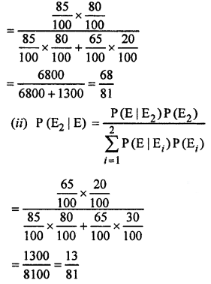
Let E : car is of standard or better quality. Also, P(E | E1)
= Prob. that a standard quality car came from plant-I = 85/100 P(E | E2)
= prob. that a standard quality car came from plant -II = 65/100
We want to find P(E1 | E)
Thus by Baye’s Theorem, we have
P(E1 | E)
= P(E∣E1)P(E1)/∑2i=1P(E∣Ei)P(Ei)
Que-19: A company has two plants to manufacture cars. Plant I manufactures 80 per cent of the cars and plant II manufactures 20 per cent. At plant I, 85 out of 100 cars are rated standard quality or better. At plant II, only 65 out of 100 cars are rated standard or better.
(i) What is the probability that cars selected at random came from plant I and it is known that the car is of standard quality?
(ii) What is the probability that the cars came from plant II if it is known that the car is of standard quality?
Sol: Consider the following events :
E1= Bolt produced by machine X
E2 = Bolt produced y} machine Y
E3 = Bolt produced by machine Z
A = A bolt drawn is defective.
∴ P(E1) = 1000/6000 = 1/6;
P(E2) = 2000/6000
= 1/3
and P(E3) = 3000/6000
= 1/2
Thus P(A | E1) = probability defective bolt from machine X = 1/100
P(A | E2)= probability of drawing defective bolt from machine Y = 1.5/100
= 3/200
P(A/E3) = probability of drawing defective bolt from machine
Z = 2/100
We want to find, probability of defective bolt drawn is produced by machine X
= P(E1 / A)
P(E1 / A) = P(E1)P(A/E1)/)P(E1)P(A/E1) + P(E2)P(A/E2) + P(E3)P(A/E3))
= 1/6×1/100 / (1/6×1/100 + 1/3×3/200 + 1/2×2/100)
= 1/600 / (1/600+3/600+1/100)
= 1/10
Thus, required probability = 1/10.
Que-20: A card from a pack of 52 cards is lost. From the remaining cards of the pack, two cards are drawn and are found to be both diamonds. Find the probability of the lost card being a diamond.
Sol: Let us define the events are as follows :
E1 : lost card is a diamond card
E2 : lost card is not of diamond.
E : both drawn cards, are of diamond suit Then P(E1) = prob. of drawing a diamond
card = 13/52 = 1/4
P(E2) = 1 – 1/4 = 3/4
∴P(E | E1) = prob. of drawing two diamond cards when it is given that lost card is a diamond card
= 12C2/51C2
P(E | E2) = prob. of drawing two diamond cards given that lost card is not of diamond card = 13C2/51C2
We want to find P(E1 | E)
Thus by Baye’s Theorem, we have
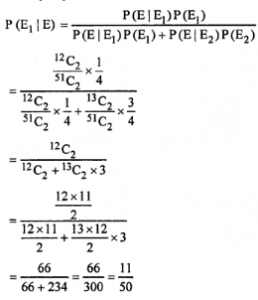
Que-21: A speaks the truth 2 out of 3 times and B, 4 out of 5 times. They agree in the assertion that from a bag containing 6 balts of different colours a black ball has been drawn. Find the probability that the statements are true.
Sol: The prob. of drawing a black ball = 16 prob. of drawing a non-black ball
= 1 – 1/6
= 5/6
Given P( A speaks truth )= 2/3
P(B speaks truth )= 4/5
∴ Prob. that both A and B agree in assertion that it is black ball = 1/6 × 2/3 × 4/5
= 45 = P(I)
Then prob. that A} asserts wrongly i.e. a certain ball is black = P(A tell a lie ). P(of drawing a ball from 5 balls other than black)
= (1 – 2/3) × 1/5
= 1/15
The prob. that B} asserts wrongly i.e. a certain ball is black = P(B tell a lie).P (of drawing a ball from 5 balls other from black)
= (1 – 4/5) × 1/5
= 1/25
Thus when a non black ball is drawn and both A and B agree in asserting that it is black
= 5/6 × 1/15 × 1/25
= 1/450 = P (II)
Thus by Baye’s Theorem, required probability that statement is true
= P(I)P(I)+P(II)
= 4/45 / (4/45+1/450)
= 4/45 / ((40+1)/450)
= 4/45 × 450/41
= 40/41
Que-22: In 2004, there will be three candidates for the position of principal C1, C2 and C3. The chances of their selection are in the proportion 4 : 2 : 3 respectively. The probability that C1, if selected, will introduce co-education in the college is 0.3 . The probabilities of C2 and C3 doing the same are respectively 0.5 and 0.8 .
(i) What is the probability that there will be co-education in the college in 2004?
(ii) Also, find the probability that principal C2 introduces co-education in the college.
Sol: Let us define the events are as follows :
E1 : C1 be selected as a principal
E2 : C2 be selected as a principal
E3 : C3 be selected as a principal
E : Introduction of co-education in the college
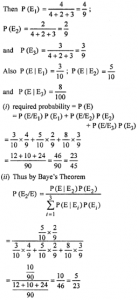
Que-23: You note that your officer is happy on 60 % of your calls, so you assign a probability of his being happy on your visit as 0.6 or 6 / 10. You have noticed also that if he is happy, he accedes to your request with a probability of 0.4 or 4 / 10 whereas if he is not happy, he accedes to the request with a probability of 0.1 or 1/10. You call one day, and he accedes to your request. What is the probability of his being happy?
Sol: Let us define the events are as follows :
E1 : The officer is being happy
E2 : The officer is be not happy
E : The officer accedes to request
Then P(E1) = 6/10
and P(E2) = 1 – 6/10
= 4/10
Also, P(E | E1) = prob. that he accedes to request when it is given that officer is being happy
= 4/10
P(E | E1) = probability that he accedes to request when it is given that officer is not happy
= 1/10
We want to find P(E1 | E)
Thus by Baye’s Theorem, we have
P(E1 | E) = P(E/E1)P(E1)P(E/E1)P(E1)+P(E/E1)P(E¯1)
= 4/10×6/10 / (4/10×6/10 + 1/10×4/10)
= 24/100 / (24/100 + 4/100)
= 24/28
= 6/7
Que-24: The chance that a female worker in a chemical factory will contract an occupational disease is 0.04 and the chance for a male worker 0.06 . Out of 1000 workers in a factory 200 are females. One worker is selected at random and the worker is found to have contracted the disease. What is the probability that the worker is a female?
Sol: Let us define the events are as follows :
E1 : worker is a female
E2 : worker is a male
E : The worker is found to have contracted the disease.
Then
P(E1) = 200/1000 = 2/10;
P(E2) = 800/1000 = 8/10
∴ P(E | E1) = probability that female worker will contract an occupational disease = 0.04
P(E | E2) = probability that male worker will contract an occupational disease = 0.06
We want to find P(E1 | E)
Thus by Baye’s Theorem, we have
P(E1 | E) = P(E/E1)P(E1)/(P(E/E1)P(E1) + P(E/E2)P(E2))
= 0.04×2/10 / (0.04×2/10 + 0.06×8/10)
= 8/1000 / (8/1000 + 48/1000)
= 8/56
= 1/7
Que-25: An insurance company insured 2000 scooter drivers, 4000 car drivers and 6000 truck drivers. The probability of an accident involving a scooter driver, car driver and a truck driver is 0.01,0.03 and 0.15 respectively. One of the insured persons meets with an accident. What is the probability that he is a scooter driver? [Type solved Ex. 20.]
Sol: Let us define the events are as follows :
E1 : Insured person is scooter driver
E2 : Insured person is car driver
E3 : Insured person is truck driver
E : Insured person meets an accident
Then
P(E1) = 2000 / (2000+4000+6000)
= 2000/12000 = 1/6
P(E2) = 4000 / (2000+4000+6000)
= 4000/12000
= 1/3
P(E3) = 6000 / (2000+4000+6000)
= 6000/12000 = 1/2
Also P(E | E1) = probability of an accident involving a scooter driver = 0.01
P(E | E2) = probability of an accident involving a car driver = 0.03
P(E | E3) = probability of an accident involving a truck driver = 0.15
We want to find P(E1 | E)
Thus by Baye’s Theorem, we have
P(E1 | E) = 2000 / (2000+4000+6000)
= 0.01×1/6 / (0.01×1/6 + 0.03×1/3 + 0.15×1/2)
= 0.01/6 / (0.01+0.06+0.456)
= 0.01/0.52 = 1/52
Que-26: There are three coins. One is a two headed coin (having head on both faces), another is a biased coin that comes up heads 75 % of the times and the third is also a biased coin that comes up tails 40 % of the times. One of the three coins is chosen at random and tossed and it shows head. What is the probability that it was the two headed coin?
Sol: Let us consider the events :
E1 : first coin is chosen
E2 : second coin is chosen
E3 : third coin is chosen
∴ P(E1) = 1/3, P(E2) = 1/3,
P(E3) = 1/3
Let A denote the event when the toss shows a heads.
It is also given that
P(A / E1) = 1, P(A / E2) = 0.75,
P(A / E2)= 0.6
We want to find P(E1 / A).
Then by Baye’s theorem, we have
= 1/3(1) / (1/3(1) + 1/3(0⋅75) + 1/3(0⋅60))
= 1/4 / 47/60
= 20/47
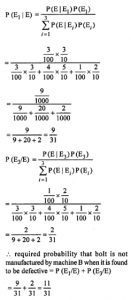
Que-27: In a factory which manufactures bolts, machines A, B and C manufacture respectively 30 %, 50 % and 20 % of the bolts of their outputs, 3 %, 4% and 1 % respectively are defective bolts. A bolt is drawn at random from the product and is found to be defective. Find the probability that this is not manufactured by machine B.
Sol: Let us define the events are as follows :
E1 : bolt manufactured by machine A
E2 : bolt manufactured by machine B
E3 : bolt manufactured by machine C
E : bolt is found to be defective
Then
P(E1) = 30 % = 30/100 = 3/10;
P(E2) = 50/100 = 5/10;
P(E3) = 20 % = 20/100 = 2/10
Also P(E | E1) = prob. that bolt is defective and it is given that it is produced by
machine A = 3/100
P(E | E2) = 4/100;
P(E | E3) = 1/100
Thus by Baye’s Theorem, we have
–: End of Significance of Baye’s Theorem Class 12 OP Malhotra Exe-19A ISC Maths Solutions :–
Return to :- OP Malhotra ISC Class-12 S Chand Publication Maths Solutions
Please share with your friends
Thanks