Statistics Class 11 OP Malhotra Exe-28B ISC Maths Ch-28 Solutions. In this article you would learn about Median in an Ungrouped Frequency Distribution. Step by step solutions of latest textbook has been given as latest syllabus. Visit official Website CISCE for detail information about ISC Board Class-11 Mathematics.
Statistics Class 11 OP Malhotra Exe-28B ISC Maths Solutions Ch-28
| Board | ISC |
| Publications | S Chand |
| Subject | Maths |
| Class | 11th |
| Chapter-28 | Statistics |
| Writer | O.P. Malhotra |
| Exe-28(B) | Median in an Ungrouped Frequency Distribution |
Median in an Ungrouped Frequency Distribution.
Statistics Class 11 OP Malhotra Exe-28B ISC Maths Ch-28 Solutions.
Que-1: Find the median of the following sets of data:
(i) 2, 3, 5, 7, 9
(ii) 4, 8, 12, 16, 20, 23, 28, 32
(iii) 60, 33, 63, 61, 44, 48, 51
(iv) 13, 22, 25, 8, 11, 19, 17, 31, 16, 10
Sol: (i) arranging the given data in ascending order; we have 2, 3, 5, 7, 9
Here, no. of observations = n = 5 (odd)
∴ Md = size of {(n+1)/2}th observation = size of {(5+1)/2}th term = size of 3rd term = 5
(ii) The given data is already in ascending order.
Here no. of observations = n = 8 (even)
∴ Median = [(n/2) th term + {(n/2)+1}th term 2 = 4 th term +5 th term]/ 2 = (16+20)/2 = 18
(iii) Arranging the given data in ascending order; we have, 33, 44, 48, 51, 60, 61, 63
Here no. of observations = n = 7 (odd)
∴ Median = size of {(n+1)/2}th term = size of {(7+1)/2}th term = size of 4th term = 51
(iv) Arranging the given data in ascending order, we get, 8, 10, 11, 13, 16, 17, 19, 22, 25, 31
Here no. of observations = n = 10 (even)
∴ Median = size of = [(n/2) th term + {(n/2)+1}th term 2 = 4 th term +5 th term] / 2
size of [(5th term + 6th term)/2]
= (16+17)/2 = 16.5
Que-2: Find the median of the following data:
41, 43, 127, 99, 61, 92, 71, 58, 57. If 58 is replaced by 85, what will be the new median?
Sol: Arranging the given data in ascending order; we get
41, 43, 57, 58, 61, 71, 92, 99, 127,
Here no. of observations = n = 9 (odd)
∴ Median = size of {(n+1)/2}th term = size of {(9+1)/2}th term = size of 5th term = 61
When observation 58 is replaced by 85,
Then data arranged in ascending order is an under : 41, 43, 57, 58, 61, 71, 92, 99, 127,
Then median = size of {(9+1)/2}th term = size of 5th term = 71
Que-3: Calculate the median of the following incomes.

Sol: The table of values is given as under:
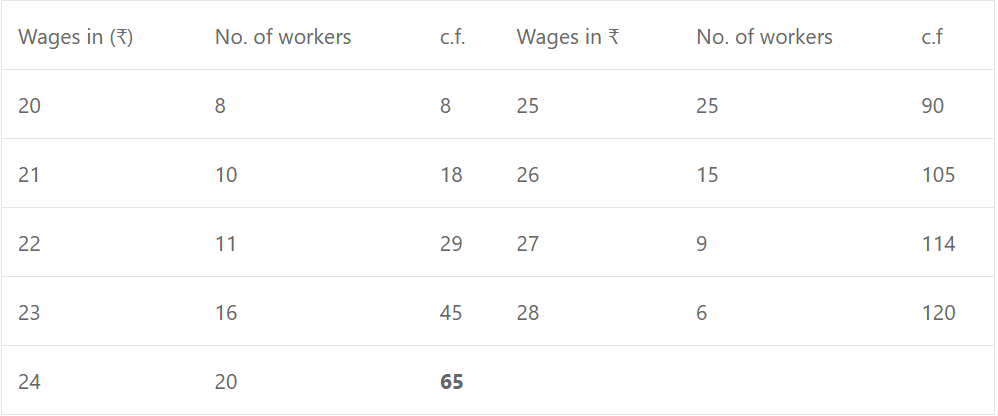
Here Md = {(n+1)/2}th item = size of {(120+1)/2}th item = size of 60.5th term = 24
Thus median income of workers be ₹ 24.
Que-4: Compute the median of the following distributions:

Sol: The table of values is given as under:
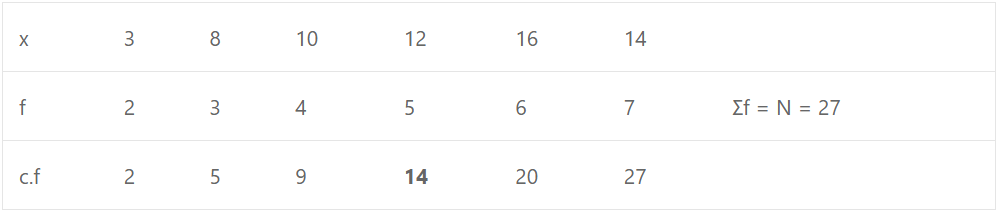
Here Σf = = 27 ∴ Md = size of {(N+1)/2}th item = size of 14th item = 12
Que-5: Marks obtained by 38 students are given below. Calculate the median marks:

Sol: The table of values is given as under:
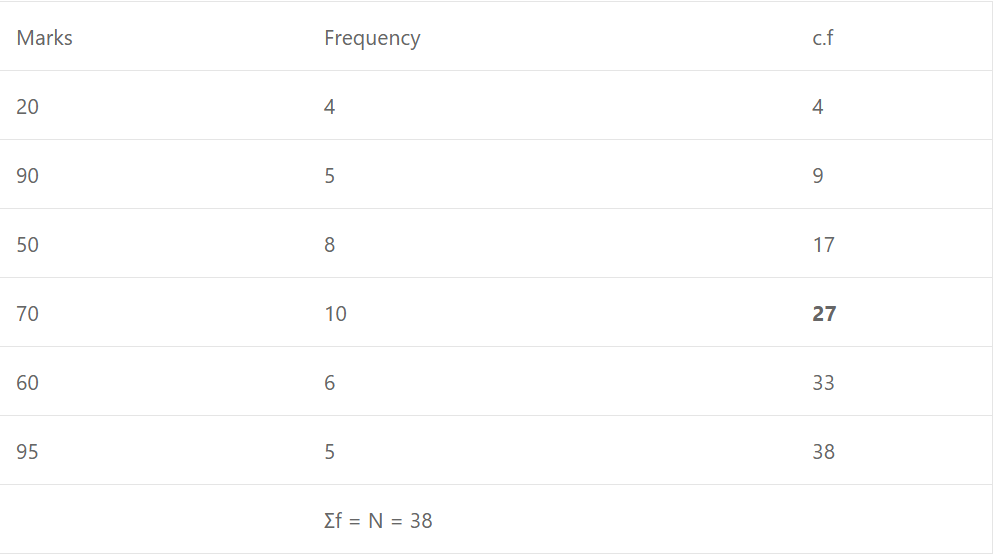
Here Md = size of {(N+1)/2}th item = size of {(38+1)/2}th item = size of 19.5th item = 70 [since value 19.5 lies under c.f column in 27]
Que-6: Find whether the following statements are true or false:
(i) The median of a frequency distribution is the most commonly occurring value.
(ii) The median of a discrete ungrouped frequency distribution containing a number of items is the value of the middle item, the data being arranged in ascending or descending order.
Sol: (i) False, Mode of a frequency distribution is the most commonly occurring value.
(ii) True, Md = size of {(n+1)/2}th item
Que-7: In a school examination it is decided that exactly half the pupils will pass. Name the measure of central tendency that is used.
Sol: Since by definition of median, equal number of items above and below the median. Thus median’s exactly the middle point of array of given numbers. Since it is given that exactly half the pupils will pass. Thus the measure of central tendency that is used be median.
Que-8: (1, 2, 3, 6, 8) is a set of five positive integers whose mean is 4 and median is 3. Write down two other sets of five positive integers, each having the same mean and median as this set.
Sol: For given five observations, mean is 4 and median is 3.
Let the observations 1, 2, 3, 5, 9
∴ Mean = (1+2+3+5+9)/5 = 4 and Md = size of {(5+1)/2}th item = size of 3rd item = 3
Let the observations are 1, 2, 3, 4, 10
Here Mean = (1+2+3+4+10)/5 = 4 and Md = 3
Que-9: Find the median from the following distribution:

Sol: The table of values is given as under:
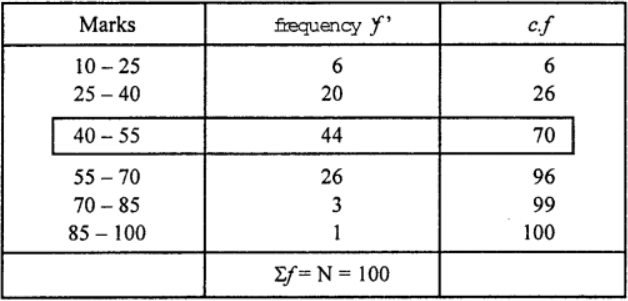
Here N/2 = 100/2 = 50 (even) which lies in median class 40-55
∴ l = 40; f = 44; C = 26 and i = 15
Thus Md = l + [{(N/2)-C}/f] × i
= 40 + {(50-26)/44} × 15
= 40 + 8.1818 = 48.18
Here the required median marks are 48.18 marks.
Que-10:

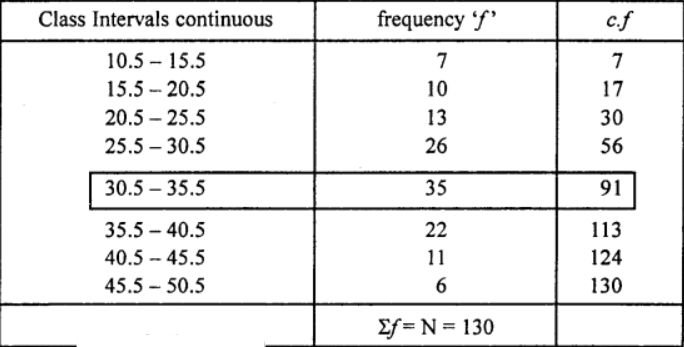
Sol: Here class intervals are discontinuous, we make it continuous by using
adjustment factor = (16−15)/2 = 0.5 which is to be subtracting from lower limit and adding to upper limit of each class interval.
The table of values is given as under:
 /
/
Here N/2 = 130/2 = 6/5 which lies in median class 30.5 – 35.5
Thus, l = 30. 5; f = 35; c = 56; i = 5
Md = l + [{(N/2)-C}/f] × i
= 30.5 + {(65-56)/35} × 5
= 30.5 + (9/7) = 31.785
Que-11:
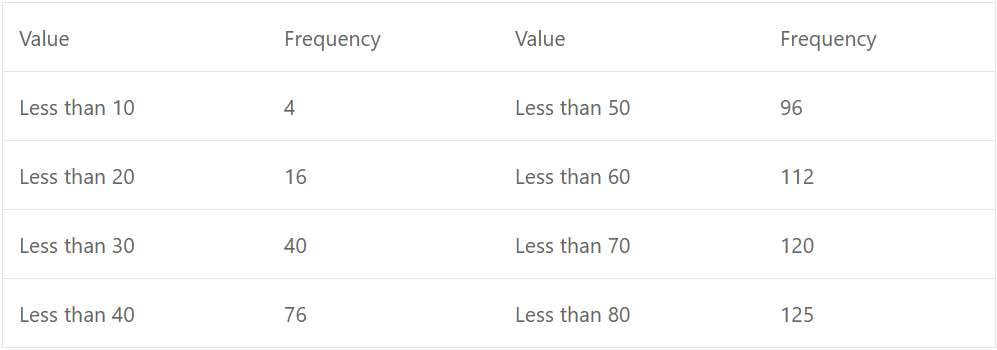
Sol: The table of values is given as under:
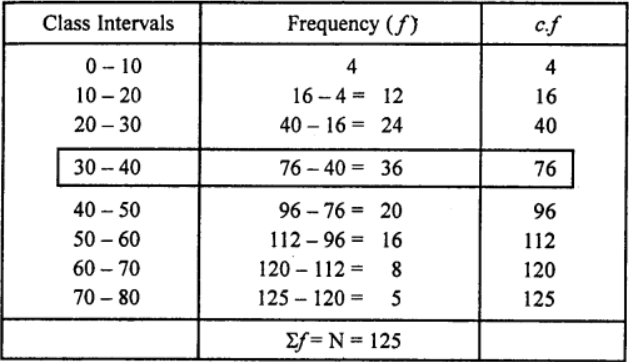
Here N/2 = 125/2 = 62.5 which lies in median class 30 – 40.
Thus, l = 30; f = 36; c = 40; i = 10
Md = l + [{(N/2)-C}/f] × i
= 30 + {(62.5-40)/36} × 10
= 30 + 6.25 = 36.25
Que-12:
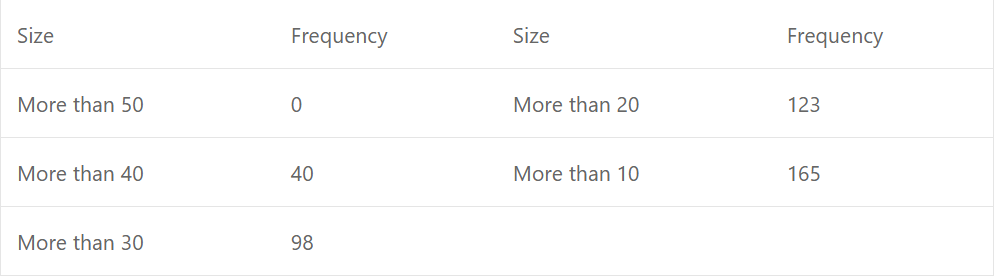
Sol: The table of values is given as under:
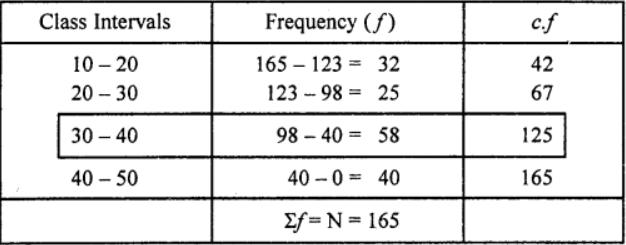
Here N/2 = 165/2 = 82.5 which lies in median class 30 – 40.
Thus, l = 30; f = 58; c = 67; i = 10
Md = l + [{(N/2)-C}/f] × i
= 30 + {(82.5-67)/58} × 10
= 30 + 2.67 = 32.67
Que-13: Find the median and first and third quartile for the following data:
2, 4, 6, 8, 10, 12, 14, 16, 18, 20, 22
Sol: Given data is already in ascending order: 2, 4, 6, 8, 10, 12, 14, 16, 18, 20, 22
Here number of observations = n = 11 (odd)
∴ Md = size of {(n+1)/2}th item = size of {(11+1)/2}th item = size of 6th item = 12
Q1 = size of {(n+1)/4}th item = size of {(11+1)/4}th item = size of 3rd item = 6
and Q3 = size of 3{(n+1)/4}th item = size of {(11+1)/4}th item = size of 9th item = 18
Que-14: Compute Q1, Q3, D3, D6 and D8 for the following data:
14, 7, 13, 12, 13, 17, 8, 10, 6, 15, 18, 21, 20
Sol: Arranging the given data in ascending order: 6, 7, 8, 10, 12, 13, 14, 15, 17, 18, 20, 21
Here no. of observations = n = 13 (odd)
Q1 = size of {(n+1)/4}th item = size of {(13+1)/4}th item = size of 3,5th item = 3rd item + 0.5 (4th item – 3rd item) = 8 + 0.5 (10 – 8) = 8 + 1 = 9
Q3 = size of {(n+1)/4}th item = size of 3{(13+1)/4}th item = size of 10.5th item = 10th item + 0.5 (11th item – 10th item) = 17 + 0.5 (18 – 17) = 17.5
D3 = size of {(n+1)/10}th item = size of 3{(13+1)/10}th item = size of 4.2th item = 4th item + 0.2 (5th item – 4th item) = 10 + 0.2 (12 – 10) = 10 + 0.4 = 10.4
D6 = size of {(n+1)/10}th item = size of 6{(13+1)/10}th item = size of 8.4th item = 8th item + 0.4 (9th item – 8th item) = 14 + 0.4 (15 – 14) = 14.4
D8 = size of 8{(n+1)/10}th item = size of 11.2th item = 11 th item + 0.2 (12th – 11th) = 18 + 0.2 (20 – 18) = 18.4
Que-15: Following are the scores of 12 students in a class test of 30 marks:
18, 20, 9, 15, 21, 26, 14, 13, 27, 22, 16, 28 Find D7 and P33.
Sol: Arranging the data in ascending order : 9, 13, 14, 15, 16, 18, 20, 21, 22, 26, 27, 28
Here no. of observations = n = 12
∴ D7 = size of 7{(n+1)/10}th item = size of 7 {(12+1)/10}th item = size of 9.1th item = 9th item + 0.1 (10th – 9th item) = 22 + 0.1 (26 – 22) = 22.4
P33 = size of 33 {(n+1)/100}th item = size of 33 {(12+1)/100}th item = size of 4.29 th item = 4th item + 0.29 (5th item – 4th item) = 15 + 0.29 (16 – 15) = 15.29
Que-16: Compute Q1, Q3, Q6 and P45 for the following data:

Sol: We construct the following table:
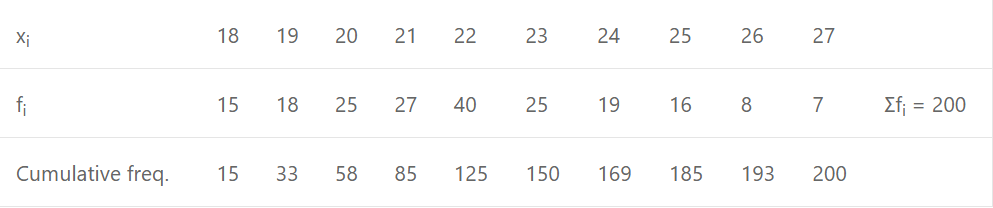
Q1 = {(n+1)/4}th value = {(200+1)/4}th value = 50.25th value
= 50th value + 0.25 (51th value – 50th value) = 20 + 0.25 (20 – 20) = 20 [both 51th and 50th values are same]
Q3 = 3 {(n+1)/4}th value = 3 {(200+1)/4}th value = 150.75th value = 150th value + 0.75 (151th value – 150th value) = 23 + 0.75 (24 – 23) = 23.75
D6 = 6 {(n+1)/10}th value = 6 {(200+1)/10}th value = 120.6th value = 120th value + 0.6 (121th value – 120th value) = 22 + 0.6(22 – 22) = 22
P45 = 45 {(n+1)/100}th value = 45 {(200+1)/100}th value = 90.45th value = 90th value + 0.45 (91th value – 90th value) =22 + 0.45 (22 – 22) = 22 (since 91th and 90th values are same)
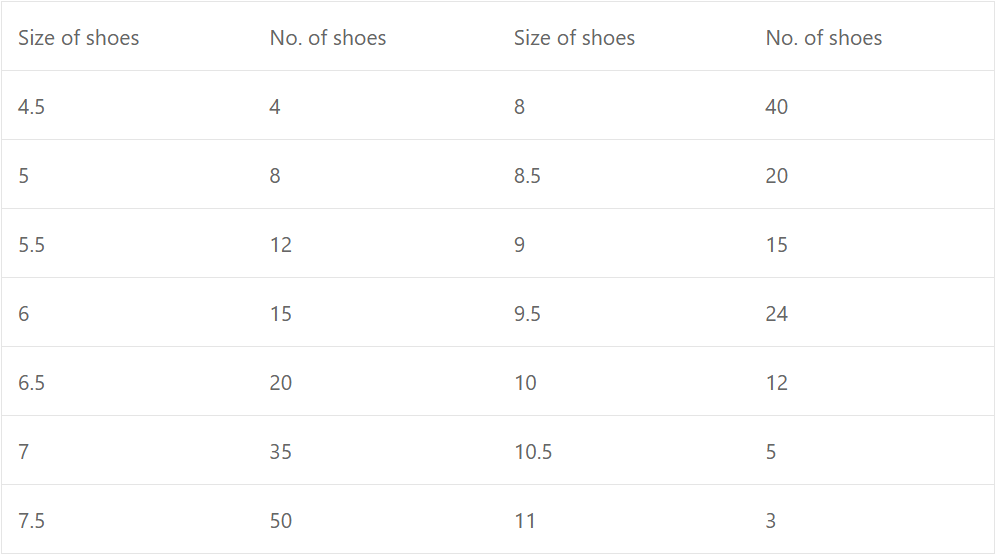
Que-17: Following are the different sizes and number of shoes in a shoe shop. Calculate median, first quartile, third quartile, 6th decile and 80th percentile.
Sol:
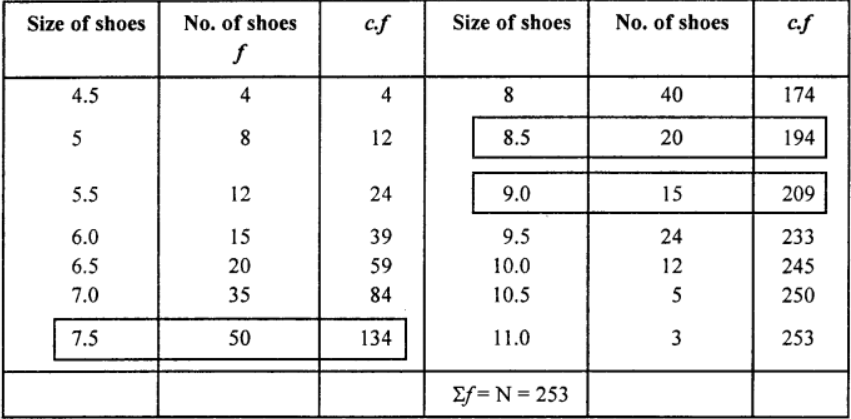
∴ Md = size of {(N+1)/2}th item = size of {(253+1)/2}th item = size of 127 th item = 7.5
Q1 = size of {(N+1)/4}th item = size of {(253+1)/4}th item = size of 63.5 th item = 7.0
Q3 = size of 3 {(N+1)/4}th item = size of 3 {(253+1)/4}th item = size of 190.5 th item = 8.5
D6 = size of 6 {(N+1)/10)}th item = size of 6 {(253+1)/10}th item = size of 152.4 th item = 8
P80 = size of 80 {(N+1)/100}th item = size of 80{(253+1)/100}th item = 203.2th item = 9.0
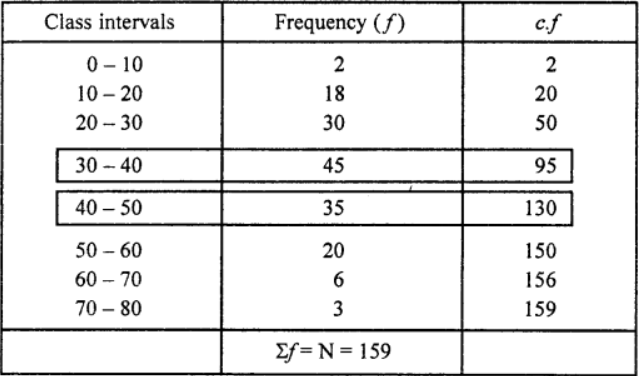
Que-18: Find out first quartile, third quartile and first decile.
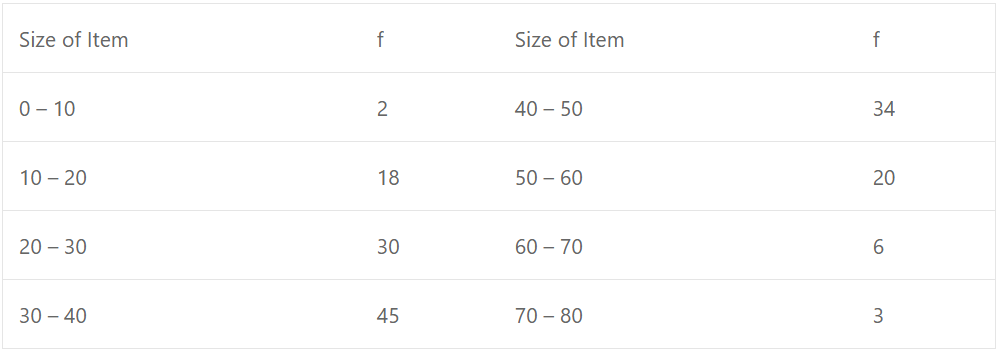
Sol: The table of values is given as under:

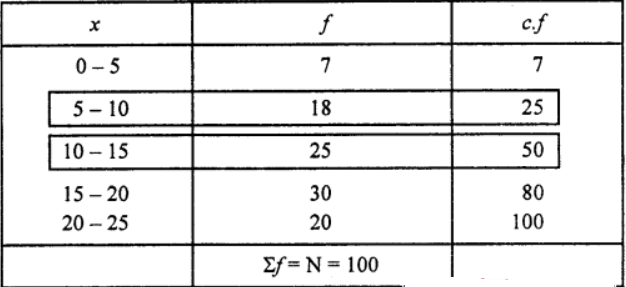
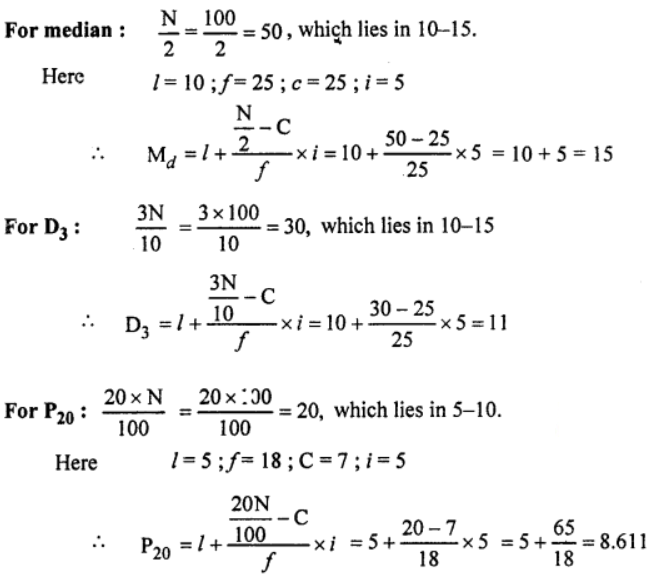
Que-19: Calculate the median, 3rd decile and 20th percentile for the following data:

Sol: The table of values is given as under:
Que-20: Find the interquartile range, quartile deviation for the following data:

Sol: The table of values is given as under:
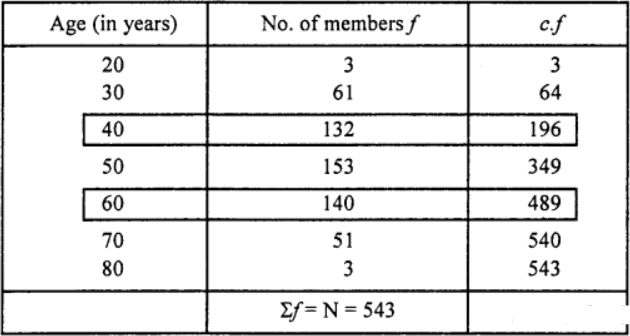
For Q1 : Q1 = size of {(N+1)/4}th item = size of {(543+1)/4}th item = size of 136th item = 40
Q3 = size of 3 {(N+1)/4}th item = size of 3 {(543+1)/4}th item = size of 408 th item = 60
∴ Interquartile range = Q3 – Q1 = 60 – 40 = 20
∴ Q.D = (Q3−Q1)/2 = (60−40)/2 = 10
Que-21: Find the interquartile range, semi-interquartile range, and coefficient of quartile deviation from the following frequency distribution.

Sol: The table of values is given as under:
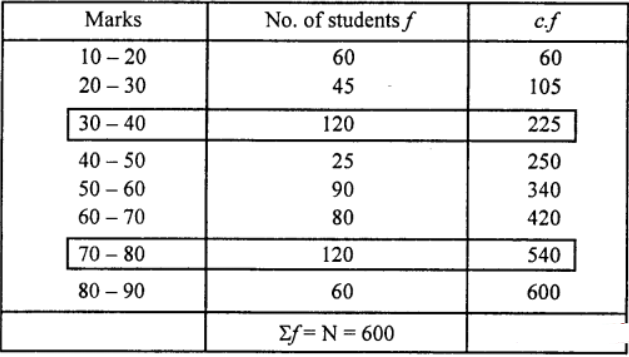
For Q1 : N/4 = 600/4 = 150, which lies in class interval 30 – 40
Here l = 30; f= 120; c = 105; i = 10
∴ Q1 = l + [{(N/4)−C}/f] × i = 30 + [{(150−105)/120}] × 10 = 30 + 3.75 = 33.75
For Q3 : 3N4 = (3×600)/4 = 450 which lies in 70-80
Here l = 70; f= 120; c = 420; i = 10
Q3 = l + [{(3N/4)−C}/f] × i = 70 + [{(450−420)/120}] × 10 = 72.5
∴ Interquartile range = Q3 – Q1 = 72.5 – 33.75 = 38.75
and Semi-interquartile range = (Q3−Q1)/2 = 19.375
and Coeff. of Q.D = (Q3−Q1)/(Q3+Q1) = (72.5−33.75)/(72.5+33.75)
= 38.75/106.25 = 0.365
–: End of Statistics Class 11 OP Malhotra Exe-28B ISC Maths Ch-28 Solutions. :–
Return to :- OP Malhotra ISC Class-11 S Chand Publication Maths Solutions
Please share with your friends
Thanks