Stopping Potential Numerical Class-12 Nootan ISC Physics Solution Ch-23 Photoelectric Effect. Step by step solutions of Kumar and Mittal Physics of Nageen Prakashan as council latest prescribe guideline for upcoming exam. Visit official Website CISCE for detail information about ISC Board Class-12 Physics.
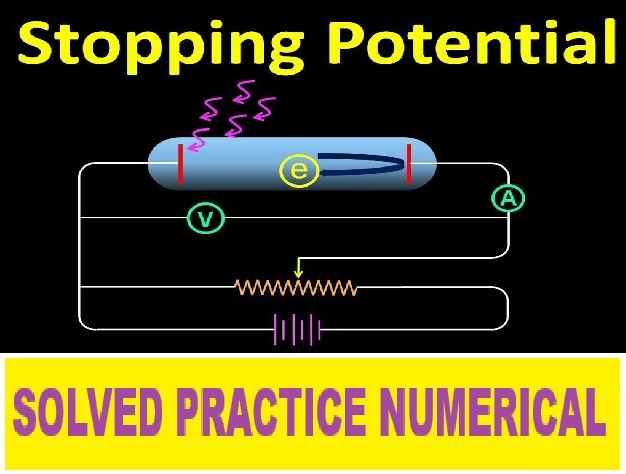
Stopping Potential Numerical Class-12 Nootan ISC Physics Solution Ch-23 Photoelectric Effect
| Board | ISC |
| Class | 12 |
| Subject | Physics |
| Book | Nootan |
| Chapter-23 | Photoelectric Effect |
| Topics | Numericals on Stopping Potential |
| Academic Session | 2025-2026 |
Numericals on Stopping Potential
Class-12 Nootan ISC Physics Solution Ch-23 Photoelectric Effect.
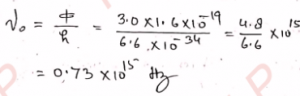
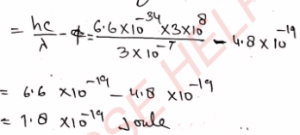
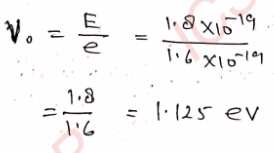
Que-23: A metal whose work function is 3.0 eV, is illuminated by light of wavelength 3 x 10^-7 m. Calculate (i) the threshold frequency, (ii) the maximum energy of photoelectrons and (iii) the stopping potential.
Ans- (i) Threshold frequency
(ii) The maximum Energy E
(iii) Stopping potential
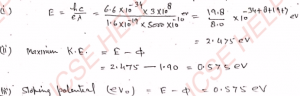
Que-24: 500 nm light falls on a surface whose photoelectric work function is 1.90 eV. Find (i) energy of the incident photon, (ii) maximum kinetic energy of the photoelectrons, (iii) stopping potential, and (iv) threshold wavelength.
Ans-
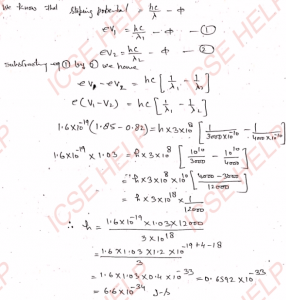
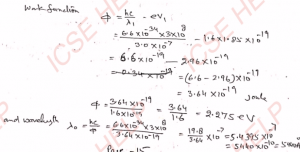
Que-25: (i) When light of 300 nm is incident on sodium cathode, the stopping potential is 1.85 V; and when light of 400 nm is incident, then the stopping potential becomes 0.82 V. Calculate: Planck’s constant, work function of sodium, threshold wavelength for sodium. (ii) At stopping potential, if the wavelength of the incident light is kept fixed at 400 nm, but the intensity of light is increased two times, will photoelectric current be obtained? Give reasons for your answer.
Ans-
(ii) At the stopping potential, the photoelectric current cannot be obtained by increasing the intensity of the incident light, because the stopping potential (or maximum kinetic energy of the photoelectrons) does not depend upon the intensity of the incident light.
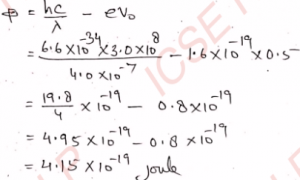
Que-26: A retarding potential of 0.5 V is required to block the movement of electrons from the cathode of a photoelectric cell when violet light of wavelength 400 nm strikes its surface. Find (i) the work function of this surface, (ii) the threshold frequency, (iii) the energy of light of wavelength 300 nm and (iv) the maximum energy of the electron emitted from the cathode surface when 300 nm light strikes it.
Ans- Given Vo = 0.5 volt , λ = 4000 Å = 4.0 x 10^-7 m
(i) Work function
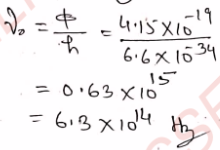
(ii) Threshold frequency
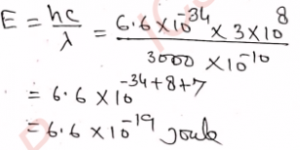
(iii) Energy of light
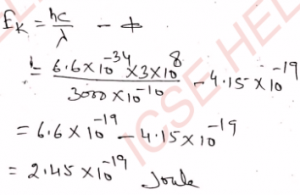
(iv) Maximum Energy
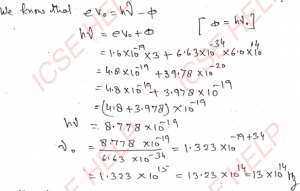
Que-27: Find the frequency of light which ejects from a metal surface electrons which are fully stopped by a retarding potential of 3 V. The photoelectric effect starts in this metal at a frequency of 6 x 10^14 s^-1.
Ans-
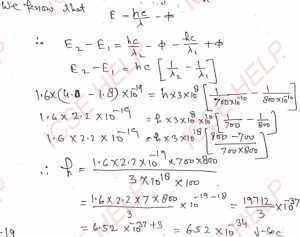
Que-28: Ultraviolet light of wavelengths 80 nm and 70 nm, when allowed to fall on hydrogen atoms in their ground state, is found to liberate electrons with kinetic energies 1.8 eV and 4.0 eV respectively. Find the value of Planck’s constant.
Ans- Suppose that the planks constant is h
Que-29: In an experiment of photoelectric effect, the graph of maximum kinetic energy Ek of the emitted photoelectrons versus the frequency v of the incident light is a straight line shown in the figure. Calculate: (i) threshold frequency, (ii) function W of cathode-metal in eV, (iii) stopping potential for the electrons emitted by light of frequency v = 30 x 10^14 second^-1.
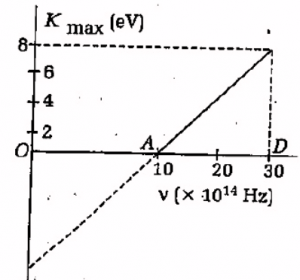
Ans- from graph
(i) Threshold frequency
= frequency at point A
= 10 x 10^14 Hz
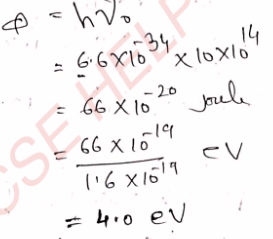
(ii) Work function
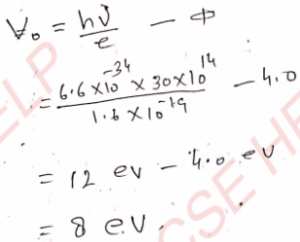
(iii) Stopping potential
Que-30: Given figure shows the plot of the stopping potential versus the frequency of the light used in an experiment on photoelectric effect. Calculate the value of Planck’s constant h. Charge on an electron e = 1.6 x 10^-19 C
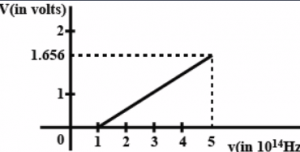
Ans- 6.6 x 10^-34 J-s
Que-31: The stopping potential Vo (in volt) as a function of frequency (v) for a sodium emitter, is shown in the figure. What will be the work function of sodium, from the data plotted in the figure? You can’t use the known value of Planck’s constant.
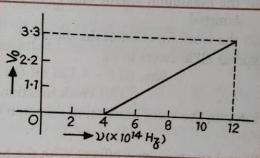
Ans- 2.64 x 10^-19 J
Que-32: When a certain metallic surface is illuminated with monochromatic light of wavelength 2, the stopping potential for photoelectric current is 3V, and when the same surface is illuminated with light of wavelength 22, the stopping potential is Vo. Find the threshold wavelength for the given surface.
Ans- λo = 4λ
Que-33: When the energy of incident radiation is increased by 40%, the kinetic energy of the photoelectrons emitted from a metal surface is increased from 0.5 eV to 1.0 eV Find the work function of the metal surface.
Ans- Kmax = E – φ
for initial energy
=> 0.5 = E1 – φ
for increased energy
=> 1.0 = 1.4E1 – φ
Subtracting eq.
E1 = 1.25 eV
φ = E1-0.5
=> 1.25 – 0.5 = 0.75 eV
Que-34: In a photoelectric experiment, ultraviolet light of wavelength 280 nm is used with lithium cathode having work-function = 2.5 eV. If the wavelength of incident light is switched to 400 nm, find out the change in the stopping potential.
Ans- E1 = hc/λ1 = 4.44 eV , E2 = hc/λ2 = 3.1 eV
K1= E1 – φ = 4.44 – 2.5 = 1.94 eV
K2 = E2 – φ = 3.1 – 2.5 = 0.6 eV
ΔVs = K1/e – K2/e
=> 1.94 – 0.6 = 1.3 V
Que-35: When the wavelength of radiation falling on a metal is changed from 500 nm to 200 nm, the maximum kinetic energy of the photoelectrons becomes three times larger. Find the work function of the metal.
Ans- Kmax = hυ – φ
frequency υ = c/λ
υ1 = 6 x 10^14 Hz
υ2 = 1.5 x 10^15 Hz
Subtracting eq.
2K1 = h(υ2 – υ1)
K1 = 3 x 10^-19 J
φ = hυ1 – K1 = 1.0 x 10^-19 J => 0.62 eV
Que-36: The stopping potential for electrons emitted from a photosensitive surface illuminated by light of wavelength 491 nm is 0.710 V. When the incident wavelength is changed to a new value, the stopping potential is Find the new wavelength. hc = 1240 eV nm
Ans-
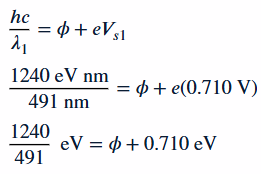
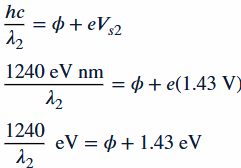
Subtracting eq (i) from (ii) we get
new wavelength = 383.14 nm
–: Stopping Potential Numerical Class-12 Nootan ISC Physics Solution Ch-23 Photoelectric Effect. :–
Return to : – Nootan Solutions for ISC Class-12 Physics
Thanks
Please share with your friends