Sulphuric Acid MCQs Concise Class-10 ICSE Chemistry Selina Solutions Chapter-11. We Provide Step by Step Answer of MCQs Questions of Exercise-11 for ICSE Class-10. The given Solutions is according to the Latest editions. Visit official Website CISCE for detail information about ICSE Board Class-10.
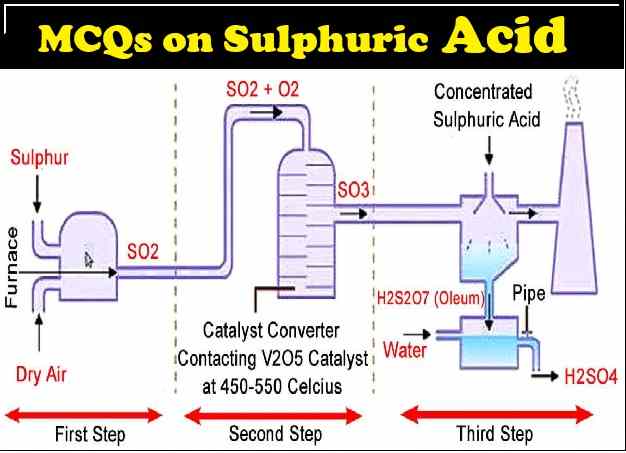
Sulphuric Acid MCQs Concise Class-10 ICSE Chemistry Selina Solutions Chapter-11
| Board | ICSE |
| Book / Publication | Concise / Selina |
| Subject | Chemistry |
| Class | 10th |
| Writer | Dr SP Singh |
| Chapter-11 | Study of Compounds – Sulphuric Acid |
| Topics | MCQs |
| Edition | 2025-2026 |
MCQs on Sulphuric Acid
Page-184 (Choose the correct answer from the options given below).
Que-1: The gas evolved when dil. sulphuric acid reacts with iron sulphide.
(a) Hydrogen sulphide
(b) Sulphur dioxide
(c) Sulphur trioxide
(d) Vapour of sulphuric acid.
Ans: (a) Hydrogen sulphide
Hint: FeS + H2SO4 [dil.] ⟶ FeSO4 + H2S
Que-2: In the given equation :
H2S + 2H2SO4 ⟶ S + 2H2O + SO2
Identify the role played by conc. H2SO4
(a) Non-volatile acid
(b) Oxidising agent
(c) Dehydrating agent
(d) None of the above.
Ans: (b) Oxidising agent
Hint: The oxidising property of concentrated sulphuric acid leads to its thermal decomposition, and yields nascent oxygen [O]. In the above reaction, Hydrogen sulphide is oxidised by this nascent oxygen released from sulphuric acid.
Que-3: Dilute sulphuric acid will produce a white ppt. when added to a solution of:
(a) Copper nitrate
(b) Zinc nitrate
(c) Lead nitrate
(d) Sodium nitrate
Ans: (c) Lead nitrate
Hint: Pb(NO3)2 + H2SO4 (dil) ⟶ 2HNO3 + PbSO4 ↓ [white ppt. formed]
White ppt. of PbSO4 is visible.
Que-4: On passing SO2 through chlorine water, the acid produced is :
(a) H2SO3
(b) HNO3
(c) H2SO4
(d) H2PO4
Ans: (c) H2SO4
Hint: On passing SO2 through chlorine water, oxidation of aqueous solution of sulphur dioxide takes place and H2SO4 is formed.
SO2 + H2O + Cl2 ⟶ H2SO4 + 2HCl
Que-5: When HCl is prepared by the reaction of NaCl with H2SO4, the property of H2SO4 exhibited is :
(a) Dehydrating agent
(b) Drying agent
(c) Oxidising property
(d) Non volatile acid
Ans: (d) Non volatile acid
Hint: Concentrated sulphuric acid is used for preparing volatile acid hydrochloric acid from their salts by double decomposition, because sulphuric acid is considered to be a non-volatile acid with high boiling point (338 °C).
Que-6: The catalyst preferred in contact process is :
(a) Pt
(b) V2O5
(c) Fe
(d) Pd
Ans: (b) V2O5
Hint: The catalyst preferred in contact process is vanadium pentoxide (V2O5). It is highly efficient at converting SO2 to SO3.
Que-7: The substance added to SO3 to manufacture H2SO4 by contact process is :
(a) H2O
(b) H2SO4
(c) H2S2O7
(d) H2S
Ans: (b) H2SO4
Hint: The substance added to SO3 to manufacture H2SO4 by contact process is H2SO4. Sulphur trioxide on dissolving in water can produce sulphuric acid, but it does not dissolve in water satisfactorily and it gives a lot of heat and forms misty droplets of sulphuric acid so it is not directly absorbed by water. It is first absorbed by sulphuric acid to produce oleum. oleum is further diluted to produce H2SO4.
Que-8: The role of sulphuric acid in the reaction given below is :
S + 2H2SO4 ⟶ 3SO2 + 2H2O
(a) Non volatile acid
(b) Oxidising agent
(c) Dehydrating agent
(d) None of the above
Ans: (b) Oxidising agent
Hint: The oxidising property of concentrated sulphuric acid leads to its thermal decomposition, and yields nascent oxygen [O]. In the above reaction, sulphur is oxidised by this nascent oxygen released from sulphuric acid.
Que-9: Dilute H2SO4 and conc. H2SO4 can be distinguished by :
(a) Copper
(b) Silver
(c) Gold
(d) Platinum
Ans: (a) Copper
Hint: Dilute H2SO4 and conc. H2SO4 can be distinguished by Copper. Copper does not react with dilute H2SO4, because dilute H2SO4 cannot act as an oxidising agent. Whereas, conc. sulphuric acid on heating with copper evolves sulphur dioxide.
Que-10: On adding conc. H2SO4 to cane sugar, the colour observed is :
(a) yellow
(b) black
(c) green
(d) violet
Ans: (b) black
Hint: On adding conc. H2SO4 to cane sugar (carbohydrate), they react immediately to give a black spongy mass of carbon.
Que-11: The acid which produces charcoal from sugar is :
(a) conc. HNO3
(b) conc. HCl
(c) Conc. H2SO4
(d) conc. H3PO4
Ans: (c) Conc. H2SO4
Hint: All carbohydrates react with Conc. H2SO4 immediately to give a black spongy mass of carbon. Carbon obtained in this reaction is very pure and is called as sugar charcoal.
Que-12: The substance which can be used as drying as well as dehydrating agent is :
(a) conc. H2SO4
(b) conc. HNO3
(c) Conc. HCl
(d) conc. H2CO3
Ans: (a) Conc. H2SO4
Hint: Conc. H2SO4 has a great affinity for water. It readily removes chemically combined water molecules i.e., elements of water from other compounds. Hence, it acts as drying as well as dehydrating agent.
Que-13: The compound formed by the oxidation of sulphur by nitric acid is :
P – Sulphuric acid
Q – Nitrogen dioxide
R – Sulphur dioxide
(a) Only P
(b) Only Q
(c) Only R
(d) Both P and Q
Ans: (d) Both P and Q
Hint: The compounds formed by the oxidation of sulphur by nitric acid are Sulphuric acid (H2SO4) and Nitrogen dioxide (NO2).
S + 6HNO3 ⟶ H2SO4 + 6NO2 + 2H2O
The following questions are Assertion-Reason based questions. Choose the answer based on the codes given below.
1. Both A and R are true and R is the correct explanation of A.
2. Both A and R are true but R is not the correct explanation of A.
3. A is true but R is false.
4. A is false but R is true.
Que-14:
Assertion (A): Sulphuric acid is known as the oil of vitriol.
Reason (R): Sulphuric acid was first obtained by heating crystals of green vitriol.
(a) (1)
(b) (2)
(c) (3)
(d) (4)
Ans: (a) (1) Both A and R are true and R is the correct explanation of A.
Explain Why: Sulphuric acid is referred to as Oil of vitriol because in the later middle ages, it was obtained as an oily viscous liquid by heating crystals of green vitriol. Hence, the assertion is true.
Sulphuric acid was first obtained by heating crystals of green vitriol. Hence, reason is true.
Reason explains why sulphuric acid is known as the oil of vitriol. Hence, reason is the correct explanation of assertion (A).
Que-15:
Assertion (A): V2O5 or Pt is used in the catalytic oxidation of sulphur dioxide
Reason (R): The catalytic oxidation of SO2 is an exothermic reaction, so it requires to be heated to about 450°C only in the beginning.
(a) (1)
(b) (2)
(c) (3)
(d) (4)
Ans: (b) (2) Both A and R are true but R is not the correct explanation of A.
Explain Why: In the catalytic oxidation of sulphur dioxide, vanadium pentoxide (V2O5) or platinum is used as a catalyst. Hence, the assertion is true.
The catalytic oxidation of sulphur dioxide is highly exothermic, the catalyst is heated only in the beginning to about 450°C. This temperature is maintained by the heat evolved during the reaction. Hence, the reason is true.
Reason (R) doesn’t explain why V2O5 or Pt is used as the catalyst. Hence, reason is not the correct explanation of assertion.
Que-16:
Assertion (A): Sulphuric acid when dissolved in water forms a basic salt
Reason (R): Sulphuric acid ionises in two stages, it is a dibasic acid.
(a) (1)
(b) (2)
(c) (3)
(d) (4)
Ans: (d) (4) A is false but R is true.
Explain Why: Sulphuric acid when dissolved in water forms hydronium ion and shows acidic properties. Hence, the assertion is false.
Sulphuric acid ionises in two stages and is called dibasic acid. Hence, the reason (R) is true.
H2SO4 + 2H2O ⇔ H3O+ + HSO4–
HSO4– + 2H2O ⇔ H3O+ + SO42-
Que-17:
Assertion (A): Pure sulphuric acid is almost a non-conductor of electricity.
Reason (R): Dilute sulphuric acid is a good conductor of electricity.
(a) (1)
(b) (2)
(c) (3)
(d) (4)
Ans: (b) (2) Both A and R are true but R is not the correct explanation of A.
Explain Why: Pure (conc.) H2SO4 is not ionized significantly because no water is present to dissociate it into ions. Therefore, it does not conduct electricity. Hence, the assertion is true.
When H2SO4 is diluted with water, it ionizes completely to give H– and SO42- ions, which are free to move. These ions carry electric current, making it a strong electrolyte. Hence, the reason is true.
However, reason does not explain why pure sulphuric acid is a poor conductor of electricity. Hence, reason is not the correct explanation of assertion (A).
Que-18:
Assertion (A): Impurity of arsenic oxide must be removed before passing the mixture of SO2 and air through the catalytic chamber.
Reason (R): Arsenic oxide poisons the catalyst.
(a) (1)
(b) (2)
(c) (3)
(d) (4)
Ans: (a) (1) Both A and R are true and R is the correct explanation of A.
Explain Why: In the manufacture of sulphuric acid, purification of gases is done by removing the impurity of arsenic oxide before passing the mixture of SO2 and air through the catalytic chamber. Hence, the assertion is true.
Purification of gases is done because arsenic oxide poisons the catalyst and the catalyst loses its efficiency. Hence, the reason is true and it is the correct explanation of assertion.
Que-19:
Assertion (A): Concentrated sulphuric acid is kept in air tight bottles.
Reason (R): Air contains impurities, therefore H2SO4 will get spoiled.
(a) (1)
(b) (2)
(c) (3)
(d) (4)
Ans: (c) (3) A is true but R is false.
Explain Why: As concentrated sulphuric acid is hygroscopic and has a great affinity for water hence, it absorbs moisture from the atmosphere. Therefore, it is kept in air tight bottles. Hence, the assertion (A) is true.
The main concern to keep sulphuric acid in air tight bottles is to avoid moisture from entering, not impurities. Impurities in air do not significantly affect concentrated sulphuric acid. Hence, the reason is false.
Que-20:
Assertion (A): Sulphuric acid acts as an oxidising agent.
Reason (R): Sulphuric acid produces hydrogen on reacting with zinc.
(a) (1)
(b) (2)
(c) (3)
(d) (4)
Ans: (b) (2) Both A and R are true but R is not the correct explanation of A.
Explain Why: Sulphuric acid acts as an oxidising agent due to the fact that on thermal decomposition, it yields nascent oxygen. This nascent oxygen oxidises non-metals, metals and inorganic compounds. Hence, the assertion is true.
H2SO4 ⟶ 2H2O + SO2 + [O]
Dilute sulphuric acid reacts with metals like zinc, that is present above hydrogen in the activity series to form metallic sulphate and hydrogen at ordinary temperature. Hence, the reason is true.
Zn + H2SO4 ⟶ ZnSO4 + H2 ↑
But, reason doesn’t explain the reason behind oxidising property of sulphuric acid. Hence, reason is not the correct explanation of assertion.
—: End of Study of Compounds – Sulphuric Acid MCQs Concise Class-10 ICSE Chemistry Selina Solutions : –
Return to:- Concise Selina Chemistry for ICSE Class-10 Solutions
Please Share with Your Friends if Helpful
Thanks