Sulphuric Acid Short Ans Concise Class-10 ICSE Chemistry Selina Solutions Chapter-11. We Provide Step by Step Answer of Short Ans Questions of Exercise-11 for ICSE Class-10. The given Solutions is according to the Latest editions. Visit official Website CISCE for detail information about ICSE Board Class-10.
Sulphuric Acid Short Ans Concise Class-10 ICSE Chemistry Selina Solutions Chapter-11
| Board | ICSE |
| Book / Publication | Concise / Selina |
| Subject | Chemistry |
| Class | 10th |
| Writer | Dr SP Singh |
| Chapter-11 | Study of Compounds – Sulphuric Acid |
| Topics | Short Ans |
| Edition | 2025-2026 |
Short Ans Questions on Sulphuric Acid
Page-186
Que-1: Give reasons for the following.
(a) Sulphuric acid forms two types of salts with NaOH
(b) A piece of wood becomes black when concentrated sulphuric acid is poured on it
(c) Brisk effervescence is seen when oil of vitriol is added to sodium carbonate.
Ans:
(a) Two types of salts are formed when sulphuric acid reacts with NaOH because sulphuric acid is dibasic.
NaOH + H2SO → NaHSO4 + H2O
2NaOH + H2SO4 → Na2SO4 + 2H2O
(b) A piece of wood becomes black when concentrated sulphuric acid is poured on it because it gives a mass of carbon.
(c) When sulphuric acid is added to sodium carbonate it liberates carbon dioxide which produces brisk effervescence.
Na2CO3+H2SO4 → Na2SO4 +H2O+CO2 ↑
Que-2: Why is water not added to concentrated H2SO4 in order to dilute it?
Ans: Water is not added to concentrated acid since it is an exothermic reaction. If water is added to the acid, there is a sudden increase in temperature and the acid being in bulk tends to spurt out with serious consequences.
Que-3: Why is:
(a) Concentrated sulphuric acid kept in air tight bottles?
(b) H2SO4 is not a drying agent for H2S?
(c) Sulphuric acid used in the preparation of HCl and HNO3? Give equation in both cases.
Ans:
(a) Concentrated sulphuric acid is hydroscopic substance that absorbs moisture when exposed to air. Hence, it is stored in air tight bottles.
(b) Sulphuric acid is not a drying agent for H2S because it reacts with H2S to form sulphur.
H2SO4+H2S → 2H2O+SO2+S ↓
(c) Concentrated sulphuric acid has high boiling point (356oC). So, it is considered to be non-volatile. Hence, it is used for preparing volatile acids like Hydrochloric acid and Nitric acids from their salts by double decomposition.
NaCl + H2SO4 → NaHSO4 +HCl
NaNO3 + H2SO4 → NaHSO4 +HNO3
Que-4: State your observation when –
(a) Sugar crystals are added to a hard glass test tube containing conc. sulphuric acid.
(b) Conc. H2SO4 is added to a crystal of hydrated copper sulphate.
Ans:
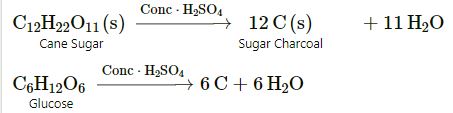
(a) Charring of sugar takes place. Sulphuric acid dehydrates sugar leaving behind carbon which is black in colour.
(b) The blue coloured hydrous copper sulphate changes to white anhydrous copper sulphate as the water of crystallization is removed.
Que-5: Give balanced equation(s) for :
(a) Reaction of dilute sulphuric acid when poured over sodium sulphite
(b) Manufacture of sulphuric acid by the Contact process.
(c) Heating sulphur with conc. sulphuric acid
(d) Dehydration of sugar crystals by conc. sulphuric acid
(e) Action of concentrated sulphuric acid on carbon.
Ans:
(a) Na2SO3 + H2SO4 (dil.) ⟶ Na2SO4 + H2O + SO2
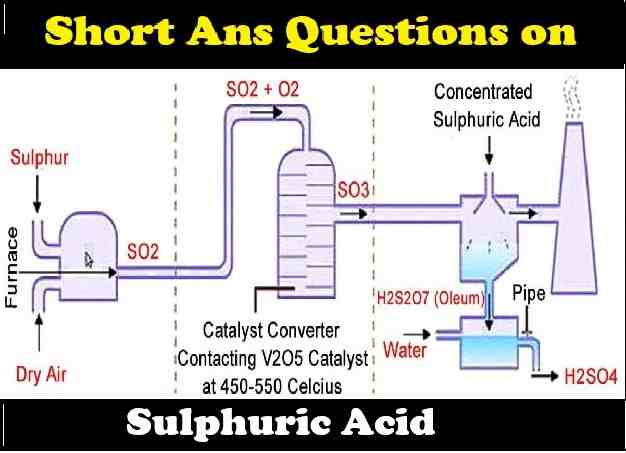
(b) Contact process: Sulphur or Pyrite Burner:
S + O2 ⟶ SO2
4FeS2 + 11O2 ⟶ 2Fe2O3 + 8SO2
(c) S + 2H2SO4 [conc.] ⟶ 3SO2 + 2H2O
(d) C < em > 12H </em> 22O11 (s) → (Conc. H2SO4 ) 12C (s) + 11H2O
(e) C + 2H2SO4 [conc.] ⟶ CO2 + 2H2O + 2SO2
Que-6: Write the equations for the following reactions:
(a) dil. H2SO4 and barium chloride.
(b) dil. H2SO4 and sodium sulphide.
(c) Zinc sulphide and dilute sulphuric acid.
Ans:
(a) BaCl2 + H2SO4 (dil) ⟶ 2HCl + BaSO4 ↓ [white ppt. formed]
(b) Na2S + H2SO4 ⟶ Na2SO4 + H2S
(c) ZnS + H2SO4 (dil.) ⟶ ZnSO4 + H2S
Que-7: Dilute and concentrated sulphuric acid can be distinguished by using metals copper and zinc. Explain by giving balanced equations.
Ans: Conc. sulphuric acid acts as an oxidising agent and oxidises metals like copper and Zinc.
Cu + 2H2SO4 (conc.) ⟶ CuSO4 + H2O + 2SO2 ↑
Zn + 2H2SO4 (conc.) ⟶ ZnSO4 + H2O + 2SO2 ↑
alse, dil. sulphuric acid is not an oxidising agent and it cannot oxidise copper and zinc.
Therefore, Conc. sulphuric acid and dil. sulphuric acid can be distinguished by considering the oxidising property of sulphuric acid.
Que-8: Give two balanced reactions of each type to show the following properties of sulphuric acid.
(a) Acidic nature
(b) Oxidising agent
(c) dehydrating Nature
(d) Non-volatile nature
Ans: Balanced reactions are:
(a) Acidic nature:
(i) Dilute H2SO4 reacts with basic oxides to form sulphate and water.
2 NaOH+H2SO4 → Na2SO4+2H2O
(ii) CuO+H2SO4 → CuSO4+H2O
(b) Oxidising agent:
H2SO4 → H2O +SO2 +[O]
Nascent oxygen oxidizes non-metals, metals and inorganic compounds.
For example,
Carbon to carbon dioxide
C+H2SO4 CO2 +H2O +2SO2
Sulphur to sulphur dioxide
S + H2SO4 → 3SO2 +2H2O
(c) dehydrating Nature
(d) Non-volatile nature:
It has a high boiling point (356oC) so it is considered to be non-volatile. Therefore, it is used for preparing volatile acids like hydrochloric acid, nitric acid from their salts by double decomposition reaction.
NaCl + H2SO4 ⟶ NaHSO4 + HCl
KCl + H2SO4 ⟶ KHSO4 + HCl
Que-9: Give a chemical test to distinguish between:
(a) Dilute sulphuric acid and dilute hydrochloric acid
(b) Dilute sulphuric acid and conc. sulphuric acid
(c) Dilute sulphuric acid and dilute hydrochloric acid [using barium chloride solution]
Ans:
(a) Bring a glass rod dipped in Ammonia solution near the mouth of each test tubes containing dil. Hel and dil. H2SO4each.
| Dil HCl | Dil. H2SO4 |
| White fumes of ammonium chloride | No such fumes |
(b)
1. Dilute sulphuric acid treated with zinc gives Hydrogen gas which bums with pop sound.
Concentrated H2SO4 gives SO2 gas with zinc and the gas turns Acidified potassium dichromate paper green.
2.Barium chloride solution gives white ppt. with dilute H2SO4, This white ppt. is insoluble in all acids.
Concentrated H2SO4 and NaCl mixture when heated gives dense white fumes if glass rod dipped in Ammonia solution is brought near it.
(c) Barium chloride soln. reacts with dilute sulphuric acid to give a white ppt. of barium sulphate but with dilute hydrochloric acid no white ppt. is produced since barium chloride is soluble in dil. sulphuric acid.
Que-10: State the conditions required for the conversion of sulphur dioxide to sulphur trioxide to take place:
Ans: The conditions for the conversion of sulphur dioxide to sulphur trioxide are:
- Temperature: 450 to 500°C
- Pressure: 1 to 2 atmosphere
- Presence of Catalyst: Vanadium pentoxide (V2O5)
- Excess of Oxygen
Que-11: Making use only of substances given: dil. sulphuric acid, Sodium carbonate, Zinc, Sodium Sulphite, Lead, Calcium carbonate:
Give equations for the reactions by which you could obtain:
(a) hydrogen
(b) sulphur dioxide
(c) carbon dioxide
(d) zinc carbonate (2 steps)
Ans:
(a) Zn + H2SO4 ⟶ ZnSO4 + H2
(b) Na2SO3 + H2SO4 ⟶ Na2SO4 + H2O + SO2
(c) Na2CO3 + H2SO4 ⟶ Na2SO4 + H2O + CO2
(d) Zn + H2SO4 ⟶ ZnSO4 + H2
ZnSO4 + Na2CO3 ⟶ ZnCO3 + Na2SO4
Que-12: Give equations for the action of sulphuric acid on
(i) Potassium hydrogen carbonate
(ii) Sulphur
Ans:
(i) Action of sulphuric acid on potassium hydrogen carbonate
2KHCO3+ H2SO4→ K2SO4+ 2H2O + 2CO2↑
(ii) Action of sulphuric acid on sulphur
S + 2H2SO4→ 3SO2 + 2H2O
Que-13: In the manufacture of sulphuric acid by contact process, give the equations for the conversion of sulphur trioxide to sulphuric acid.
Ans: In the contact process for the manufacture of sulphuric acid, the equations for the conversion of sulphur trioxide to sulphuric acid are
SO3 + H2SO4 → H2S2O7
(oleum or pyro sulphuric acid)
H2S2O7 + H2O → 2H2SO4
Que-14: Give a balanced equation for the conversion of zinc oxide to zinc sulphate.
—: End of Study of Compounds – Sulphuric Acid Short Ans Concise Class-10 ICSE Chemistry Selina Solutions : –
Return to:- Concise Selina Chemistry for ICSE Class-10 Solutions
Please Share with Your Friends if Helpful
Thanks