Excretory System Class 10 Concise Structured/Applications/Skill Type Ans Selina Solutions Ch-9. In this article you will get the solutions of Structured/Applications/Skill Type Type Questions as council latest syllabus. Visit official website CISCE for detail information about ICSE Board Class-10 Biology.
Excretory System Class 10 Concise Structured/Applications/Skill Type Ans Selina Solutions Ch-9
| Board | ICSE |
| Subject | Biology |
| Class | 10 |
| Book | Selina Concise |
| Chapter-9 | Excretory System |
| Topics | Solutions of Structured/Applications/Skill Type Questions |
Excretory System: Solutions of Structured/Applications/Skill Type Type Questions
Page 121-122
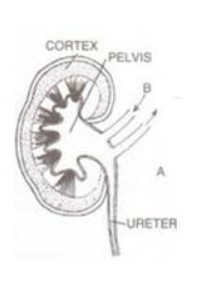
Que-1: Given below is a simple diagram of the longitudinal section of a human kidney. Study the same and answer the following questions:
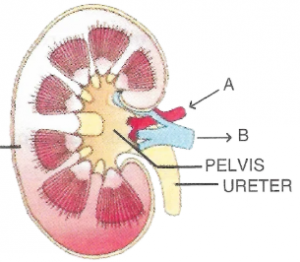
(a) Name the part of kidney which is found between medulla and pelvis.
(b) What is the basic structural and functional unit of kidney ?
(c) What is main function of kidney ?
(d) Mention the exact location of kidney.
(e) Write two differences in the composition of blood flowing through blood vessels A and B.
(f) Name the part of kidney which collects urine for the first time from the nephrons.
(g) Define ‘Osmoregulation’.
(h) Name the technique which is normally suggested by the doctors to the patients in case of a permanent damage to both the kidneys.
(i) Name the hormone which is associated with the ‘reabsorption’ step of urine production.
(j) Draw a neat and labelled diagram of a malpighian capsule.
Ans:
(a) Conical or Renal pyramids
(b) Nephron
(c) Purification of blood by extracting nitrogenous waste from the blood.
(d) Kidneys are located on either side of the backbone and protected by last two ribs.
(e) Two differences in the composition of blood flowing through blood vessels A and B:
| S. No. |
Blood vessel A | Blood vessel B |
|---|---|---|
| 1. | It is renal artery. It contains oxygen rich blood. | It is renal vein. It contains deoxygenated blood. |
| 2. | Blood has wastes. | Blood is purified. |
(f) Collecting Duct
(g) The regulation of osmotic pressure of the blood by regulating its composition (water and electrolyte) is called osmoregulation.
(h) Dialysis
(i) Antidiuretic hormone (ADH)
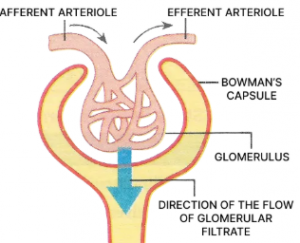
(j) The labelled diagram of a malpighian capsule is shown below:
Que-2: Given below is the figure of certain organs and associated parts in the human body. Study the same and answer the questions that follow:
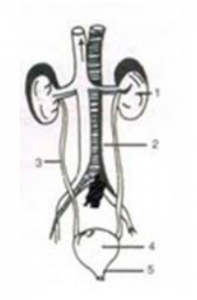
(a) Name all the organ-systems shown completely or even partially.
(b) Name the parts numbered 1 to 5.
(c) Name the structural and functional unit of the part marked ‘1’.
(d) Name the two main organic constituents of the fluid that flows down the part labeled ‘3’.
(e) Name the two major steps involved in the formation of the fluid that passes down the part labeled ‘3’.
Ans:
(a) Excretory system and Circulatory system.
(b) 1-kidney, 2-renal artery, 3-ureter, 4-urinary bladder, 5-urethera
(c) Nephron
(d) Urea and ammonia
(e) Ultrafiltration and selective reabsorptiona
Que-3: The figure given below represents a kidney tubule in humans and its blood supply. Study the figure and answer the questions that follow. Write specific name and numbers shown in the diagram for each answer.
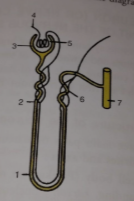
(a) Name the part which consists of a knot-like mass of blood capillaries.
(b) What is the specific name for the combination of parts shown as 5 and 3?
(c) Name the part which collects the glomerular filtrate.
(d) Where is the most water reabsorbed?
(e) Name the part which collects urine in the diagram shown.
(f) Which part lies in the medulla of the kidney?
(g) Which of the above parts is involved in the process of tubular secretion?
(h) How is hydrostatic pressure created?
(i) Where does ultrafiltration take place?
(j) Name two important constituents of urine.
Ans:
(a) Glomerulus (Part 5)
(b) Malpighian Capsule
(c) Bowman’s Capsule (Part 3)
(d) Proximal Convoluted Tubule (Part 2)
(e) Collecting Duct (Part 7)
(f) Loop of Henle (Part 1) & Collecting Duct (Part 7)
(g) Distal Convoluted Tubule (Part 6)
(h) The efferent arteriole is narrower than the afferent arteriole. This creates the hydrostatic pressure.
(i) Glomerulus (Part 5)
(j) Urea, Sodium chloride
Que-4: Given below is a highly simplified diagram of the human kidney cut open longitudinally. Answer the questions that follow:
(a) Define excretion.
(b) Why does the cortex of the kidney show a dotted appearance?
(c) Why does the medulla of the kidney show a striped appearance ?
(e) Write two differences in composition of the blood flowing through the blood vessels, ‘A’ and ‘B’.
Ans:
(a) The process of removal of chemical wastes especially nitrogenous waste from the body is known as excretion.
(b) As the cortex region contains numerous nephrons or kidney tubules, therefore, it shows a dotted appearance.
(c) Due to neuron ending
(d) The blood vessel ‘B’ is renal artery and the blood vessel ‘A’ is renal vein.
So the blood vessel ‘B’ contains oxygenated blood with high concentration of urea and glucose whereas the blood vessel ‘A’ contains deoxygenated blood with low concentration of urea and glucose as compared to renal artery.
Que-5: Study the diagram given below and then answer the questions that follow:
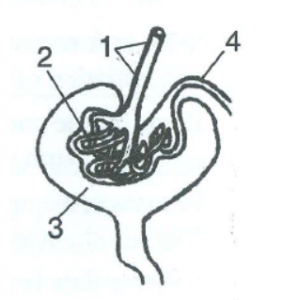
(a) Name the region in the kidney where the above structure is present?
(b) Name the parts labelled 1, 2, 3, and 4.
(c) Name the stages involved in the formation of urine.
(d) What is the technical term given to the process occurring in 2 and 3? Briefly describe the process.
Ans:
(a) The structure is a Bowman’s capsule, which is part of the nephron. The Bowman’s capsule is found in the cortex of the kidney.
(b)
1 – Afferent arteriole
2 – Glomerulus
3 – Bowman’s capsule
4 – Efferent arteriole
(c) Urine formation occurs in two steps – ultrafiltration and reabsorption.
(d) The process occurring in 2 and 3 is known as ultrafiltration. In the glomerulus, the blood flows under high pressure because of the narrow lumen of the capillary network of the glomerulus. This forces most of the components (both waste and useable materials) of the blood out of the capillaries. This process of the filtration of blood under high pressure in the Bowman’s capsule is known as ultrafiltration.
–: Excretory System Class 10 Concise Structured/Applications/Skill Type Ans Selina Solutions Ch-9 :–
Return to : Concise Biology for ICSE Class 10 Selina Solutions
Please share with your Friends if helpful
thanks