The Straight Line Class 11 OP Malhotra Exe-16A ISC Maths Solutions Ch-16 Solutions. In this article you would learn about Angle between Two Lines and Slope. Step by step solutions of latest textbook has been given as latest syllabus. Visit official Website CISCE for detail information about ISC Board Class-11 Mathematics.
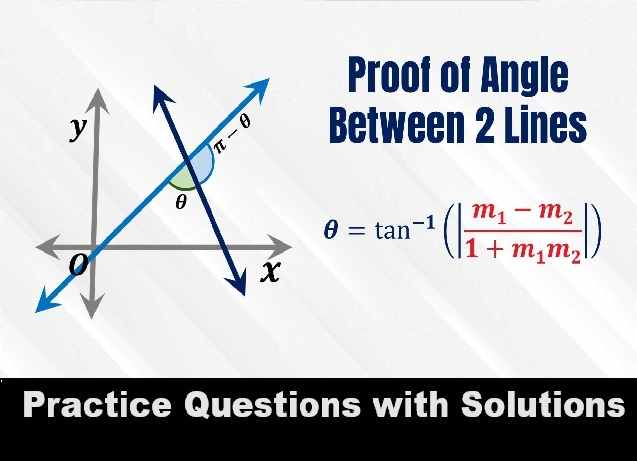
The Straight Line Class 11 OP Malhotra Exe-16A ISC Maths Solutions Ch-16
| Board | ISC |
| Publications | S Chand |
| Subject | Maths |
| Class | 11th |
| Chapter-16 | The Straight Line |
| Writer | O.P. Malhotra |
| Exe-16(A) | Angle between Two Lines and Slope. |
Angle between Two Lines and Slope
The Straight Line Class 11 OP Malhotra Exe-16A ISC Maths Solutions Ch-16 Solutions.
Que-1: Find the slope of a line whose inclination is
(i) 30° (ii) 45° (iii) 60° (iv) 15° (v) 135°
Sol: (i) Given inclination of line = θ = 30°
∴ slope of line = tan 30° = 1/√3
(ii) Given inclination of line θ = 45°
∴ slope of line = tan θ = tan 45° = 1
(iii) Given inclination of line = θ = 60°
∴ slope of line = tan θ = tan 60° = √3
(iv) Given inclination of line θ = 15°
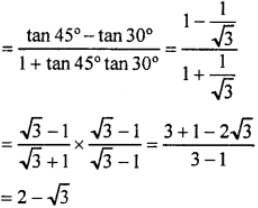
∴ required slope of line = tan 15° = tan (45° – 30°)
(v) Given inclination of line θ = 135°
∴ required slope of line = tan 135°
= tan (180° – 45°)
= – tan 45° = – 1
Que-2: Find the slope and inclination of the line through each pair of the following points :
(i) (1, 2) and (5, 6)
(ii) (0, 0) and (-√3, 3)
(iii) (10, 4) and (- 2, – 2)
(iv) (- 1, – 8) and (5, 7).
Sol: We know that slope of line joining two points (x1, y1) and (x2, y2) = m = (y2−y1)/(x2−x1)
(i) ∴ Slope of line joining two points (1, 2) and (5, 6) = (6−2)/(5−1) = 1 = m
Let θ be the inclination of line Then tan θ = m = 1 ⇒ θ = 45°
(ii) Slope of line joining the points (0, 0) and (-√3, 3)
m = (3-1)/(-√3-0) = -√3.
Let θ be the inclination of the line Then m = tan θ
∴ tan θ = – √3 = – tan (π/3) = tan (π−(π/3))
⇒ θ = π – (π/3) = 2π/3 or 120°
(iii) Thus, slope of line joining the points (10, 4) and (- 2, – 2) = m
= (−2−4)/(−2−10) = −6/−12 = 1/2
Let θ be the inclination of line then slope of line = m = tan θ
∴ tan θ = 1/2 ⇒ θ = 26°34′
(iv) ∴ slope of line joining the points (- 1, – 8) and (5, 7) be m = (7+8)/(5+1) = 15/6 = 5/2
Let θ be the inclination of the line Then slope of the line = tan θ
∴ tan θ = 5/2 ⇒ θ = 68°12′
Que-3: In the hexagon PQRSTU, RS || P U || QT. Which sides or diagonals have
(i) positive slope
(ii) negative slope
(iii) zero slope
(iv) infinite slope ?
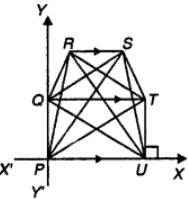
Sol: (i) If θ be the inclination of line. Then slope of line be positive if θ > 0
i.e. 0 < θ < 90°.
Then the lines QR, QS, PS, PT, PR are having positive slope.
(ii) Then line with negative slope means tan θ < 0 ⇒ 90° < θ < 180°.
Clearly the lines RT, QU, RU, ST and SU are having negative slopes.
(iii) The line is having zero slope
∴ tan θ = 0 ⇒ θ = 0
Thus the lines PU, QT and RS are having 0 slope.
(iv) Clearly the line is having infinite slope
∴ tan θ → ∞ ⇒ θ → π/2
Thus the lines PQ and UT are having infinite slopes.
Que-4: The side BC of an equilateral △ABC is parallel to the x-axis. What are the slopes of its sides?
Sol: Since the side BC of equilateral △ABC is parallel to x-axis.
∴ inclination of side BC = 0°
Thus slope of side BC = tan 0° = 0
Clearly the side AC makes an angle of 120° with +ve direction of x-axis.
∴ slope of side AC = tan 120°
= tan (180° – 60°)
= – tan 60° = -√3
Clearly the side AB makes an angle of 60° with positive direction of x-axis.
∴ slope of side AB of △ABC = tan 60° = +√3
Que-5: In a regular hexagon ABCDEF, AB || E D || the x-axis. What are the slopes of its sides?
Sol: Let the side AB and AE of hexagon ABCDEF along x-axis and y-axis.
We know that, exterior angle of hexagon = 360°/6 = 60°
∴ inclinations of sides BC, CD, DE, EF and AF are 60°, 120°, 0°, 60° and 120°
Thus slopes of sides BC, CD, DE, EF and AF are tan 60°, tan 120°, tan 0°, tan 60° and tan (180° – 60°)
i.e. √3, – √3, 0, √3, – √3.
Que-6: Using slopes determine which of the following sets of three points are collinear.
(i) (5, – 2), (7, 6), (0, – 2);
(ii) (- 2, 3), (8, – 5), (5, 3);
(iii) (6, – 1), (5, 0), (2, 3);
(iv) (-1, 5), (3, 1), (5, 7).
Sol: (i) Given points are A(5, – 2); B(7, 6) and C(0, – 2)
slope of line AB = (6+2)/(7−5) = 4
slope of line BC = (−2−6)/(0–7) = 8/7
and slope of line AC = (−2+2)/(0–5) = 0
∴ Slope of line AB ≠ slope of BC ≠ slope of AC
Thus, given points A, B and C are not collinear.
(ii) Given points are A (- 2, 3), B(8, – 5) and C (5, 4).
∴ slope of line AB = (−5−3)/(8+2) = −8/10 = −4/5
slope of line BC = (4+5)/(5−8) = 9/−3 = -3
and slope of line AC = (4−3)/(5+2) = 1/7
Clearly points A, B and C are not collinear.
(iii) Given points are A(6,- 1), B(5, 0) and C(2, 3).
∴ slope of line AB = (0+1)/(5−6) = – 1
slope of line BC = (3−0)/(2−5) = – 1
and slope of line AC = (3+1)/(2−6) = – 1
∴ slope of AB = slope of BC = slope of AC
Thus the points A, B and C are collinear.
(iv) Given points are A(- 1, 5), B(3, 1) and C(5, 7).
∴ slope of line AB = (1−5)/(3+1) = – 1
slope of line BC = (7−1)/(5−3) = 6/2 = 3
and slope of line AC = (7−5)/(5+1) = 2/6 = 1/3
Clearly the given points A, B and C are not collinear.
Que-7: Find y if the slope of the line joining (- 8, 11),(2, y) is -4/3.
Sol: slope of line joining the points (- 8, 11) and (2, y) = (y−11)/(2+8) = (y−11)/10
Also given slope of line be –4/3.
∴ (y−11)/10 = –4/3
⇒ 3y – 33 = – 40
⇒ 3y = 33 – 40
⇒ y = –7/3
Que-8: Find the angle between the lines whose slope are (i) 2 and -1 (ii) 2 and 3/4
Sol: (i) Given m1 = 2 and m2 = – 1
Let θ be the acute angle between the lines
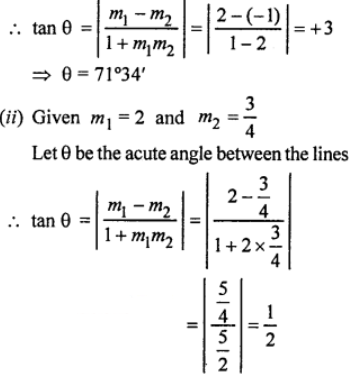
θ = 26°34’
Que-9: Find the slope of the line which makes an angle of 45° with a line of slope -6/5
Sol: Let m be the slope of line which makes an angle of 45° with a line of slope 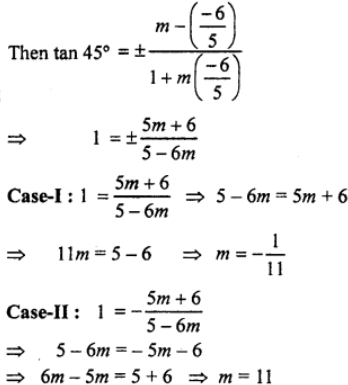
Hence the slopes of required line be 11 and -1/11
Que-10: Find the interior angles of the triangles whose vertices are (4, 3) B (-2, 2) and C (2, – 8).
Sol: slope of line AC = (−8−3)/(2−4) = 11/2
slope of side BC = (−8−2)/(2+2) = −5/2
slope of side AB = (3−2)/(4+2) = 1/6
We know that, if θ be the angle between the lines having slopes m1 and m2.
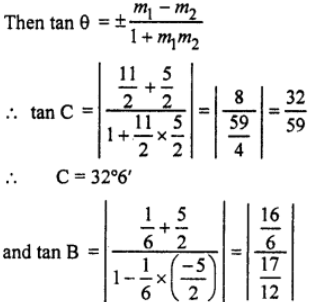
tan B = (16/6) × (12/7) = 32/17
B = 77°40’
Since the sum of angles of ΔABC is 180°
A = 180° – 77°40’ – 32°6’
= 70°14’
Que-11: Find the slope of a line parallel to a line whose slope is
(i) -3
(ii) 1/2
(iii) 2.3
(iv) 0
Sol: Two lines are having slopes m1 and m2 are parallel iff m1 = m2
(i) Thus slope of line which is || to line having slope – 3 = – 3
(ii) Slope of line which is parallel to line having slope 1/2 = 1/2
(iii) Slope of line which is parallel to line having slope 2.3 = 2.3
(iv) Slope of line which is || to line having slope 0 = 0
Que-12: Find the slope of a line parallel to the line which passes through each pair of the following points :
(i) (0, 0) and (5, 6),
(ii) (- 1, 3) and (4, 7),
(iii) (- 5, – 8) and (3, 0),
(iv) (-a, 0) and (0, b).
Sol: (i) Slope of line passes through the points (0, 0) and (5, 6)
∴ slope of line parallel to line joining (0, 0) and (5, 6) = 6/5
[If two lines having slopes m1 and m2 are parallel. Then m1 = m2 ]
(ii) Slope of line joining (-1, 3) and (4, 7) = (7−3)/(4−(−1)) = 4/5
∴ slope of line parallel to line joining (-1, 3) and (4, 7) = 4/5
[∵ slopes of parallel lines are equal]
(iii) Slope of line passes through the points
(-5, – 8) and (3, 0) = (0+8)/(3+5) = 8/8 = 1
∴ slope of line parallel to line passes through the point (- 5, – 8) and (- 3, 0) be 1 .
(iv) slope of line joining the points (-a, 0) and (0, b) = (b−0)/(0+a) = b/a
Thus slope of line parallel to line passes through the point (-a, 0) and (0, b) = b/a
Que-13: Find the slope of a line perpendicular to the line whose slope is
(i) 1/3
(ii) –5/6
(iii) 5
(iv) -5*(1/7)
(v) 0
(vi) Infinite
Sol: We know that two lines are perpendicular if product of their slopes is -1
∴ m1 m2 = -1
(i) given slope of line = 1/3
∴ slope of line ⊥ to given line = –1/(1/3) = -3
(ii) Slope of given line = –5/6
∴ slope of line ⊥ to given line = −1/(−5/6) = 6/5
(iii) Slope of given line be 5
∴ slope of line ⊥ to given line be −1/5.
(iv) Slope of given line = -5*(1/7) = –36/7
∴ slope of line ⊥ to given line = −1/(−36/7) = 7/36
(v) Slope of given line = 0
∴ Slope of line ⊥ to given line = 1/0 = + ∞
(vi) Slope of given line = ∞
∴ Slope of line ⊥ to given line = 1/∞ = 0
Que-14: Find the slope of a line perpendicular to the line which passes through each pair of the following points :
(i) (0, 8) and (-5, 2);
(ii) (1, – 11) and (5, 2);
(iii) (-k, h) and (b,- f)
(iv) (x1, y1) and (x2, y2)
Sol: (i) Slope of line passes through the points (0, 8) and (-5, 2) = (2−8)/(−5−0) = −6/−5 = 6/5
∴ slope of line ⊥ to given line (−1/−6)/5 = –5/6 [∵ m1 m2 = -1]
(ii) Slope of line passes through the points (1, – 11) and (5, 2)
(2+11)/(5−1) = 13/4 [∵ slope = (y2−y1)/(x2−x1)]
Thus slope of line ⊥ to the line passes through the points (1, – 11) and (5, 2)
= −1/(13/4) = −4/13 [∵ m1m2 = -1]
(iii) Slope of line passes through the points (- k, h) and (b, – f)
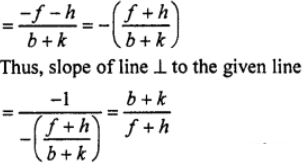
(iv) Slope of line joining the points(x1, y1)
and (x2, y2) = (y2−y1)/(x2−x1)
∴ slope of line ⊥ to given line = −1/{(y2−y1)/(x2−x1)}
= − {(x2−x1)/(y2−y1)}
Que-15: In rect. ABCD, slope of AB = 5/6. State the slope of (i) BC, (ii) CD, (iii) DA.
Sol: Given slope of AB = 5/6
Since ABCD is a rectangle.
∴ AB || DC and AD || BC
Further AB ⊥ BC
since AB || DC
∴ slope of CD = slope of AB = 5/6
∴ slope of BC = –1 slope of AB = −1/(5/6) = –6/5
Also DA || BC
∴ slope of DA = slope of BC = –6/5
Que-16: In Parallelogram ABCD, slope of AB = -2, slope of BC = 3/5. state the slope of
(i) AD (ii) CD (iii) the altitude of AD, (iv) the altitude of CD.
Sol: Given slope of AB = – 2
and slope of BC = 3/5
since ABCD is a parallelogram
∴ AB || DC.
∴ slope of DC = slope of AB = – 2
slope of AD = slope of BC = 3/5 [∵ AD || BC]
Clearly slope of the altitude to AD
= – 1 / slope of AD = −1/(3/5) = −5/3
Clearly slope of the altitude to CD
= −1 / slope of line BC = −1/−2 = 1/2
Que-17: The vertices of a △ABC are A(1, 1), B(7, 3) and C(3, 6). State the slope of the altitude to
(i) AB,
(ii) BC,
(iii) AC.
Sol: slope of AB = (3−1)/(7−1) = 2/6 = 1/3
slope of BC = (6−3)/(3−7) = −3/4
slope of AC = (6−1)/(3−1) = 5/2
Slope of the altitude AB = -1 / slope of AB
= -1/(1/3) = -3
Slope of the altitude BC = -1 / slope of BC
= -1/(-3/4) = 4/3
Slope of the altitude AC = -1 / slope of AC
= -1/(5/2) = -2/5.
Que-18: The line joining (-5, 7) and (0, – 2) is perpendicular to the line joining (1, – 3) and (4, x). Find x.
Sol: The slope of line joining (- 5, – 7) and (0, – 2) = m1 = (−2−7)/(0+5) = −9/5
and slope of line joining (1, – 3) and (4, x)
= m2 = (x+3)/(4−1) = (x+3)/3
Since the line joining (- 5, 7) and (0, – 2) is ⊥ to the line joining (1, – 3) and (4, x).
∴ m1 m2 = – 1
⇒ (−9/5) {(x+3)/3} = – 1
⇒ -9x – 27 = – 15
⇒ -9x = 12
⇒ x = −12/9 = −4/3
Que-19: Show that the tangent of an angle between the lines (x/a)+(y/b) = 1 and (x/a)-(y/b) = 1 is 2ab/(a²-b²)
Sol: We have
and (x/a) + (y/b) = 1 and (x/a) − (y/b) = 1
and ⇒ (y/b) = (−x/a) + 1 and (y/b) = (x/a) − 1
and ⇒ y = (−bx/a) + b and y = (b/a) − b
The slopes of the two lines are and −b/a and b/a
Now, the tangent of an angle between the lines is given by
{(b/a)+(b/a)}/[1−(b/a)×(b/a)]
= {2b/a}/{(a²−b²)/a²}
= 2ab/(a²−b²).
–: End of The Straight Line Class 11 OP Malhotra Exe-16A ISC Maths Ch-16 Solutions. :–
Return to :- OP Malhotra ISC Class-11 S Chand Publication Maths Solutions
Thanks
Please share with your friends