The Straight Line Class 11 OP Malhotra Exe-16C ISC Maths Solutions Ch-16 Solutions. In this article you would learn about Various Forms of Equations of the Straight Line. Step by step solutions of latest textbook has been given as latest syllabus. Visit official Website CISCE for detail information about ISC Board Class-11 Mathematics.
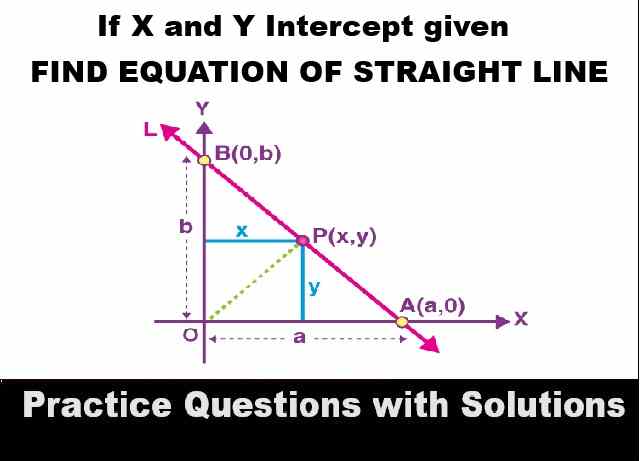
The Straight Line Class 11 OP Malhotra Exe-16C ISC Maths Solutions Ch-16
| Board | ISC |
| Publications | S Chand |
| Subject | Maths |
| Class | 11th |
| Chapter-16 | The Straight Line |
| Writer | O.P. Malhotra |
| Exe-16(C) | x and y intercept Equations of the Straight Line. |
Exercise- 16C
The Straight Line Class 11 OP Malhotra Exe-16C Solution.
Que-1: write down the equation of the straight line cutting off intercepts a and b from the axes where
(i) a = – 2, b = 3
(ii) a = 5, b = – 6
(iii) a = –k/m, b = k
Sol: (i) Let the eqn. of straight line having intercepts a and b on axes be
(x/a) + (y/b) = 1 …(1)
given a = – 2, b = 3
∴ eqn. (1) becomes ;
(x/−2) + (y/3) = 1
⇒ – 3x + 2y = + 6
⇒ 3x – 2y + 6 = 0
(ii) The eqn. of straight line having intercepts a and b on axes be given by
(x/a) + (y/b) = 1 …(1)
Here a = 5 and b = – 6
∴ eqn. (1) becomes ;
(x/5) + (y/−6) = 1
⇒ 6x – 5y – 30 = 0
(iii) The eqn. of straight line cut off intercepts a and b on axes be given by
(x/a) + (y/b) = 1 …(1)
Here a = –k/m and b = k
∴ eqn. (1) becomes; {x/(−k/m)} + (y/k) = 1
⇒ -mx + y = k ⇒ mx – y + k = 0
Que-2: Determine the x-intercept ‘a’ with the y intercept ‘b’ of the following lines. Sketch each.
(i) 3x + 5y – 15 = 9, (ii) x – y – 7 = 0.
Sol: (i) Given eqn. of line
3x + 5y – 15 = 0
it can be written as 3x + 5y = 15
⇒ (x/5) + (y/3) = 1
On comparing with (x/a) + (y/b) = 1
Here a = 5 and b = 3
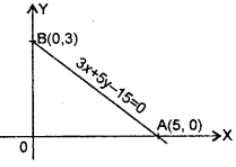
(ii) Given eqn. of line be x – y – 7 = 0
⇒ x – y = 7 ⇒ ⇒ (x/7) + (y/−7) = 1
On comparing with (x/a) + (y/b) = 1
∴ a = 7 and b = – 7
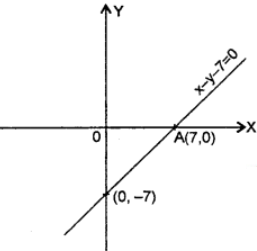
Que-3: Find the equation of the line which makes equal intercepts on the axes and passes through the point (2, 3).
Sol: Since the line makes equal intercepts on axes and let the length of intercept on axes be a
Let its eqn. be
(x/a) + (y/a) = 1
⇒ x + y = a …(1)
Since eqn. (1) passes through the point (2, 3)
∴ 2 + 3 = a ⇒ a = 5
Thus eqn. (1) becomes ; x + y = 5 be the required eqn. of line.
Que-4: Write down the equation of the line which makes an intercept of 2a on the x-axis and 3a on the y-axis. Given that the line passes through the point (14, – 9), find the numerical value of a.
Sol: The required eqn. of line which makes an intercept of 2a on x-axis and 3a on y-axis be given by
(x/2a) + (y/3a) = 1
⇒ 3x + 2y = 6a …(1)
It is given that line (1) passes through the point (14, – 9).
∴ 3 × 14 + 2 × (-9) = 6a ….(1)
⇒ 24 = 6a ⇒ a = 4
Que-5: Find the equation of the straight line which passes through the point (5, 6) and has intercept on the axes equal in magnitude but opposite in sign.
Sol: Let the eqn. of straight line in intercept form be given by
(x/a) + (y/b) = 1 …(1)
since intercept on the axes equal in magnitude but opposite in sign
∴ b = -a Thus eqn. (1) becomes;
(x/a) + (y/b) = 1 ⇒ x – y = a ….(2)
line (2) passes through the point (5, 6).
∴ 5 – 6 = a ⇒ a = – 1
Thus eqn. (2) becomes; x – y = – 1 be the required line.
Que-6: A straight line passes through (2, 3) and the portion of the line intercepted between the axes is bisected at this point. Find its equation.
Sol: Let the eqn. of line using intercept form be
(x/a) + (y/b) = 1 …(1)
line (1) meets coordinate axes at A(a, 0) and B(0, b).
Let P be the mid-point of AB.
∴ Coordinates of P are {(a/2), (b/2)}.
Also given coordinates of P are (2, 3).
∴ a/2 = 2 ⇒ a = 4
and b/2 = 3 ⇒ b = 6
Thus eqn. (1) becomes ; (x/4) + (y/6) = 1
⇒ 3x + 2y – 12 = 0
be the required eqn. of line.
Que-7: Show that the three points (5, 1),(1, – 1) and (11, 4) lie on a straight line. Further find
(i) its intercepts on the axes;
(ii) the length of the portion of the line intercepted between the axes;
(iii) the slope of the line.
Sol: Using two point form, eqn. of line through the points (5, 1) and (1, – 1) be given by
y – 1 = {(−1−1)/(1−5)} (x – 5)
⇒ y – 1 = (1/2) (x – 5)
⇒ x – 2y – 3 = 0 …(1)
Now the point (11, 4) lies on eqn. (1).
if 11 – 2 × 4 – 3 = 0 if 0 = 0, which is true.
Hence the given points (5, 1),(1, – 1) and (11, 4) lies on same straight line.
(i) eqn. (1) can be written as ;
x – 2y = 3 ⇒ (x/3) + {y/(−3/2)} = 1 …(2)
So line (2) cut off intercept 3 and −3/2 on axes.
(ii) Clearly line (2) intersects x-axis at A(3, 0) and B(0,−3/2)
∴ required length of the portion of the line intercept between the axes
= √[(0-3)²+{(-3/2)-0}²]
= √{9+(9/4)} = √(45/4)
= (3√5)/2
(iii) eqn. (1) can be written as ;
y = (x/2) – (3/2)
On comparing with y = mx + b
we have m = 1/2 and b = −3/2
∴ slope of line = 1/2
Que-8: Find the equation of the straight line which passes through the point (3, – 2) and cuts off positive intercepts on the x and y-axes which are in the ratio 4 : 3.
Sol: Let the eqn. of straight line be
(x/a) + (y/b) = 1 …(1)
where a > 0, b > 0
Since the intercepts on coordinates axes are in the ratio 4 : 3. Let the intercepts on x axis and y-axis are 4a and 3a.
∴ eqn. (1) becomes ; (x/4a) + (y/3a) = 1
⇒ 3x + 4y = 12a …(2)
Since line (2) passes through the point (3, – 2).
∴ 9 – 8 = 12a ⇒ 12a = 1
∴ eqn. (1) becomes ; 3x + 4y = 1 be the required line
Que-9: Find the equation of the straight line at a distance of 3 units from the origin such that the perpendicular from the origin to the line makes an angle α, given by the equation tan α = 5/12, with the positive direction of the axis of x.
Sol: Here p = ⊥ distance from (0, 0) on required line = 3
given tan α = 5/12
∴ sin α = 5/13
and cos α = 12/13
has using normal form, eqn. of line be given by x cos α + y sin α = p
⇒ x × (12/13) + y + (5/13) = 3
⇒ 12x + 5y = 39
Que-10: Show on a diagram the position of the straight line x cos 30° + y sin 30° = 2 in relation to the co-ordinate axes, indicating clearly which angle is 30° and which length is 2 units. Find
(i) the equation of the straight line parallel to that given and passing through the point (4, 3);
(ii) the length of the perpendicular from the origin on to this line ;
(iii) the distance between the two parallel straight lines.
Sol: Given eqn. of straight line be
x cos 30° + y sin 30° = 2
x (√3/2) + (y/2) = 2
⇒ √3x + y = 4 …(1)
line (1) intersect x-axis at A (4/√3, 0) and B (0, 4)
(i) from (1); y = -√3x + 4
∴ slope of line (1) = -√3
∴ slope of line parallel to line (1) = -√3
Thus eqn. of straight line parallel to line (1) and passing through the point (4, 3) be given by
y – 3 = -√3(x – 4)
⇒ √3x + y = 3 + 4√3
⇒ (√3/2)x + (y/2) = (3/2) + 2√3
⇒ x cos 30° + y sin 30° = (3/2) + 2√3 …(2)
(ii) On comparing with
x cos α + y sin α = p
∴ length of ⊥ from origin on line (2)
= 3/2 + 2√3
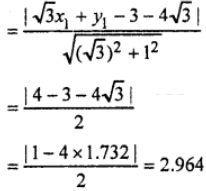
(iii) Distance between parallel lines = ⊥ distance of any point (x1, y1) on line (1) to line (2)
Que-11: A straight line (x/a) – (y/b) = 1 passes through the point (8, 6) and cuts off a triangle of area 12 units from the axes of coordinates. Find the equations of the straight line.
Sol: Given eqn. of straight line be
(x/a) – (y/b) = 1 …(1)
eqn. (1) passes through the point (8, 6).
∴ (8/a) – (6/b) = 1
⇒ 8b – 6a = ab …(2)
Further line (1) passes through A(a, 0) and B(0, – b) and also line (1) passes through the point P(8, 6).
area of ΔOAB = (1/2) × OA × OB
= (1/2) × a × b = ab/2
area of ΔOAB = (1/2) × OA × OB
= ab/2 = 12
ab = 24.
From (2) and (3); we have
8b – 6 × (24/b) = 24 ⇒ 8b² – 24b = 144
⇒ b2 – 3b – 18 = 0 ⇒ (b – 6)(b + 3) = 0
⇒ b = 6, – 3
When b = 6 ∴ from (2); a = 24/6 = 4
Thus eqn. (1) becomes; (x/4) – (y/6) = 1 be the required line.
When b = – 3 ∴ from (2); a = 24/−3 = – 8
Thus eqn. (1) becomes ;
(x−8)/( – y−3) = 1
⇒ (x/8) – (y/3) = 1
which is the required line.
Que-12: A straight line passes through the points (a, 0) and (0, b). The length of the line segment contained between the axes is 13 and the product of the intercepts on the axes is 60 . Calculate the values of a and b and find the equation of the straight line.
Sol: Given |AB| = 13 units
⇒ √{(a−0)²+(0−b)²} = 13
⇒ a² + b² = 169 ….(1)
Also product of the intercepts on the axes be 60 .
∴ ab = 60 …(2)
(a+b)² = a² + b² + 2ab
=169 + 2 × 60 = 289
⇒ a + b = ± 17
Case-I : When a + b = 17 ⇒ b = 17 – a
∴ from (2); a(17 – a) = 60
⇒ a2 – 17a + 60 = 0
⇒ (a – 5)(a – 12) = 0
⇒ a = 5, 12
When a = 5 ⇒ b = 12
When a = 12 ⇒ b = 5
Thus eqn. of lines (using intercept form) be given by
(x/5) – (y/12) = 1
0r (x/12) – (y/5) = 1
Case-II : When a + b = – 17
⇒ b = – 17 – a
∴ from (2); a( – 17 – a) = 60
⇒ a2 + 17a + 60 = 0
⇒ (a + 5) (a + 12) = 0
⇒ a = – 5, – 12
When a = – 5 ⇒ b = – 12
When a = – 5 ⇒ b = – 12
When a = – 12 ⇒ b = – 5
Thus the corresponding eqns. of straight lines are
(x/−5) + (y/−12) = 1
0r (x/−12) + (y/−5) = 1
–: End of The Straight Line Class 11 OP Malhotra Exe-16C ISC Maths Ch-16 Solutions. :–
Return to :- OP Malhotra ISC Class-11 S Chand Publication Maths Solutions
Thanks
Please share with your friends