The Straight Line Class 11 OP Malhotra Exe-16D ISC Maths Solutions Ch-16 Solutions. In this article you would learn about Identical Lines, Gradient, Angle Between Two Lines. Step by step solutions of latest textbook has been given as latest syllabus. Visit official Website CISCE for detail information about ISC Board Class-11 Mathematics.
The Straight Line Class 11 OP Malhotra Exe-16D ISC Maths Solutions Ch-16
| Board | ISC |
| Publications | S Chand |
| Subject | Maths |
| Class | 11th |
| Chapter-16 | The Straight Line |
| Writer | O.P. Malhotra |
| Exe-16(D) | Identical Lines, Gradient, Angle Between Two Lines. |
Identical Lines, Gradient, Angle Between Two Lines.
The Straight Line Class 11 OP Malhotra Exe-16D ISC Maths Solutions Ch-16 Solutions
Que-1: Write down the slopes of the following lines :
(i) 2x + 3y + 1 = 0
(ii) 7x – 5y + 8 = 0
(iii) – 6y – 11x = 0
(iv) xx1 + yy1 = a2
(v) 3x + 4y – 2 (x – x1) – 5 (y + y1) + 2 = 0
Sol: (i) Given eqn. of line be
2x + 3y + 1 = 0
∴ slope of given line = – coeff. of x / coeff. of y
= –2/3
(ii) Given eqn. of line be 7x – 5y + 8 = 0
∴ slope of given line = – coeff. of x / cceff. of y
= −7/−5 = 7/5
(iii) Given eqn. of line be
– 6y – 11x = 0 ⇒ 6y + 11x = 0
∴ slope of given line = – coeff. of x / cceff. of y
= –11/6
(iv) Given eqn. of line be xx1 + yy1 = a²
∴ slope of given line = – coeff. of x / cceff. of y
= –x1/y1
(v) Given eqn. of line be
3x + 4y – 2 (x + x1) – 5(y + y1) + 2 = 0
⇒ x – y – 2×1 – 5y1 + 2 = 0
∴ slope of given line be = – coeff. of x / coeff. of y
= −1/−1 = 1
Que-2: Find the value of k such that the line (k – 2) x+ (k + 3) y – 5 = 0 is
(i) parallel to the line 2x – y + 7 = 0
(ii) perpendicular to it.
Sol: Given eqn. of line be
(x – 2)x + (k + 3) y – 5 = 0 …(1)
∴ slope of line (1) = m1 = – {(k−2)/(k+3)}
and slope of line 2x – y + 7 = 0 be
m2 = −2/−1 = 2
(i) Since both lines are parallel ∴ m1 = m2
⇒ –(k−2)/(k+3) = 2
⇒ k – 2 = – 2(k + 3)
⇒ k – 2 = – 2k – 6
⇒ 3k = -6 + 2 = -4
⇒ k = –4/3
(ii) Since both given lines are perpendicular
∴ m1m2 = – 1
⇒ – {(k−2)/(k+3)} 2 = -1
⇒ 2(k – 2) = k + 3
⇒ 2k – 4 = k + 3
⇒ k = 7
Que-3: Prove that the lines
(i) 3x + 4y – 7 = 0 and 28x – 21y + 50 = 0 are mutually perpendicular ;
(ii) px + qy – r = 0 and – 4px – 4qy + 5s = 0 are parallel.
Sol: (i) Given eqns. of lines are
3x + 4y – 7 = 0 …(1)
and 28x – 21 y + 50 = 0 …(2)
slope of line (1) = m1 = –3/4
slope of line (2) = m2 = −28/−21 = 28/21
Here m1m2 = (−3/4) (28/21) = 1
Thus both lines (1) and (2) are mutually perpendicular.
(ii) eqns. of given lines are
px + qy – r = 0 …(1)
and -4px – 4py + 5s = 0 …(2)
slope of line (1) = m1 = – coeff. of x / coeff. of y
= –p/q
slope of line (2) = m2 = −4p/−4q = p/q
Here m1 = m2
Thus both gives lines are parallel.
Que-4: Find the slope of the line which is perpendicular to the line 7x + 11y – 2 = 0.
Sol: eqn. of given line be 7x + 11y – 2 = 0 …(1)
∴ slope of line (1) = m = – coeff. of x / coeff. of y
= –7/11
Thus slope of line ⊥ to line (1)
= −1 / slope of line (1) = −1/(−7/11) = 11/7
Que-5: Determine the angle between the lines whose equations are
(i) 3x + y – 7 = 0 and x + 2y + 9 = 0,
(ii) 2x – y + 3 = 0 and x + y – 2 = 0.
Sol: (i) Given eqns. of lines are
3x + y – 7 = 0 …(1)
and x + 2y + 9 = 0 …(2)
∴ slope of line (1) = m1 = – coeff. of x / coeff. of y
= –3/1 = – 3
and slope of line (2) = m2 = –1/2
Let θ be the acute angle between the given lines
tan θ = |(m1-m2)/{1+m1m2}|
= |{-3+(1/2)} / 1+{(-3)(-1/2)}|
= |(-5/2)/(5/2)|
⇒ tan θ = 1 ⇒ θ = 45°
(ii) eqns. of given lines are ;
2x – y + 3 = 0 …(1)
and x + y – 2 = 0 …(2)
Slope of line (1) = m1 = – coeff. of x / coeff. of y
= –(+2) / −1 = 2
slope of line (2) = m2 = (−1)/1 = – 1
Let θ be the acute angle between the given lines
Then tan θ = |(m1-m2)/{1+m1m2}|
= |(2+1)/(1+2(-1))|
= |-3| = 3
= tan¯¹ (3) = 71°34’
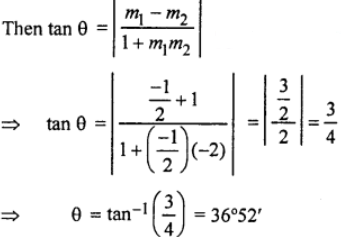
Que-6: Use tables to find the acute angle between the lines 2y + x = 0 and (x/1) + (y/2) = 2.
Sol: Given equations of lines are
2y + x = 0 …(1)
and (x/1) + (y/2) = 2 …(2)
∴ slope of line (1) = m1 = – coeff. of x / coeff. of y = –1/2
slope of line (1) = m1 = – coeff. of x / coeff. of y
= –1/2
∴ slope of line (2) = m2 = −1/(1/2) = – 2
Let θ be the acute angle between the given lines (1) and (2).
Que-7: Reduce the following equations to the normal form and find the values of p and α
(i) √3x – y + 2 = 0.
(ii) 3x + 4y + 10 = 0 (Use tables).
Sol: (i) eqn. of given line be √3x – y + 2 = 0
⇒ √3x – y = – 2
⇒ -√3x + y = 2
⇒ –(√3/2)x + (y/2) = 1 …(1)
On comparing eqn. (1) with
x cos α + y sin α = p
we have, cos α = −√3/2 …(2)
and sin α = 1/2 …(3)
and p = 1
On dividing eqn. (3) by eqn. (2); we have
tan α = –1/√3 = – tan (π/6) = tan (π−(π/6))
[Here α lies in 2nd quadrant ∴ sin α > 0 and cos α < 0]
α = 5π/6 or 150° and p = 1
(ii) given eqn. of line be,
3x + 4y + 10 = 0
⇒ 3x + 4y = – 10
⇒ -3x – 4y = 10
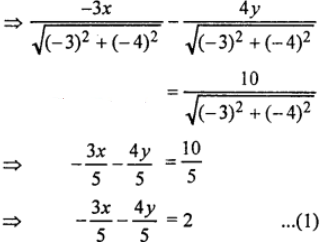
Comparing eqn. (1) with
x cos α + y sin α = p
cos α = –3/5 …(2)
and sin α = –4/5 …(3)
and p = 2
since sin α, cos α < 0
∴ α lies in 3rd quadrant.
On dividing eqn. (3) by eqn. (2); we have
tan α = (−4/5)/(−3/5) = 4/3
= tan(180°+tan¯¹(4/3))
α = 180° + 53°81′ = 233°8′
and p = 2
Que-8: Put the equation 12y = 5x + 65 in the form x cos θ + y sin θ = p and indicate clearly in a rough diagram the position of the straight line and the meaning of the constant θ and p.
Sol: Given eqn. of line be
12y = 5x + 65
⇒ – 5x + 12y = 65
On dividing eqn. (1) throughout by
√{(−5)²+12²} i.e. 13; we have
(−5/13)x + (12/13)y = (65/13) = 5 …(2)
On comparing eqn. (1) with
x cos θ + y sin θ = p
we have, cos θ = −5/13 …(3)
and sin θ = 12/13 …(4)
and p = 5
On dividing eqn. (4) by eqn. (3) ; we have
tan θ = –12/5
Here cos θ < 0 and sin θ > 0
∴ θ lies in 2nd quadrant.
⇒ tan θ = -tan α = tan (π – α)
⇒ θ = π – α = π – tan¯¹ (12/5)
⇒ θ = 180° – 67°23′ = 112°37′
Thus eqn. (3) becomes;
x cos 112°37′ + y sin 112°37′ = 5
Que-9: If Ax + By = C and x cos α + y sin α = p represent the same line, find p in terms of A, B, C.
Sol: Given eqns. of lines are
Ax + By = C …(1)
and x cos α + y sin α = p …(2)
Since eqns. (1) and (2) represents same line.
∴ A/cosα = B/sinα = C/p
⇒ AP = C cos α …(1)
and BP = C sin α …(2)
On squaring and adding eqn. (1) and (2) ; we have
(A2 + B2)p2 = C2(cos2 α + sin2 α) = C2
p² = C²/(A²+B²)
p = |C| / √(A²+B²)
Que-10: Show that (2, – 1) and (1, 1) are on opposite sides of 3x + 4y = 6.
Sol: The eqn. of given line be
3x + 4y – 6 = 0 …(1)
putting the point (2, – 1) in L.H.S of eqn. (1) we have, 3 × 2 + 4( – 1) – 6 = – 4 < 0 Again putting the point (1, 1) in L.H.S of eqn. (1), we have, 3 × 1 + 4 × 1 – 6 = 1 > 0
Since the results are of opposite sign and hence the given points lies on opposite sides of given line (1).
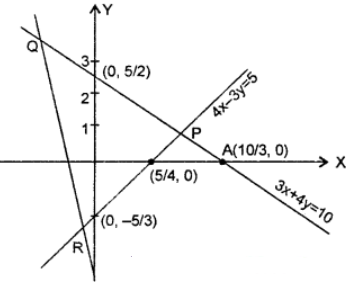
Que-11: The sides of a straight triangles are given by the equations 3x + 4y = 10, 4x – 3y = 5, and 7x + y + 10 = 0; show that the origin lies within the triangle.
Sol: Sol. Given eqns. of lines are
3x + 4y = 10 …(1)
4x – 3y = 5 …(2)
and 7x + y + 10 = 0 …(3)
Line (1) meets x-axis at B(0, 5/2)
and y-axis at A(10/3, 0)
line (2) meets coordinate axes at c(5/4, 0) and D(0, −5/3).
and line (3) meets coordinate axes at E(−10/7, 0) and F(0, – 10).
Clearly (0, 0) lies within the △PQR.
Que-12: Find by calculation whether the points (13, 8),(26, – 4) lie in the same, adjacent, or opposite angles formed by the straight lines 5x + 6y – 12 = 0, and 10x + 11 y – 217 = 0.
Sol: Given eqns. of straight lines are
5x + 6y – 112 = 0 …(1)
10x + 11y – 217 = 0 …(2)
putting the coordinates (13, 8) in L.H.S of eqn. (1); we have
5 × 13 + 6 × 8 – 112 = 113 – 112 = 1 > 0
and the coordinates (13, 8) in L.H.S of eqn. (2) ; we have
10 × 13 + 11 × 8 – 217 = 218 – 217 = 1 > 0
Putting the coordinates (26, – 4) in L.H.S of eqn. (1); we have
5 × 26 + 6( – 4) – 112 = 106 – 112 = – 6 < 0
Also, putting the coordinates (26, – 4) in L.H.S of eqn. (2) ; we have,
10 × 26 + 11 × (- 4) – 217 = 216 – 217 = – 1 < 0
Hence, both points (13, 8) and (26, – 4) lies on opposite sides of both lines.
–: End of The Straight Line Class 11 OP Malhotra Exe-16D ISC Maths Ch-16 Solutions. :–
Return to :- OP Malhotra ISC Class-11 S Chand Publication Maths Solutions
Thanks
Please share with your friends