The Straight Line Class 11 OP Malhotra Exe-16E ISC Maths Solutions Ch-16 Solutions. In this article you would learn about Intersection of Straight Lines and Concurrency. Step by step solutions of latest textbook has been given as latest syllabus. Visit official Website CISCE for detail information about ISC Board Class-11 Mathematics.
The Straight Line Class 11 OP Malhotra Exe-16E ISC Maths Solutions Ch-16
| Board | ISC |
| Publications | S Chand |
| Subject | Maths |
| Class | 11th |
| Chapter-16 | The Straight Line |
| Writer | O.P. Malhotra |
| Exe-16(E) | Intersection of Straight Lines and Concurrency |
Intersection of Straight Lines and Concurrency
The Straight Line Class 11 OP Malhotra Exe-16E ISC Maths Solutions Ch-16 Solutions
Que-1: Find the co-ordinates of the point of intersection of the straight lines
(i) 3x – 5y + 5 = 0, 2x + 3y – 22 = 0
(ii) 2x – 3y – 7 = 0, 3x – 4y – 13 = 0.
Sol: (i) Given eqns. of lines are
3x – 5y + 5 = 0 …(1)
2x + 3y – 22 = 0 …(2)
To find the point of intersection of both lines we solve eqn. (1) and (2) simultaneously.
3 × eqn. (1) + 5 × eqn. (2); we have
19x – 95 = 0 ⇒ x = 5
∴ from (1); 15 – 5y + 5 = 0 ⇒ y = 4
∴ (5, 4) be the required point of intersection of both lines.
(ii) Given eqns. of lines are
2x – 3y – 7 = 0 …(1)
and 3x – 4y – 13 = 0 …(2)
For point of intersection of lines (1) and (2), we solve eqn. (1) and (2) simultaneously.
4 × eqn. (1) – 3 × eqn. (2); we have
8x – 9x – 28 + 39 = 0 ⇒ x = 11
putting x = 11 in eqn. (1); we have
22 – 3y – 7 = 0 ⇒ y = 15/3 = 5
Thus (11, 5) be the required point of intersection of both lines.
Que-2: Find the area of the triangle formed by the lines y + x – 6 = 0, 3y – x + 2 = 0 and 3y = 5x + 2.
Sol: Given lines are
y + x – 6 = 0 …(1)
3y – x + 2 = 0 …(2)
and 3y = 5x + 2 …(3)
To find the point of intersection of lines (1) and (2) we have to solve (1) and (2) simultaneously.
on adding (1) and (2); we have
4y – 4 = 0 ⇒ y = 1
∴ from (1); 1 + x – 6 = 0 ⇒ x = 5
Thus lines (1) and (2) intersects at A (5, 1).
To find point of intersection of lines (2) and (3)
we solve (2) and (3) simultaneously.
5x + 2 – x + 2 = 0 ⇒ x = – 1
∴ from (2); 3y + 1 + 2 = 0 ⇒ y = – 1
Thus lines (2) and (3) intersection at B (- 1, – 1)
To find point of intersection of lines (1) and (3)
we solve eqn. (1) and (3) simultaneously
3 (6 – x) = 5x + 2
⇒ 18 – 3x = 5x + 2
⇒ 8x = 16 ⇒ x = 2
∴ from (1) ; y = 4
Thus lines (1) and (3) intersects at C(2, 4).
∴ required area of △ABC
= 1/2 | (- 5 + 1) + (- 4 + 2) + (2 – 20) |
= 1/2 | – 4 – 2 – 18 | = 12 sq. units
Que-3: Find the orthocentre of the triangle whose angular points are (0, 0), (2, – 1), (- 1, 3).
Sol: Let AL, BM and CN are the altitudes of the △ABC with vertices A(0, 0) ; B(2, – 1) and C(- 1, 3).
slope of BC = (3+1)/(−1−2) = −4/3
since AL ⊥ BC
∴ slope of AL = −1 / slope of BC = −1/(−4/3) = 3/4
slope of CA = (3−0)/(−1−0) = – 3
since BM ⊥ AC
∴ slope of BM = −1 / slope of AC = −1/−3 = 1/3
slope of AB = (−1−0)/(2−0) = –1/2
since CN ⊥ AB
∴ slope of CN = −1 / slope of AB = −1/(−1/2) = 2
Equation of line AL, passing through (0, 0) and having slope 3/4 is given by
y – 0 = (3/4) (x – 0) ⇒ y = (3/4) x …(1)
Equation of line BM, i.e. line passing
through B(2, – 1) and having slope 1/3 is given by
y + 1 = (1/3) (x – 2)
⇒ x – 3y – 5 = 0 …(2)
Eqn. of line CN i.e. line passing through C (- 1, 3)
and having slope 2 is given by
y – 3 = 2(x + 1)
⇒ 2x – y + 5 = 0 …(3)
For point of intersection of lines AL and BM,
we solve (1) and (2) simultaneously
x – (9x/4) – 5 = 0 ⇒ 4x – 9x – 20 = 0
⇒ -5x – 20 = 0 ⇒ x = – 4
∴ from (1) ; y = – 3
Thus (- 4, -3 ) be the point of intersection of lines (1) and (2).
The point (- 4, – 3) lies on eqn. (3) if 2(- 4) – (- 3) + 5 = 0
if 0 = 0, which is true.
Hence AL, BM and CN intersects at a point (- 4, – 3) and be the required orthocentre.
Que-4: The vertices of a triangle are A (0, 5), B (- 1, – 2) and C(11, 7). Write down the equations of BC and the perpendicular from A to BC and hence find the co-ordinates of the foot of the perpendicular.
Sol: Using two point form, eqn. of line joining B(- 1, – 2) and C (11, 7) be given by
y + 2 = (7+2)/(11+1) (x + 1)
⇒ y + 2 = (9/2) (x + 1)
⇒ y + 2 = (3/4) (x + 1)
⇒ 3x – 4y – 5 = 0 …(1)
∴ slope of line BC = – coeff. of x / coeff. of y = −3/−4 = 3/4
Let AD be the ⊥ drawn from A to BC
∴ slope of AD = −1 / slope of BC = −1/(3/4) = −4/3
Thus required eqn. of line through the point A(0, 5) and ⊥ to BC be given by
y – 5 = (–4/3) (x – 0) ⇒ y – 5 = (–4x/3)
⇒ 4x + 3y – 15 = 0 …(2)
Let D be the foot of ⊥ which is the point of intersection of lines BC and AD.
eqn. (1) × 3 + 4 × eqn. (2); we have
9x – 15 + 16x – 60 = 0
⇒ 25x = 75 ⇒ x = 3
∴ from (1) ; 3 × 3 – 4y – 5 = 0
⇒ 4y = 4
⇒ y = 1
Thus coordinates of required foot of ⊥ are (3, 1).
Que-5: Find the equation of the straight line passing through the point of intersection of the two lines x + 2y + 3 = 0 and 3x + 4y + 7 = 0 and parallel to the straight line y – x = 8.
Sol: Given eqns. of lines are
x + 2y + 3 = 0 …(1)
and 3x + 4y + 7 = 0 …(2)
To find the point of intersection of lines (1) and (2); we solve (1) and (2) simultaneously eqn. (2) – 2 eqn. (1); we have
x + 1 = 0 ⇒ x = – 1
∴ from (1);
– 1 + 2y + 3 = 0 ⇒ y = – 1
Thus point of intersection of lines (1) and (2) be (- 1, – 1)
given eqn. of line be y – x = 8 …(3)
∴ slope of line (3) = −(−1)/1 = 1
Thus slope of line || to line (3) be 1 .
Hence required eqn. of line through the point (- 1, – 1) and having slope 1 be given by y + 1 = 1(x + 1) ⇒ x – y = 0
Que-6: Find the equation of the line through the intersection of y + x = 9 and 2x – 3y + 7 = 0, and perpendicular to the line 2y – 3x – 5 = 0.
Sol: Given eqns. of lines are
y + x = 9 …(1)
and 2x – 3y + 7 = 0 …(2)
To find the point of intersection of (1) and (2), we solve (1) and (2) simultaneously
3 × eqn. (1) + eqn. (2) gives;
5x = 27 – 7 ⇒ 5x = 20 ⇒ x = 4
putting the value of x = 4 in eqn. (1) ; we have
y + 4 = 9 ⇒ y = 5
Thus (4, 5) be the point of intersection of given lines.
Also, eqn. of given line be
2y – 3x – 5 = 0 …(3)
∴ slope of line (3) = − coeff. of x / coeff. of y = −(−3)/2 = 3/2
Thus slope of line ⊥ to line (3) = –1/(3/2) = –2/3
Hence the eqn. of line through the point (4, 5) and having slope –2/3 is given by
y – 5 = (–2/3) (x – 4) | y – y1 = m(x – x1)
⇒ 2x + 3y – 23 = 0
Que-7: Prove that the three lines 5x + 3y – 7 = 0, 3x – 4y = 10, and x + 2y = 0 meet in a point.
Sol: Equations of given lines are
5x + 3y – 7 = 0 …(1)
3x – 4y – 10 = 0 …(2)
and x + 2y = 0 …(3)
all the given lines meet at a point if point of intersection of any two lines say (1) and (2) lies on line (3).
For the point of intersection of line (1) and (2) we solve (1) and (2) simultaneously.
4 × eqn. (1) + 3 × eqn. (2); we have
29x – 58 = 0 ⇒ x = 2
putting x = 2 in eqn. (1); we have
10 + 3y – 7 = 0 ⇒ 3y = – 3 ⇒ y = – 1
Thus (2, – 1) be the point of intersection of lines (1) and (2).
Now point (2, – 1) lies on eqn. (3)
∴ 2 – 2 = 0 ⇒ 0 = 0, which is true.
Thus point of intersection of lines (1) and (2) lies on line (3). Therefore all the given lines meet in a point.
Que-8: For what value of m are the three lines y = x + 1, y = 2(x + 1) and y = mx + 3 concurrent?
Sol: Given eqns. of lines are
y = x + 1 …(1)
y = 2(x + 1) …(2)
y = mx + 3 …(3)
Three lines are concurrent if point of intersection of both lines (1) and (2) lies on line (3).
For line of intersection of eqn. (1) and (2) we solve eqn. (1) and (2) simultaneously.
From (1) and (2); we have
y = 2y ⇒ y = 0
∴ from (1); x = – 1
∴ (- 1, 0) be the point of intersection of lines (1) and (2). Since given lines are concurrent.
∴ (- 1, 0) lies on eqn. (3).
⇒ 0 = – m + 3 ⇒ m = 3
Que-9: The co-ordinates of A, B and C are (3, 1), (1, 5) and (4, 2) respectively. P is the midpoint of BC and (i) Q lies on AC and is such that CQ : QA = 3 : 1, R lies on AB and is such that AR : RB = 1 : 3. Find the equation of the lines AP, BQ and CR and prove that lines are concurrent.
Sol: The coordinates of points A, B and C are (3, 1), (1, 5) and (4, 2). Since P be the midpoint of BC using mid-point formula, we have
Coordinates of P are [{(1+4)/2}, {(5+2)/2}]
i.e. {(5/2), (7/2)}.
Since Q lies on AC and is such that
CQ : QA = 3 : 1
∴ Q divides CA in the ratio 3 : 1
Then by section formula, we have
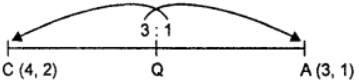
Coordinates of Q are
[{(3×3+4×1)/(3+1)}, {(3×1+1×2)/(3+1)}] i.e. {(13/4), (5/4)}
Also R lies on AB such that AR : RB = 1 : 3
∴ R lies on AB in the ratio 1 : 3
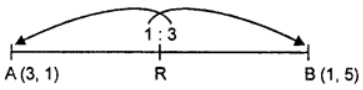
Then by section formula coordinates of R are given by [{(1×1+3×3)/(1+3)}, {(1×5+3×1)/(1+3)}]
i.e. {(10/4), (8/4)} i.e. {(5/2), 2}
using two-point form, eqn. of line AP be given by
y-1 = [{(7/2)-1} / {(5/2)-3}] (x-3)
y-1 = {(5/2)/(-1/2)} (x-3)
y-1 = -5 (x-3)
5x+y-16 = 0 ……… (1)
The equation of line BQ be given by
y-5 = [{(5/4)-5} / {(13/4)-1}] (x-1)
y-5 = {(-15/4)/(9/4)} (x-1)
y-5 = (-5/3) (x-1)
5x+3y-20 = 0 ………….. (2)
Required equation of line CR is given by
y-2 = [(2-2)/{(5/2)-4}] (x-4)
y-2 = 0 …….. (3)
On solving eqn. (2) and (3); we have
y = 2 and 5x + 6 – 20 = 0 ⇒ x = 14/5
Thus (14/5, 2) be the point of intersection of lines (1) and (2), it lies on line (1)
if 5 × (14/5) + 2 – 16 = 0 if 0 = 0, which is true. Hence all the three lines pass through the point (14/5, 2). Thus the lines AP, BQ and CR are concurrent.
Que-10: The sides of a triangle are OA, OB, AB and have equations 2x – y = 0, 3x + y = 0, x – 3y + 10 = 0, respectively. Find the equation of the three medians of the triangle and verify that they are concurrent.
Sol: Given eqns. of side OA, OB and AB of △OAB are
2x – y = 0 …(1)
3x + y = 0 …(2)
x – 3y + 10 = 0 …(3)
Clearly the lines (1) and (2) intersect at O(0, 0)
The coordinates of A can be found out by finding the point of intersection of line (1) and (3).
On solving eqn. (1) and (3) simultaneously we have, x – 3(2x) + 10 = 0 ⇒ x = 2
∴ from (1); y = 2x = 2 × 2 = 4
Thus coordinates of A are (2, 4)
Clearly lines (2) and (3) intersects at point B and its coordinates can be found out by solving eqn. (2) and (3) simultaneously.
∴ x – 3(-3x) + 10 = 0 ⇒ x = 1
∴ from (2); y = 3
Thus coordinates of B are (- 1, 3).
Let OL, AM and BN are the three medians of △ABC, where L, M and N are the midpoints of sides AB, OB and OA of △OAB respectively.
∴ Coordinates of L are [{(2−1)/2}, {(4+3)/2}]
i.e. (1/2, 7/2)
Coordinates of M are [{(−1+0)/2}, {(3+0)/2}]
i.e. (−1/2, 3/2)
and Coordinates of N are [{(2+0)/2}, {(4+0)/2}] i.e. (1, 2)
using two point form, eqn. of line OL be given by
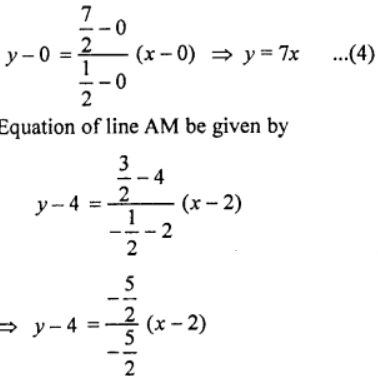
y-4 = x-2
x-y+2 = 0 …… (5)
Equation of median BN be given by
y – 3 = {(2−3)/(1+1)} (x + 1)
⇒ y – 3 = (–1/2) (x + 1) ⇒ x + 2y – 5 = 0
Solving eqn. (4) and eqn. (5) ; we have
x – 7x + 2 = 0 ⇒ 6x = 2 ⇒ x = 1/3
∴ from (4); y = 7/3
Thus point of intersection of lines (4) and (5) be {(1/3), (7/3)}.
Now point {(1/3), (7/3)} lies on eqn. (6)
if 1/3 + 14/3 – 5 = 0 if 0 = 0, which is true. Hence the three medians pass through the point {(1/3), (7/3)} and hence all the medians are concurrent.
Que-11: Show that the lines lx + my + n = 0, mx + ny + l = 0 and nx + ly + m = 0 are concurrent if l + m + n = 0.
Sol: Given equations of lines are ;
lx + my + n = 0 …(1)
mx + ny + l = 0 …(2)
and nx + ly + m = 0 …(3)
Clearly all the three lines are concurrent if point of intersection of any two lines say line (1) and line (2) lies on line (3).
Clearly the line (1) and (2) pass through the point (1, 1) if l + m + n= 0
Also point (1, 1) lies on eqn. (3) if
l + m + n = 0
Alter : The given lines are concurrent if the point of intersection of lines (1) and (2) lies on line (3).
For point of intersection of line (1) and (2) we solve (1) and (2) simultaneously
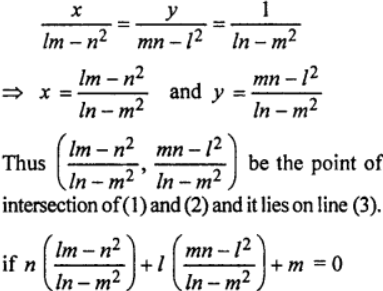
if 3lmn – n3 – l3 – m3 = 0
if l3 + m3 + n3 – 3lmn = 0
if (l + m + n) (l2 + m2 + n2 – lm – mn – nl) = 0
if (1/2) (l + m + n) [(l – m)2 + (m – n)2 + (n – l)2] = 0
since l ≠ m ≠ n otherwise given lines coincident.
∴ (l – m)2 + (m – n)2 + (n – l)2 > 0
⇒ l + m + n = 0
Que-12: Prove that the lines (b – c) x + (c – a) y + (a – b) = 0, (c – a) x + (a – b) y + (b – c) = 0 and (a – b) x + (b – c) y + (c – a) = 0 are concurrent.
Sol: Given eqns. of lines are
(b – c) x + (c – a) y + (a – b) = 0 …(1)
(c – a) x + (a – b) y + (b – c) = 0 …(2)
and (a – b) x + (b – c) y + (c – a) = 0
Clearly the point (1, 1) lies on all three lines.
[∵ (b – c) × 1 + (c – a) × 1 + a – b = 0]
Thus all the three lines pass through the point (1, 1).
So all given lines intersect at one point (1, 1). Hence given three lines are concurrent.
Que-13: Prove that the medians of a triangle are concurrent.
Sol: Let one vertex of △OAB at origin and side OA along x-axis.
Let the coordinates of point O, A and B are (0, 0),(a, 0) and (m, n).
Let BL, OM and AN are the medians of △OAB,
where L, M and N are the mid-points of sides OA, AB and OB of △OAB respectively.
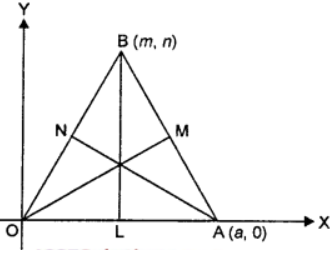
Thus coordinates of L are (a/2, 0)
Coordinates of M are [{(a+m)/2}, (n/2)]
and coordinates of N are (m/2, n/2).
Thus eqn. of median BL be given by
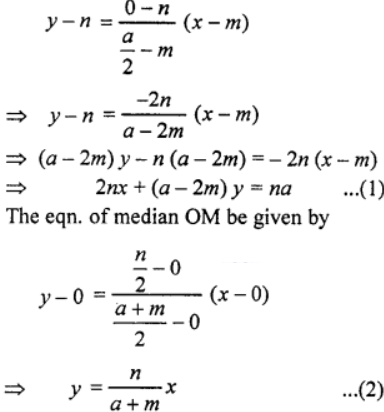
For point of intersection of lines (1) and (2) ; we solve (1) and (2) simultaneously.
From (1) and (2);
2nx + [{(a−2m)nx}/(a+m)] = na
⇒ 2n (a + m) x +(a – 2m) nx = na (a + m)
⇒ x[2na + 2mn + an – 2mn]=na (a + m)
⇒ 3anx = na (a + m) ⇒ x = {(a+m)/3}
∴from (2) y = {n/(a+m)} × {(a+m)/3} = n/3
Thus point of intersection of lines (1) and (2) be [{(a+m)/3}, (n/3)].
Thus, eqn. of AN be given by
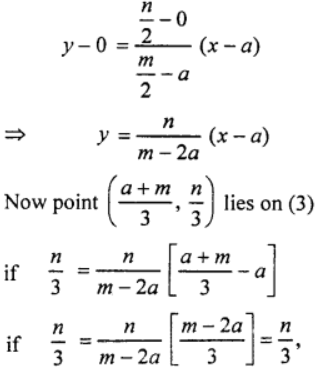
Thus all the three medians BL, OM and AN pass through the point [{(a+m)/3}, (n/3)] and hence concurrent.
–: End of The Straight Line Class 11 OP Malhotra Exe-16E ISC Maths Ch-16 Solutions. :–
Return to :- OP Malhotra ISC Class-11 S Chand Publication Maths Solutions
Thanks
Please share with your friends