The Straight Line Class 11 OP Malhotra Exe-16H ISC Maths Solutions Ch-16 Solutions. In this article you would learn about Family of Lines, Parallel and Perpendicular Lines. Step by step solutions of latest textbook has been given as latest syllabus. Visit official Website CISCE for detail information about ISC Board Class-11 Mathematics.
The Straight Line Class 11 OP Malhotra Exe-16H ISC Maths Solutions Ch-16
| Board | ISC |
| Publications | S Chand |
| Subject | Maths |
| Class | 11th |
| Chapter-16 | The Straight Line |
| Writer | O.P. Malhotra |
| Exe-16(H) | Family of Lines, Parallel and Perpendicular Lines. |
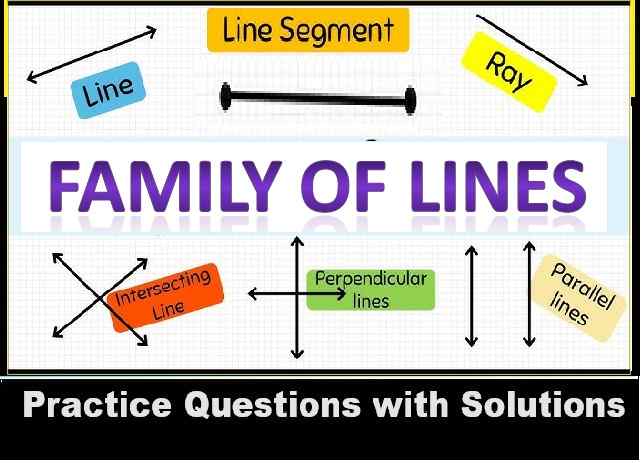
Family of Lines, Parallel and Perpendicular Lines
The Straight Line Class 11 OP Malhotra Exe-16H ISC Maths Solutions Ch-16 Solutions.
Que-1: Find the equation of the straight line which passes through the point (4, 5) and is (i) parallel, (ii) perpendicular to the straight line 3x – 2y + 5 = 0.
Sol: (i) given eqn. of straight line be
3x – 2y + 5 = 0 …(1)
∴ eqn. of line parallel to line (1) be given by
3x – 2y + k = 0 …(2)
eqn. (2) passes through the point (4, 5); we have
12 – 10 + k = 0 ⇒ k = – 2
putting k = – 2 in eqn. (2); we have
3x – 2y – 2 = 0
be the required eqn. of line.
(ii) eqn. of line ⊥ to line (1) be given by
2x + 3y + c = 0 …(3)
eqn. (3) passes through the point (4, 5); we have
8 + 15 + c = 0 ⇒ c = – 23
putting the value of c in eqn. (3);
2x + 3y – 23 = 0 be the required line.
Que-2: Find the equation of the straight line which is such that
(i) it passes through the point (4, 3) and is parallel to the line 3x – 4y + 5 = 0.
(ii) it passes through the point (4, 3) and is perpendicular to the line 3x – 4y + 5 = 0.
Sol: (i) eqn. of given line be
3x – 4y + 5 = 0 …(1)
The eqn. of line parallel to line (1) be given by
3x – 4y + k = 0 …(2)
Now eqn. (2) passes through the point (4, 3); we get
12 – 12 + k = 0 ⇒ k = 0
putting the value of k in eqn. (2); we get 3x – 4y = 0 be the required line.
(ii) The eqn. of line ⊥ to line 3x – 4y + 5 = 0 be given by
4x + 3y + k = 0 …(1)
Now eqn. (1) passes through the point (4, 3), we get
16 + 9 + k = 0 ⇒ k = – 25
putting the value of k in eqn. (1); we get
4x + 3y – 25 = 0 be the required line.
Que-3: Find the equation of the straight line which passes through
(i) the origin and the point of intersection of the st. lines y – x + 7 = 0, y + 2x – 2 = 0 ;
(ii) the point (2, – 9) and the intersection of the lines 2x + 5y – 8 = 0 and 3x – 4y = 35 ;
(iii) the origin and the point of intersection of the lines ax + by + c = 0 and a’x + b’y + c = 0
Sol: (i) The equations of given lines are ;
y – x + 7 = 0 …(1)
y + 2x – 2 = 0 …(2)
Thus the eqn. of line passes through the point of intersection of lines (1) and (2) be given by
y – x + 7 + k(y + 2x – 2) = 0 …(3)
Now eqn. (3) passes through origin (0, 0); we get
0 – 0 + 7 + k(0 + 0 – 2) = 0
⇒ 7 – 2k = 0 ⇒ k = 7/2
putting the value of k = 7/2 in eqn. (3); we get
y – x + 7 + (7/2) (y + 2x – 2) = 0
⇒ 12x + 9y = 0 ⇒ 4x + 3y = 0
which is the required line.
(ii) The eqns. of given lines are ;
2x + 5y – 8 = 0 …(1)
and 3x – 4y – 35 = 0 …(2)
Thus, the eqn. of line passes through the point of intersection of lines (1) and (2) be given by
2x + 5y – 8 + k(3x – 4y – 35) = 0 …(3)
eqn. (3) passes through the point (2, – 9).
4 – 45 – 8 + k(6 + 36 – 35) = 0
⇒ – 49 + 7k = 0
⇒ k = 7
putting the value of k in eqn. (3) ; we have
2x + 5y – 8 + 7(3x – 4y – 35) = 0
⇒ 23x – 23y – 253 = 0
⇒ x – y – 11 = 0
which is the required eqn.
(iii) The eqns. of given lines are
ax + by + c = 0 …(1)
and a’x + b’y + c’ = 0 …(2)
Thus, the eqn. of line passes through the point of intersection of lines (1) and (2) be given by
ax + by + c + k(a’x + b’y + c’) = 0 …(3)
Now eqn. (3) passes through origin (0, 0); we have
0 + 0 + c + k(0 + 0 + c’) = 0
⇒ c + kc’ = 0 ⇒ k = –c/c′
putting the value of k in eqn. (3) ; we get
ax + by + c – (c/c′) (a’x + b’y + c’) = 0
⇒ (ac’ – a’c) x + (bc’ – cb’) y = 0
which is the required eqn. of straight line.
Que-4: Show that the equation n(ax + by + c) = c(lx + my + n)
represents the line joining the origin to the point of intersection of
ax + by + c = 0 and lx + my + n = 0 .
Sol: The equations of given lines are
ax + by + c = 0 …(1)
lx + my + n = 0 …(2)
Thus, the equation of line through the point of intersection of lines (1) and (2) be given by
ax + by + c + k(lx + my + n) = 0 …(3)
eqn. (3) passes through the point (0, 0); we get
0 + 0 + c + k(0 + 0 + n) = 0 ⇒ k = –c/n
putting the value of k = –c/n in eqn. (3) ; we get
ax + by + c (–c/n) (lx + my + n) = 0
⇒ n(ax + by + c) – c (lx + my + n) = 0
which is the required line.
Que-5: Find the equation of the line through the intersection of x – y = 1 and 2x – 3y + 1 = 0 and parallel to 3x + 4y = 12.
Sol: The eqns. of given lines are
x – y – 1 = 0 …(1)
and 2x – 3y + 1 = 0 …(2)
Thus the eqn. of line passes through the point of intersection of (1) and (2) be given by
x – y – 1 + k(2x – 3y + 1) = 0
⇒ (1 + 2k) x + (- 1 – 3k) y – 1 + k = 0 …(3)
∴ slope of line (3) = {–(1+2k)}/{−1−3k} = (1+2k)/(1+3k)
It is given that line (3) is parallel to given line 3x + 4y – 12 = 0 whose slope be –3/4
∴ {(1+2k)/(1+3k)} = –3/4 [∵ m1 = m2]
⇒ 4 + 8k = – 3 – 9k
⇒ 17k = – 7
⇒ k = −7/17
putting the value of k in eqn. (3); we have
(1−(14/17))x + (−1+(21/17))y y – 1 – (7/17) = 0
⇒ (3x/17) + (4y/17) – (24/17) = 0
⇒ 3x + 4y – 24 = 0
which is the required r=eqn. of line
Que-6: Find the equation of the line through the intersection of x + 2y + 3 = 0 and 3x + 4y + 7 = 0 and parallel to y – x = 8.
Sol: The eqns. of given lines are
x + 2y + 3 = 0 …(1)
3x + 4y + 7 = 0 …(2)
Thus the eqn. of line through the intersection of lines (1) and (2) be given by
x + 2y + 3 + k(3x + 4y + 7) = 0
⇒ (1 + 3k) x + (2 + 4k) y + 3 + 7k = 0 …(3)
∴ slope of line (3) = {–(1+3k)}/{2+4k}
Also slope of given line y – x – 8 = 0 be 1 Since it is given that line (3) is parallel to y – x – 8 = 0 ∴ their slopes are equal.
∴ (1+3k)/(2+4k) = -1 ⇒ 1 + 3k = – 2 – 4k
⇒ 7k = – 3 ⇒ k = –3/7
putting the value of k in qn. (3) ; we get
(1−(9/7))x + (2−(12/7))y + 3 – 3 = 0
⇒ -2x + 2y = 0 ⇒ x – y = 0
which is the required line.
Que-7: Find the equation of the line through the intersection of y + x = 0 and 2x – 3y + 7 = 0, and perpendicular to the line 2y – 3x – 5 = 0.
Sol: equations of given lines are
y + x – 9 = 0 …(1)
and 2x – 3y + 7 = 0 …(2)
Thus, eqn. of line through the intersection of lines (1) and (2) be given by
(y + x – 9) + k (2x – 3y + 7) = 0
⇒ (1 + 2k) x + (1 – 3k) y – 9 + 7k = 0 …(3)
∴ slope of line (3) = {−(1+2k)}/(1−3k)
Also slope of given line 2y – 3x – 5 = 0 be −(−3)/2 = 3/2
Since it is given that line (3) is ⊥ to the line 2y – 3x – 5 = 0. Thus product of their slopes must be equal to -1 .
{(−1−2k)/(1−3k)} (3/2) = -1
⇒ {(2k+1)/(3k−1)} (3/2) = -1
⇒ 6k + 3 = – 6k + 2
⇒ 12k = – 1 ⇒ k = −1/12
putting the value of k in eqn. (3) ; we have
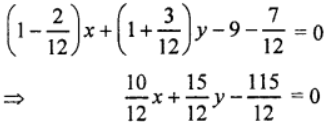
2x+3y-23 = 0
which is the required eqn. of line.
Que-8: Find the equation of the straight line which passes through the intersection of 3x-4y+1=0 and 5x+y-1=0 and cuts off equal intercepts from the axes.
Sol: 5x+y=1 = 0
y = 1-5x
3x−4(1−5x)+1=0
3x−4+20x+1=0
23x−3=0
x = 23/3
y = 1−5x
= 1− (15/23) = 8/23
(x/a)+(y/b) = 1
(x+y)/a = 1
x+y = a
(3/23)+(8/23) = 11/23 = a
x+y = 11/23
23x + 23y = 11
–: End of The Straight Line Class 11 OP Malhotra Exe-16H ISC Maths Ch-16 Solutions. :–
Return to :- OP Malhotra ISC Class-11 S Chand Publication Maths Solutions
Thanks
Please share with your friends