The Straight Line Class 11 OP Malhotra Exe-16I ISC Maths Ch-16 Solutions. In this article you would learn about Locus and its equations. Step by step solutions of latest textbook has been given as latest syllabus. Visit official Website CISCE for detail information about ISC Board Class-11 Mathematics.
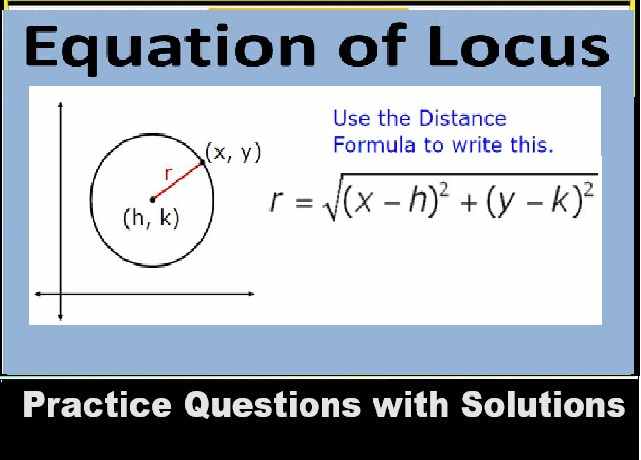
The Straight Line Class 11 OP Malhotra Exe-16I ISC Maths Solutions Ch-16
| Board | ISC |
| Publications | S Chand |
| Subject | Maths |
| Class | 11th |
| Chapter-16 | The Straight Line |
| Writer | O.P. Malhotra |
| Exe-16(I) | Locus and its equations. |
Locus and its equations.
The Straight Line Class 11 OP Malhotra Exe-16I ISC Maths Ch-16 Solutions.
Find the locus of a point which moves so that
Que-1: Its distance from the x-axis is c2.
Sol: Let (h, k) be any point on the locus. then by given condition, | k | = c2
∴ Locus of point (h, k) be given by | y | = c2
Que-2: It distance from the origin is 5 .
Sol: Let (h, k) be any point on the locus Then according to given condition, we have
√{(h−0)²+(k−0)²} = 5
On squaring both sides; we have
h2 + k2 = 25
∴ Locus of point (h, k) be given by
x2 + y2 = 25
Que-3: The sum of the squares of its distances from the points (2, 4) and (- 3, – 1) is 30 .
Sol: Let P(h, k) be any point on the locus and given points are A(2, 4) and B(- 3, – 1)
Then by given condition, we have
PA2 + PB2 = 30
⇒ (h – 2)2 + (k – 4)2 + (h + 3)2 + (k + 1)2 = 30
⇒ 2h2 + 2k2 + 2h – 6k = 0
⇒ h2 + k2 + h – 3k = 0
Thus the locus of point (h, k) be given by
x2 + y2 + x – 3y = 0
Que-4: Its distance from the x-axis is half its distance from the y-axis.
Sol: Let P(h, k) be any point on the locus and equations of x-axis and y-axis are given by
y = 0 and x = 0 .
Then by given condition, we have
| k | = (1/2) | h |
Thus required locus of point P(h, k) be given by | y | = (1/2) | x |
⇒ 2y = ± x
Que-5: Its distance from the y-axis is equal to its distance from the point (1, 1).
Sol: Let P(h, k) be any point on the locus and given point be A(1, 1).
eqn. of y-axis be x = 0
∴ distance of P(h, k) from y-axis = | h |
distance of P(h, k) from A(1, 1)
= √{(h−1)²+(k−1)²}
Then according to given condition, we have
| h | = √{(h−1)²+(k−1)²};
On squaring both sides ; we have
h2 = (h – 1)2 + (k – 1)2
⇒ h2 = h2 – 2h = 1 + k2 – 2k + 1
⇒ k2 – 2k – 2h + 2 = 0
Thus the required locus of P(h, k) be given by y2 – 2y – 2x + 2 = 0
Que-6: Find the locus of a point which is equidistant from the points (1, 0) and (- 1, 0).
Sol: Let P(h, k) be any point on the locus and given points are A(1, 0) and B(- 1, 0).
Then by given condition, we have
| PA| = | PB |
⇒ PA2 = PB2
(h – 1)2 + (k – 0)2 = (h + 1)2 + (k – 0)2
⇒ h2 – 2h + 1 = h2 + 2h = 1
⇒ 4h = 0 ⇒ h = 0
Hence the required locus of P(h, k) be given by x = 0
Que-7: A(2, 0) and B(4, 0) are two given points. A point P moves so that P2 = PB2 = 10. Find the locus of P.
Sol: Let P(h, k) be the required locus.
given PA2 + PB2 = 10
∴ (h – 2)2 + (k – 0)2 + (h – 4)2 + (k – 0)2 = 10
⇒ h2 – 4h + 4 + k2 + h2 – 8k + 16 + k2 = 10
⇒ 2h2 + 2k2 – 4h – 8k + 10 = 0
⇒ h2 + k2 – 2h – 4k + 5 = 0
Thus required locus of P(h, k) be given by
x2 +y2 – 2x – 4y + 5 = 0
Que-8: Find the locus of a point such that the sum of its distances from the points (0, 2) and (0, – 2) is 6 .
Sol: Let P(h, k) be any point on the locus and the given points are A (0, 2) and B(0, – 2).
Then by given condition, we have
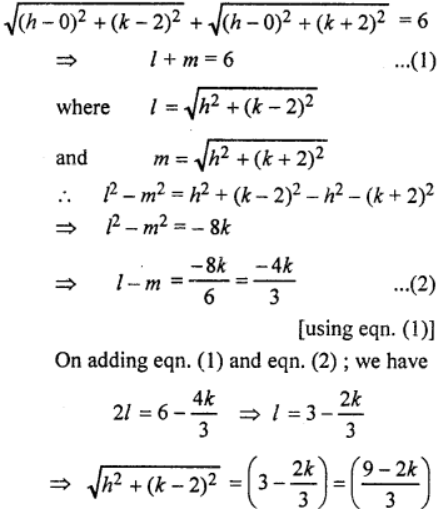
On squaring both sides; we have
9[h2 + (k – 2)2] = (9 – 2k)2
⇒ 9[h2 + k2 – 4k + 4] = 81 + 4k2 – 36k
⇒ 9h2 + 5k2 – 45 = 0
Thus the required locus of P(h, k) be given by 9x2 + 5y2 – 45 = 0
Que-9: Find the locus of a point, so that the join of points (- 5, 1) and (3, 2) subtends a right angle at the moving point.
Sol: Let P(h, k) be any point on the locus.
Then by given condition, we have
PA2 + PB2 = AB2 [using pythagoras theorem]
(h + 5)2 + (k – 1)2 + (h – 3)2 + (k – 2)2 = (3 + 5)2 + (2 – 1)2
⇒ 2h2 + 2k2 + 4h – 6k – 26 = 0
⇒ h2 + k2 + 2h – 3k – 13 = 0
Thus the required locus of P(h, k) be given by x2 + y2 + 2x – 3y – 13 = 0
Que-10: Two points A and B with co-ordinates (5, 3) and (3, – 2) re given. A point P moves so that the area of △PAB is constant and equal to 9 square units. Find the equation to the locus of the point P.
Sol: Let P(h, k) be any point on the locus and given points are A(5, 3) and B(3, – 2)
∴ area of △PAB = 1/2 | (3h – 5k) + (- 10 – 9) + 3k + 2h |
= 1/2 | 5h – 2k – 9 |
Then by given condition, we have
area of △PAB = 9
1/2 | 5h – 2k – 19 | = 9
⇒ 5h – 2k – 19 = ± 18
⇒ 5h – 2k – 1 = 0 and 5h – 2k – 37 = 0
Hence, the locus of P(h, k) be given by
3x – 2y – 1 = 0 and 5x – 2y – 37 = 0
Que-11: Show that (1, 2) lies on the locus x2 + y2 – 4x – 6y + 11 = 0 .
Sol: eqn. of given locus be
x2 + y2 – 4x – 6y + 11 = 0 …(1)
putting x =1 and y = 2 in L.H.S of eqn. (1)
L.H.S. =12 + 22 – 4 – 12 + 11 = 0 = R.H.S
Thus, the point (1, 2) lies on the locus.
Que-12: Does the point (3, 0) lie on the curve 3x2 + y2 – 4x + 7 = 0?
Sol: eqn. of given locus be,
3x2 + y2 – 4x + 7 = 0 …(1)
putting x = 3 and y = 0 in L.H.S of eqn. (1).
L.H.S =3 × 32 + 0 – 4 × 3 + 7
= 22 ≠ 0 = R.H.S
Thus point (3, 0) does not lies on given locus.
Que-13: Find the condition that the point (h, k) may lie on the curve x2 + y2 + 5x + 11y – 2 = 0.
Sol: eqn. of given curve be
x2 + y2 + 5x + 11y – 2 = 0
The point (h, k) lies on given curve (1)
∴ h2 + k2 + 5h + 11k – 2 = 0
which is the required condition.
Que-14: If the line (2 + k) x -(2 – k) y +(4k + 14) = 0 passes through the point (- 1, 21), find k.
Sol: eqn. of given line be
(2 + k) x – (2 – k) y + 4k + 14 = 0 …(1)
eqn. (1) passes through the point (- 1, 21).
(2 + k)(- 1) – (2 – k) 21 + 4k + 14 = 0
⇒ – 2 – k – 42 + 21k + 4k + 14 = 0
⇒ 24k – 30 = 0
⇒ k = 30/24 = 5/4
Que-15: A is the point (- 1, 0) and B is the point (1, 1). Find a point on the line 4x + 5y = 4, which is equidistant from A and B.
Sol: Let P(h, k) be any point on line 4x + 5y = 4
∴ 4h + 5k = 4
Also by given condition, we have
| PA | = | PB | ⇒ PA2 = PB2
⇒ (h + 1)2 + (k – 0)2 = (h – 1)2 + (k – 1)2
⇒ h2 + 2h + 1 + k2 = h2 – 2h + k2 – 2k + 2
⇒ 4h + 2k – 1 = 0 …(2)
eqn. (1) – eqn. (2) gives;
3k = 3 ⇒ k = 1
∴ from (1); 4h + 5 = 4 ⇒ 4h = – 1
⇒ h = –1/4
Hence the coordinates of required point be [(-1/4), 1]
Que-16: The co-ordinates of the point S are (4, 0) and a point P has coordinates (x, y). Express PS2 in terms of x and y. Given that M is the foot of the perpendicular from P to the y-axis and that the point P moves so that the lengths PS and PM are equal, prove that the locus of P is 8 x = y2 + 16. Find the co-ordinates of one of the two points on the curve whose distance from S is 20 units.
Sol: ∴ PS2 = (x – 4)2 + (y – 0)2 = (x – 4)2 + y2
eqn. of y-axis be x = 0
Since M be the foot of ⊥ from P(x, y) on y-axis. ∴ Coordinates of M are (0, y).
Then by given condition, we have
PS = PM ⇒ PS2 = PM2
(x – 4)2 + y2 = (x – 0)2 + (y – y)2
⇒ x2 – 8x + 16 + y2 = x2
⇒ y2 – 8x + 16 = 0
which is the required locus.
Let Q(h, k) be any point on curve (1)
∴ k2 – 8h + 16 = 0 …(1)
Also by given condition QS = 20
⇒ QS2 = 400
⇒ (h – 4)2 + (k – 0)2 = 400
⇒ h2 – 8h + 16 + 8h – 16 = 400 [using eqn. (2)]
⇒ h2 = 400
⇒ h = ± 20
When h = 20 ∴ from (2); we have
k2 – 144 = 0 ⇒ k = ± 12
When h = – 20 ∴ from (2); k2 + 176 = 0
which does not gives real values of k.
Thus required points on curve be (20, ± 12).
Que-17: Find the ratio in which the line joining the points (6, 12) and (4, 9) is divided by the curve x2 + y2 = 4.
Sol: Let the point P divides the line segment joining the points A(6, 12) and B(4, 9) in the ratio k : 1
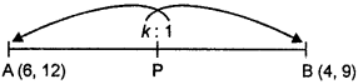
Then by section formula, coordinates of P are [{(4k+6)/(k+1)}, {(9k+1)/(2k+1)}]. Further point P lies on given curve x² + y² = 4.
[{(4k+6)/(k+1)}]² + [{(9k+1)/(2k+1)}]²
16k²+36+48k+81k²+144+216k = 4 (k+1)²
93k² + 256k + 176 = 0
(3k+4) (31k+44) = 0
k = (-4/3), (-44/31)
Thus the required ratio be 4 : 3 and 44 : 31 externally
i.e. the curve divides the line segment externally in the ratio 4 : 3 and 44 : 31.
Que-18: AB is a line of fixed length, 6 units, joining the points A(t, 0) and B which lies on the positive y-axis. P is a point on AB distant 2 units from A. Express the co-ordinates of B and P in terms of t. Find the locus of P as t varies.
Sol: Let the coordinates of B are (0, k) and given coordinates of A are (t, 0).
since | AB | = 6
⇒ AB2 = 36
⇒ (t – 0)2 + (0 – k)2 = 36
⇒ t2 + k2 = 36
⇒ k = ± √(36-t²)
But B lies on +ve y-axis.
∴ Coordinates of B are (0, +√(36-t²))
Thus P(α, β) divides the line segment AB in the ratio 4 : 2 i.e. 2 : 1.
Then by section formula, the coordinates of P are (22/3, (36-t²)/√3)
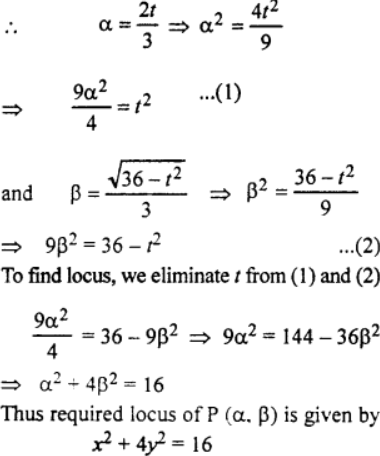
Que-19: A rod of length l slides with its ends on two perpendicular lines. Find the locus of its mid-point.
Sol: Let AB be a rod of length l and suppose it intersects on x-axis at A(a, 0) and y-axis at (0, b).
Let its mid-point whose locus is to be find out be P(h, k).
∴ h = a/2, k = b/2
Also In right angled △AOB, we have
OA2 + OB2 = AB2
⇒ a2 + b2 = l2
⇒ (2h)2 + (2k)2 = l2
⇒ 4h2 + 4k2 = l2
Thus the locus of P(h, k) be given by
4x2 + 4y2 = l2.
Que-20: If O is the origin and Q is a variable, point on x2 = 4y, find the locus of the mid-point of OQ.
Sol: eqn. of given curve be
x2 = 4y …(1)
Let Q(h, k) be any point on curve.
∴ h2 = 4k …(2)
Now Mid-point of OQ be [(h/2), (k/2)]
Also mid-point of OQ be (α, β), whose locus is to be find out.
∴ α = h/2 ⇒ h = 2α
and β = k/2 ⇒ k = 2β
∴ from (2) ; (2α)2 = 4(2β) ⇒ α2 = 2β
Thus locus of (α, β) be given by x2 = 2y
Que-21: Find the locus of a point which moves such that square of its distance from the point (3,-2) is numerically equal to its distance from the line 5x – 12y = 3.
Sol: Let (p, q) be any moving point.
∴ Distance between (p, q) and (3, -2)
d1 = √{(p-3)²+(q-(-2))²}
⇒ (d1)2 = (p – 3)2 + (q + 2)2
Now, distance of the point (p, q) from the given line 5x – 12y – 3 = 0 is
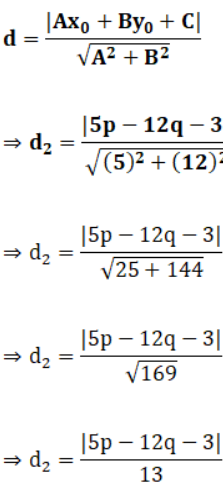
According to the question, we have (d1)2 = d2
(p-3)² + (q+2)² = |(5p-12q-3)/13
⇒ 13[(p – 3)2 + (q + 2)2] = 5p – 12q – 3
⇒ 13[p2 + 9 – 6p + q2 + 4 + 4q] = 5p – 12q – 3
⇒ 13p2 + 117 – 78p + 13q2 + 52 + 52q = 5p – 12q – 3
⇒ 13p2 + 13q2 – 78p + 52q + 169 = 5p – 12q – 3
⇒ 13p2 + 13q2 – 78p + 52q + 169 – 5p + 12q + 3 = 0
⇒ 13p2 + 13q2 – 83p + 64q + 172 = 0
–: End of The Straight Line Class 11 OP Malhotra Exe-16I ISC Maths Ch-16 Solutions. :–
Return to :- OP Malhotra ISC Class-11 S Chand Publication Maths Solutions
Thanks
Please share with your friends