Theoretical Probability Distribution of Random Variable Class 12 OP Malhotra Exe-20A Maths Solutions Ch-20. In this article you would learn about probability distribution of a random variable . Step by step solutions of latest textbook has been given as latest syllabus. Visit official Website CISCE for detail information about ISC Board Class-12 Mathematics.
Theoretical Probability Distribution of Random Variable Class 12 OP Malhotra Exe-20A Maths Solutions Ch-20
| Board | ISC |
| Publications | S Chand |
| Subject | Maths |
| Class | 12th |
| Chapter-20 | Theoretical Probability Distribution |
| Writer | OP Malhotra |
| Exe-20(a) | Probability Distribution of a Random Variable |
Probability Distribution of a Random Variable
Theoretical Probability Distribution Class 12 OP Malhotra Exe-20A Solutions
Que-1: Which of the following experiments give a discrete random variable. (You are not asked to find any probabilities).
(i) A book is chosen at random from a shelf with 5 0 books and its author noted.
(ii) A book is chosen at random from a shelf with 50 books and the number of pages noted.
(iii) A pupil is chosen at random from a particular class and the pupil’s name, is noted.
(iv) A pupil is chosen at random from a particular class and the pupil’s height is recorded to the nearest cm.
(v) The number of cars passing a given point on the road between 10: 00 and 11: 00 hours on a particular day.
Sol: (i) Here, the set of values given to random variable is not numeric i.e. can’t be counted ∴ it is not a discrete random variable.
(ii) Here set of values which a random variable takes can be counted so it is a discrete random variable.
(iii) Here the set of values, which a random variable takes can not be counted so it is not a discrete random variable.
(iv) Here the set of values which a random variable takes can be counted. ∴ random variable is discrete.
(v) Here, the set of values which a random variable takes can be counted so it is a descrete random variable.
Que-2:
(i) Determine which of the following can be probability distribution of a random variable X:
(a)
X |
0 |
1 |
2 |
P(X) |
0.4 |
0.4 |
0.2 |
(b)
X |
0 |
1 |
2 |
P(X) |
0.5 |
0.2 |
0.2 |
(ii) Find the value of A : if a random variable X has the following probability distribution:
| X | -2 | -1 | 0 | 1 | 2 | 3 |
| P(X) | 0.1 | k | 0.2 | 2k | 0.3 | k |
Sol: (i) (a) Here P(X = 0) + P(X = 1) + P(X = 2) = 0.4 + 0.4 + 0.2 = 1.0
Thus the sum of probabilities is equal to 1 .
Therefore, given distribution of probabilities is a probability distribution of random variable X.
(b) P(X = 0) + P(X = 1) + P(X = 2) = 0.5 + 0.2 + 0.2 = 0.9 < 1
Thus given distribution of probabilities is not a probability distribution of random variable X.
(ii) Since the sum of probabilities of probability distribution is 1 ∴ ∑ P(X) = 1
P(X = 2) + P(X = -1) + P(X = 0) + P(X = 1) + P(X = 2) + P(X = 3) = 1
⇒ 0.1 + K + 0.2 + 2 K + 0.3 + K = 1
⇒ 4 K + 0.6 = 1
⇒ 4 K = 0.4
⇒ K = 0.1
Que-3: Two cards are drawn in succession from a well shuffled deck of 52 cards, the first card being replaced, before the second is drawn. Let X denote the number of spades drawn. Find the probability distribution of X.
Sol: Here, X denote the number of spade cards drawn. Then X can takes values 0,1,2.
Here, probability of getting a spade card = 13/52
= 1/4 = p
∴ q = 1 – p = 1 – 1/4
= 3/4
∴ P(X = 0)
= P(no spade card ) = q
q = 3/4 × 3/4
= 9/16
P(X = 1) = P (one spade card in two draws)
= p q + q p = 1/3 × 3/4 + 3/4 × 1/4
= 6/16
P(X = 2) = p p = 1/4 × 1/4
= 1/16
Thus the probabilities distribution of X is given below:
| X | 0 | 1 | 2 |
| P(X) | 9/16 | 6/16 | 1/16 |
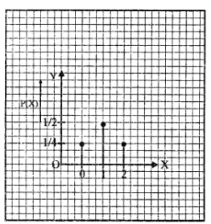
Que-4: Show graphically the probability function of the discrete random variable X, where X is the number of heads appearing when an unbiased coin is tossed twice in succession.
Sol: Since X is the no, of heads appearing when an unbiased coin is tossed twice
∴ Sample space = {H.H, HT, TH, TT}
Thus X can takes values 0, 1, 2
P(X = 0) = P(T T) = 1/4 ;
P(X = 1) = P(H T, T H) = 2/4 = 1/2 ;
P(X = 2) = P(H H) = 1/4
Find the probability distribution of X in questions 5-7. Sketch the graphs.
Que-5: A box contains 3 red marbles and 5 green marbles. Two marbles are taken at random without replacement and X is the number of green marbles obtained.
Sol: Given X denote the no. of green marbles obtained so X can take values 0,1,2.
P(X = 0) = prob. of getting no green marble and 2 red marbles = 3C2/8C2
= 3/(8×7/2)
= 3/28
P(X = 1) = prob. of getting 1 green and I red marble
= 3C1×5C1/8C2
= 3×5/(8×7/2)
= 15/28
P(X = 2) = prob. of getting 2 green marables = 5C2/8C2
=( 5×4/2)/(8×7/2)
= 20/56 = 5/14
= 10/28
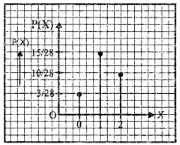
Thus the probability distribution of X is given below :
| X | 0 | 1 | 2 |
| P(X) | 3/28 | 15/28 | 10/28 |
Que-6: A fair coin has, the number ‘ 1 ‘ on one face and the number ‘ 2 ‘ on the other. The coin is thrown with a fair die and X is the sum of the scores.
Sol: Since a fair coin has number 1 on one face and 2 on other face.
When the coin and dice is thrown and X be the random variable denotes the sum of scores.
So X = 2, 3, 4, 5, 6, 7, 8.
Here total no. of outcomes = 12
{(1,1),(1,2),(1,3),(1,4),(1,5),(1,6),(2,1),(2,2),(2,3),(2,4),(2,5),(2,6)\}
P(X = 2) = P(1,1) = 1/12 ;
P(X = 3) = P(1,2),(2,1) = 2/12
P(X = 4) = P(1,3),(2,2) = 2/12 ;
P(X = 5) = P(1,4),(2,3) = 2/12
P(X = 6) = P(1,5),(2,4) = 2/12 ;
P(X = 7) = P(1,6),(2,5) = 2/12
P(X = 8) = P(2,6) = 1/12
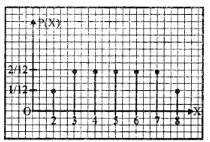
Thus the probability distribution of X is given below:
| X | 2 | 3 | 4 | 5 | 6 | 7 | 8 |
| P(X) | 1/12 | 2/12 | 2/12 | 2/12 | 2/12 | 2/12 | 1/12 |
Que-7: An urn contains 4 white and 3 red balls. Find the probability distribution of the number of red balls in a random draw of three balis.
Sol: Let X denote the random variable represents the no. of red balls in a random draw of three balls. ∴ X can takes values 0, 1, 2, 3.
Since the urn contains 4 white and 3 red balls
P(X = 0) = prob. of drawing 3 white balls
= 4C3/7C3
= 4 / (7×6×5/6)
= 4/35
P(X = 1) = prob. of drawing 1 red ball and 2 white balls = 4C2×3C1/7C3
= (4×3/2)×3 / (7×6×5/6)
= 18/35
P(X = 2) = prob. of drawing 2 red balls and 1 white ball
= 4C1×3C2/7C3
= 4×3 / (7×6×5/6)
= 12/35
P(X = 3) = prob. of drawing 3 red balls
= 3C3/7C3
= 1/35
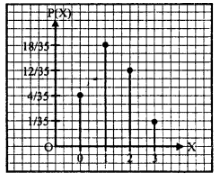
Thus the probability distribution of X is given below:
| X | 0 | 1 | 2 | 3 |
| P(X) | 4/35 | 18/35 | 12/35 | 1/35 |
Que-8: Two cards are drawn successively without replacement from a well shuffled pack of 52 cards. Find the probability distribution of the jmmber of aces.
Sol: Let X be the random variable denotes the number of aces in two draws without replacement.
Thus X can take values 0,1,2.
∴ P(X = 0) = Prob. of getting no ace = 48/52 × 47/51
= 12/13 × 47/51
= 4×47/13×17
= 188/221
P(X = 1) = prob. of getting one ace and one other card
= 2×4C1/52C1 × 48C1/51C1
= 2×4×48/52×51
= 2×1×16/13×17
= 32/321
P(X = 2) = prob. of getting two ace cards in two draws
= 4/52 × 3/51
= 1/221
| X | 0 | 1 | 2 |
| P(X) | 188/221 | 32/321 | 12/21 |
Que-9: From a list containing 25 items, 5 of which are defective, 4 are chosen at random. Let X be the number of defectives found. Obtain the probability distribution of X, if the items are chosen without replacement.
Sol: Total no. of items = 25
no. of defective items = 5
∴ no. of non-defective items = 25 – 5 = 20
Let X be the random variable denotes the no. of defective item found.
∴ X can take values 0,1,2,3,4.
P(X = 0) = prob. of getting no defective items i.e. getting 4 non-defective items
= 20C4/25C4
= 20×19×18×17/25×24×23×22
= 969/2530
P(X= 1) = prob. of getting one defective and 3 non-defective items
= 5C1×20C3/25C3
= 5 × (20×19×18/6) / (25×24×23×22/24)
= 5×20×19×3/25×23×22
= 114/253
P(X = 2) = prob. of getting = defective and 2 non-defective item
= 5C2×20C2/25C4
= (5×4/2×20×19/2) / (25×25×23×22/24)
= 5×20×19/25×23×22
= 38/253
P(X = 3) = prob. of getting 3 defective and 1 non-defective item
= 5C3×20C1/25C4
= (5×4/2)×20 / 25×23×22
= 4/253
P(X = 4) = prob. of getting 4 defective items
= 5C4/25C4
= 5 / 25×23×22
= 1/2530
Thus the probability distribution of random variable X is given by
| X | 0 | 1 | 2 | 3 | 4 |
| P(X) | 596/2530 | 114/253 | 38/253 | 4/253 | 1/2530 |
Que-10: A random variable A ” has the following probability distribution.
X |
0 |
1 |
2 |
3 |
4 |
5 |
6 |
7 |
8 |
P(X) |
a |
3a |
5a |
7a |
9a |
11a |
13a |
15a |
17a |
Sol: (i) The value of a.
(ii) P(X < 3) (iii) P(X > 3)
(iv) P(0 < X < 5)
Answer:
(i) Since ∑P(X) = 1
⇒ P(X= 0) + P(X = 1) + P(X = 2) + P(X = 3) + P(X = 4) + P(X = 5) + P(X = 6) + P(X = 7) + P(X = 8) = 1
⇒ a + 3 a + 5 a + 7 a + 9 a + 11 a + 13 a + 15 a + 17 a = 1
⇒ 81 a = 1
⇒ a = 1/81
(ii) P(X < 3) = P(X = 0) + P(X = 1) + P(X = 2)
= a + 3 a + 5 a = 9 a
= 9/81
= 1/9
(iii) P(X < 3) = 1 – P(X < 3)
= 1 – 1/9
= 8/9
(iv) P(0 < X < 5) = P(X = 1) + P(X = 2) + P(X = 3) + P(X = 4)
= 3 a + 5 a + 7 a + 9 a = 24 a
= 24/81
= 8/27
Que-11: A random variable X has the following probability distribution:
X |
0 |
1 |
2 |
3 |
4 |
5 |
6 |
7 |
P(X) |
a |
4a |
3a |
7a |
8a |
10a |
6a |
9a |
(i) Find the value of a;
(ii) Find P(X < 3), P(X < 4), P(0 < X < 5);
(iii) Give the smallest value of m for which P(X > m) < 0.6.
Sol: (i) For probability distribution, ∑ P(X) = 1
i.e. P(X = 0) + P(X = 1) + P(X = 2) + P(X = 3) + P(X = 4) + P(X = 5) + P(X = 6) + P(X = 7) = 1
⇒ a+4 a+3 a+7 a+8 a+10 a+6 a+9 a = 1
⇒ 48 a = 1
⇒ a = 1/48
(ii) P(X < 3) = P(X = 0) + P(X = 1) + P(X = 2) = a + 4 a + 3 a = 8 a = 8/48 = 1/6 = 0.167 P(X > 4) = P(X = 4) + P(X = 5) + P(X = 6) + P(X = 7)
= 8 a+10 a+6 a+9 a
= 33 a
= 33/48
= 11/16
= 0.6875
and P(0 < X < 5) = P(X = 1) + P(X = 2) + P(X = 3) + P(X = 4)
= 4 a + 3 a + 7 a + 8 a = 22 a
= 22/48
= 11/24
= 0.458
(iii) Given P(X < m) > 0.6
The probability distribution of X is given by
| X | 0 | 1 | 2 | 3 | 4 | 5 | 6 | 7 |
| P(X) | 1/48 | 4/48 = 0.0.83 | 3/48 = 1/16 | 7/48 = 0.145 | 0.167 | 0.2083 | 0.125 | 0.1875 |
Clearly P(X < 4)
= a + 4 a + 3 a + 7 a + 8 a = 23 a
= 23/48
= 0.479
P(X < 5) = a + 4 a + 3 a + 7 a + 8 a + 10 a
= 33 a
= 33/48
= 0.6875
Thus the smallest value of m for which P(X < m) > 0.6 be 5 .
Since P(X < 5) = 0.6875 > 0.6
But P(X < 4) = 0.479 < 0.6
–: End of Theoretical Probability Distribution of Random Variable Class 12 OP Malhotra Exe-20A Maths Solutions :–
Return to :- OP Malhotra ISC Class-12 S Chand Publication Maths Solutions
Please share with your friends
Thanks