Trigonometrical Ratios Class 9 OP Malhotra Exe-19B ICSE Maths Solutions Ch-19. Step by step solutions of latest textbook has been given as latest syllabus. Visit official Website CISCE for detail information about ICSE Board Class-9 Mathematics.
Trigonometrical Ratios Class 9 OP Malhotra Exe-19B ICSE Maths Solutions Ch-19
| Board | ICSE |
| Publications | S Chand |
| Subject | Maths |
| Class | 9th |
| Chapter-19 | Trigonometrical Ratios |
| Writer | O.P. Malhotra |
| Exe-19(B) | To find value of sin cos and tan |
Exe-19(B)
Trigonometrical Ratios Class 9 OP Malhotra Exe-19B ICSE Maths Solutions Ch-19
Que-1: Given that tan θ = 5/12 and angle θ is an acute angle, find sin θ and cos θ.
Sol: tan θ = 5/12 = Perpendicular / Base
In the △ABC, ∠B = 90°,
AB = 12, BC = 5, then
AC2 = AB2 + BC2 (Pythagoras Theorem)
= (12)2 + (5)2 = 144 + 25 = 169
= (13)2
∴ AC = 13
Now sin θ = Perpendicular / Hypotenuse
BC/AC = 5/13
and cos θ = Base / Hypotenuse
AB/AC = 12/13
Que-2: If sin θ = 3/5 and θ is an acute angle, find
(i) cos θ,
(ii) tan θ.
Sol: sin θ = Perpendicular / Hypotenuse = AC/AB
∴ In △ABC,
AC = 3, AB = 5
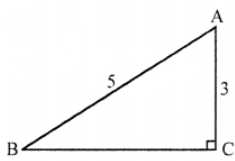
Now, AB2 = BC2 + AC2 ⇒ (5)2 = BC2 + (3)2
⇒ BC2 = (5)2 – (3)2 = 25 – 9 = 16 = (4)2
∴BC = 4
Now,
(i) cos θ = Base / Hypotenuse = BC / AB = 4/5
(ii) and tan θ = Perpendicular / Base = AC / BC = 3/4
Que-3: △ABC is right-angled at ∠A. Find tan, sine and cos of angles B and C in each of the following cases.
(i) AB = 7 cm, AC = 24 cm
(ii) AB = 12 cm, AC = 9 cm
Sol: (i) In right △ABC, ∠A = 90°
AB = 7 cm, AC = 24 cm
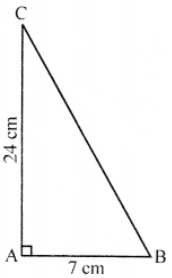
∴ BC2 = AB2 + AC2
= (7)2 + (24)2
= 49 + 576 = 625
= (25)2
∴BC = 25 cm
Now, tan B = AC / AB = 24/7
tan C = AB / AC = 7/24
sin B = AC / BC = 24/25
sin C = AB / BC = 7/25
cos B = AB / BC = 7/25
cos C = AC / BC = 24/25
(ii) In ∠ABC, ∠A = 90
AB = 12 cm, AC = 9 cm
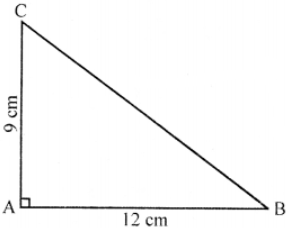
∴ BC2 = AB2 + AC2
= (12)2 + (9)2
= 144 + 81 = 225
= (15)2
∴ BC = 15 cm
Now, tan B = AC / AB = 12/9 or 4/3
tan C = AB / AC = 9/12 or 3/4
sin B = AC / BC = 9/15 or 3/5
sin C = AB / BC = 12/15 or 4/5
cos B = AB / BC = 12/15 or 4/5
cos C = AC / BC = 9/15 or 3/5
Que-4: △PQR is right-angled at R. Find tan, sine and cos of ∠P and ∠Q in each of the following cases.
(i) PQ = 10 cm, QR = 8 cm
(ii) PQ = 29 mm, PR = 21 mm
(iii) PQ = 3.7 cm, PR = 3.5 cm
Sol: (i) In △PQR, ∠R = 90°
PQ = 10 cm, QR = 8 cm
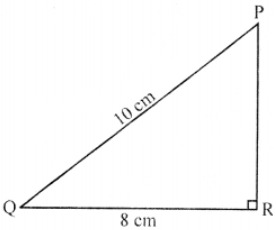
PQ2 = QR2 + PR2 (Pythagoras Theorem)
(10)2 = (8)2 + PR2 ⇒ 100 = 64 + PR2
⇒ PR2 = 100 – 64 = 36 = (6)2
∴ PR = 6 cm
tan P = QR / PR = 8/6 or 4/3,
tan Q = PR / QR = 6/8 or 3/4,
sin P = QR / PQ = 8/10 or 4/5,
sin Q = PR / PQ = 6/10 or 3/5,
cos P = PR / PQ = 6/10 or 3/5,
cos Q = QR / PQ = 8/10 or 4/5
(ii) In △PQR, ∠R = 90°
PQ = 29 mm, PR = 21 mm
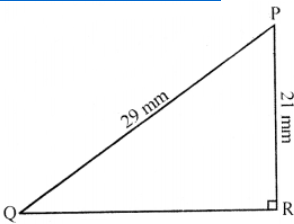
PQ2 = PR2 + QR2 (Pythagoras Theorem)
(29)2 = (21)2 + QR2
⇒ 841 = 441 + QR2
⇒ QR2 = 841 – 441 = 400 = (20)2
∴QR = 20 mm
Now,
tap P = QR / PR = 20/21, tan Q = PR / QR = 21/20
sin P = QR / PQ = 20/29, sin Q = PR / PQ = 21/29
cos P = PR / PQ = 21/29, cos Q = QR / PQ = 20/29
(iii) In △PQR, ∠R = 90°
PQ = 37 cm, PR = 3.5 cm
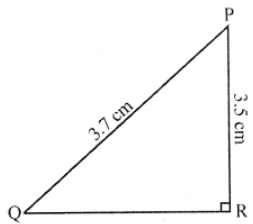
But PQ2 = PR2 + QR2
⇒ (3.7)2 = (3.5)2 + QR2
⇒ 13.69 = 12.25 + QR2
QR2 = 13.69 – 12.25
=1.44 = (1.2)2
∴ QR = 1.2 cm
Now,
tan P = QR / PR = 1.2/3.5 or 12/35,
tan Q = PR / QR = 3.5/1.2 or 35/12
sin P = QR / PQ = 1.2/3.7 or 12/37,
sin Q = PR / PQ = 3.5/3.7 or 35/37
cos P = PR / PQ = 3.5/3.7 or 35/37,
cos Q = QR / PQ = 1.2/3.7 or 12/37
Que-5: For any angle θ, state the value of sin2θ + cos2θ.
Sol: In △ABC, ∠A = θ and ∠B = 90°
∴ sin θ = BC / CA and cos θ = AB / CA
∵ABC is a right angled triangle
∴ CA2 = AB2 + BC2
Now, sin²θ + cos²θ = (BC/CA)² + (AB/CA)²
= (BC)²/(CA)² + (AB)²/(CA)²
= {(BC)²+(AB)²}/(CA)² = CA²/CA² [From (i)]
= 1
Hence sin²θ + cos²θ = 1
Que-6: The diagonals AC, BD of a rhombus ABCD meet at O. If AC = 6, BD = 8, find sin OCD.
Sol: In rhombus ABCD, diagonals AC and BD bisect each other at O at right angles
∴ AO = OC and BO = OD
and ∠AOB = ∠BOC = ∠COD = ∠DOA = 90°
∵ AC = 6 units and BD = 8 units
∴ AO = OC = 6/2 = 3 units and BO = OD = 8/2 =4 units
Now in right △DOC
DC2 = DO2 + OC2
= (4)2 + (3)2 =16 + 9 = 25 = (5)2
∴ DC = 5 units
Now sin ∠OCD = OD/DC = 4/5
Que-7: If cos θ = 0.6, find the value of 5 sin θ – 3 tan θ.
Sol: In △ABC, ∠B = 90° and ∠A = θ
cos θ = 0.6 = 6/10 = 3/5 = AB / CA
∴ AB = 3, CA = 5
Now,
CA2 = AB2 + BC2 (Pythagoras Theorem)
⇒ (5)2 = (3)2 + BC2 ⇒ 25 = 9 + BC2
⇒ BC2 = 25 – 9 = 16 = (4)2
∴ BC = 4
∴ sin θ = BC / CA = 4/5 and tan θ = BC / AB = 4/3
Now 5 sin θ – 3 tan θ = 5 × (4/5) – 3 × (4/3) = 4 – 4 = 0
Que-8: In a right-angled triangle, it is given that A is an acute angle and that tan A = 3/4. Without using tables, find the value of cos A.
Sol: Let ABC is a right triangle in which ∠A is an acute angle, ∠B = 90°
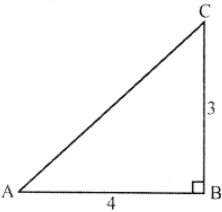
tan A = BC / AB = 3/4
∴ BC = 3, AB = 4
But AC2 = AB2 + BC2
= (4)2 + (3)2 = 16 + 9 = 25 = (5)2
∴ AC = 5
Now cos A = AB/AC = 4/5
Que-9: If sin θ = 6/10, find, without using table, the value of (cosθ+tanθ).
Sol: In △ABC, ∠B = 90° and ∠A = θ
sin θ = 6/10 = BC / AC
∴ BC = 6, AC = 10
But AC2 = AB2 + BC2 (Pythagoras Theorem)
(10)2 = AB2 + (6)2
⇒ 100 = AB2 + 36
⇒ AB2 = 100 – 36 = 64
⇒ AB2 = 64 = (8)2
∴ AB = 8
Now cos θ = AB / AC = 8/10 = 4/5
and tan θ = BC / AB = 6/8 = 3/4
∴ cos θ + tan θ = (4/5) + (3/4)
= (16+15)/20 = 31/20 = 1*(11/20)
Que-10: Answer true or false.
(a) In the diagram
(i) tan θ = BC / AB ;
(ii) sec θ = BC / AC ;
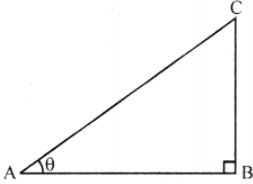
(b) In a triangle right-angled at B, the ratio AB : BC is the same as the ratio of sin A : cos A.
Sol: (a) In the figure,
(i) tan θ = Perpendicular / Base = AB / BC
tan θ = BC / AB is false
(ii) sec θ = Hypotenuse / Base = AC / BC
∴ sec θ = BC / AC is false
(b) AB : BC = sin A : cos A
Now, sin A : cos A = sin A / cos A = tan A
= Perpendicular / Base = BC / AB
= BC : AB
∴ AB : BC = sin A : cos A is false
Que-11: Using the measurements given in figure,
(a) Find the value of (i) sin Φ, (ii) tan θ
(b) Write an expression for AD in terms of θ.
Sol: (a) (i) sin Φ = CD / BC = 5/13
Draw DE || BC so that
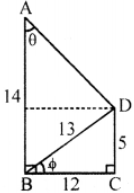
(ii) ED = BC = 12 and
EB = DC = 5
∴ AE = AB – EB = 14 – 5 = 9
Now tan θ = DE / AE = 12/9 = 4/3
(b) In right △AED,
AD2 = AE2 + ED2
= (9)2 + (12)2 = 81 + 144
= 225 = (15)2
∴ AD = 15
sin θ = DE / AD ⇒ AD = DE/sinθ = 12/sinθ
and cos θ = AE / AD ⇒ AD = AE/cosθ = 9/cosθ
∴ AD = 12/sinθ or 9/cosθ
Que-12: ABC is a right-angled triangle, right-angled at B. Give that ∠ACB = θ, side AB = 2 units and side BC = 1 unit, find the vlaue of sin2 θ + tan 2 θ.
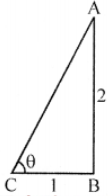
Sol: In △ABC, ∠B = 90°, ∠C = θ
AB = 2, BC = 1 units
But AC2 = BC2 + AB2 (Pythagoras Theorem)
= (1)2 +(2)2 = 1 + 4 = 5
∴ AC = √5
Now sin θ = AB/AC = 2/√5 and tan θ = AB/BC = 2/1
∴ sin²θ + tan²θ = (2/√5)² + (2/1)² = (4/5) + (4/1)
= (4+20)/5 = 24/5 = 4*(4/5)
Que-13: (i) If sin θ = {4*(12/13)} and θ is less than 90°, find the value of (cos θ + tan θ).
(ii) If cos θ = {4*(12/13)}, find the value of sin θ and tanθ. Also, find the value of 2 sin θ – 4 tan θ, where θ is acute.
Sol: (i) In △ABC, ∠A = θ and ∠B = 90°
sin θ = 12/13 = BC/AC
∴BC = 12 and AC = 13
But AC2 = AB2 + BC2 (Pythagoras Theorem)
⇒ (13)2 = AB2 + (12)2 ⇒ 169 = AB2 + 144
⇒ AB2 = 169 – 144 = 25 = (5)2
∴ AC = 5
Now cos θ = AB/AC = 5/13
and tan θ = BC/AB = 12/5
∴ cos θ + tan θ = (5/13) + (12/5)
= (25+156)/65 = 181/65 = 2*(51/65)
(ii) In △ABC, ∠A = θ, ∠B = 90°
cos θ = 12/13 = AB/AC
∴ AB = 12, AC = 13
But AC2 = AB2 + BC2
⇒ (13)2 = (12)2 + BC2 ⇒ 169 = 144 + BC2
⇒ BC2 = 169 – 144 = 25 = (5)2
∴ BC = 5
Now sin θ = BC/AC = 5/13
and tan θ = BC/AB = 5/12
and 2 sin θ – 4 tan θ = 2 × (5/13) – 4 × (5/12)
= (10/13) – (5/3)
= (30−65)/39 = −35/39
Que-14: If tan θ = 5/12, find the value of
(cosθ−sinθ) / (cosθ+sinθ)
Sol: tan θ = 5/12
Now (cosθ−sinθ) / (cosθ+sinθ) = [(cosθ/cosθ)−(sinθ/cosθ)] / [(cosθcosθ)+(sinθ/cosθ)]
(Dividing each term by cos θ)
= (1−tanθ)/(1+tanθ) = {1−(5/12)} / {1+(5/12)}
={(12−5)/12} / {(12+5)/12} = (7/12) / (17/12)
= (7/12) × (12/17) = 7/17
Que-15: If 5 sin θ = 4, find the value of (1+sinθ) / (1−sinθ).
Sol: 5 sin θ = 4 ⇒ sin θ = 4/5
Now, (1+sinθ) / (1−sinθ) = {1+(4/5)} / {1−(4/5)} = {(5+4)/5} / {(5−4)/5}
=(9/5) / (1/5) = (9/5) × (5/1) = 9
Que-16: If b tan θ = a, find the value of (cosθ+sinθ) / (cosθ−sinθ).
Sol: b tan θ = a ⇒ tan θ = ab
Now, (cosθ+sinθ) / (cosθ−sinθ)
= [{(cosθ/cosθ)}+{(sinθ/cosθ)] / [{(cosθ/cosθ)}−{(sinθ/cosθ)}] (Dividing each term by cos θ)
= (1+tanθ)/(1−tanθ) = {1+(a/b)} / {1−(a/b)}
= {(b+a)/b} / {(b−a)/b} = {(b+a)/b} × {b/(b−a)}
= (b+a) / (b−a)
Que-17: If 5 tan θ = 4, find the value of (5sinθ−3cosθ) / (5sinθ+2cosθ).
Sol: 5 tan θ = 4 ⇒ tan θ = 4/5
Now, (5sinθ−3cosθ) / (5sinθ+2cosθ)
= {(5sinθ/cosθ)−(3cosθ/cosθ)} / {(5sinθ/cosθ)+(2cosθ/cosθ)}
= (5tanθ−3) / (5tanθ+2) {Dividing each term by cos θ}
= {5×(4/5)−3} / {5×(4/5)+2}
= (4−3)/(4+2) = 1/6
Que-18: If 13 sin A = 5 and ∠A is acute, find the value of (5sinA−2cosA)/tan A.
Sol: 13 sin A = 5 ⇒ sin A = 5/13
In right △ABC, ∠B = 90°
sin A = 5/13 = BC/AC
∴ BC = 5, AC 13
But AC2 = AB2 + BC2 ⇒ (13)2 = AB2 + (5)2
⇒ 169 = AB2 + 25
⇒ AB = 169 – 25 = 144 = (12)2
∴AB = 12
Now cos A = AB/AC = 12/13 and tan A = BC/AB = 5/12
Now (5sinA−2cosA)/tan A = [5×(5/13)−2×(12/13)] / (5/12)
= {(25/13)−(24/13)} / (5/12) = (1/13) / (5/12)
= (1/13) x (12/5) = 12/65
Que-19: Given 5 cos A – 12 sin A = 0, find the value of (sinA+cosA)/(2cosA−sinA).
Sol: 5 cos A – 12 sin A = 0
⇒ 5 cos A = 12 sin A
⇒ sinA/cosA = 5/12
Now, (sinA+cosA)/(2cosA−sinA)
= {(sinA/cosA)+(cosA/cosA)} / {(2cosA/cosA)−(sinA/cosA)} (Dividing each term by cos A)
= (tanA+1)/(2−tanA) = {(5/12)+1} / {2−(5/12)}
= {(5+12)/12} / {(24−5)/12} = (17/12) / (19/12)
= (17/12) × (12/19) = 17/19
-: Trigonometrical Ratios Class 9 OP Malhotra Exe-19B ICSE Maths Solutions Ch-19:–
Return to :– OP Malhotra S Chand Solutions for ICSE Class-9 Maths
Thanks
Please Share with Your Friends