Trigonometrical Ratios Class 9 OP Malhotra Exe-19C ICSE Maths Solutions Ch-19. We Provide Step by Step Solutions / Answer of Questions on standard trigonometrical angle. Visit official Website CISCE for detail information about ICSE Board Class-9 Mathematics.


Trigonometrical Ratios Class 9 OP Malhotra Exe-19C ICSE Maths Solutions Ch-19
| Board | ICSE |
| Publications | S Chand |
| Subject | Maths |
| Class | 9th |
| Chapter-19 | Trigonometrical Ratios |
| Writer | OP Malhotra |
| Exe-19C | Solved Problems on standard trigonometrical angle |
| Edition | 2025-2026 |
Solved Problems on standard trigonometrical angle
Trigonometrical Ratios Class 9 OP Malhotra Exe-19C ICSE Maths Solutions Ch-19
Que-1: (i) Prove that sin 60° = 2 sin 30° cos 30°.
(ii) Without using trigonometric tables find the value of 3 sin2 45° + 2 cos2 60°.
Sol: (i) L.H.S. = sin 60° = √3/2
R.H.S. = 2 sin 30° cos 30°
= 2 × (1/2) × (√3/2) = √3/2
Hence sin 60° = 2 sin 30° cos 30°
(ii) 3 sin2 45° + 2 cos2 60°
= 3(1/√2)² + 2 (1/2)²
= (3/2) + 2 × (1/4)
= (3/2) + (1/2) = (3+1)/2 = 4/2 = 2
Que-2: If 0 ≤ x ≤ 90°, state the numerical value of x for which sin x° = cos x°.
Sol: sin x° = cos x° ⇒ sinx/cosx = 1
⇒ tan x = 1 = tan 45° {∵ tan 45° = 1}
comparing, we get
x = 45°
Que-3: Find the value of :
(i) sin² 60° + cos° 45°
(ii) 3 cos² 30° + tan² 60°
(iii) 4 sin² 60° + 3 tan² 30° – 8 sin 45° cos 45°
(iv) 2 sin² 30° – 3 cos² 45° + tan² 60°
(v) (sin60°/cos²45°) – 3 tan 30° + 5 cos 90°
(vi) cos 90° + cos² 45° sin 30° tan 45°
(vii) cos² 45° + sin² 60° + sin² 30°
(viii) sin² 30° + cos² 60°
(ix) (sin²45°+cos²45°)/tan²60°
(x) (5sin²30°+cos²45°−4tan²30°) / (2sin30°cos30°+tan45°)
(xi) 2√2 cos 45°. cos 60° + 2√3 sin 30°. tan 60° – cos 0°
(xii) (4/3) tan² 30° + sin² 60° – 3 cos² 60° + (3/4) tan² 60° – 2 tan² 45°
(xiii) (cos 0° + sin 45° + sin 30°) × (sin 90° – cos 45° + cos 60°)
Sol: (i) sin² 60° + cos° 45°
= (√3/2)² + (1/√2)²
= (3/4) + (1/2)
= (3+2)/4 = 5/4 = 1*(1/4)
(ii) 3 cos² 30° + tan² 60°
= 3 (√3/2)² + (√3)²
= 3 × (3/4) + 3
= (9/4) + 3
= (9+12)/4
= 21/4 = 5*(1/4)
(iii) 4 sin² 60° + 3 tan² 30° – 8 sin 45° cos 45°
= 4(√3/2)² + 3(1/√3)² – 8 (1/√2) (1/√2)
= 4 (3/4) + 3 (1/3) – 8 (1/2)
= 3 + 1 – 4 = 0
(iv) 2 sin² 30° – 3 cos² 45° + tan² 60°
= 2 (1/2)² – 3 (1/√2)² + (√3)²
= 2 × (1/4) – 3 × (1/2) + 3
= (1/2) – (3/2) + 3
= (1−3+6)/2 = 4/2 = 2
(v) (sin60°/cos²45°) – 3 tan 30° + 5 cos 90°
= (√3/2)/(1/√2)² – 3 (1/√3) + 5 (0)
= (√3)/{2(1/2)} – {3/(√3)} + 0
= √3 – √3 + 0 = 0
(vi) cos 90° + cos² 45° sin 30° tan 45°
= 0 + (1/√2)² (1/2) (1)
= 0 + {1/4} (1)
= 1/4
(vii) cos² 45° + sin² 60° + sin² 30°
= (1/√2)² + (√3/2)² + (1/2)²
= (1/2) + (3/4) + (1/4)
= (2+3+1)/4
= 6/4 = 3/2 = 1*(1/2)
(viii) sin² 30° + cos² 60°
= (1/2)² + (1/2)²
= (1/4) + (1/4)
= 1/2
(ix) (sin²45°+cos²45°)/tan²60°
= [(1/√2)²+(1/√2)²] / √3²
= [(1/2)+(1/2)] / 3
= 1/3
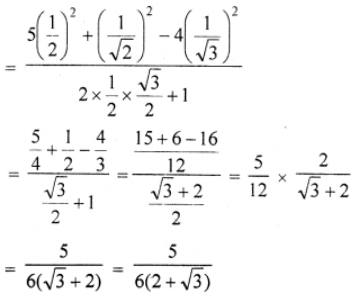
(x) (5sin²30°+cos²45°−4tan²30°) / (2sin30°cos30°+tan45°)
(xi) 2√2 cos 45°. cos 60° + 2√3 sin 30°. tan 60° – cos 0°
= 2√2 (1/√2) (1/2) + (2√3) (1/2) (√3) – 1
= 1 + 3 – 1
= 3
(xii) (4/3) tan² 30° + sin² 60° – 3 cos² 60° + (3/4) tan² 60° – 2 tan² 45°
= (4/3) (1/√3)² + (√3/2)² – 3 (1/2)² + (3/4) (√3)² – 2(1)²
= (4/3) × (1/3) + (3/4) – 3 × (1/4) + (3/4) x 3 – 2
= (4/9) + (3/4) – (3/4) + (9/4) – (2/1)
= (16+27−27+81−72)/36
= 25/36
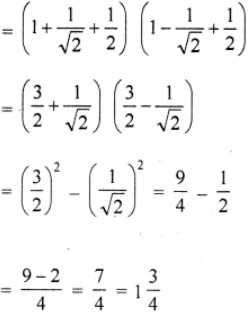
(xiii) (cos 0° + sin 45° + sin 30°) × (sin 90° – cos 45° + cos 60°)
Que-4: ABC is an isosceles right triangle. Assuming AB = BC = x, find the value of each of the following trigonometric ratios.
(i) sin 45°
(ii) cos 45°
(iii) tan 45°
Show your complete working neatly.
Sol: In △ABC, AB = AC = x
Draw AD ⊥ BC which bisects BC at D
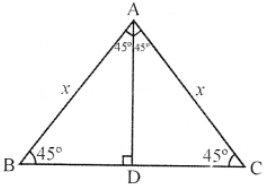
∵ ∠B = 45°, then ∠C = 45°
and ∠A = 90°
∴ ∠BAD = ∠CAD = 45°
( ∵AD is the perpendicular which bisect ∠A)
∴ BD = DC = AD = (1/2) BC
∵ ∠A = 90°
∴ BC2 = AB2 + AC2
= x2 + x2 = 2x2
BC = √2x
∴ BD = DC = AD = √2x/2
Now (i) sin 45° = AD/AB = {√2x/2}/2
= √2/2 = 1/√2
cos 45° = BD/AB = {√2x/2}/x = √2/2 = 1/√2
tan 45° = AD/BD = {√2x/2}/{√2x/2} = 1
Que-5: Without using tables, find the value of
(sin30°−sin90°+2cos0°) / (tan30°×tan60°)
Sol: (sin30°−sin90°+2cos0°) / (tan30°×tan60°) = {(1/2)−1+2×1}/{(1/√3)×√3}
= {(1/2)−1+2}/1 = (1/2) – 1 + 2 = 1*(1/2) = 1.5
Que-6: Without using tables verify that :
(i) sin 60° = (2tan30°)/(1+tan²30°) = √3/2;
(ii) cos 60° = (1−tan²30°)/(1+tan²30°) = 1/2;
(iii) cos 60° = cos² 30° – sin² 30°
(iv) cos 60° = 1 – 2 sin² 30° = 2 cos² 30° – 1.
Sol: (i) sin 60° = (2tan30°)/(1+tan²30°) = √3/2
sin 60° = √3/2
and (2tan30°)/(1+tan²30°) = {2×(1√3)}/{1+(1/√3)²} = (2/√3)/{1+(1/3)}
= (2/√3)/(4/3) = (2/√3) × (3/4) = √3/2
Hence sin 60° = (2tan30°)/(1+tan²30°) = √3/2
(ii) cos 60° = (1−tan²30°)/(1+tan²30°) = 1/2
cos 60° = 1/2
and (1−tan²30°)/(1+tan²30°) = [1−(1/√3)²] / [1+(1/√3)²] = {1−(1/3)}/{1+(1/3)}
= (2/3)/(4/3) = (2/3) × (3/4) = 1/2
Hence cos 60° = (1−tan²30°)/(1+tan²30°) = 1/2
(iii) cos 60° = cos² 30° – sin² 30°
cos 60° = 12
and cos² 30° – sin² 30° = (√3/2)² – (1/2)²
= (3/4) – (1/4)
= 2/4 = 1/2
Hence cos 60° = cos² 30° – sin² 30°
(iv) cos 60° = 1 – 2sin² 30° = 2 cos² 30° – 1
cos 60° = 12
1 – 2sin² 30° = 1 – 2 × (1/2)² = 1 – 2 × (1/4)
= 1 – (1/2) = 1/2
and 2 cos² 30° – 1 = 2 (√3/2)² – 1
= 2 × (3/4) – 1
= (3/4) – 1 = 1/2
Hence cos 60° = 1 – 2 sin² 30°
= 2 cos² 30° – 1
Que-7: Prove that:
(i) cos2 30° + sin2 30° + tan2 45° = 2.
(ii) 4 (sin4 30° + cos4 60°) – 3 ( cos2 45° – sin2 90°) = 2.
Sol: (i) L.H.S. = cos² 30° + sin² 30° + tan² 45°
= (√3/2)² + (1/2)² + (1)²
= (3/4) + (1/4) + 1
= 1 + 1 = 2 = R.H.S.
(ii) L.H.S. = 4 (sin 4 30° 1+ cos 4 60°) – 3 (cos2 45° – sin2 90°)
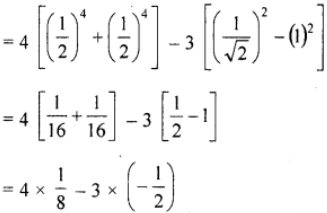
= (1/2) + (3/2)
= 4/2 = 2 = RHS
Que-8: A pole 15 m long rests against a vertical wall at an angle of 60° with the ground. Calculate
(i) how high up the wall will the pole reach?
(ii) how far is the foot of the pole from the wall?
Sol: AC is wall and AB is a pole which rests with wall at 60°
In right △ABC, ∠C = 90°
AB = 15 m
Let height of wall = x m
and away from foot of wall = y m
(i) ∵ sin 60° = AC/AB
⇒ √3/2 = x/15
⇒ x = (15√3)/2
⇒ x = {15(1.732)}/2 = 25.980/2 = 12.99 m
∴ Height of wall = 12.99 m
(ii) cos 60° = BC/AB ⇒ 1/2 = y/15
⇒ y = 15/2 = 7.5 m
∴ Distance from the foot of wall = 7.5 m
Que-9: In the given triangle, calculate θ if B = 90°, AB = 20 cm and AC = 40 cm.
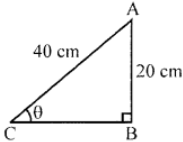
Sol: In the △ABC, ∠B = 90° and
∠C = θ, AC = 40 cm, AB = 20 cm
Here sin θ = AB/AC = 20/40 = 1/2
= sin 30° {∵ sin 30° = 1/2}
∴ θ = 30°
Que-10: Without using tables solve each of the following triangle ABC, right-angled at C; given
(i) A = 30° and c = 40;
(ii) B = 60° and c = 15;
(iii) A = 45° and a = 7.
Sol: (i) In △ABC, ∠c = 90°
∠A = 30 and c = 40
sin θ = BC/AB = a/c
⇒ sin 30° = a/c ⇒ 1/2 = a/40
⇒ a = 40/2 = 20
But c² = a² + b² (Pythagoras Theorem)
(40)² = (20)² +b² ⇒ 1600 – 400 = 1200
= 400 × 3
∴ b = √(400×3) = 20√3 = 20(1.732)
= 34.64 = 34.64
a = 20 and b = 34.64 and
∠B = 90° – 30° = 60°
(ii) ∠B = 60° and c = 15
sin θ = AC/AB ⇒ sin 60° = a/c
⇒ √3/2 = a/15 ⇒ a = 15√3/2
⇒ a = {15(1.732)}/2 = 12.99
We know that by Pythagoras Theorem,
(15)² = {(15√3)/2}² + b² ⇒ 225 = (675/4) + b²
⇒ b² = 225 – (675/4)
= (900−675)/4 = 225/4
∴ b = √(225/4) = 15/2 = 7.5
and ∠A = 90° – B = 90° – 60° = 30°
(iii) A = 45° and a = 7
sin θ = BC/AC ⇒ sin 45° = a/c
⇒ 1/√2 = 7/c ⇒ c = 7√2 = 7(1.414)
⇒ c = 9.898 = 9.9
But C² = a² + b²
⇒ (7√2)² = (7)² + b²
⇒ 98 = 49 + b²
⇒ b² = 98 – 49 = 49 = (7)²
∴ b = 7
Hence c = 9.9 and b = 7
and ∠B = 90° – ∠A = 90° – 45° = 45°
Que-11: If 4 sin2 θ – 1 = 0 and angle θ is less than 90°; find the value of θ and hence the value of cos2 θ + tan2 θ.
Sol: 4 sin² θ – 1 = 0 ⇒ 4 sin² θ = 1
⇒ sin² θ = 1/4 = (1/2)²
(i) ∴ sin θ = 1/2 = sin 30° {∵ sin 30° = 1/2}
∴ θ = 30°
Now cos² θ + tan² θ = cos² 30° + tan² 30°
= (√3/2)² + (1/√3)²
= (3/4) + (1/3)
= (9+4)/12 = 13/12 = 1*(1/12)
Que-12: If θ is an acute angle and sin θ = cos θ, find the value of 2 tan2 θ + sin2 θ – 1.
Sol: (i) ∵ sin θ = cos θ ⇒ sinθ/cosθ = 1
⇒ tan θ = 1 = tan 45° {∵ tan 45° = 1}
∴ θ = 45°
(ii) Now 2 tan2 θ + sin2 θ – 1
= 2 tan2 45° + sin2 45° – 1
= 2 (1)² + (1/√2)² – 1
= 2 × 1 + (1/2) – 1 = 2 + (1/2) – 1
= 1*(1/2) = 3/2 = 1.5
Que-13: A kite, flying at a height of 75 metres from the level ground, is attached to a string inclined at 60° to the horizontal, find the length of the string to the nearest metre.
Sol: Height of the kite = 75 m
Angle of elevation = 60°
∴ JK is the string tied to the kite
Let JK = x m
Now sin θ = KL/JK
⇒ sin 60° = 75/x ⇒ √3/2 = 75/x
⇒ x = (75×2)/√3 = (150×√3)/(√3×√3) m
= (150√3)/3 = 50√3 = 50(1.732)
= 86.600 m = 87 m
Que-14: If 2 sin θ – 1 = 0, find :
(i) the value of θ in degrees where θ is an acute angle;
(ii) cos2θ + tan2θ.
Sol: (i) 2 sin θ – 1 = 0 ⇒ 2 sin θ = 1
⇒ sin θ = 1/2 = sin 30° {∵ sin 30° = 1/2}
∴ θ = 30°
(ii) Now, cos²θ + tan²θ = cos² 30° + tan² 30°
= (√3/2)² + (1/√3)² = (3/4) + (1/3)
= (9+4)/12 = 13/12 = 1*(1/12)
Que-15: The altitude AD of a △ABC, in which ∠A is obtuse, is 10 cm. If BD = 10 cm and CD = 10√3 cm, determine ∠A.
Sol: In △ABC, ∠A is an obtused angle AD ⊥ BC,
BD = 10 cm and CD = 10√3 cm
Let ∠BAD = α and ∠CAD = β
∠A = α + β
Now tan α = BD/AD = 10/10 = 1 = tan 45° {∵ tan 45° = 1}
∴ α = 45°
and tan β = CD/AD = 10√3/10 = √3 = tan 60° {∵ tan 60° = √3}
∴ β = 60°
Now ∠A = α + β = 45° + 60° = 105°
Que-16: In a right triangle ABC, right angled at C, if ∠B = 60° and AB = 15 units, find the remaining angles and sides.
Sol: In △ABC, ∠C = 90°, ∠B = 60°,
AB = 15 units
∠A = 180° – (90° + 60°)
= 180° – 150° = 30°
Now sin θ = AC/AB ⇒ sin 60° = AC/AB
⇒ √3/2 = AC/15
⇒ AC = (15√3)/2 = (15/2) √3 units
and cos 60° = BC/AB ⇒ 1/2 = BC/15
⇒ BC = 15/2 = 7.5 units
Hence ∠B = 30°, BC = 7.5 units, AC = (15/2)√3 units
Que-17: In a rectangle ABCD, AB = 20 cm, ∠BAC = 60°, calculate side BC and diagonals AC and BD.
Sol: In rectangle ABCD, AB = 20 cm
∠BAC = 60° and AC and BD are its two diagonals which are equal
tan ∠BAC = BC/AB
⇒ tan 60° = BC/20 ⇒ √3 = BC/20
⇒ BC = 20√3 cm
Similarly cos 60° = AB/AC = 20/AC
⇒ 1/2 = 20/AC = AC = 20 × 2 = 40 cm
∵ BD = AC
⇒ BD = 40 cm
Que-18: A ladder is placed against a wall such that it just reaches the top of the wall. The foot of the ladder is 1.5 m away from the wall and the ladder is inclined at an angle of 60° with the ground. Find the height of the wall. (Given √3 = 1.73)
Sol: Let AB is wall and AC is ladder which is placed against the wall and makes an angle of 60° with the ground
Foot of the ladder is 1.5 m away from the wall i.e. BC = 1.5 m
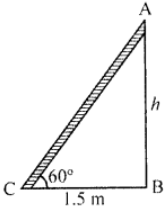
Let h be the height of the wall then
tan C = AB/AC ⇒ tan 60° = h/1.5
⇒ √3 = h/1.5 ⇒ h = 1.5√3
⇒ h = (1.5) (1.73) m = 2.595 m
∴ Height of the wall = 2.595 m = 2.59 m
Que-19: An electric pole is 10 m high. A steel wire tied to the top of the pole is affixed at a point on the ground to keep the pole upright. If the steel wire makes an angle 45° with the horizontal through the foot of the pole, find the length of the steel wire. (Given √2 = 1.41)
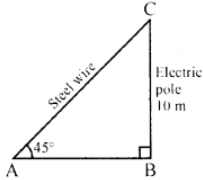
Sol: BC is the electric pole and AC is the wire tied to it such that
∠A = 45° and BC = 10 m Let AC = x
Now sin A = BC/AC
⇒ sin 45° = 10/x
⇒ 1/√2 = 10/x
⇒ x = 10√2 = 10 (1.414) m = 14.14 m
Length of wire = 14.14 = 14.1 m
Que-20: A vertically straight tree, 15 m high, is broken by the wind in such a way that its top just touches the ground and makes an angle of 60° with the ground. At what height from the ground did the tree break ? (Use √3 = 1.73)
Sol: Let DB is a tree which is broken from A and makes an angle of 60° with the ground then AD = AC and DB = 15 cm
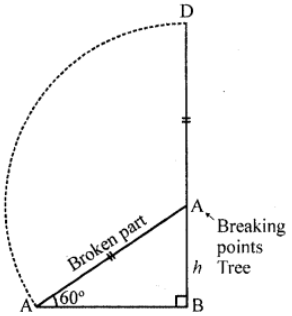
Let AB = x, then
AC = AD = (15 – x) m
Now, sin θ = Perp. Hyp. ⇒ sin 60° = AB/AC
⇒ √3/2 = x/(15−x) ⇒ 2x = 15√3 = √3 x
⇒ 2x + √3 x = 15√3
⇒ (2 + √3) x = 15√3
∴ x = (15√3)/(2+√3) = {15√3(2−√3)} / {(2+√3)(2−√3)}
= {30√3−45}/(4−3)
= {30(1.73)−45}/1 = 51.9 – 45 = 6.9 m
∴ Height of tree from which it was broken = 6.9 m
Que-21: The string of a kite is 150 m long and it makes an angle of 60° with the horizontal. Find the height of the kite from the ground. (Take √3 = 1.73).
Sol: K is kite and KL is string tied to it which makes an angle of 60° with the ground
∠L = 60°, LK = 150 m
Let KM = h m
sin θ = Perp. / Hyp.
⇒ sin 60° = KM/KL
⇒ √3/2 = h/150 ⇒ h = (150√3)/2 = 75√3 m
∴ Height of the kite = 75√3 = 75 x 1.73 m = 129.75 = 129.8 m
–: Trigonometrical Ratios Class 9 OP Malhotra Exe-19C ICSE Maths Solutions Ch-19. :–
Return to :– OP Malhotra S Chand Solutions for ICSE Class-9 Maths
Thanks
Please Share with Your Friends