Upthrust in Fluids Archimedes Principle and Floatation Class-9 Exe-5A MCQs Concise Physics ICSE Selina Solutions. In this article you would learn to solve MCQs on Upthrust and Archimedes Principle. Visit official Website CISCE for detail information about ICSE Board Class-9 Physics.
Upthrust in Fluids Archimedes Principle and Floatation Class-9 Exe-5A MCQs Concise Physics ICSE Selina Solutions
| Board | ICSE |
| Class | 9 |
| Subject | Physics |
| Writer / Publication | Concise Selina Publishers |
| Chapter-5 | Upthrust in Fluids, Archimedes’ Principle and Floatation |
| Exe – 5A | Upthrust and Archimedes Principle |
| Topics | Solution of Exe-5(A) MCQs Type |
| Academic Session | 2025-2026 |
Upthrust and Archimedes Principle
Upthrust in Fluids Archimedes Principle and Floatation Class-9 Exe-5A MCQs Concise Physics ICSE Selina Solutions
Page 120 (Choose the correct answer from the options given below).
Que-1: The property of a liquid to exert an upward force on a body immersed in it is called :
(a) buoyancy
(b) pressure
(c) friction
(d) viscosity
Ans: (a) buoyancy
Hint- Buoyancy is defined as the property of a liquid to exert an upward force on a body immersed in it.
Que-2: If an empty can is pushed into water, we feel :
(a) a downward force
(b) an upward force
(c) it is easy to push the can into water
(d) both (a) and (c)
Ans: (b) an upward force
Hint- The upward force exerted on the empty can by water opposing the push is called upthrust or buoyant force.
Que-3: The effect of upthrust is that the weight of a body immersed in a liquid appears to be :
(a) more than its actual weight
(b) the same as its weight outside the liquid
(c) less than its actual weight
(d) None of these
Ans: (c) less than its actual weight
Hint- Due to the upthrust or the buoyant force acting on a body immersed in water, the weight of a body appears to be less than its actual weight.
Page 121
Que-4: Which of the following are the correct characteristic properties of upthrust ?
(i) the smaller the volume of a body submerged in a liquid, the smaller is the upthrust
(ii) the upthrust acts on the body in an upward direction at the centre of buoyancy
(iii) for the same volume of a body inside a fluid, the less the density of the fluid, greater will be the upthrust
(a) (i) & (ii)
(b) (i) & (iii)
(c) (ii) & (iii)
(d) (i), (ii) & (iii)
Ans: (a) (i) & (ii)
Hint- Characteristic properties of upthrust :
Larger the volume of a body submerged in a fluid, greater is the upthrust.
For the same volume of a body inside a fluid, more the density of fluid, greater is the upthrust.
The upthrust acts on the body in upward direction at the centre of buoyancy i.e., the centre of gravity of the displaced fluid.
Que-5: The S.I. unit of upthrust is:
(a) Pa
(b) N
(c) kg
(d) kg m2
Ans: (b) N
Hint- Upthrust, being a force, has S.I. unit as newton (N).
Que-6: The correct relation for upthrust on a solid of volume V immersed in a liquid of density ρ is :
(a) FB = VsggVs
(b) Fg= ρgVVρg
(c) FB= Vρg
(d) Fg= VgρρVg
Ans: (c) FB = Vρg
Que-7: Archimedes’ principle applies on :
(a) solids and liquids
(b) liquids and gases
(c) solids and gases
(d) solids, liquids and gases
Ans: (b) liquids and gases
Hint- Archimedes’ principle applies on both, liquids & gases.
Que-8: If a body is completely immersed in a liquid, the volume of the liquid displaced will be …………… its own volume and the upthrust will be ……………
(a) less than, minimum
(b) equal to, minimum
(c) more than, maximum
(d) equal to, maximum
Ans: (d) equal to, maximum
Hint- If a body is completely immersed in a liquid, the volume of the liquid displaced will be equal to its own volume and the upthrust will be maximum.
Que-9: The apparent loss in weight is equal to the upthrust on the body verifies :
(a) Pascal’s law
(b) Newton’s third law
(c) Archimedes’ principle
(d) Newton’s second law
Ans: (c) Archimedes’ principle
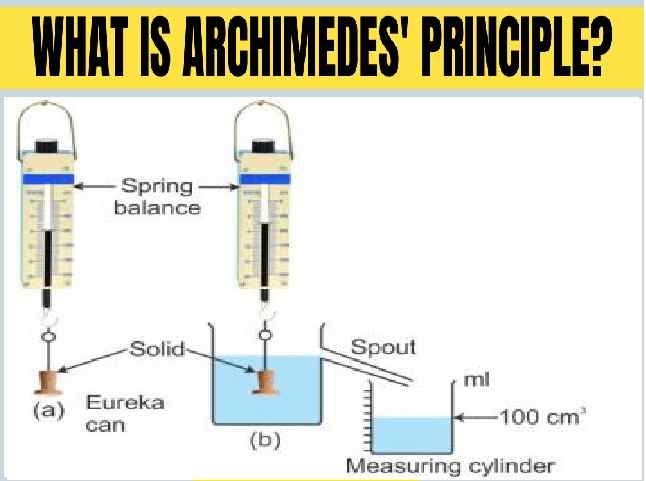
Hint- Archimedes’ principle states that when a body is immersed partially or completely in a liquid, it experiences an upthrust, which is equal to the weight of the liquid displaced by it.
Que-10: A body weighed ‘W’ in air by a sensitive spring balance, will weigh …………… in vacuum.
(a) the same
(b) slightly more
(c) slightly less
(d) zero
Ans: (b) slightly more
Hint- A body weighed ‘W’ in air by a sensitive spring balance, will weigh slightly more in vacuum, because in vacuum no upthrust acts.
Que-11: Floating of a cork on the surface of water indicates that :
(a) the density of water is more than the density of cork.
(b) the density of water is less than the density of cork.
(c) the density of water is equal to the density of cork.
(d) the density of water plays no role in the floatation of cork.
Ans: (a) the density of water is more than the density of cork.
Hint- Bodies of density greater than that of the liquid sink in it, while bodies of average density equal to or smaller than that of the liquid float on it.
Que-12: Sinking of an iron nail in water implies that :
(a) the density of nail is more than the density of water
(b) the density of nail is less than the density of water
(c) the density of nail is equal to the density of water
(d) the sinking of nail does not depend upon the density of water
Ans: (a) the density of nail is more than the density of water
Hint- Bodies of density greater than that of the liquid sink in it, while bodies of average density equal to or smaller than that of the liquid float on it.
Que-13: Bodies of density …………… than that of the liquid sink in it, while bodies of average density equal to or …………… than that of the liquid float on it.
(a) smaller, greater
(b) greater, greater
(c) greater, smaller
(d) smaller, smaller
Ans: (c) greater, smaller
Hint- Bodies of density greater than that of the liquid sink in it, while bodies of average density equal to or smaller than that of the liquid float on it.
Que-14: A body will experience minimum upthrust when it is completely immersed in:
(a) Turpentine
(b) Water
(c) Glycerine
(d) Mercury
Ans: (a) Turpentine
Hint- One of the factors affecting the upthrust is the density of the liquid in which the body is submerged. Lesser the density of the liquid, lesser is the upthrust experienced by a body. As amongst the given options turpentine has the least density, hence minimum upthrust will be offered by turpentine.
Que-15: A body of density ρ sinks in a liquid of density ρL. The densities ρ and ρL are related as:
(a) ρ = ρL
(b) ρ < ρL
(c) ρ > ρL
(d) nothing can be said
Ans: (b) ρ > ρL
Hint- Bodies of density greater than that of liquid, sink in it. Hence, ρ > ρL
— : End of Upthrust in Fluids Archimedes Principle and Floatation Class-9 Exe-5A MCQs Concise Physics :–
Return to Concise Selina Physics ICSE Class-9 Solutions
Thanks
Please share with your friends