Upthrust in Fluids Archimedes Principle and Floatation Class-9 Exe-5B MCQs Concise Physics ICSE Selina Solutions Ch-5. In this article you would learn to solve MCQs on Relative Density and it’s Measurement by Archimedes’ Principle. Visit official Website CISCE for detail information about ICSE Board Class-9 Physics.
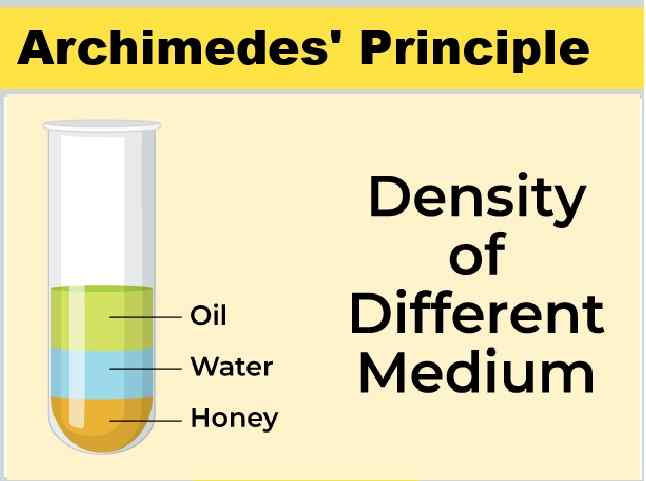
Upthrust in Fluids Archimedes Principle and Floatation Class-9 Exe-5B MCQs Concise Physics ICSE Selina Solutions Ch-5
| Board | ICSE |
| Class | 9 |
| Subject | Physics |
| Writer / Publication | Concise Selina Publishers |
| Chapter-5 | Upthrust in Fluids, Archimedes’ Principle and Floatation |
| Exe – 5B | Relative Density and it’s Measurement by Archimedes’ Principle |
| Topics | Solution of Exe-5(B) MCQs Type |
| Academic Session | 2025-2026 |
Relative Density and it’s Measurement by Archimedes’ Principle
Upthrust in Fluids Archimedes Principle and Floatation Class-9 Exe-5B MCQs Concise Physics ICSE Selina Solutions Ch-5
Page 128
Que-1: The effect of temperature on density is that it :
(a) decreases with an increase in temperature
(b) increases with an increase in temperature
(c) first decreases then increases with a decrease in temperature
(d) is not affected by temperature
Ans: (a) decreases with an increase in temperature
Hint- Most of the substances expand on heating and contract on cooling, but their mass remains unchanged. Therefore, density of most of the substances decreases with the increase in temperature and increases with the decrease in temperature.
Que-2: The density of copper is :
(a) 9.0 g cm-3
(b) 8.9 g cm-3
(c) 9.1 g cm-3
(d) 8.9 kg m-3
Ans (b) 8.9 g cm-3
Hint- The density of copper is 8.9 g cm-3. It means that the mass of 1 cm3 of copper is 8.9 g.
Que-3: The mass of 1 cm3 of iron is 7.8 g, its density in S.I. unit is :
(a) 7.8 kg/cm3
(b) 7.8 g cm-3
(c) 7800 g/cm3
(d) 7800 kg/m3
Ans: (d) 7800 kg/m3
Hint-
Density = mass/volume = 7.8/1 g/cm3
Converting g cm-3 into kg m-3,
We know, 1 g = 10-3 kg
1 cm = 10-2 m
1 cm3 = 10-6 m3
Therefore,
7.8 g/cm³
= 7.8 10-3/kg10-6m³
= 7.8 10³kg/1m³
= 7.8 x 1000 kg m-3
Hence,
7.8 g/cm3 = 7800 kg/m3
Que-4: The density of water is maximum at …………… °C and is …………… kg/m3
(a) 0, 1
(b) 0, 1000
(c) 4, 1
(d) 4, 1000
Ans: (d) 4, 1000
Hint- Due to anomalous expansion of water, when cooled it first contracts in volume but below 4°C, it starts expanding and continues to do so till the temperature reaches 0°C, the point at which it freezes into ice. Thus, The density of water is maximum at 4°C and is 1000 kg/m3.
Que-5: Relative density of a substance is expressed by comparing the density of that substance with the density of:
(a) air
(b) mercury
(c) water
(d) iron
Ans (c) Water
Hint– Relative density of a substance is also defined as the ratio of the mass of a certain volume of a substance to the mass of an equal volume of water at 4°C.
Que-6: The unit of relative density is:
(a) g cm-3
(b) kg m-3
(c) m3 kg-1
(d) no unit
Ans: (d) no unit
Hint– Since relative density is a pure ratio, it has no unit.
Que-7: The correct relation between density and relative density is :
(a) R.D. = Density of substance in g cm−³/1.0 g cm−³
(b) R.D. = Density of substance in g m−³/1.0 kg m−³
(c) R.D. = Density of substance in kg cm−³/1.0 g cm³
(d) None of these
Ans: (a) R.D. = Density of substance in g cm−³/1.0 g cm−³
Hint- In C.G.S. system, density of water at 4°C is 1 g cm-³, so the relative density of a substance is equal to the numerical value of density of that substance.
Que-8: The relative density of silver is :
(a) 11.7
(b) 9.5
(c) 12.8
(d) 10.5
Ans: (d) 10.5
Hint– The relative density of silver is 10.5. It means that the mass of a certain volume of silver is 10.5 times the mass of an equal volume of water at 4°C.
Que-9: The correct expression for relative density when the weight of a body in air is W1, and in water is W2 is given by :
(a) R.D. = W2(W1−W2)
(b) R.D. = W1(W1+W2)
(c) R.D. = (W1+W2)W1
(d) R.D. = W1(W1−W2)
Ans: (d) R.D. = W1(W1−W2)
Que-10: If the weight of a body in air is W1, in a liquid is W2 and in water is W3, then :
(a) R.D. of liquid = (W2−W3)/(W1−W3)
(b) R.D. of liquid = (W1−W2)/(W1−W3)
(c) R.D. of liquid = (W2−W3)/(W1+W3)
(d) R.D. of liquid = (W1−W2)/(W1+W3)
Ans: (b) R.D. of liquid = (W1−W2)/(W1−W3)
— : End of Upthrust in Fluids Archimedes Principle and Floatation Class-9 Exe-5B MCQs Concise Selina Ch-5 Selina Solutions :–
Return to Concise Selina Physics ICSE Class-9 Solutions
Thanks
Please share with your friends