YDSE Numerical Class-12 Nootan ISC Physics Solution Ch-20 Interference of Light. Step by step solutions of Kumar and Mittal Physics of Nageen Prakashan as council latest prescribe guideline for upcoming exam. Visit official Website CISCE for detail information about ISC Board Class-12 Physics.
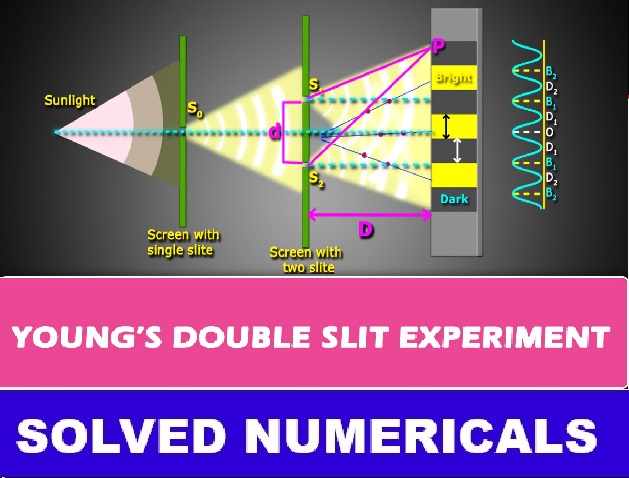
YDSE Numerical Class-12 Nootan ISC Physics Solution Ch-20 Interference of Light
| Board | ISC |
| Class | 12 |
| Subject | Physics |
| Book | Nootan |
| Chapter-20 | Interference of Light. |
| Topics | Numericals on YDSE |
| Academic Session | 2025-2026 |
Numericals on YDSE
Class-12 Nootan ISC Physics Solution Ch-20 Interference of Light
Que-5: The initial phase difference between two interfering waves is 54°. When these waves reach a point on a screen, a path difference of 1.5 λ is introduced between them. What is the total phase difference at that point?
Ans- Δd = 54 x π/180 + 1.5λ x 2π/λ
=> 3.3 π rad
Que-6: Two slits are 1.0 mm apart and placed at a distance of 1.0 m from a screen. Find fringe-width when light of wavelength 500 nm is used. What would be the fringe-width if the separation between the slits is halved and the distance of the screen from the slits is doubled?
Ans- β = Dλ/d
=> 1 x 500 x 10^-9 / 1 x 10^-3
=> 0.5 x 10^-3 = 0.5 mm
again β1/β2 = D1/d1 x d2/D2
=> 0.5/β2 = D1/d1 x d1 / (2 x 2D1)
=> β = 2.0 mm
Que-7: A beam of monochromatic light of wavelength 500 nm falls on two parallel slits. The distance between the slits is 0.15 mm. Determine the width of the interference fringes on a screen placed at a distance of 1.5 m from the slits.
Ans- β = Dλ/d
=> 1.5 x 500 x 10^-9 / 0.15 x 10^-3
=> 5 x 10^-3 m = 5 mm
Que-8: In Young’s double-slit experiment, the slits are separated by 0.24 mm. The screen is 1.2 m away from the slits. The fringe-width is 0.3 cm. Find the wavelength of light used.
Ans- λ = βd/D
=> 0.3 x 10^-2 x 0.24 x 10^-3 / 1.2
=> 6000 x 10^-10
=> 6000 Å
Que-9: In Young’s experiment, what will be the phase difference and the path difference between the light waves reaching (i) the third bright fringe and (ii) the third dark fringe from the central fringe? (λ = 6000 Å).
Ans- phase difference for third bright fringe
= 3λ = 3 x 2π (λ ≈ 2π)
= 6 π
or 3 x 6000 = 18000 Å
and for third
Que-10: The two slits in Young’s double-slit experiment are separated by a distance of 0.03 cm. When light of wavelength 5000 Å falls on the slits, an interference pattern is produced on a screen 1.5 m away. Find the distance of 4th bright fringe from the central maximum.
Ans- X = nDλ / d
=> 4 x 1.5 x 5000 x 10^-10 / 0.03 x 10^-2
=> 1 x 10^-2 m = 1 cm
Que-11: In Young’s double-slit experiment, the slits are 0.2 mm apart and the screen is 1.5 m away. The distance between the central bright fringe and the fourth dark fringe is 1.8 cm. Find the wavelength of light used.
Ans- λ = dX / (n-1/2) D
=> 0.2 x 10^-3 x 1.8 x 10^-2 / 3.5 x 1.5
=> 6857 Å
≈ 6860 Å
Que-12: In Young’s double-slit experiment, light of wavelength 5000 Å is used. The third bright band on the screen is formed at a distance of 1 cm from the central bright band. If the screen is at a distance of 1.5 m from the centre of the two narrow slits, calculate the separation between the slits.
Ans- d = nDλ / x
=> 3 x 1.5 x 5000 x 10^-10 / 1 x 10^-2
=> 0.225 x 10^-3 m
=> 0.225 mm
Que-13: The light used in Young’s double-slit experiment has a frequency of 6.0 x 10^14 s^-1. The distance between the centres of adjacent bright fringes is 0.75 mm. If the screen is 1.5 m away, what is the distance between the slits?
Ans- d = Dλ/β = Dc / fβ
=> 1.5 x 3 x 10^8 / 6 x 10^14 x 0.75 x 10^-3
=> 1.0 x 10^-3 m
=> 1.0 mm
Que-14: A double-slit of separation 0.5 mm is illuminated by blue light of wavelength 480 nm. At what distance should a screen be placed from the double-slit to obtain interference fringes that are 1.0 mm apart? What would be the fringe-width, if this distance be doubled?
Ans- D = βd/λ
=> 1 x 10^-3 x 0.5 x 10^-3 / 480 x 10^-9
=> 1.04 = 104 cm
β1/β2 = D1/D2 => 1/β2 = D1/2D1
=> β2 = 2 mm
Que-15: In Young’s experiment, the wavelength of light used is 6000 Å, the distance between two slits is 0.05 cm and the distance of screen from the slits is 1 m. Find out the distance between first dark fringe and first bright fringe.
Ans- β/2 = Dλ/2d
=> 1 x 6000 x 10^-10 / 2 x 0.05
=> 0.06 x 10^-2 m
=> 0.06 cm
Que-16: The fringe-width in Young’s experiment, when the separation between the slits is 0.5 mm and the distance of the screen from the slits in 1.5 m, is 1.8 mm. Find the path difference between the interfering waves at the position of first-order maximum.
Ans- path difference for the first order max = λ
=> λ = βd/D
=> 1.8 x 10^-3 x 0.5 x 10^-3 / 1.5
=> 6 x 10^-7 m
–: YDSE Numerical Class-12 Nootan ISC Physics Solution Ch-20 Interference of Light :–
Return to : – Nootan Solutions for ISC Class-12 Physics
Thanks
Please share with your friends