
Circles Class 10 Concise Exe-17A ICSE Maths Selina Solutions Ch-17. In this article you would learn how to solve problems / questions on Relation between Arcs and Segments and Cyclic Properties. Visit official Website CISCE for detail information about ICSE Board Class-10 Mathematics.

Circles Class 10 Concise Exe-17A ICSE Maths Selina Solutions Ch-17
| Board | ICSE |
| Publications | Selina |
| Subject | Maths |
| Class | 10th |
| Chapter-17 | Circles |
| Writer | R.K. Bansal |
| Exe-17A | Relation between Arcs and Segments and Cyclic Properties. |
| Edition | 2025-2026 |
Question on Relation between Arcs and Segments and Cyclic Properties
Class 10 Concise Exe-17A ICSE Maths Selina Solutions Ch-17
Que-1: In the given figure, O is the centre of the circle. ∠OAB and ∠OCB are 30° and 40° respectively. Find ∠AOC. Show your steps of working.
Sol:
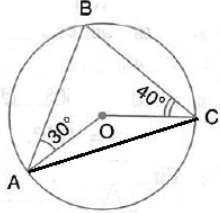
Join AC,
Let ∠OAC = ∠OCA = x …(Say)
∴ ∠AOC =180° – 2x
Also, ∠BAC = 30° + x
∠BCA = 40° + x
In ΔABC,
∠ABC =180° – ∠BAC – ∠BCA
= 180° – (30° + x) – (40°+ x)
= 110° – 2x
Now, ∠AOC = ∠2ABC
(Angle at the centre is double the angle at the circumference subtended by the same chord)
⇒ 180° – 2x = 2(110° – 2x)
⇒ 2x = 40°
∴ x = 20°
∴ ∠AOC = 180° – 2 × 20° = 140°
Que-2: In the given figure, ∠BAD = 65°, ∠ABD = 70°, ∠BDC = 45°
(i) Prove that AC is a diameter of the circle.
(ii) Find ∠ACB.
Sol: (i) In ΔABD, ∠DAB + ∠ABD + ∠ADB = 180°
⇒ 65° + 70° + ∠ADB = 180°
⇒ ∠ADB = 180° – 70° – 65° = 45°
Now, ∠ADC = ∠ADB + ∠BDC = 45° + 45° = 90°
⇒ ∠ADC is the angle of semi-circle
So, AC is a diameter of the circle.
(ii) ∠ACB = ∠ADB (angle subtended by the same segment)
∠ACB = 45°
Que-3: Given O is the centre of the circle and ∠AOB = 70°. Calculate the value of:
(i) ∠ OCA,
(ii) ∠OAC.
Sol: Here, ∠AOB = 2∠OCA …(Angle at the center is double the angle at the circumference by the same chord)
⇒ ∠ACB = 70/2 = 35°
Now, OC = OA …(Radii of same circle)
⇒ ∠OCA = ∠OAC = 35°
Que-4: In each of the following figures, O is the centre of the circle. Find the values of a, b, and c.
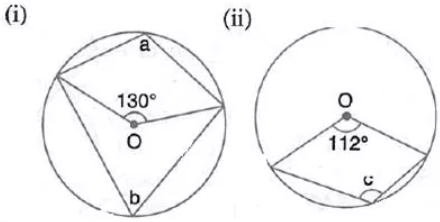
Sol: (i) Here, 𝑏 = (1/2) × 130°
(Angle ate he centre is double the angle at the circumference subtended by the same chord)
⇒ b = 65°
Now, a + b = 180°
(Opposite angles of a cyclic quadrilateral are supplementary)
⇒ a = 180° – 65° = 115°
(ii) Reflex ∠AOC = 360° – ∠AOC
= 360° – 112° = 248°.
We know that,
Angle which an arc subtends at the center is double that which it subtends at any point on the remaining part of the circumference.
Major arc AC subtends Reflex ∠AOC at center and ∠ABC on circumference.
∴ Reflex ∠AOC = 2∠ABC
⇒ 248° = 2c
⇒ c = 124°.
Hence, c = 124°
Que-5: In each of the following figures, O is the centre of the circle. Find the value of a, b, c and d.
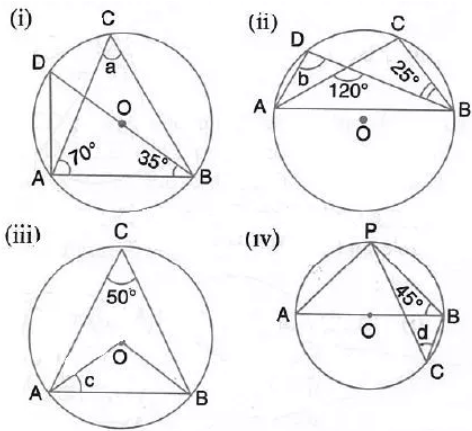
Sol: (i) Here, ∠BAD = 90° (Angle in a semicircle)
∴ ∠BDA = 90° – 35° = 55°
Again, a = ∠ACB = ∠BDA = 55°
(Angle subtended by the same chord on the circle are equal)
(ii) Here, ∠DAC = ∠CBD = 25°
(Angle subtended by the same chord on the circle are equal)
Again, 120° = b + 25°
(In a triangle, measure of exterior angle is equal to the sum of pair of opposite interior angles)
⇒ b = 95°
(iii) ∠AOB = 2∠AOB
= 2 × 50°
= 100°
(Angle at the centre is double the angle at the circumference subtended by the same chord)
Also, OA = OB
⇒ ∠OBA = ∠OAB = C
∴ 𝑐 = (180°−100°)/2
= 40°
(iv) We know that,
Angle in semi-circle is a right angle.
∴ ∠APB = 90°
In △APB,
⇒ ∠APB + ∠PBA + ∠PAB = 180°
⇒ 90° + 45° + ∠PAB = 180°
⇒ ∠PAB = 180° – 135° = 45°.
We know that,
Angles subtended by the same chord on the circle are equal.
∴ d = ∠PAB = 45°.
Que-6: In the figure, AB is common chord of the two circles. If AC and AD are diameters; prove that D, B and C are in a straight line. O1 and O2 are the centres of two circles.
Sol: Two circles with centre O1 and O2 intersect each other at A and B. AC and AD are the diameters of the circles.
Join AB.
AO1C is diameter.
∠ABC = 90° …(Angle in a semi-circle)
Similarly, ∠ABD = 90°,
Adding, we get:
∠ABC + ∠ABD = 90° + 90° = 180°
DBC is a straight line or D, B, C are in the same line.
Que-7: In the figure given beow, find :
(i) ∠ BCD, (ii) ∠ ADC, (iii) ∠ ABC.
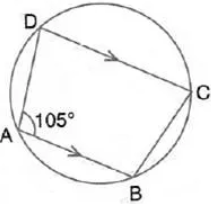
Show steps of your working.
Sol: (i) ∠BCD + ∠BAD = 180°
(Sum of opposite angles of a cyclic quadrilateral is 180°)
⇒ ∠BCD = 180° – 105° = 75°
(ii) Now, AB || CD
∴ ∠BAD + ∠ADC = 180°
(Interior angles on the same side of parallel lines is 180°)
⇒ ∠ADC = 180° – 105° = 75°
(iii) ∠ADC + ∠ABC = 180°
(Sum of opposite angles of a cyclic quadrilateral is 180°)
⇒ ∠ABC = 180° – 75° = 105°
Que-8: In the given figure, O is centre of the circle. If ∠ AOB = 140° and ∠ OAC = 50°; find :
(i) ∠ ACB, (ii) ∠ OBC, (iii) ∠ OAB, (iv) ∠CBA
Sol: Here, ∠𝐴𝐶𝐵 =12 Reflex (∠𝐴𝑂𝐵)
= (1/2) (360°−140°)
= 110°
(Angle at the centre is double the angle at the circumference subtended by the same chord)
Now, OA = OB (Radii of same circle)
∴ ∠OBA = ∠OAB
= (180° − 140°)/2
= 20°
∴ ∠CAB = 50° – 20° = 30°
ΔCAB,
∠CBA = 180° – 110° – 30° = 40°
∴ ∠OBC = ∠CBA + ∠OBA
= 40° + 20°
= 60°
Que-9: Calculate :
(i) ∠ CDB,
(ii) ∠ ABC,
(iii) ∠ ACB.
Sol: Here,
∠CDB = ∠BAC = 49°
∠ABC =∠ADC = 43°
(Angle subtend by the same chord on the circle are equal)
By angle – sum property of a triangle,
∠ACB = 180° – 49° – 43° = 88°
Que-10: In the figure given below, ABCD is a eyclic quadrilateral in which ∠ BAD = 75°; ∠ ABD = 58° and ∠ADC = 77°. Find:
(i) ∠ BDC,
(ii) ∠ BCD,
(iii) ∠ BCA.
Sol: (i) By angle – sum property of triangle ABD,
∠BAD + ∠ABD + ∠ADB = 180°
133° + ∠ADB = 180°
∠ADB = 180° – 133°
∠ADB = 47°
∴ ∠ADC = ∠ADB + ∠BDC
∴ 77° = 47° + ∠BDC
∴ 77° – 47° = ∠BDC
∴ ∠BDC = 30°
(ii) ∠BAD + ∠BCD = 180° …(Sum of opposite angles of a cyclic quadrilateral is 180°)
⇒ ∠BCD = 180° – 75° = 105°
∴ ∠BCD = 105°
(iii)∠BCA = ∠BDA = 47° …(Angle subtended by the same chord on the circle are equal)
Que-11: In the following figure, O is centre of the circle and ∆ ABC is equilateral. Find :
(i) ∠ ADB
(ii) ∠ AEB
Sol: Since ∠ACB and ∠ADB are in the same segment,
∠ADB = ∠ACB = 60°
Join OA and OB
Here, ∠AOB = 2∠ACB
= 2 × 60°
= 120°
∠𝐴𝐸𝐵 = 1/2 Reflex (∠𝐴𝑂𝐵) = (1/2) (360°−120°) = 120°
(Angle at the centre is double the angle at the circumference subtended by the same chord)
Que-12: Given—∠ CAB = 75° and ∠ CBA = 50°. Find the value of ∠ DAB + ∠ ABD
Sol: In ΔABC, ∠CBA = 50°, ∠CAB = 75°
∠ACB = 180° – (∠CBA + CAB)
= 180° – (50° + 75°)
= 180° – 125°
= 55°
But ∠ADB = ∠ACB = 55°
(Angle subtended by the same chord on the circle are equal)
Now consider ΔABD,
∠DAB + ∠ABD + ∠ADB = 180°
⇒ ∠DAB + ∠ABD + 55° = 180°
⇒ ∠DAB + ∠ABD = 180° – 55°
⇒ ∠DAB + ∠ABD = 125°
Que-13: ABCD is a cyclic quadrilateral in a circle with centre O.
If ∠ ADC = 130°; find ∠ BAC.
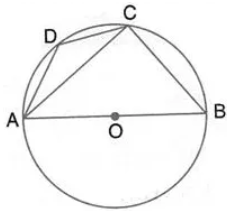
Sol: Here ∠ACB = 90°
(An angle in a semicircle is right angle.)
Also, ∠ABC = 180° – ∠ADC = 180° – 130° = 50°
(A pair of opposite angles in a cyclic quadrilateral are supplementary.)
By angle sum property of right triangle ACB,
∠BAC = 90° – ∠ABC = 90° – 50° = 40°
Que-14: In the figure given below, AOB is a diameter of the circle and ∠ AOC = 110°. Find ∠ BDC.
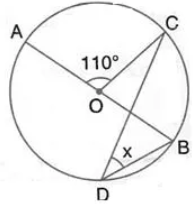
Sol: Join AD.
Here, ∠𝐴𝐷𝐶 = 1/2 ∠𝐴𝑂𝐶
= 1/2 × 110°
= 55°
(Angle at the centre is double the angle at the circumference subtended by the same chord)
Also, ∠ADB = 90°
(Angle in a semicircle is a right angle)
∴ ∠BDC = 90° – ∠ADC
= 90° – 55°
= 35°
Que-15: In the following figure, O is centre of the circle,
∠ AOB = 60° and ∠ BDC = 100°.
Find ∠ OBC.
Sol: Here, ∠𝐴𝐶𝐵 = 1/2 ∠𝐴𝑂𝐵
= 1/2 × 60°
= 30°
(Angle at the centre is double the angle at the circumference subtended by the same chord)
By angle sum property of ΔBDC,
∴ ∠DBC = 180° – 100° – 30° = 50°
Hence, ∠OBC = 50°
Que-16: ABCD is a cyclic quadrilateral in which ∠ DAC = 27°; ∠ DBA = 50° and ∠ ADB = 33°.
Calculate :
(i) ∠ DBC,
(ii) ∠ DCB,
(iii) ∠ CAB.
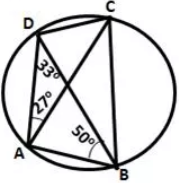
Sol: (i) ∠DBC = ∠DAC = 27°
(Angle subtended by the same chord on the circle are equal)
(ii) ∠ACB = ∠ADB = 33°
∠ACD = ∠ABD = 50°
(Angle subtended by the same chord on the circle are equal)
∴ ∠DCB = ∠ACD + ∠ACB
= 50° + 33°
= 83°
(iii) ∠DAB + ∠DCB = 180°
(Pair of opposite angles in a cyclic quadrilateral are supplementary)
⇒ 27° + ∠CAB + ∠83° = 180°
⇒ ∠CAB = 180° – 110° = 70°
Que-17: In the figure given alongside, AB and CD are straight lines through the centre O of a circle. If ∠AOC = 80° and ∠CDE = 40°. Find the number of degrees in:
(i) ∠DCE;
(ii) ∠ABC.
Sol: (i) Here, ∠CED = 90°
(Angle in a semicircle is a right angle)
∴ ∠DCE = 90° – ∠CDE
= 90° – 40°
= 50°
∴ ∠DCE = ∠OCB = 50°
(ii) In ΔBOC,
∠AOC = ∠OCB + ∠OBC
(Exterior angle of a Δ is equal to the sum of pair of interior opposite angles)
⇒ ∠OBC = 80° – 50° = 30° …[∠AOC = 80°, given]
Hence, ∠ABC = 30°
Que-18: In the figure given below, AC is a diameter of a circle, whose centre is O. A circle is described on AO as diameter. AE, a chord of the larger circle, intersects the smaller circle at B. Prove that AB = BE.
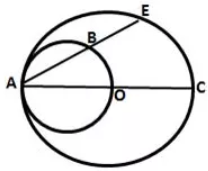
Sol: Join OB,
Then ∠OBA = 90°
(Angle in a semicircle is a right angle)
i.e. OB ⊥ AE
We know the perpendicular drawn from the centre to a chord bisects the chord.
Therefore, AB = BE
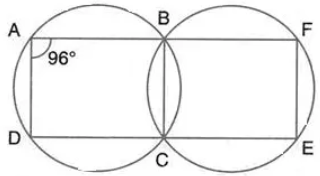
Que-19: (a) In the following figure,
(i) if ∠BAD = 96°, find BCD and
(ii) Prove that AD is parallel to FE.
(b) ABCD is a parallelogram. A circle through vertices A and B meets side BC at point P and side AD at point Q. Show that quadrilateral PCDQ is cyclic.
Sol: (a)
(i) ABCD is a cyclic quadrilateral
∴ ∠BAD + ∠BCD = 180°
(Pair of opposite angles in a cyclic quadrilateral are supplementary)
⇒ ∠BCD = 180° – 96° = 84°
∴ ∠BCE = 180° – 84° = 96°
Similarly, BCEF is a cyclic quadrilateral
∴ ∠BCE + ∠BFE = 180°
(Pair of opposite angles in a cyclic quadrilateral are supplementary)
∴ ∠BFE = 180° – 96° = 84°
(ii) Now, ∠BAD + ∠BFE
= 96° + 84°
= 180°
But these two are interior angles on the same side of a pair of lines AD and FE
∴ AD || FE
(b) ABCD is a parallelogram. A circle whose centre O passes through A, B is so drawn that it intersect AD at P and BC at Q. To prove points P, Q, C and D are con-cyclic.
Join PQ
∠1 = ∠A …[Exterior angle property of cyclic quadrilateral]
But ∠A = ∠C …[Opposite angles of a parallelogram]
∴ ∠1 = ∠C …(i)
But ∠C + ∠D = 180° …[Sum of cointerior angles on same side is 180°]
⇒ ∠1 + ∠D = 180° …[From equation (i)]
Thus, the quadrilateral QCDP is cyclic.
So, the points P, Q, C and D are con-cyclic.
Hence proved.
Que-20: Prove that:
(i) the parallelogram, inscribed in a circle, is a rectangle.
(ii) the rhombus, inscribed in a circle, is a square.
Sol: (i) Let ABCD be a parallelogram inscribed in a circle.
Now, ∠BAD + ∠BCD
(Opposite angles of a parallelogram are equal.)
And ∠BAD + ∠BCD = 180°
(A pair of opposite angles in a cyclic quadrilateral are supplementary.)
∠BAD + ∠BCD = 180°/2 = 90°
The other two angles are 90°, and the opposite pair of sides are equal.
∴ ABCD is a rectangle.
(ii) Let ABCD be a rhombus, inscribed in a circle
Now, ∠BAD + ∠BCD
(Opposite angles of a parallelogram are equal)
And ∠BAD + ∠BCD =180°
(Pair of opposite angles in a cyclic quadrilateral are supplementary)
∴ ∠BAD + ∠BCD = 180°/2 = 90°
The other two angles are 90°, and all the sides are equal.
∴ ABCD is a square.
Que-21: In the following figure, AB = AC. Prove that DECB is an isosceles trapezium.
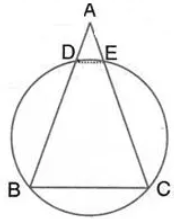
Sol: Here, AB = AC
⇒ ∠B = ∠C
∴ DECB is a cyclic quadrilateral
(In a triangle, angles opposite to equal sides are equal)
Also, ∠B + ∠DEC = 180° …(1)
(Pair of opposite angles in a cyclic quadrilateral are supplementary)
⇒ ∠C + ∠DEC = 180° …[From (1)]
But this is the sum of interior angles
On one side of a transversal.
∴ DE || BC
But ∠ADE = ∠AED = ∠C …[Corresponding angles]
Thus, ∠ADE = ∠AED
⇒ AD = AE
⇒ AB – AD = AC – AE …(∴ AB = AC)
⇒ BD = CE
Thus, we have, DE || BC and BD = CE
Hence, DECB is an isosceles trapezium
Que-22: Two circles intersect at P and Q. Through P diameters PA and PB of the two circles are drawn. Show that the points A, Q and B are collinear.
Sol: Let O and O’ be the centres of two intersecting circle, where
Points of intersection are P and Q and PA and PB are their diameter respectively.
Join PQ, AQ and QB.
∴ ∠AQP = 90° and ∠BQP = 90°
(Angle in a semicircle is a right angle)
Adding both these angles,
∠AQP + ∠BQP = 180°
∠AQB = 180°
Hence, the points A, Q and B are collinear.
Que-23: The figure given below, shows a circle with centre O. Given: ∠ AOC = a and ∠ ABC = b.
(i) Find the relationship between a and b
(ii) Find the measure of angle OAB, if OABC is a parallelogram
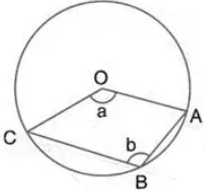
Sol: (i) ∠ABC = 1/2 Reflex (∠COA)
(Angle at the centre is double the angle at the circumference subtended by the same chord)
⇒𝑏 = 1/2 (360−𝑎)
⇒ a + 2b = 360°
(ii) Since OABC is a parallelogram, so opposite angles are equal.
2b + b = 360°
3b = 360°
b = 120°
∴ 120° + 120° + x + x = 360°
2x = 360° – 240°
2x = 120°
𝑥 =120°/2
x = 60°
⇒ ∠OAB = 60°
Que-24: Two chords AB and CD intersect at P inside the circle. Prove that the sum of the angles subtended by the arcs AC and BD as the centre O is equal to twice the angle APC.
Sol:
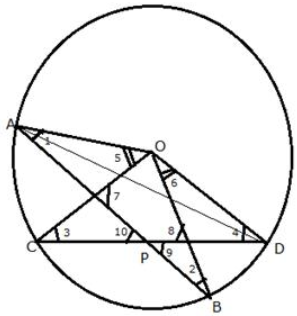
Two chords AB and CD intersect each other at P inside the circle. OA, OB, OC and OD are joined.
Join AD.
Arc AC subtends ∠AOC at the centre and ∠ADC at the remaining part of the circle.
∠AOC = 2∠ADC …(1)
Similarly,
∠BOD = 2∠BAD …(2)
Adding (1) and (2),
∠AOC + ∠BOD = 2∠ADC + 2∠BAD
= 2(∠ADC + ∠BAD) …(3)
But ΔPAD,
Ext. ∠APC = ∠PAD + ∠ADC
= ∠BAD + ∠ADC …(4)
From (3) and (4),
∠AOC + ∠BOD = 2∠APC
Que-25: In the figure given RS is a diameter of the circle. NM is parallel to RS and ∠MRS = 29°
Calculate:
(i) ∠RNM;
(ii) ∠NRM.
Sol: (i) Join RN and MS.
∴ ∠RMS = 90°
(Angle in a semicircle is a right angle)
∴ ∠RSM = 90° – 29° = 61°
(By angle sum property of triangle RMS)
∴ ∠RNM = 180° ∠RSM = 180° – 61° = 119°
(Pair of opposite angles in a cyclic quadrilateral are supplementary)
(ii) Also, RS || NM
∴ ∠NMR = ∠MRS = 29° …(Alternate angles)
∴ ∠NMS = 90° + 29° = 119°
Also, ∠NRS + ∠MS = 180°
(Pair of opposite angles in a cyclic quadrilateral are supplementary)
⇒ ∠NMR + 29° + 119° = 180°
⇒ ∠NRM = 180° – 148°
∴ ∠NRM = 32°
Que-26: In the figure given alongside, AB || CD and O is the centre of the circle. If ∠ ADC = 25°; find the angle AEB. Give reasons in support of your answer.
Sol: Join AC and BD
∴ ∠CAD = 90° and ∠CBD = 90°
(Angle in a semicircle is a right angle)
Also, AB || CD
∴ ∠BAD = ∠ADC = 25° …(Alternate angles)
∠BAC = ∠BAD + ∠CAD
= 25° + 90°
= 115°
∴ ∠ADB = 180° – 25° – ∠BAC
= 180° – 25° – 115°
= 40°
(Pair of opposite angles in a cyclic quadrilateral are supplementary)
Also, ∠AEB = ∠ADB = 40°
(Angle subtended by the same chord on the circle are equal)
Que-27: Two circles intersect at P and Q. Through P, a straight line APB is drawn to meet the circles in A and B. Through Q, a straight line is drawn to meet the circles at Cand D. Prove that AC is parallel to BD.
Sol: Join AC, PQ and BD
ACQP is a cyclic quadrilateral
∴ ∠CAP + ∠PQC = 180° …(i)
(Pair of opposite in a cyclic quadrilateral are supplementary)
PQDB is a cyclic quadrilateral
∴ ∠PQD + ∠DBP = 180° …(ii)
(Pair of opposite angles in a cyclic quadrilateral are supplementary)
Again, ∠PQC + ∠PQD = 180° …(iii)
(CQD is a straight line)
Using (i), (ii) and (iii)
∴ ∠CAP + ∠DBP = 180°
Or ∴ ∠CAB + ∠DBA = 180°
We know, if a transversal intersects two lines such that a pair of interior angles on the same side of the transversal is supplementary, then the two lines are parallel
∴ AC || BD
Que-28: ABCD is a cyclic quadrilateral in which AB and DC on being produced, meet at P such that PA = PD. Prove that AD is parallel to BC.
Sol:
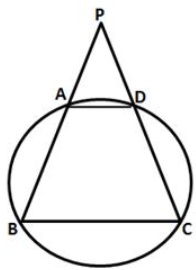
Let ABCD be the given cyclic quadrilateral
Also, PA = PD …(Given)
∴ ∠PAD = ∠PDA …(1)
∴ ∠BAD = 180° – ∠PAD
And ∠CDA = 180° – PDA
= 180° – ∠PAD …(From (1))
We know that the opposite angles of a cyclic quadrilateral are supplementary
∴ ∠ABC = 180° – ∠CDA
= 180° – (180° – ∠PAD)
= ∠PAD
And ∠DCB = 180° – ∠BAD
= 180° – (180° – ∠PAD)
= ∠PAD
∴ ∠ABC = ∠DCB = ∠PAD = ∠PAD
That means AD || BC
Que-29: AB is a diameter of the circle APBR as shown in the figure. APQ and RBQ are straight lines. Find:
(i) ∠PRB
(ii) ∠PBR
(iii) ∠BPR.
Sol: (i) ∠PRB = ∠PAB = 35°
(Angles subtended by the same chord on the circle are equal)
(ii) ∠BPA = 90°
(Angle in a semicircle is a right angle)
∴ ∠BPQ = 90°
∴ ∠PBR = ∠BQP + ∠BPQ
= 25° + 90°
= 115°
(Exterior angle of a ∆ is equal to the sum of pair of interior opposite angles)
(iii) ∠ABP = 90° – ∠BAP
= 90° – 35°
= 55°
∴ ∠ABR = ∠PBR – ∠ABP
= 115° – 55°
= 60°
∴ ∠APR = ∠ABR = 60°
(Angles subtended by the same chord on the circle are equal)
∴ ∠BPR = 90° – ∠APR
= 90° – 60°
= 30°
Que-30: In the given figure, SP is the bisector of angle RPT and PQRS is a cyclic quadrilateral. Prove that: SQ = SR.
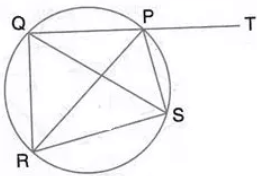
Sol: PQRS is a cyclic quadrilateral
∠QRS + ∠QPS = 180° …(i)
(Pair of opposite angles in a cyclic quadrilateral are supplementary)
Also, ∠QPS + ∠SPT = 180° …(ii)
(Straight line QPT)
From (i) and (ii)
∠QRS = ∠SPT …(iii)
Also, ∠RQS = ∠RPS …(iv)
(Angle subtended by the same chord on the circle are equal)
And ∠RPS = ∠SPT
(PS bisects ∠RPT) …(v)
From (iii), (iv) and (v)
∠QRS = ∠RQS
⇒ SQ = SR
Que-31: In the figure, O is the centre of the circle, ∠AOE = 150°, DAO = 51°. Calculate the sizes of the angles CEB and OCE.
Sol: ∠ADE = 1/2 Reflex (∠AOE)
= 1/2 (360°−150°)
= 105°
(Angle at the center is double the angle at the circumference subtended by the same chord)
∠DAB + ∠BED = 180°
(Pair of opposite angles in a cyclic quadrilateral are supplementary)
⇒ ∠BED = 180° – 51° = 129°
∴ ∠CEB = 180° – ∠BED (Straight line)
= 180° – 129°
= 51°
Also, by angle sum property of ∆ADC,
∠OCE = 180° – 51° – 105° = 24°
Que-32: In the figure, P and Q are the centres of two circles intersecting at B and C. ACD is a straight line. Calculate the numerical value of x.
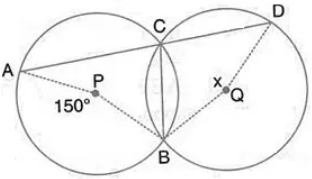
Sol: ∠𝐴𝐶𝐵 = 1/2 ∠𝐴𝑃𝐵 = (1/2) × 150° = 75°
(Angle at the centre is double the angle at the circumference subtended by the same chord)
∠ACB + ∠BCD = 180°
(Straight line)
⇒ ∠BCD = 180° – 75° = 105°
Also, ∠BCD = 12 reflex ∠BQD = 1/2 (360°−𝑥)
(Angle at the center is double the angle at the circumference subtended by the same chord)
⇒105° = 180° − (𝑥/2)
∴ x = 2(180° – 105°)
= 2 × 75°
= 150°
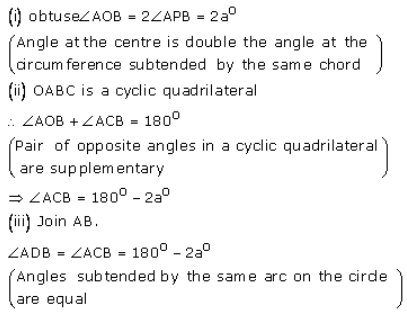
Que-33: The figure shows two circles which intersect at A and B. The centre of the smaller circle is O and lies on the circumference of the larger circle. Given that ∠APB = a°. Calculate, in terms of a°, the value of:
(i) obtuse ∠AOB
(ii) ∠ACB
(iii) ∠ADB.
Give reasons for your answers clearly.
Sol:
Que-34: In the given figure, O is the centre of the circle and ∠ ABC = 55°. Calculate the values of x and y.
Sol: ∠AOC = 2∠ABC = 2 × 55°
(Angle at the centre is double the angle at the circumference subtended by the same chord)
∴ x = 110°
ABCD is cyclic quadrilateral
∴ ∠ADC + ∠ABC = 180°
(Pair of opposite angles in a cyclic quadrilateral are supplementary
⇒ y = 180° – 55° = 125°
Que-35: In the given figure, A is the centre of the circle, ABCD is a parallelogram and CDE is a straight line. Prove that ∠BCD = 2∠ABE
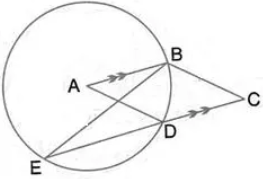
Sol: ∠BAD = 2∠BED
(Angle at the centre is double the angle at the circumference subtended by the same chord)
And ∠BED = ∠ABE (Alternate angles)
∴ ∠BAD = 2∠ABE …(i)
ABCD is a parallelogram
∴ ∠BAD = ∠BCD …(ii)
(Opposite angles in a parallelogram are equal)
From (i) and (ii),
∠BCD = 2∠ABE
Que-36: ABCD is a cyclic quadrilateral in which AB is parallel to DC and AB is a diameter of the circle. Given ∠BED = 65°; calculate:
(i) ∠ DAB,
(ii) ∠BDC
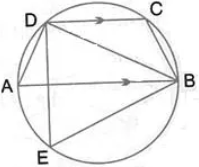
Sol: (i) Angles BED and DAB are angles subtended by the same chord DB in the same circle.
∴ ∠DAB = ∠BED = 65°
(ii) Find ∠BDC
Since AB is a diameter, angle ADB is an angle in a semicircle:
∠ADB = 90°.
In triangle ABD:
∠ABD = 180° − (∠ADB + ∠DAB)
∠ABD = 180° − (90° + 65°)
∠ABD = 25°.
AB ∥ DC,
∠ABD and ∠BDC are corresponding angles.
∴∠BDC = ∠ABD = 25°.
Que-37: In the given figure, AB is a diameter of the circle. Chord ED is parallel to AB and ∠ EAB = 63°; calculate:
(i) ∠EBA,
(ii) BCD.
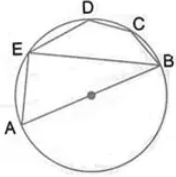
Sol: AB || ED
Therefore ∠DEB = EBA = 27° (Alternate angles)
Therefore BCDE is a cyclic quadrilateral
Therefore ∠DEB + ∠BCD = 180°
[Pair of opposite angles in a cyclic quadrilateral are supplementary]
Therefore ∠BCD = 180° – 27° = 153°
Que-38: In the given figure, AB is a diameter of the circle with centre O. DO is parallel to CB and ∠DCB = 120°; calculate:
(i) ∠ DAB,
(ii) ∠ DBA,
(iii) ∠ DBC,
(iv) ∠ ADC.
Also, show that the ∆AOD is an equilateral triangle.
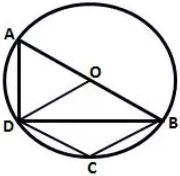
Sol: (i) ABCD is a cyclic quadrilateral
∴ ∠DCB + ∠DAB = 180°
(Pair of opposite angles in a cyclic quadrilateral are supplementary)
⇒ ∠DAB = 180° – 120° = 60°
(ii) ∠ADB = 90°
(Angle in a semicircle is a right angle)
∴ ∠DBA = 90° – ∠DAB
= 90° – 60°
= 30°
(iii) OD = OB
∴ ∠ODB = ∠OBD
Or ∠ABD = 30°
Also, AB || ED
∴ ∠DBC = ∠ODB = 30° (Alternate angles)
(iv) ∠ABD + ∠DBC = 30° + 30° = 60°
⇒ ∠ABC = 60°
In cyclic quadrilateral ABCD,
∠ADC + ∠ABC = 180°
(Pair of opposite angles in a cyclic quadrilateral are supplementary)
⇒ ∠ADC = 180° – 60° = 120°
In ∆AOD, OA = OD (Radii of the same circle)
∠AOD = ∠DAO Or ∠DAB = 60° [Proved in (i)]
⇒ ∠AOD = 60°
∠ADO = ∠AOD =∠DAO = 60°
∴ ∆AOD is an equilateral triangle
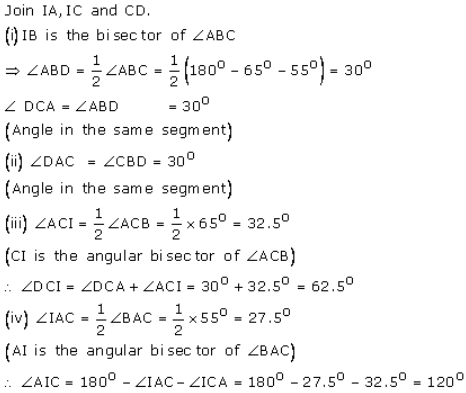
Que-39: In the given figure, I is the incentre of the ∆ ABC. Bl when produced meets the circumcirle of ∆ ABC at D. Given ∠BAC = 55° and ∠ ACB = 65°, calculate:
(i) ∠DCA,
(ii) ∠ DAC,
(iii) ∠DCI,
(iv) ∠AIC.
Sol:
Que-40: A triangle ABC is inscribed in a circle. The bisectors of angles BAC, ABC and ACB meet the circumcircle of the triangle at points P, Q and R respectively. Prove that:
(i) ∠ABC = 2 ∠APQ
(ii) ∠ACB = 2 ∠APR
(iii) ∠QPR = 90° – 1/2 BAC
Sol: Join PQ and PR
(i) BQ is the bisector of ∠ABC
⇒∠𝐴𝐵𝑄 = 1/2 ∠𝐴𝐵𝐶
Also, ∠APQ = ∠ABQ
(Angle in the same segment)
∴ ∠ABC = 2 ∠APQ
(ii) CR is the bisector of ∠ACB
⇒∠𝐴𝐶𝑅 = 1/2 ∠𝐴𝐶𝐵
Also, ∠ACR = ∠APR
(Angle in the same segment)
∴ ∠ACB = 2∠APR
(iii) Adding (i) and (ii)
We get
∠ABC + ∠ACB = 2(∠APR + ∠APQ) = 2∠QPR
⇒ 180° – ∠BAC = 2∠QPR
⇒∠𝑄𝑃𝑅 = 90° − 1/2 ∠𝐵𝐴𝐶
Que-41: Calculate the angles x, y and z if : x/3 = y/4 = z/5.
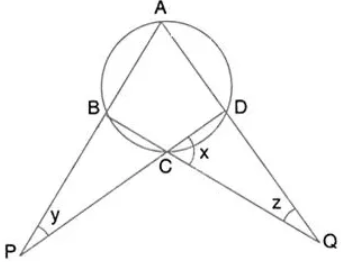
Sol: Let x = 3k, y = 4k and z = 5k
∠ADC = x + z = 8k and ∠ABC = x + y = 7k
(Exterior angle of a ∆ is equal to the sum of pair of interior opposite angles)
Also, ∠ABC + ∠ADC = 180°
(Pair of opposite angles in a cyclic quadrilateral are supplementary)
⇒ 8k + 7k = 180°
⇒ 15k = 180°
∴ 𝑘 = 180°/15 = 12°
∴ x = 3 × 12° = 36°
y = 4 × 12° = 48°
z = 5 × 12° = 60°
Que-42: In the given figure, AB = AC = CD and ∠ADC = 38°. Calculate:
(i) Angle ABC
(ii) Angle BEC.
Sol: (i) AC = CD
∴ ∠CAD = ∠CDA = 38°
∴∠ACD = 180° – 238° = 104°
∴∠ACB = 180° – 104° = 76° …(Straight line)
Also, AB = AC
∴ ∠ABC = ACB = 76°
(ii) By angle sum property,
∠BAC = 180° – 2 × 76°
∠BAC = 28°
∴ ∠BEC = ∠BAC = 28° …(Angles in the same chord)
Que-43: In the given figure, AC is the diameter of circle, centre O. Chord BD is perpendicular to AC. Write down the angles p, and r in terms of x.
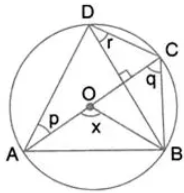
Sol: Arc subtends ∠AOB at the centre and ∠ACB at the remaining part of the circle.
∴ ∠AOB = 2∠ACB
⇒ x = 2q
⇒𝑞 = 𝑥/2
But ∠ADB and ∠ACB are in the same segment
∴ ∠ADB = ∠ACB = q
Now in ΔAED.
p + q + 90° = 180° …(Sum of angles of a Δ)
p + q = 90°
p = 90° – q
𝑝 =90° − (𝑥/2)
∵ Arc BC subtends ∠BOC at the centre and ∠ADC at the remaining part of the circle
∴ ∠BOC = 2∠BDC = 2r
∴ 𝑟 = (1/2) ∠𝐵𝑂𝐶 = (1/2) (180°−𝑥)
∵ (∠AOB + ∠BOC = 180°)
∴ 𝑟 = 90° − (1/2)𝑥
= 90° − (𝑥/2)
Que-44: In the given figure, AC is the diameter of circle, centre O. CD and BE are parallel. Angle AOB = 80° and angle ACE = 10°. Calculate:
(i) Angle BEC;
(ii) Angle BCD;
(iii) Angle CED.
Sol: (i) ∠BOC = 180° – 80° = 100° (Straight line)
And ∠BOC = 2∠BEC
(Angle at the centre is double the angle at the circumference subtended by the same chord)
⇒∠𝐵𝐸𝐶 = 100°/2 = 50°
(ii) DC || EB
∴ DCE = ∠BEC = 50° (Alternate angles)
∴ ∠AOB = 80°
⇒∠𝐴𝐶𝐵 = 1/2 ∠𝐴𝑂𝐵 = 40°
Angle at the center is double the angle at the circumference subtended by the same chord)
We have,
∠BCD = ∠ACB + ∠ACE + ∠DCE
= 40° + 10° + 50°
= 100°
(iii) ∠BED = 180° – ∠BCD
= 180° – 100°
= 80°
(Pair of opposite angles in a cyclic quadrilateral are supplementary)
⇒ ∠CED + 50° = 80°
⇒ ∠CED = 30°
Que-45: In the given figure, AE is the diameter of circle. Write down the numerical value of ∠ABC + ∠CDE. Give reasons for your answer.
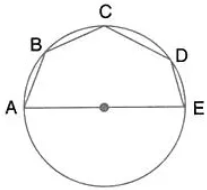
Sol: Join OA, OB, OC, OD.
In ΔOAB,
OA = OB …(Radii of the same circle)
∠1 = ∠2
Similarly we can prove that
∠3 = ∠4,
∠5 = ∠6,
∠7 = ∠8
In ΔOAB,
∠1 + ∠2 + ∠a = 180° …(Angles of a triangle)
Similarly ∠3 + ∠4 + ∠b = 180°
∠5 + ∠6 + ∠c = 180°
∠7 + ∠8 + ∠d = 180°
Adding we get
∠1 + ∠2 + ∠3 + ∠4 + ∠5 + ∠6 + ∠7 + ∠8 + ∠a + ∠b + ∠c + ∠d = 4 × 180° = 720°
⇒ ∠2 + ∠2 + ∠3 + ∠3 + ∠6 + ∠6 + ∠ 7 + ∠7 + ∠a + ∠b + ∠c + ∠d = 720°
⇒ 2∠2 + 2∠3 + 2∠6 + 2∠7 + ∠a + ∠b + ∠c + ∠d = 720°
⇒ 2[∠2 + ∠3] + 2[∠6 + ∠7| + 180° = 720° …(∠a + ∠b + ∠c + ∠d = 180°)
⇒ 2∠ABC + 2∠CDE = 720° – 180° = 540°
⇒ 2(∠ABC + ∠CDE) = 540°
⇒ ∠ABC + ∠CDE = 270°
Que-46: In the given figure, AOC is a diameter and AC is parallel to ED. If ∠CBE = 64°, calculate ∠DEC.
Sol: Join AB,
∠ABC = 90°
(Angle in a semi circle)
∴ ∠ABE = 90° – 64° = 26°
Now, ∠ABE = ∠ACE = 26°
(Angle in the same segment)
Also, AC || ED
∴ ∠DEC = ∠ACE = 26°
(Alternate angles)
Que-47: Use the given figure to find
(i) ∠BAD
(ii) ∠DQB.
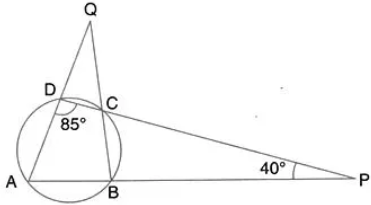
Sol: (i) By angle sum property of ∆ADP,
∠BAD = 180° – 85° – 40° = 55°
(ii) ∠ABC = 180° – ∠ADC = 180° – 85° = 95°
(Pair of opposite angles in a cyclic quadrilateral are supplementary)
By angle sum property,
∠AQB = 180° – 95° – 55°
⇒ ∠DQB = 30°
Que-48: In the given figure, AOB is a diameter and DC is parallel to AB. If ∠ CAB = x°; find (in terms of x) the values of:
(i) ∠COB
(ii) ∠DOC
(iii) ∠DAC
(iv) ∠ADC.
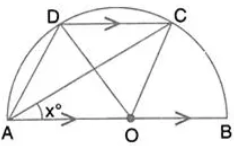
Sol: (i) ∠COB = 2∠CAB = 2x
(Angle ate the centre is double the angler at the circumference subtended by the same order)
(ii) ∠OCD = ∠COB = 2x (Alternate angles)
In ΔOCD, OC = OD
∴ ∠ODC = ∠OCD = 2x
By angle sum property of ∆OCD,
∠DOC = 180° – 2x – 2x = 180° – 4x
(iii) ∠𝐷𝐴𝐶 = 1/2 ∠𝐷𝑂𝐶
= 1/2 (180°−4𝑥)
= 90° – 2x
(Angle at the centre is double the angle at the circumference subtended by the same chord)
(iv) DC || AO
∴ ∠ACD = ∠OAC = x (Alternate angles)
By angle sum property,
∠ADC = 180° – ∠DAC – ∠ACD
= 180° – (90° – 2x) – x
= 90° + x
Que-49: In the given figure, AB is the diameter of a circle with centre O. ∠BCD = 130°. Find:
(i) ∠DAB
(ii) ∠DBA
Sol: (i) ABCD is a cyclic quadrilateral
m∠DAB = 180° − ∠DCB
= 180° – 130°
= 50°
(ii) In ∆ADB,
m∠DAB + m∠ADB + m∠DBA = 180°
⇒ 50° + 90° + m∠DBA = 180°
⇒ m∠DBA = 40°
Que-50: In the given figure, PQ is the diameter of the circle whose centre is O. Given ∠ROS = 42°; calculate ∠RTS.
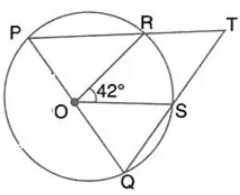
Sol: Join PS.
∠PSQ = 90°
(Angle in a semicircle)
Also, ∠𝑆𝑃𝑅 = 1/2 ∠𝑅𝑂𝑆
(Angle ate the centre is double the angle at the circumference subtended by the same chord)
⇒ 𝑆𝑃𝑇 = 1/2 × 42° = 21°
∴ In right triangle PST,
∠PTS = 90° – ∠SPT
⇒ ∠RTS = 90° – 21° = 69°
Que-51: In the given figure, PQ is a diameter. Chord SR is parallel to PQ. Given that ∠PQR = 58°; calculate
(i) ∠RPQ
(ii) ∠STP.
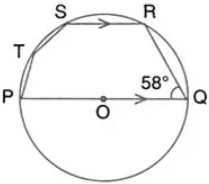
Sol: Join PR.
(i) ∠PRQ = 90°
(Angle in a semicircle)
∴ In right triangle PQR,
∠RPQ = 90° – ∠PQR
= 90° – 58°
= 32°
(ii) Also, SR || PQ
∠PRS = ∠RPQ = 32° (Alternate angles)
In cyclic quadrilateral PRST,
∠STP = 180° – ∠PRS
= 180° – 32°
= 148°
(Pair of opposite angles in a cyclic quadrilateral are supplementary)
Que-52: AOD = 60°; calculate the numerical values of:
AB is the diameter of the circle with centre O. OD is parallel to BC and ∠AOD = 60°; calculate the numerical values of:
(i) ∠ABD,
(ii) ∠DBC,
(iii) ∠ADC.
Sol: Join BD.
(i) ∠𝐴𝐵𝐷 = 1/2 ∠𝐴𝑂𝐷 = 1/2 × 60° = 30°
(The angle at the first is double the angle at the circumference subtended by the same chord.)
(ii) ∠BDA = 90°
(Angle in a semicircle)
Also, ΔOAD is equilateral (∵ ∠OAD = 60°)
∴ ∠ODB = 90° – ∠ODA
= 90° – 60°
= 30°
Also, OD || BC
∴ ∠DBC = ∠ODB = 30° (Alternate angles)
(iii) ∠ABC = ∠ABD + ∠DBC
= 30° + 30°
= 60°
In cyclic quadrilateral ABCD,
∠ADC = 180° – ∠ABC
= 180° – 60°
= 120°
(A pair of opposite angles in a cyclic quadrilateral are supplementary.)
Que-53: In the given figure, the centre of the small circle lies on the circumference of the bigger circle. If ∠APB = 75° and ∠BCD = 40″; find:
(i) ∠AOB,
(ii) ∠ACB,
(iii) ∠ABD,
(iv) ∠ADB.
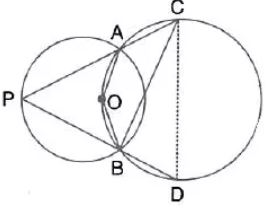
Sol: Join AB and AD
(i) ∠AOB = 2∠APB
= 2 × 75°
= 150°
(Angle at the centre is double the angle at the circumference subtended by the same chord).
(ii) In cyclic quadrilateral AOBC,
∠ACB = 180° – ∠AOB
= 180° – 150°
= 30°
(Pair of opposite angles in a cyclic quadrilateral are supplementary)
(iii) In cyclic quadrilateral ABDC
∠ABD = 180° – ∠ACD
= 180° – (40° + 30°)
= 110°
(Pair of opposite angles in a cyclic quadrilateral are supplementary
(iv) In cyclic quadrilateral AOBD,
∠ADB = 180° – ∠AOB
= 180° – 150°
= 30°
(Pair of opposite angles in a cyclic quadrilateral are supplementary
Que-54: In the given figure, ∠BAD = 65°, ∠ABD = 70° and ∠BDC = 45°; find:
(i) ∠BCD,
(ii) ∠ACB.
Hence, show that AC is a diameter.
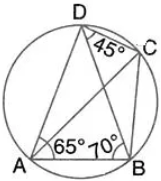
Sol: (i) In cyclic quadrilateral ABCD,
∠BCD = 180° – ∠BAD
= 180° – 65°
= 115°
(Pair of opposite angles in a cyclic quadrilateral are supplementary)
(ii) By angle sum property of ∆ABD,
∠ADB = 180° – 65° – 70° = 45°
Again, ∠ACB = ∠ADB = 45°
(Angle in the same segment)
∴ ∠ADC = ∠ADB + ∠BDC
= 45° + 45°
= 90°
Hence, AC is a semicircle.
(Since angle in a semicircle is a right angle)
Que-55: In a cyclic quadrilateral ABCD, ∠A : ∠C = 3 : 1 and ∠B : ∠D = 1 : 5; find each angle of the quadrilateral.
Sol: Let ∠A and ∠C be 3x and x respectively
In cyclic quadrilateral ABCD,
∠A + ∠C = 180°
(Pairs of opposite angles in a cyclic quadrilateral are supplementary)
⇒ 3x + x = 180°
⇒𝑥 =180°/4 = 45°
∴ ∠A = 135° and ∠C = 45°
Let the measure of ∠B and ∠D be y and 5y respectively
In cyclic quadrilateral ABCD,
∠B + ∠D = 180°
(Pair of opposite angles in a cyclic quadrilateral are supplementary are supplementary)
⇒ y + 5y = 180°
⇒𝑦 =180°/6 = 30°
∴ ∠B = 30° and ∠D = 150°
Que-56: The given figure shows a circle with centre O and ∠ABP = 42°. Calculate the measure of
(i) ∠PQB
(ii) ∠QPB + ∠PBQ
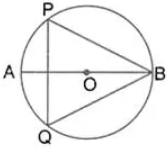
Sol: In the figure
∠ABP = 42°.
Join PO, QO
∵ Arc PA subtends ∠POA at the centre and
∵ ∠PBA at the remaining part.
∴ ∠POA = 2∠PBA = 2 × 42° = 84°
But ∠AOP + ∠BOP = 180° …(Linear pair)
⇒ ∠POA + ∠POB = 180°
⇒ 84° + ∠POB = 180°
⇒ POB = 180° – 84° = 96°
Similarly, arc BP subtrends ∠BOP on the centre and ∠PQB at the remaining part of the circle
∴ ∠𝑃𝑄𝐵 = 1/2
∠𝑃𝑂𝐵 = 1/2 × 96° = 48°
But in ΔABQ,
∠QPB + ∠PBQ + ∠PQB = 180° …(Angles of a triangle)
∠QPB + ∠PBQ + 48° = 180°
⇒ ∠QPB + ∠PBQ = 180°
⇒ ∠QPB + ∠PBQ = 180° – 48° = 132°
Hence i. PQB = 48° and ii. ∠QPB + ∠PBQ = 132°
Que-57: the given figure, M is the centre of the circle. Chords AB and CD are perpendicular to each other. If ∠ MAD =x and ∠BAC = y.
(i) express ∠AMD in terms of x.
(ii) express ∠ABD in terms of y.
(iii) prove that : x = y
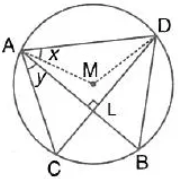
Sol: In the figure, M is the centre of the circle.
Chords AB and CD are perpendicular to each other at L.
∠MAD = x and ∠BAC = y
(i) In ∆AMD,
MA = MD
∴ ∠MAD = ∠MDA = x
But in ∆AMD,
∠MAD + ∠MDA + ∠AMD = 180°
⇒ x + x + ∠AMD = 180°
⇒ 2x + ∠AMD = 180°
⇒ ∠AMD = 180° – 2x
(ii) ∴ Arc AD ∠AMD at the centre and ∠ABD at the remaining
(Angle in the same segment)
(Angle at the centre is double the angle at the circumference subtended by the same chord)
⇒ ∠AMD = 2∠ABD
⇒∠𝐴𝐵𝐷 = 1/2 (180°−2𝑥)
⇒ ∠ABD = 90° – x
AB ⊥ CD, ∠ALC = 90°
In ∆ALC,
∴ ∠LAC + ∠LCA = 90°
⇒ ∠BAC + ∠DAC = 90°
⇒ y + ∠DAC = 90°
∴ ∠DAC = 90° – y
We have, ∠DAC = ∠ABD [Angles in the same segment]
∴ ∠ABD = 90° – y
(iii) We have, ∠ABD = 90° – y and ∠ABD = 90° – x [Proved]
∴ 90° – x = 90° – y
⇒ x = y
–: Circles Class 10 Concise Exe-17A ICSE Maths Selina Solutions :–
Return to :- Selina Concise Solutions for ICSE Class-10 Maths
Please Share with Your Friends
Thanks




2 thoughts on “Circles Class 10 Concise Exe-17A ICSE Maths Selina Solutions”
U r doing a great work for giving a help to class X student.
thanks