Quadratic Equations ICSE Class 10 Maths Notes OP Malhotra 2026-27. We Provide Step by Step Answer of all the exercises with Chapter Test of S Chand OP Malhotra Maths . Visit official Website CISCE for detail information about ICSE Board Class-10.
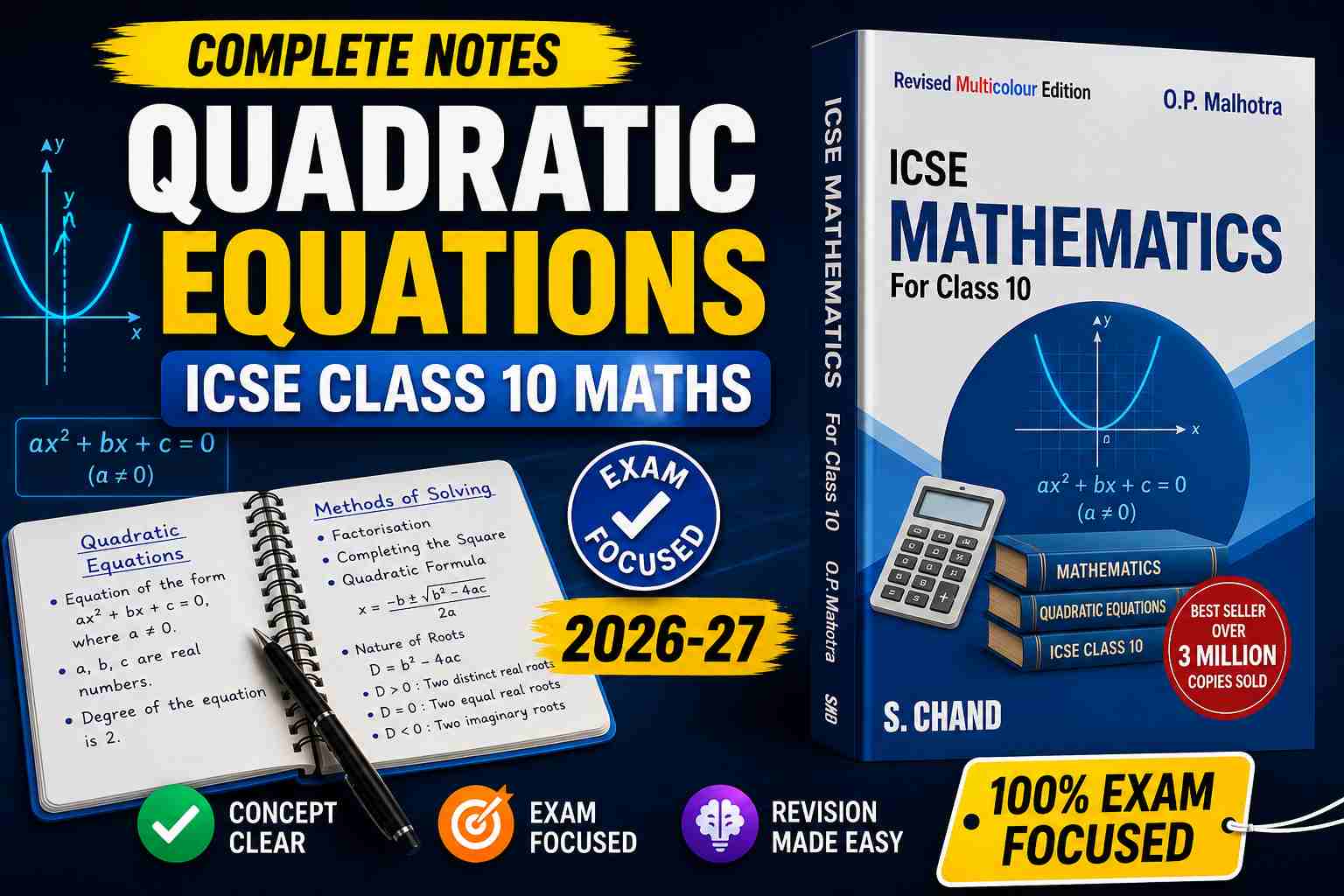
Quadratic Equations ICSE Class 10 Maths Notes OP Malhotra 2026-27
What is a quadratic equation ?
A quadratic equation in one variable is an equation in which the highest power of the variable is two.
The standard form of a quadratic equation is ax²+bx+c = 0 ; a,b,c∈R , a≠0
Thus, the equation 3x²+2x-1 = 0 is in standard form, here a=3 , b=3 , c=-1
The value of x satisfying the equation are called the zeroes or roots of the equation.
Thus a real number α is said to be root of the equation if aα²+bα+c=0
How to solve quadratic equation by factorising ?
Example,
Solve the equation (9/2)x = 5 + x2 by factorization:
Step 1: Clear all fractions and brackets, if necessary
9x = 2(5 + x2)
Step 2: Transpose all the terms to the left hand side to get an equation in the form
ax2 + bx + c = 0
9x = 2x2 + 10
⇒ 2x2 − 9x + 10 = 0
Step 3: Factorise the expression on the left hand side.
2x2 − 9x + 10 = 0
⇒ 2x2 − 5x − 4x + 10 = 0
⇒ x(2x − 5) − 2(2x − 5) = 0
⇒ (x − 2)(2x − 5) = 0
Step 4: Put each factor equal to zero and solve
(x − 2)(2x − 5) = 0
⇒ x − 2 = 0 2x − 5 = 0
⇒ x = 2; 2x = 5
⇒ x = 2; x = 5/2
Thus, we have, x = 2 or x = 5/2
Practice Questions on Factorisation :- Exercise-5(a)
Equations Reducible to Quadratic Equations
Many equations that are not in the standard form ax²+bx+c = 0 can be reduced to quadratic equation by using suitable algebraic transformation. Here you will learn reduce the non standard form to standard form of quadratic equation with some examples.
Method
- Make a suitable substitution.
- Reduce the equation to a quadratic form.
- Solve for the new variable.
- Substitute back to get the value of x.
Example 1 :- Solve: x⁴ − 5x² + 4 = 0
Sol: Let x² = t
Then t² − 5t + 4 = 0
(t − 1)(t − 4) = 0
t = 1, 4
Substituting back:
x² = 1 ⇒ x = ±1
x² = 4 ⇒ x = ±2
Ans :- x = ±1, ±2
Example 2 :- Solve: x² + 1/x² = 14
Sol: Using the identity
(x + 1/x)² = x² + 1/x² + 2
(x + 1/x)² = 14 + 2 = 16
Let x + 1/x = t
Then
t² = 16
t = ±4
When t = 4
x + 1/x = 4
Multiplying by x,
x² − 4x + 1 = 0
x = 2 ± √3
When t = -4
x + 1/x = -4
Multiplying by x,
x² + 4x + 1 = 0
x = -2 ± √3
Ans :- x = 2 + √3, 2 − √3, -2 + √3, -2 − √3
Example 3 :- Solve: x² + 1/x² = 7
Sol: Using the identity
(x − 1/x)² = x² + 1/x² − 2
(x − 1/x)² = 7 − 2 = 5
Let x − 1/x = t
Then
t² = 5
t = ±√5
When t = √5
x − 1/x = √5
Multiplying by x,
x² − √5x − 1 = 0
x = (√5 + 3)/2, (√5 − 3)/2
When t = -√5
x − 1/x = -√5
Multiplying by x,
x² + √5x − 1 = 0
x = (-√5 + 3)/2, (-√5 − 3)/2
Ans :- x = (√5 + 3)/2,
(√5 − 3)/2,
(-√5 + 3)/2,
(-√5 − 3)/2
Example 4 :- Solve: 4x − 3 × 2x+2 + 32 = 0
Sol: Let 4x = (22)x = 22x
and 3 × 2x+2 = 3 × 4 × 2x = 12 × 2x (as 2x+2 = 2x.2²)
Therefore,
22x − 12 × 2x + 32 = 0
Substitute
2x = t
Then
t2 − 12t + 32 = 0
Solve the quadratic equation
t2 − 12t + 32 = 0
(t − 4)(t − 8) = 0
t = 4 or t = 8
Substitute back
t = 2x
Case 1: 2x = 4 = 22
x = 2
Case 2: 2x = 8 = 23
x = 3
Ans :- x = 2 or x = 3
Important Identities
(x + 1/x)² = x² + 1/x² + 2
(x − 1/x)² = x² + 1/x² − 2
Practice Questions on Equations reducible to quadratic :- Exercise-5(b)
Finding Roots of the Quadratic using Quadratic Formula
general quadratic equation – ax²+bx+c = 0
Quadratic Formula ⇒ x = {-b±√(b²-4ac)}/2a
where,
a is coefficient of x²
b is coefficient of x
c is constant
Practice Questions on Solving quadratic using quadratic formula :- Exercise-5(c)
Nature of the roots of a quadratic equation
The nature of the roots of a quadratic equation depends upon the value of discriminant b² − 4ac.
- If b² − 4ac > 0, the roots are real and unequal.
- If b² − 4ac = 0, the roots are real and equal.
- If b² − 4ac < 0, the roots are imaginary (not real).
If ax² + bx + c, a ≠ 0, can be reduced to the product of two linear factors, then the roots of the quadratic equation ax² + bx + c = 0 can be found by equating each factor to zero.
Practice Questions on Nature of Roots :- Exercise-5(d)
Word Problems involving Quadratic Equations
Steps to Solve Word Problems
- Read the question carefully.
- Let the unknown quantity be x.
- Form an equation according to the given conditions.
- Simplify it into the standard form: ax² + bx + c = 0.
- Solve the quadratic equation by factorization, completing the square, or quadratic formula.
- Verify the answer and reject any impossible value (e.g., negative age, negative length).
Common Types of Word Problems
1. Number Problems
- Let the number be x.
- Represent consecutive numbers as x + 1, x + 2, etc.
- Form an equation using the given condition.
2. Age Problems
- Present age = x
- Age after n years = x + n
- Age n years ago = x − n
3. Geometry Problems
- Length = x
- Breadth = x ± k
- Use formulas for area or perimeter to form a quadratic equation.
4. Speed, Distance and Time Problems
- Distance = Speed × Time
- Express speed or time in terms of x and form the equation.
5. Area and Dimension Problems
- Use area formulas of rectangles, squares, etc.
- Convert the given condition into a quadratic equation.
6. Product and Sum Conditions
- If two numbers differ by a known value, let them be x and x + k.
- Use the given sum/product relationship to form the equation.
Word Problems on Quadratic Equations :- Exercise-5(e)
In this chapter, we study all the topics on Quadratic Equations and do some practice questions also. Here we solve extra practice questions on this chapter for better understanding.
Here is the link for extra practice questions on Quadratic Equations :- Self Evaluation
— : End of Quadratic Equations ICSE Class 10 Maths Notes OP Malhotra 2026-27 :–
Return to :– OP Malhotra S Chand Solutions for ICSE Class-10 Maths
Thanks
Please Share with Your Friends