Descriptive Answer on Human Evolution Class 10 Concise ICSE Biology Selina Solutions Ch-14. In this article you will get the solutions of Descriptive Ans Questions with the help of figures. Visit official website CISCE for detail information about ICSE Board Class-10 Biology.
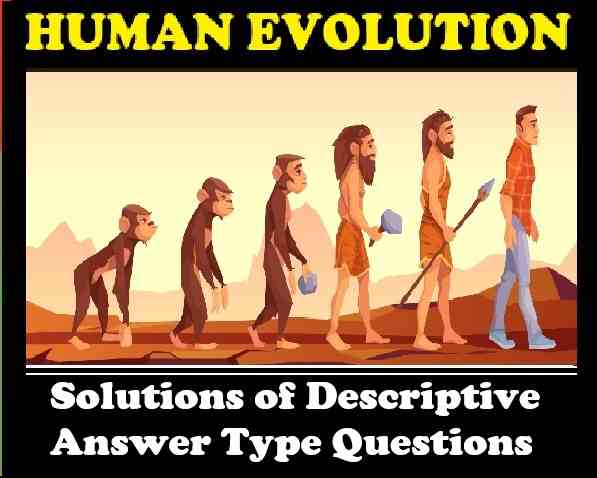
Descriptive Answer on Human Evolution Class 10 Concise ICSE Biology Selina Solutions Ch-14
| Board | ICSE |
| Subject | Biology |
| Class | 10 |
| Book | Selina Concise |
| Chapter-14 | Human Evolution |
| Topics | Solutions of Descriptive Ans Type Questions |
Descriptive Answer Type Questions on Human Evolution
Class 10 Concise ICSE Biology Selina Solutions Ch-14
Que-1: Define the following terms:
(a) Evolution
(b) Vestigial organs
(c) Speciation
(d) Bipedalism
(e) Natural selection
Ans:
(a) Evolution: Evolution is a gradual and ongoing process in which simple life forms have given rise to more complex organisms across millions of years.
(b) Vestigial organs: Vestigial organs refer to anatomical structures that once served a functional role in ancestral organisms, yet have diminished or lost that function in modern species as a result of evolutionary changes.
(c) Speciation: Origin of new species by gradual modification is called ‘speciation’.
(d) Bipedalism: Bipedalism is the act of moving in an upright posture on the hind limbs while the forelimbs remain free from touching the ground.
(e) Natural selection: Natural selection refers to the gradual increase or decrease of inherited traits within a population across generations, based on the advantage or disadvantage they provide for survival and reproduction in a specific environment.
Que-2: Distinguish between:
(a) Australopithecus and Cro-magnon (Chin)
(b) Australopithecus and Modern man (Body hair)
(c) Homo habilis and Homo sapiens sapiens (Posture)
Ans:
(a) Difference between Australopithecus and Cro-magnon (Chin):
| Australopithecus | Cro-magnon |
|---|---|
| Lack of chin | Well-developed chin |
(b) Difference between Australopithecus and Modern man (Body hair):
| Australopithecus | Modern man |
|---|---|
| Body covered with hair | Highly reduced body hair |
(c) Difference between Homo habilis and Homo sapiens (Posture):
| Homo habilis | Homo sapiens |
|---|---|
| Bent kneed posture | Fully erect posture |
Que-3: Differentiate between Lamarck’s Theory and Darwin’s Theory.
Ans: Main differences between the theories of Lamarck and Darwin:
| Lamarck’s Theory | Darwin’s Theory |
|---|---|
| This concept is known as the theory of inheritance of acquired characters. | This concept is known as the theory of natural selection. |
| The theory rests on the belief in the use and disuse of organs, proposing that parts that are used more or acquire changes are passed on to offspring. | This theory maintains that due to natural variations among individuals, only those best adapted to their environment survive the ongoing struggle for existence. |
| New species arise after extended periods and across numerous generations as they accumulate newly developed traits. | New species arise as beneficial variations accumulate within a population over an extended evolutionary period. |
–: End of Descriptive Answer on Human Evolution Class 10 Concise ICSE Biology Selina Solutions:–
Return to : Concise Biology for ICSE Class 10 Selina Solutions
Please share with your Friends if helpful
Thanks