Descriptive Answer on Sense Organs Class 10 Concise ICSE Biology Selina Solutions Ch-11. In this article you will get the solutions / answer of Descriptive Questions / problems in detail with figures. Visit official website CISCE for detail information about ICSE Board Class-10 Biology.
Descriptive Answer on Sense Organs Class 10 Concise ICSE Biology Selina Solutions Ch-11
| Board | ICSE |
| Subject | Biology |
| Class | 10 |
| Book | Selina Concise |
| Chapter-11 | Sense Organs |
| Topics | Solutions of Descriptive Questions |
Solutions / Answer of Descriptive Type Questions / Problems on Sense Organs
Page 149-150
Que-1: Define the following terms:
(a) Conjunctiva
(b) Lysozyme
(c) Adaptation
(d) Power of accommodation
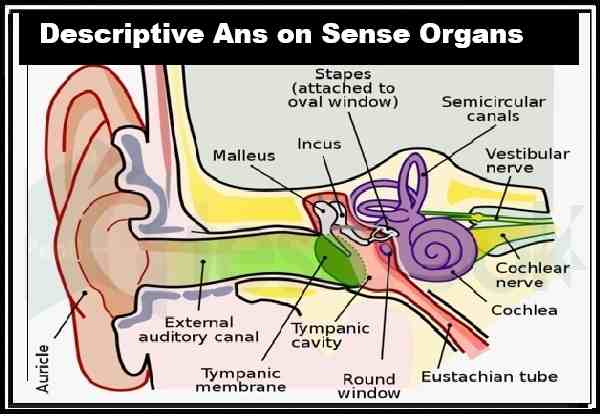
(e) Ear ossicles
Ans:
(a) Conjunctiva: A thin membrane covering the front part of the eye is called conjunctiva.
(b) Lysozyme: Lysozyme is an enzyme present in tears that has antiseptic properties.
(c) Adaptation: Adaptation of the eye is the process by which the eyes adjust to different light intensities, enabling clear vision in both bright and dim conditions.
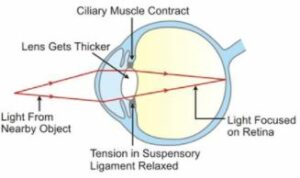
(d) Power of accommodation: The power of accommodation is the ability of the eye lens to focus both near and distant objects clearly on the retina by changing its thickness and therefore its focal length.
(e) Ear ossicles: The three bones present in ear, i.e. malleus, incus and stapes; together are called ear ossicles.
Que-2: Differentiate between members of each of the following pairs with reference to what is asked in brackets.
(a) Myopia and hyperopia (type of lens used for correction)
(b) Rods and cones (sensitivity)
(c) Aqueous humour and vitreous humour (location)
(d) Near and distant accommodation (shape of lens)
(e) Dark and light adaptation (pigments which will be regenerated)
(f) Night blindness and colour blindness (sensory cells which cannot function properly)
Ans:
(a) Differences between myopia and hyperopia (type of lens used for correction) :
| Myopia | Hyperopia |
| Myopia can be corrected by suitable concave (diverging) lens. | Hyperopia can be corrected by suitable convex (converging) lens. |
(b) Differences between rods and cones (sensitivity) :
| Rods | Cones |
| Rods are sensitive to dim light but do not respond to colour. | Cones are sensitive to bright light and are responsible for colour vision. |
(c) Differences between aqueous humour and vitreous humour (location) :
| Aqueous humour | Vitreous humour |
| Aqueous humour is the front chamber between the lens and the cornea. | Vitreous humour is larger cavity of the eyeball behind the lens. |
(d) Differences between near and distant accommodation (shape of lens) :
| Near accommodation | Distant accommodation |
| For near accommodation, the lens becomes more convex or rounded. | For distant accommodation, the lens is more flattened or thinner. |
 
(e) Differences between dark and light adaptation (pigments which will be regenerated) :
| Dark adaptation | Light adaptation |
| For dark adaptation, visual purple or rhodopsin pigment will be regenerated. | For light adaptation, visual violet or iodopsin pigment will be regenerated. |
(f) Differences between night blindness and colour blindness (sensory cells which cannot function properly):
| Night blindness | Colour blindness |
| In night blindness, the rod cells cannot function properly. | In colour blindness, the cone cells cannot function properly. |
Que-3: Give reason :
(a) Sometimes medicines dropped into the eyes come into the nose and even throat.
(b) Three small bones of ear ossicles are advantageous as compared to one single bone for hearing.
(c) Blind spot is considered as ‘area of no vision’.
Ans:
(a) Sometimes medicines dropped into the eyes come into the nose and even throat because the nasolacrimal duct conducts the secretion into the nasal cavity.
(b) The three small ear ossicles transmit and amplify the vibrations received by the tympanum. If they were replaced by a single bone, the vibrations would not be amplified. Therefore, having three ossicles instead of one provides a significant advantage in hearing.
(c) The blind spot contains no sensory cells (rods or cones), so it is considered an ‘area of no vision.’ Any image formed on this spot cannot be detected or perceived by the eye.
Que-4: Answer the following:
(a) What is meant by power of accommodation of the eye? Name the muscles of the eye responsible for the same.
(b) Mention the characteristics of the image that falls on the retina of the eye.
Ans:
(a) The process of focusing the eye at different distances is called the power of accommodation. The ciliary muscles are responsible for the power of accommodation.
(b) The image formed on the retina is inverted and real.
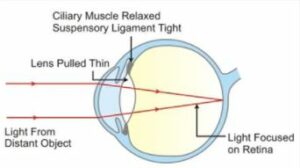
Que-5: Describe the mechanism of focusing the image of a distant object in your eye when you raise your head after reading a book.
Ans:
While reading a book, the lens is more convex or rounded due to contraction of ciliary muscles because the book is usually read from a short distance. When we raise our head and look at a distant object, the ciliary muscles relax to build the tension on the suspensory ligament so that they can stretch the lens. This change in the curvature of the lens makes us focus on distant object.
Que-6: By closing the eyes and gently pressing them with your palms, you may see some specs of brilliant light. How do you get this sensation while there is no light entering your eyes?
Ans:
If we look at a bright object and then close our eyes, the sensation of light persists for a short period. This is known as persistence image or the after image. It lasts for one-tenth of a second. Therefore by closing the eyes and gently pressing them with your palms, you see some specs of brilliant light.
Que-7: Name the three ear ossicles. How do they contribute in the mechanism of hearing?
Ans:
The three ear ossicles are: Malleus (hammer), Incus (anvil) and Stapes (stirr up).
The last ear ossicle, stapes, vibrates and transmits the vibration to the oval window.
The role of other two ear ossicles is to magnify the vibration of stapes as a result of their lever like action.
–: End of Descriptive Answer on Sense Organs Class 10 Concise ICSE Biology Selina Ch-11 Solutions :–
Return to : Concise Biology for ICSE Class 10 Selina Solutions
Please share with your Friends if helpful
Thanks