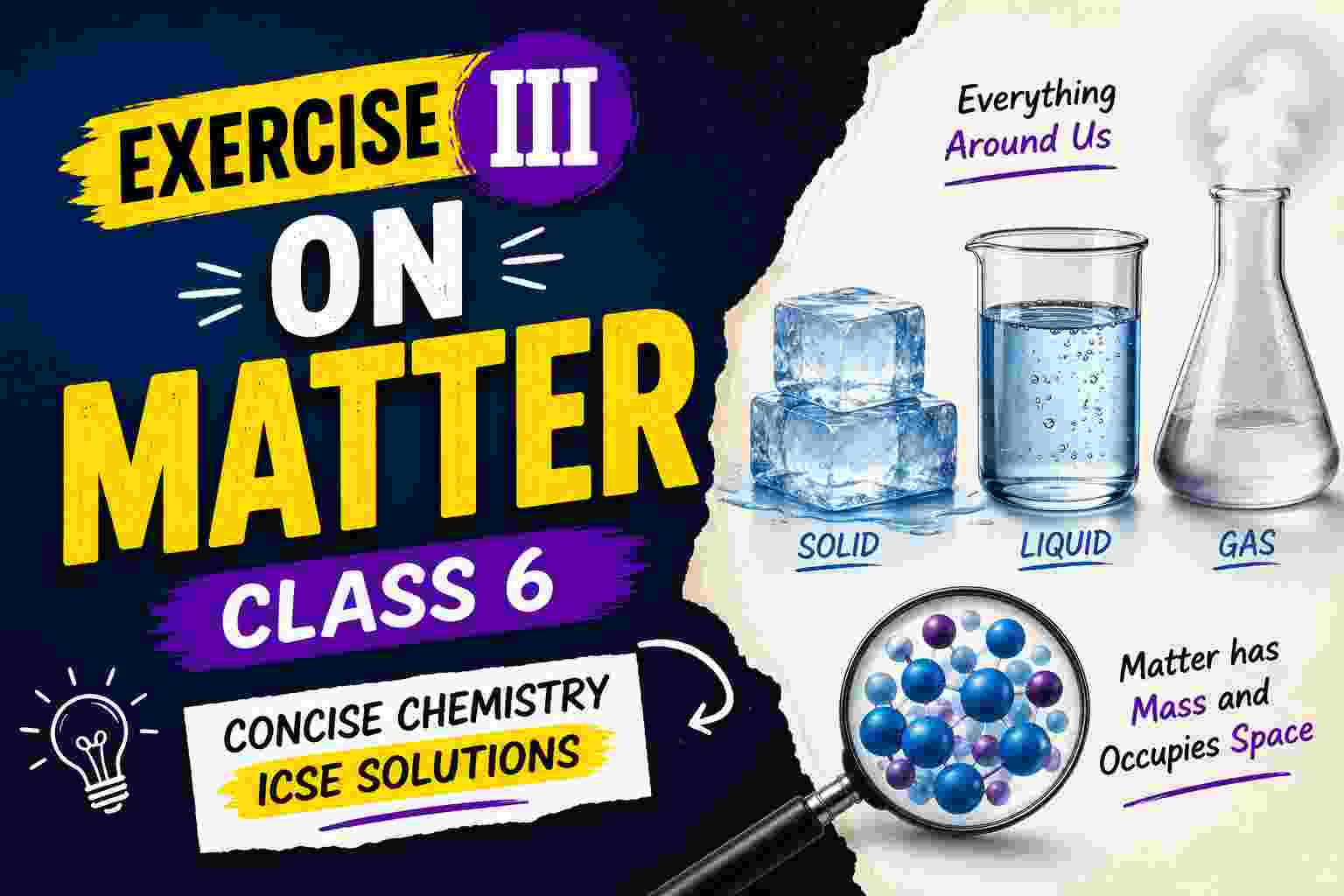
Exercise II on Matter Class 6 Concise Chemistry ICSE Solutions Ch-3. In this article you would learn how to solve Exercise II on Matter with hint and reason. Visit official Website CISCE for detail information about ICSE Board Class-6.


Exercise II on Matter
| Board | ICSE |
| Publications | Selina Publication |
| Subject | Chemistry |
| Class | 6th |
| Chapter-3 | Matter |
| Book Name | Concise |
| Topics | Solution of Exercise II |
| Academic Session | 2025-2026 |
Exercise II on Matter
Objective Type Questions
Que-1: The state of matter which has no definite shape or volume is called:
(i)solid
(ii)liquid
(iii)gas
(iv)none of these
Ans- gas
Reason — Gas is state of matter that has neither a definite shape nor a definite volume. It can be compressed inside a small container and can also spread into a large space area.
Que-2: The largest intermolecular gaps occur in:
(i)water
(ii)iron ball
(iii)common salt
(iv)air
Ans-air
Reason — In case of gases, the molecules hardly attract each other. They lie far apart from each other and hence, the intermolecular spaces are very large.
Que-3: A solid:
(i)has a definite shape
(ii)cannot flow
(iii)cannot be compressed easily
(iv)all of the above
Ans- all of the above
Reason — In solids, molecules are closely packed with very less intermolecular space. This makes solids hard and difficult to compress, giving them a fixed shape and size. So, they cannot flow like liquids.
Que-4: Which of the following diffuses very fast?
(i)Water
(ii)Gold
(iii)Milk
(iv)Nitrogen
Ans-Nitrogen
Reason — Nitrogen is a gas. Gases diffuse very fast because the particles of gases have enough space between them which allows them to move freely and to mix up easily.
Que-5: Which of the following shows the strongest cohesive force ?
(i)Petrol
(ii)Oxygen
(iii)Mercury
(iv)Hydrogen
Ans- Mercury
Reason — The force of attraction between like particles or molecules is called Cohesive force. Mercury, although a liquid, shows a strong cohesive force. Whereas, oxygen and hydrogen are gases and have least cohesive force. Petrol have a cohesive force less than mercury.
Classify the Following
Classify the following into solids, liquids and gases.
Que-1: Oxygen, milk, common salt, wax, stone, L.P.G., carbon dioxide, sugar, mercury, coal, blood, butter, copper, coconut oil, kerosene.
Ans- (i)Solids — Common salt, wax, stone, sugar, coal, butter, copper
(ii)Liquids — Milk, mercury, blood, coconut oil, kerosene
(iii)Gases — Oxygen, L.P.G, carbon dioxide
Que-2: Name the smallest particle from which matter is made of.
Ans- Matter is made up of extremely small particles called atoms .
Short Answer Type Questions
Que-1: What are molecules?
Ans- A molecule is the smallest unit of matter which exhibits all the properties of that kind of matter and is capable of independent existence.
Que-2: Define :
(a) Intermolecular force of attraction.
(b) Intermolecular space.
(c) Cohesive force
(d) Diffusion
(e) Brownian movement
Ans- (a) Particles of matter are held together by a force of attraction that exists between them. This force is known as intermolecular force of attraction.
(b) Particles of matter have spaces between them which are called inter-particle or intermolecular space.
(c) The force of attraction between like particles or molecules is called cohesive force. It holds molecules of a material together.
(d) The intermixing of particles of one kind with another kind is called diffusion.
(e) The zig-zag motion of particles suspended in a medium is called Brownian movement.
Que-3: Give one difference between atoms and molecules.
Ans-
| Atoms | Molecules |
|---|---|
| An atom is the smallest possible unit of matter that exhibits all the properties of matter. |
Two or more atoms combine together to form a minute particle called molecule. |
| Atoms usually do not have an independent existence. |
Molecule is capable of independent existence. |
Que-4: What are fluids ? Give two examples.
Ans- All substances that can flow are called fluids. Both gases and liquids are fluids.
Long Answer Type Questions
Que-1: Name the three states of matter and define them.
Ans- Solid — A solid has a definite shape and a definite volume. Molecules in the solid state are packed very close to each other.
Liquid — A liquid has a definite volume but no definite shape. The molecules in liquids are less closely packed than solids.
Gas — A gas has neither a definite shape nor a definite volume.
Que-2(a): Liquids and gases flow but solids do not.
Ans- In solids, the molecules are closely packed with negligible intermolecular space between them. There is a strong force of attraction between the molecules. This makes them hard so they cannot flow. However, liquids and gases have more intermolecular space between them compared to solids, so they can flow freely.
Que-2(b): A gas fills up the space available to it.
Ans- In case of gases, the molecules are hardly attracted to each other with very large intermolecular space. As a result, gases have neither a fixed shape nor a fixed volume. They completely fill up the space available to them.
Que-2(c): The odour of scent spreads in a room.
Ans- When you spray scent in a room, its particles mix with air molecules and diffuse and gradually spread throughout the room.
Que-2(d): We can walk through air.
Ans- Air is a gas, and its particles are widely spaced, offering very little resistance to movement. So we can easily walk through it.
Que-2(e): Liquids have a definite volume but no definite shape.
Ans- In liquids, the molecules are not very closely packed. They are moderately attracted to each other giving it a definite volume. Thus, the intermolecular spaces are larger and the molecules are able to move freely. This makes a liquid take the shape of the container.
Que-2(f): When a teaspoon of sugar is added to half a glass of water and stirred, the water level remains unchanged.
Ans- This is because sugar particles settle into the spaces between water molecules. This is a result of intermolecular spaces in liquids.
Que-2(g): When an empty gas jar is inverted over a gas jar containing a coloured gas, the gas spreads into the empty jar.
Ans- This is because of diffusion. Gases diffuse very fast; they move randomly and mix with each other, even without stirring.
Que-2(h): A red ink drop added to water turns the water red after some time.
Ans- This is because of diffusion. Liquids diffuse slower than gases, so when we add a drop of red ink to water, it diffuses slowly into the entire glass of water.
Que-2(i): Solids usually have higher density than liquids and gases.
Ans- In solids, particles are tightly packed, making them denser than liquids and gases.
Que-2(j): An egg is kicked out of a bottle when air is blown inside the bottle.
Ans- Blowing air increases the air pressure inside the bottle. The high pressure pushes the egg outward.
— : End of Exercise II on Matter Class 6 Concise Chemistry ICSE Solutions :–
Return to:- ICSE Class-6 Concise Selina Solutions
Please, Share with your friends
thanks