MCQs on Sense Organs Class 10 Concise ICSE Biology Selina Solutions Ch-11. In this article you will get the solutions / Answer of imp MCQs Questions on sense organs with hint and reason. Visit official website CISCE for detail information about ICSE Board Class-10 Biology.
Imp MCQs on Sense Organs Class 10 Concise Biology Selina Solutions Ch-11
| Board | ICSE |
| Subject | Biology |
| Class | 10 |
| Book | Selina Concise |
| Chapter-11 | Sense Organs |
| Topics | Solutions of MCQs Questions |
Very Imp MCQs on Sense Organs with Answer
Class 10 Concise ICSE Biology Selina Solutions Ch-11
Que-1: The layer in the eye where sensory cells (rods and cones) are located:
- Conjunctiva
- Cornea
- Choroid
- Retina
Ans: Retina
Hint: The retina contains sensory cells, and it works like a screen on which the image is formed.
Que-2: The vitamin required for the synthesis of rhodopsin is :
- Vitamin A
- Vitamin B
- Vitamin C
- Vitamin D
Ans: Vitamin A
Hint: Vitamin A (retinol) is essential for the synthesis of rhodopsin.
Que-3: An aperture that controls the passage of light into the eye is:
- Blind spot
- Pupil
- Yellow spot
- Iris
Ans: Pupil
Hint: The size of the pupil increases or decreases to regulate the amount of light entering the eye.
Que-4: Tears have an antiseptic property due to the presence of:
- Lysosome
- Aqueous humour
- Lysozyme
- Vitreous humour
Ans: Lysozyme
Hint: Lysozyme helps to fight the infection or avoid infection due to its antiseptic property.
Que-5: Which of the following is responsible for the adjustment of the size of pupil ?
- Iris
- Sclera
- Lens
- Choroid
Ans: Iris
Hint: The iris contains radial muscles to widen and circular muscles to constrict the pupil.
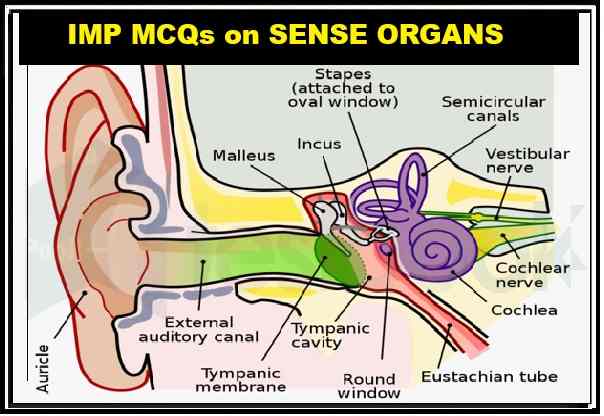
Que-6: The median canal of cochlea is filled with :
- Perilymph
- Lymph
- Endolymph
- Tissue fluid
Ans: Endolymph
Hint: The median canal of cochlea is filled with fluid called endolymph.
Que-7: The thin, transparent extension of sclerotic layer found in front of the lens is:
- Cornea
- Cochlea
- Conjunctiva
- Choroid
Ans: Cornea
Hint: The thin, transparent extension of the sclera in front of the lens is called the cornea. It is transparent and bulges outward.
Que-8: The part of the inner ear which is responsible for hearing is :
- Semicircular canal
- Utriculus
- Cochlea
- Sacculus
Ans: Cochlea
Hint: Cochlea has organ of corti which is responsible for hearing.
Que-9: The spiral organ possessing sensory cells for hearing is:
- Ampulla
- Semicircular Canal
- Vestibule
- Organ of Corti
Ans: Organ of Corti
Hint: The middle canal of the cochlea contains the spiral organ, known as the organ of Corti, which is responsible for hearing.
Que-10: Which of the following structures equalises the air pressure on either side of the tympanum ?
- Auditory tube
- Eustachian tube
- Vestibular canal
- Tympanic canal
Ans: Eustachian tube
Hint: Eustachian tube connects the cavity of middle ear with throat. It equalises the air pressure on either side of the tympanum.
Que-11: When a person comes out of a cinema hall after a noon show, he experiences a dazzling effect for a short period of time. It happens due to degeneration of (P) …………… and regeneration of (Q) …………… pigments. Which of the following options is correct for P and Q ?
- P – Iodopsin, Q – Rhodopsin
- P – Rhodopsin, Q – Iodopsin
- P – Visual violet, Q – Visual purple
- P – Iodopsin, Q – Visual violet
Ans: P – Rhodopsin, Q – Iodopsin
Hint: Rhodopsin is the pigment responsible for vision in dim light, while iodopsin enables vision in bright light. When a person moves suddenly from a dark area into bright light, rhodopsin breaks down (bleaches) rapidly due to the intense light, causing a temporary dazzling effect.
Que-12:
Assertion. Lacrimal gland is a kind of endocrine gland which secretes an enzyme called thrombokinase.
Reason. Lacrimal gland is located in the upper outer portion of the orbit of the eye. Tears act as a lubricant and also have antiseptic property.
- Both A and R are True.
- Both A and R are False.
- A is True and R is False.
- A is False and R is True.
Ans: A is False and R is True.
Explain: The lacrimal gland is an exocrine gland located above the eyeball. It secretes lacrimal fluid (tear fluid), which is isotonic to plasma, onto the surface of the eye. These tears help clean, lubricate, nourish, and protect the eye.
Que-13:
Assertion. Choroid layer provides nourishment to the eye and also prevents light rays form reflecting and scattering inside the eye.
Reason. Choroid layer is the outermost layer of the eyeball which surrounds the sclerotic layer. This layer contains two types of pigments-Rhodopsin and Iodopsin.
- Both A and R are True.
- Both A and R are False.
- A is True and R is False.
- A is False and R is True.
Ans: A is True and R is False
Explain: The choroid layer is located between the retina and the sclera. It helps maintain eye health by supplying nutrients to the retina.
Que-14:
Assertion. The image formed on the retina is straight and real.
Reason. Images from the retina are transmitted to the brain through the optic nerve. Then brain interprets it in an upright position. Both the eyes form two images but the brain interprets them as one due to the overlapping of the images.
- Both A and R are True.
- Both A and R are False.
- A is True and R is False.
- A is False and R is True.
Ans: A is False and R is True.
Explain: The image formed on the retina is real and inverted (upside down). The optic nerve carries this inverted image to the brain, where it is interpreted as upright. The brain also combines the slightly different images from both eyes into a single, clear picture because of the overlapping visual fields.
Que-15:
Assertion. Myopia is caused due to the shortening of the eyeball from front to back.
Reason. Myopia can be corrected by using suitable convex (converging) lens and the power of the glasses used is mentioned in plus “+”.
- Both A and R are True.
- Both A and R are False.
- A is True and R is False.
- A is False and R is True.
Ans: Both A and R are False.
Explain: Myopia occurs when the eyeball becomes elongated from front to back or when the eye lens is too curved. It is corrected using a concave (diverging) lens, and the power of such lenses is indicated with a negative (–) sign.
Que-16:
Assertion. Semi-circular canals are present in the middle ear and they contain sensory cells responsible for the static balance of the body.
Reason. One end of each of the three semi-circular canals is widened to form an ampulla which contains the sensory cells for dynamic balance.
- Both A and R are True.
- Both A and R are False.
- A is True and R is False.
- A is False and R is True.
Ans: A is False and R is True
Explain: The semicircular canals are located in the inner ear and contain sensory cells that help maintain the dynamic balance of the body.
Que-17:
Assertion. The tube/canal which transmits the air currents from the pinna to tympanum is termed as eustachian tube.
Reason. The eustachian tube equalizes the air pressure on either side of the ear drum allowing it to vibrate freely.
- Both A and R are True.
- Both A and R are False.
- A is True and R is False.
- A is False and R is True.
Ans: A is False and R is True
Explain: The Eustachian tube connects the middle ear cavity to the throat.
Que-18:
Assertion. The human ear is responsible for hearing, dynamic equilibrium and also static balance.
Reason. Cochlea, semi-circular canals and vestibule (utriculus and sacculus) are responsible for hearing, dynamic balance and static balance respectively.
- Both A and R are True.
- Both A and R are False.
- A is True and R is False.
- A is False and R is True.
Ans: Both A and R are True.
Explain: The inner ear contains the vestibular apparatus, which consists of the vestibule and semicircular canals. These structures help maintain body balance and postural equilibrium.
–: End of MCQs on Sense Organs Class 10 Concise ICSE Biology Selina Ch-11 solutions :–
Return to : Concise Biology for ICSE Class 10 Selina Solutions
Please share with your Friends if helpful
Thanks