Photosynthesis Structured/Applications/Skill Type Ans Concise Biology Selina Solutions for ICSE Class 10 Ch-6. In this article you will learn how to solve Structured / Applications / Skill Type Questions on Photosynthesis with Answer. Visit official website CISCE for detail information about ICSE Board Class-10 Biology.
Photosynthesis Structured / Applications / Skill Type Ans Concise Biology Selina Solutions for ICSE Class 10 Ch-6
| Board | ICSE |
| Subject | Biology |
| Class | 10 |
| Book | Selina Concise |
| Chapter-6 | Photosynthesis |
| Topics | Solutions of Structured/Applications/Skill Type Questions |
Solutions of Structured / Applications / Skill Type Questions on Photosynthesis
Page 80-81
Que-1: Given below is a schematic diagram to illustrate some aspects of photosynthesis.
(a) Fill up the gaps, in blank spaces (1-4), by writing the names of the correct items.
(b) What phenomenon do the thick arrows A and B indicate?
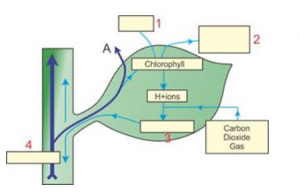
Ans:
(a)
1 – Sunlight
2 – Oxygen
3 – Glucose
4 – Xylem
(b) A – Transpiration
B – Translocation
Que-2: Given below is the representation of a certain phenomenon in nature. With four organisms 1-4.
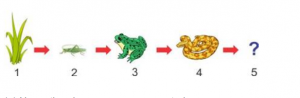
(a) Name the phenomenon represented.
(b) Name any one organism that could be shown at No .5
(c) Name the biological process which was the starting point of the whole chain.
(d) Name one natural element which all the organisms 2-4 and even 5 are getting from No. 1 for their survival.
Ans:
(a) Food chain
(b) Hawk, eagle
(c) Photosynthesis
(d) Carbon
Que-3: A potted with variegated leave was taken in order to prove a facrtor necessary for the photosynthesis. The potted plant was kept in the dark of 24 hours and the n placed in bright sunlight for a few hours. Observe the diafram and answer the question :
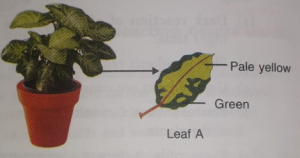
(a) What aspect of photosynthesis is being tested in the above diagram?
(b) Represent the process of photosynthesis in the form of a balanced equation.
(c) Why was the plant kept in the dark before beginning the experiment?
(d) What will be the result of the starch test performed on Leaf ‘A’ shown in the diagram ? Give an example of a plant with variegated leaves
(e) Draw a neat labelled diagram of a chloroplast.
Ans:
(a) To show that chlorophyll is necessary for photosynthesis.
(b)

(c) To destarch the leaves.
(d) It will not turn blue. Example of plants with variegated leaves is Oxalis species.
(e) Chloroplast:
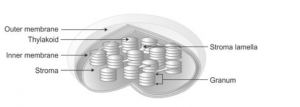
Que-4: Given belong is the diagram of an experimental set-up:
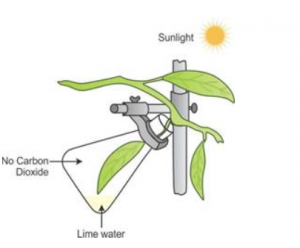
(a) What is the objective of this experiment?
(b) Will it work satisfactorily? Given reason.
(c) What alteration (s) will you make in it for obtaining expected result?
(d) Would you take any step before starting the experiment? Describe this step and explain its necessity.
Ans:
(a) To demonstrate the importance of carbon dioxide in photosynthesis
(b) No, the experiment will not work satisfactorily, as the beaker contains lime water and not potassium hydroxide to absorb CO2.
(c) Place potassium hydroxide in the beaker instead of lime water
(d) Before starting the experiment, it is necessary to destarch the leaves of the plant by keeping the plant in complete darkness for 48 hours. This is because if the plant is not destarched, then the experiment will give false results because starch stored previously may be detected in the leaf placed in the beaker even if no starch is produced during the experiment.
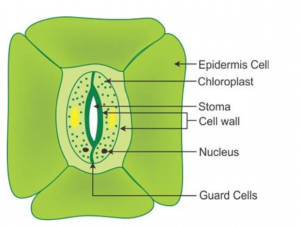
Que-5: Draw a neat diagram of the stomatal apparatus found in the epidermis of leaves and label the Stoma, Guard cells, Chloroplast, Epidermal cells, Cell wall and Nucleus.
Ans:
Que-6: Given below is the diagram of an experimental set-up (final stage). Study the same and answer the following questions :
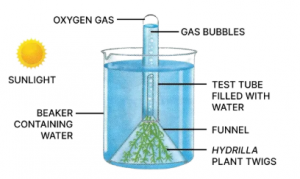
(a) What is the main aim of the experiment?
(b) Oxygen gas shown in the experiment is released from which of the raw materials ?
(c) How would you confirm the presence of oxygen gas?
(d) Name the chemical substance which can be added in water to enhance the process/rate of release of oxygen gas.
Ans:
(a) The main aim of the experiment is to show that oxygen is produced during photosynthesis.
(b) Oxygen is released from Water (H2O).
(c) The gas present in the test tube makes a glowing splinter bursts into flames. This shows the presence of oxygen.
(d) Sodium Bicarbonate
–: End of Photosynthesis Structured /Applications / Skill Type Ans Concise Biology Selina Solutions :–
Please share with your friend if helpful
Return to : Concise Biology for ICSE Class 10 Selina Solutions
Thanks