
ICSE Class 10 Notes on Ratio and Proportion OP Malhotra Maths (2026-27). We Provide Notes with Step by Step Answer of Exe-6 with Self Evaluation and Revision of S Chand OP Malhotra Maths . Visit official Website CISCE for detail information about ICSE Board Class-10.


ICSE Class 10 Notes on Ratio and Proportion OP Malhotra Maths (2026-27)
1. Proportion
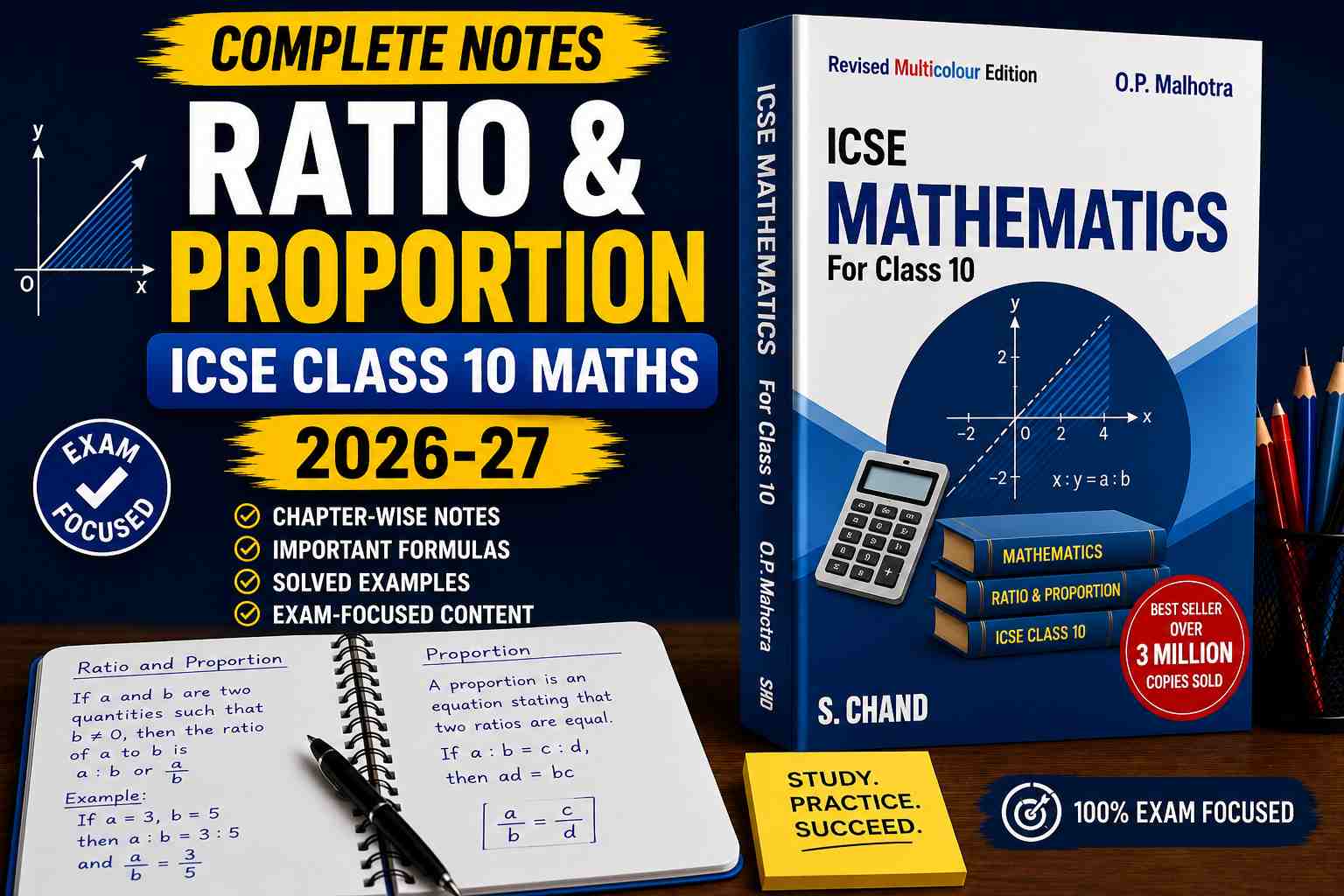
In mathematics, a proportion is a statement showing that two ratios or fractions are equal.
Four quantities a, b, c and d are said to be in proportion if: a : b :: c : d
⇒ a/b = c/d
- a and d are called Extremes.
- b and c are called Means.
Fundamental Property:
Product of Extremes = Product of Means
i.e, ad = bc
Fourth Proportional
If a : b = c : x then x is called the Fourth Proportional.
x = (b × c) / a
Shortcut: Fourth Proportional = (2nd × 3rd) ÷ 1st
Third Proportional
If a : b = b : x then x is called the Third Proportional.
x = b² / a
Shortcut: Square of second number ÷ first number
Continued Proportion
Three quantities are in continued proportion if: a : b = b : c
b² = ac
Square of Mean = Product of Extremes
Example: 3 : 6 = 6 : 12
Mean Proportional
If a : x = x : b then x is called the Mean Proportional.
x = √(ab)
(Mean Proportional)² = Product of Extremes
Some important type of questions
Q1. What number should be added to each of the four numbers 10,18,22 and 38 to make them proportional ?
Sol: Let the number to be added be x . Then ,
10+x , 18+x , 22+x and 38+ x are in proportion
(10+x):(18+x) = (22+x):(38+x) ⇒ (10+x)/(18+x) = (22+x)/(38+x)
⇒(10+x)(38+x) = (18+x)(22+x)
⇒ 380+10x+38x+x² = 396+18x+22x+x²
⇒ 380+48x = 396+40x
⇒ 8x = 16
⇒ x = 2
∴ The required number is 2 .
Q2. Find the third proportional to 5,10 .
Sol: Let x be the third proportional to 5 and 10 , then
5:10 = 10:x ⇒ 5/10 = 10/x
⇒ 5x = 100
⇒ x = 20
∴ The third proportional to 5,10 is 20.
Practice Questions on this topic : Exercise-6(a)
Important Results of Proportion
- If a:b::c:d (a/b = c/d):
- Invertendo: If a:b :: c:d then b:a :: d:c , that is a/b = c/d ⇒ b/a = d/c
- Alternendo: If a:b :: c:d then a:c :: b:d , that is a/b = c/d ⇒ a/c = b/d
- Componendo: If a:b :: c:d then (a+b):b :: (c+d):d , that is a/b = c/d ⇒ (a+b)/b = (c+d)/d
- Dividendo: If a:b :: c:d then (a-b):b :: (c-d):d , that is a/b = c/d ⇒ (a−b)/b = (c−d)/d
- Componendo-Dividendo: If a:b :: c:d then (a+b):(a-b) :: (c+d):(c-d) , that is a/b = c/d⇒ (a+b)/(a−b) = (c+d)/(c−d) ← most tested property
- Convertendo: If a:b :: c:d then a:(a-b) :: c:(c-d) , that is a/b = c/d ⇒ a/(a−b) = c/(c−d)
Some Important Type of Questions
Q1. If a:b = c:d , show that 2a+3b/2c+3d = 2a-3b/2c-3d
Sol: a/b = c/d (given)
⇒ 2a/3b = 2c/3d (Multiplying by 2/3 on both sides)
(2a+3b)/(2a-3b) = (2c+3d)/(2a-3d) (By componendo and dividendo)
(2a+3b)/(2c+3d) = (2a-3b)/(2c-3d)
Q2. Solve [2x+√(4x²+1)]/[2x-√(4x²-1)] = 4 for x , using the properties of proportion.
Sol: (2x + √(4x² − 1)) / (2x − √(4x² − 1)) = 4
⇒ [(2x + √(4x² − 1)) + (2x − √(4x² − 1))] /[(2x + √(4x² − 1)) − (2x − √(4x² − 1))] = (4 + 1) / (4 − 1) (By Componendo and Dividendo)
⇒ 4x / 2√(4x² − 1) = 5/3
⇒ 2x / √(4x² − 1) = 5/3
Squaring both sides,
⇒ [2x / √(4x² − 1)]² = (5/3)²
⇒ 4x² / (4x² − 1) = 25/9
⇒ 9(4x²) = 25(4x² − 1)
⇒ 36x² = 100x² − 25
⇒ 64x² = 25
⇒ x² = 25/64
⇒ x = ±5/8
Practice Questions on this topic : Exercise-6(b)
k-Method
When a series of fractions are equal , each of them is equal to the sum of all the numerators divided by the sum of all the denominators.
for example ,
if a/b = c/d = e/f = ……, then each ratio is equal to
(a+c+e+…)/(b+d+f+…) = sum of antecedents/sum of consequents
We can prove this by using k-method. as,
So if , a/b = c/d = e/f
Let a/b = c/d = e/f = k , Then a=bk , c=dk , e=fk
Now , a+c+e/b+d+f = bk+dk+fk/b+d+f = k(b+d+f)/(b+d+f) = k
Hence, a/b = c/d = e/f = a+c+e/b+d+f
Hence Proved .
So , this was k-Method.
Application of k-Method to Continued Proportion
Q1. If a,b,c are in continued proportion , prove that (a+b):(b+c) = a²(b-c) : b²(a-b)
Sol: Given,
(a + b)/(b + c) = a²(b − c)/b²(a − b)
Since a, b, c are in continued proportion,
a/b = b/c
Let, a/b = b/c = k
Then,
a = bk and b = ck
Hence,
a = bk = (ck)k = ck²
LHS = (a + b)/(b + c)
LHS = (ck² + ck)/(ck + c)
LHS = ck(k + 1)/c(k + 1)
LHS = [ck(k + 1)]/[c(k + 1)]
LHS = k ………. (I)
RHS = a²(b − c)/b²(a − b)
RHS = (ck²)²(ck − c)/(ck)²(ck² − ck)
RHS = c²k⁴(c(k − 1))/c²k²(ck(k − 1))
RHS = c³k⁴(k − 1)/c³k³(k − 1)
RHS = k ………. (II)
From (I) and (II),
LHS = RHS
Q.2 If a,b,c,d are in continued proportion prove that a:d = (a-b)³:(b-c)³
Sol: a, b, c, d are in continued proportion
a/b = b/c = c/d = k (say)
c = dk,
b = ck = dk²,
a = bk = dk³
a : d = dk³ : d = k³
∴ a − d = d(k³ − 1)
(a − b)³ = (dk³ − dk²)³
L.H.S.
a/d = a ÷ d
= dk³ / d
= k³
R.H.S.
(a − b)³ / (b − c)³
= (dk³ − dk²)³ / (dk² − dk)³
= [dk²(k − 1)]³ / [dk(k − 1)]³
= d³k⁶(k − 1)³ / d³k³(k − 1)³
= k³
∴ L.H.S. = R.H.S.
Practice Questions on this topic : Exercise-6(c)
Self Evaluation and Revision: Coming Soon
— : End of ICSE Class 10 Notes on Ratio and Proportion OP Malhotra Maths (2026-27) :–
Return to :- OP Malhotra S Chand Solutions for ICSE Class-10 Maths
Thanks
Please Share with Your Friends
9 thoughts on “ICSE Class 10 Notes on Ratio and Proportion OP Malhotra Maths (2026-27)”
Kindly upload Self Evalution and Revision ( Latest ICSE Questions) of Chapter 6
And try to upload Self Evalution of all chapter
Hope you will try to work on it…!!
~Anurag Chandra
Class-X
Sir content is protected….. unable bro see solutions …..fix it by tmrow sir pls
not protected it is fully working
From 26 fen 2021 it’s showing content is protected pls fix it no solution are able to seen😞
ok
Content is protected it is showing pls fix it
the uploading solution work is in progress
It is showing content is protected and we can’t see solutions pls fix it asap
not protected , currently unavailable